Intro
We have yet another rare book by Mirza Basheer ud Din Mahmud Ahmad, its called “Hindu Muslim Problem and its Solution” by Mirza Basheer ud Din Mahmud Ahmad (1927). On 20 March 1927, Muslim leaders had a meeting in Delhi – presided by Jinnah – to discuss the basic demands of Muslims, including the separate electorates. They agreed to compromise the demand for separate electorates in an effort to break the ice and decided to offer Hindus the withdrawal of this demand, provided all other demands were accepted. (Quaid-e-Azam Aur Unka Ehad – Hayat-e-Muhammad Ali Jinnah, by Raees Ahmad Jafri, p. 162)
He wrote another book a year later entitled :“The Nehru report and Muslim Rights” by Mirza Basheer ud Din Mahmud Ahmad (1930).
On 7 September 1927, during the second session of the Ittehad Conference in Simla, he suggested:
“Although the idea of joint electorates is correct principally, but not during the current circumstances of India and in our view, it is dangerous for the Muslim interest. Anyway, Jamaat-e-Ahmadiyya, Muslims of Punjab and Muslims of some other provinces are not ready to accept the joint electorates for now. So, it is our demand that the right for separate electorates should continue for the Muslims and other parties also, if they like it, should get this right.” (Zamima Al Fazl, 16 September 1927)
In Simla, Huzoor had a conversation with Jinnah on this issue. Jinnah stated that nationalism (qaumiyyat) could only be inculcated through joint electorates. Huzoorra responded that although he agreed that joint electorates were necessary for nationalism, but considering the circumstances at the time, when the Muslims were weaker and unable to cope with the power and deceits of Hindus, separate electorates were the need of the time. But Jinnah did not agree. (Tarikh-e-Ahmadiyyat, Vol. 4, pp. 619-620)
Then, during a meeting of the Muslim leaders, chaired by Jinnah, Huzoorra delivered a speech in favour of separate electorates and most of the speakers agreed with Huzoor’sra views and spoke in favour of separate electorates. Jinnah, after delivering his concluding speech, stated that now he knew that the majority of the nation favoured separate electorates and when the decisive time would come, he would cater for their views. (Ibid)______________________________________________________________________________________________
The PDF
Hindu Muslim Problem and its Solution
_____________________________________________________________________________________________
https://www.alhakam.org/1927-unity-conference-harmony-muslim-rights-shimla/
Communal harmony, Unity Conference and Muslim rights: Hazrat Musleh-e-Maud’s 1927 visit to Shimla
Last Updated on 24th February 2023
Ata-ul-Haye Nasir, Al Hakam
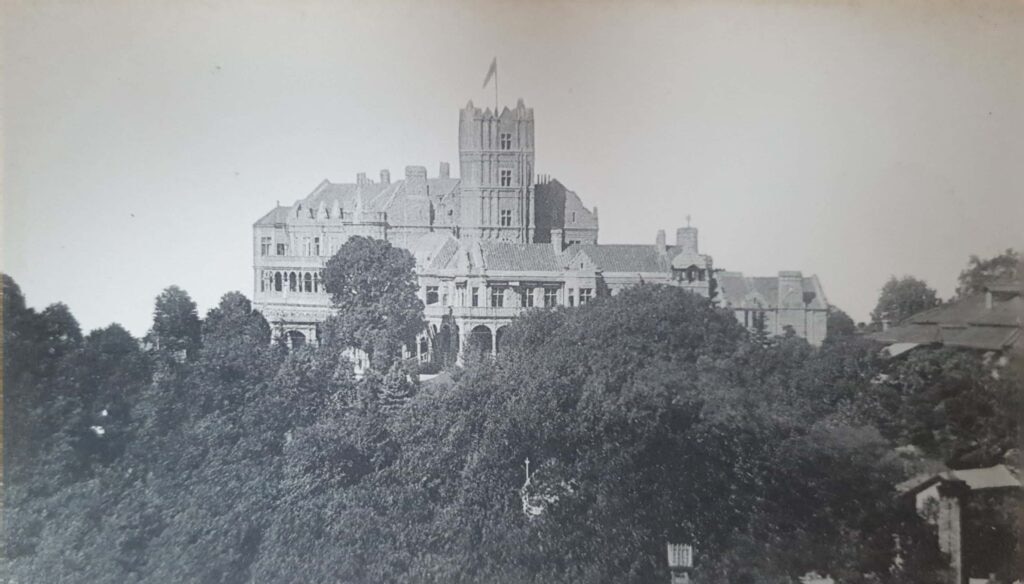
On 10 February 2023, Al Hakam published an article titled “Sarojini Naidu and other dignitaries meet with Hazrat Musleh-e-Maud in Shimla to promote peace and harmony”, which mentioned that Hazrat Musleh-e-Maud, Mirza Bashiruddin Mahmud Ahmadra visited Simla [now Shimla] from 13 August to 2 October 1927. Throughout this tour, Huzoor’sra activities were focused on religious, national, and community matters. Various leaders and dignitaries had the opportunity to meet him, including the then Viceroy of India and the then Governor of Punjab.
The ‘circumstances’
These seven weeks hold great significance considering the prevailing religious and political tensions. “Nationalism faced challenges from various quarters, but communal insecurities of minorities, be it at the centre or the province, formed the major hurdle.” (Mehta, Simmi Kapoor. “PUNJAB POLITICS 1922-1934.” Proceedings of the Indian History Congress 75 (2014): 536–45. www.jstor.org/stable/44158428)
The rift between the Hindu and Muslim communities was intensifying, particularly following the Shuddhi Movement and the publication of disrespectful literature against the blessed character of the Holy Prophet Muhammadsa, for instance, Vichitra Jivan by Pandit Kalicharan Sharma (1923), the booklet Rangila Rasul by Pandit Chamupati (1924), and an article titled Sair–i–Dauzakh by Devi Sharan Sharma in the May 1927 issue of Risala-i-Vartman. Moreover, the political disagreements were making the picture even worse. The division among the Muslim leaders on certain matters, such as the Delhi Proposals of 1927, was also a source of concern for the Indian Muslims.
Keeping in mind the above-stated circumstances, during his meetings in Shimla, Hazrat Musleh-e-Maudra made full efforts to guide the Indian leaders towards a solution to the ongoing conflict. Huzoorra also advised the government to take necessary steps to foster peace and harmony within the country, and particularly urged them to ensure that the respect and honour of the holy founders of all religions is safeguarded. As stated earlier, these events hold great significance in the history of British India, since they played a great role in redirecting the mindset of many leaders and officials, and eventually crafted a new chapter in history.
Huzoor’sra press release from Shimla in response to the verdict on the Vartman case
On 6 August 1927, the High Court of Lahore concluded the case of Risala-i-Vartman; the author was sentenced to a year of imprisonment and a fine of 500 rupees in lieu of an additional six months of imprisonment, and the publisher was sentenced to six months of imprisonment and a fine of 250 rupees in lieu of an additional three months of imprisonment. Upon this, Huzoorra issued a press release from Shimla on 22 August 1927, which was published in The Civil and Military Gazette.
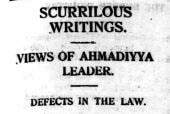
In this press release, Huzoorra called the attention of the government to making some amendments to the law and advised them to take steps that are necessary to safeguard the honour of the holy founders of all religions. (The Civil and Military Gazette, 26 August 1927, p. 15)
Huzoor’sra guidance in light of the Delhi Proposals
Let us now look at the circumstances from the perspective of Muslims; one significance of these meetings and gatherings was due to the difference of opinion among the Muslim leaders after the Delhi Proposals of 1927. The Muslims of the Indian subcontinent presented many demands from time to time and all of them had their own importance, but the demand for separate electorates was a special one. People often assert that from the beginning, MA Jinnah was a strong advocate of separate electorates, as this point was among his famous Fourteen Points, however, this is completely wrong.
On 20 March 1927, Muslim leaders had a meeting in Delhi – presided over by Jinnah – to discuss the basic demands of the Muslims, including separate electorates. Though they included the separate electorates in their demands, they also agreed to compromise on this demand provided all other demands were accepted by the Indian National Congress. These proposals are commonly known as “The Delhi Proposals”. (Quaid-e-Azam Aur Unka Ehad – Hayat-e-Muhammad Ali Jinnah, by Raees Ahmad Jafri, p. 162)
It became apparent very soon that the Muslim leaders were divided on the question of separate electorates; MA Jinnah and Maulana Muhammad Ali were against it, while Sir Shafi and Sir Abdur Rahim were in favour of this demand. Following this development, Hazrat Musleh-e-Maudra raised his voice in favour of the separate electorates, since he believed that, considering the then circumstances of India, the greater interest of the Muslims was in sticking to this very demand.
Hazrat Musleh-e-Maudra invited the leaders of various provinces to Kingsley, his place of stay in Shimla. For instance, he invited Jinnah to a tea party, and discussed the issue of separate electorates. Jinnah argued that nationalism could only be inculcated through joint electorates. Huzoorra responded that he agreed to the extent that joint electorates are essential for nationalism, however, considering the circumstances at the time, when the Muslims were weaker and unable to cope with the power and the majority of Hindus, separate electorates were the need of the time. But Jinnah did not agree to quit his stance. (Tarikh-e-Ahmadiyyat, Vol. 4, pp. 619-620)
Viceroy’s address and call for peace
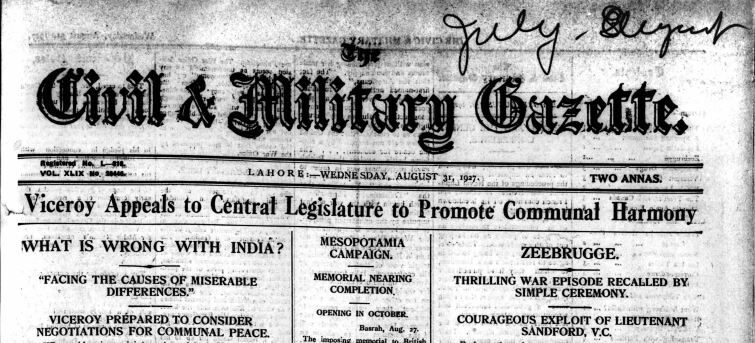
On 28 August 1927, the Viceroy of India delivered a speech to the members of the Council of State and the Legislative Assembly, in which he emphasised the need to make peace between the Hindu and Muslim communities.
The Civil and Military Gazette reported:
“A conference to discuss the present communal tension in India was foreshadowed by Lord Irwin in his address to the joint session of the Council of State and the Legislative Assembly today. […]
“The Viceroy said:
“‘A little more than a year ago, I invited India to pause and seriously consider the communal situation, and I then appealed to leaders and the rank and file to pursue peace and cultivate a spirit of toleration towards one another. […] Let me recall the salient incidents of India’s recent history. I am not exaggerating when I say that, during the 17 months that I have been in India, the whole landscape has been overshadowed by the lowering clouds of communal tension, which have repeatedly discharged their thunderbolts, spreading far throughout the land their devastating havoc. From April to July last year, Calcutta seemed to be under the mastery of some evil spirit, which so gripped the minds of men that, in their insanity, they held themselves absolved from the most sacred restraints of human conduct. […] Since then we have seen the same sinister influences at work in Pabna, Rawalpindi, Lahore and many other places, and have been forced to look upon that abyss of unchained human passions that lies too often beneath the surface of habit and of law. In less than 18 months, so far as numbers are available, the toll taken by this bloody strife has been between 250 to 300 killed, and over 2,500 injured.’” (The Civil and Military Gazette, 31 August 1927, p. 1)
At the end of his speech, he said:
“I believe – and I think India believes – in the power of spiritual forces to assert themselves over their material expression, by which they may often be betrayed.” (Ibid, p. 7)
The Western Morning News and Mercury stated:
“Lord Irwin’s conference might be fruitful of good results, but it is questionable whether better and more immediate good would not follow the suppression of publications whose sole purpose is the stirring up of hatred.” (The Western Morning News and Mercury, 31 August 1927, p. 4)
Hindu and Muslim leaders agree to hold a Unity Conference
“In August 1927, as an immediate result of the agitation started in connection with the ‘Rangila Rasul’ pamphlet, Maulana Shaukat Ali wrote on behalf of the Central Khilafat Committee to Dr Moonji, President of the Hindu Maha Sabha, requesting his [sic] to agree to the calling of a meeting when representatives of the Central Khilafat Committee and the Hindu Maha Sabha could meet and discuss the communal situation and try and discover remedial measures. Dr Moonji promptly responded to this invitation and as a consequence, a conference was summoned at Simla.” (The Indian Quarterly Register, July-Dec 1927, Vol. II, p. 39, The Annual Register Office, Calcutta)
The outset of the Unity Conference
On 29 August, a meeting was held between the Hindu and Muslim leaders:
“The conference convened at the invitation of the Khilafat leaders was held this evening, when a large number of Congress leaders and prominent members of the Hindu Sabha were present. Mr MA Jinnah presided. […] It was agreed that a list should be prepared of the points of difference between the two communities for submission to a meeting of leaders to be held on September 6. It was agreed that the list should be handed over to Mr Jinnah on or before September 10.” (The Englishman, 1 September 1927, p. 7)
During the meeting, a suggestion was tabled by Dr Gokalchand Narang to make an appeal to the public and press to calm the tense atmosphere. (The Civil and Military Gazette, 2 September 1927, p. 16)
On 30 August, a session of the Unity Conference was held at the Council Chamber, where Hazrat Musleh-e-Maudra delivered a speech, shed light on the methods for achieving peace between all communities, and advocated the protection of the economic rights of Muslims. (Tarikh-e-Ahmadiyyat, Vol. 4, p. 614)
The Civil and Military Gazette reported:
“The Unity Conference met again this afternoon to approve the draft appeal prepared by Mr Quereshi and Dr Narang. Mr Jinnah was in the chair. […] Pandit Malaviya characterised the appeal as a solemn document and said that they were earnestly determined to find a solution to Hindu-Muslim differences. […] The appeal was then signed by a very large number of Hindu and Muslim leaders now in Simla, including the members of the Central Legislature.” (The Civil and Military Gazette, 2 September 1927, p. 16)
Huzoor’sra proposals for peace and harmony
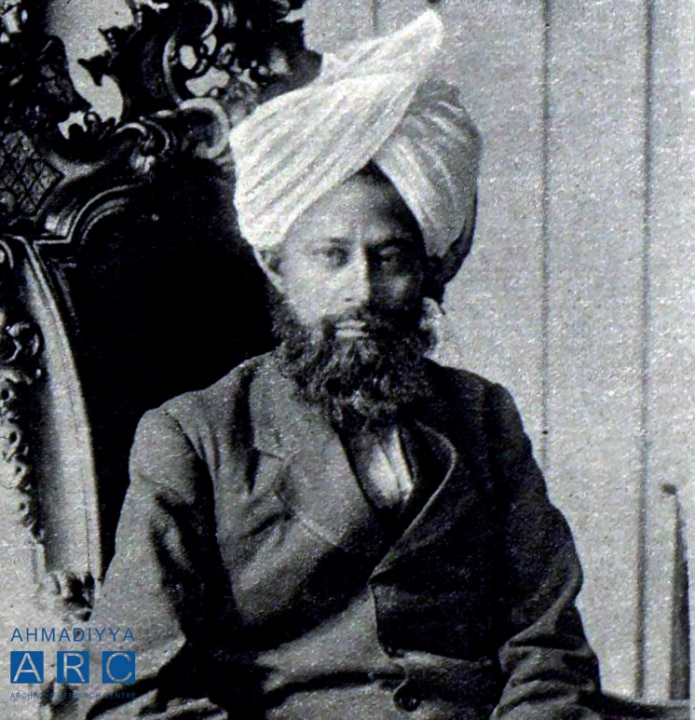
Since it was decided during the meeting on 29 August that a list of points of difference between the two communities be submitted to the conference, Hazrat Musleh-e-Maudra published a 20-point memorandum on 1 September, that outlined his proposals for the establishment of peace and harmony between Hindus and Muslims. The memorandum was sent to the leaders of both parties.
One of those points stated that the idea of joint electorates is correct in principle, but not under the prevailing circumstances in India and that it is detrimental to Muslim interests. Huzoorra said that the Ahmadiyya Muslim Jamaat, and other Muslims of Punjab and some other provinces were not ready to accept the joint electorates at the time. He demanded that the right to separate electorates continue for the Muslims, and for other parties as well, if they deemed it beneficial. (Appendix to Al Fazl, 16 September 1927)
The Viceroy meets Hazrat Musleh-e-Maudra
On the same day, 1 September, a meeting took place between Hazrat Musleh-e-Maudra and the then Viceroy of India, Lord Irwin, at the Viceregal Lodge. (The Civil and Military Gazette, 4 September 1927, p. 3)
During the meeting, Hazrat Mufti Muhammad Sadiqra was also present as an interpreter. The meeting continued for around 30 minutes, during which the ongoing political and religious situation in the country was discussed. Huzoorra advised the Viceroy to make full efforts to make peace between the Muslims and Hindus. (Al Fazl, 13 September 1927, p. 1)
The Unity Conference continues
On 7 September, during a session of the Unity Conference, Huzoorra presented his proposals, which had already been published as a memorandum on 1 September, and granted in-depth guidance in light of those points.
On the evening of 7 September, another session commenced under the chairmanship of Jinnah, at the hall of Brahmo Samaj Mandir, which was attended by various leaders from the Hindu and Muslim communities. Huzoorra delivered an address and spoke in favour of the Muslims’ demand for separate electorates and most of the speakers agreed with Huzoor’sra views. Jinnah, after delivering his concluding speech, stated that now he knew that the majority of the Muslims favoured separate electorates and thus, when the decisive time came, he would cater to their views. (Tarikh-e-Ahmadiyyat, Vol. 4, p. 620)
A subcommittee formed
The Civil and Military Gazette reported:
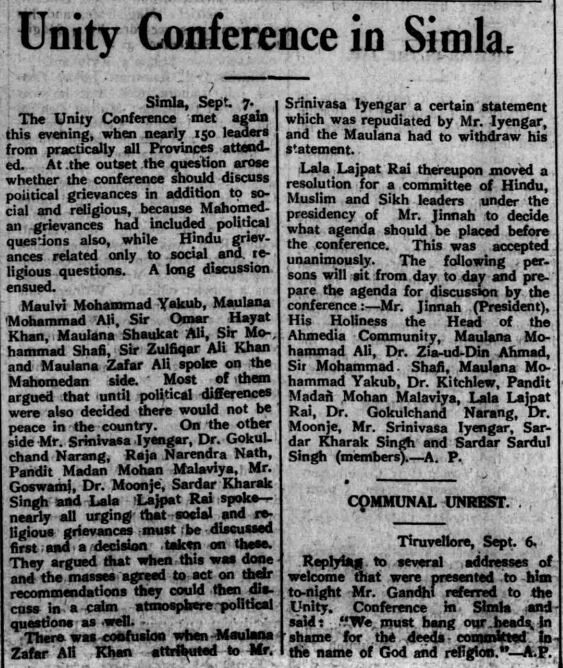
“The Unity Conference met again this evening, when nearly 150 leaders from practically all provinces attended. At the outset, the question arose whether the conference should discuss political grievances in addition to social and religious ones, because Mahomedan grievances had included political questions as well, while Hindu grievances related only to social and religious questions. A long discussion ensued. […]
“Lala Lajpat Rai thereupon moved a resolution for a committee of Hindu, Muslim and Sikh leaders under the presidency of Mr Jinnah to decide what agenda should be placed before the conference. This was accepted unanimously. The following persons will sit from day to day and prepare the agenda for discussion at the conference:
“Mr Jinnah (President), His Holiness the Head of the Ahmedia Community, Maulana Mohammad Ali, Dr Zia-ud-Din Ahmad, Sir Mohammad Shafi, Maulana Mohammad Yakub, Dr Kitchlew, Pandit Madan Mohan Malaviya, Lala Lajpat Rai, Dr Gokulchand Narang, Dr Moonje, Mr Srinivasa Iyengar, Sardar Kharak Singh and Sardar Sardul Singh (members).” (The Civil and Military Gazette, 9 September 1927, p. 5)
This subcommittee was to convene at 9am on the next day at the Cecil Hotel, located at the Chaura Maidan, nearby the Viceregal Lodge. Huzoorra reached there at the appointed time, however, some of the members were not yet present, and for this reason, the session did not take place on that day. (Al Fazl, 16 September 1927, p. 2)
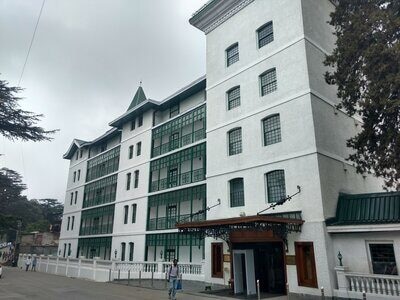
Thereafter, on 9 September, the subcommittee met at the Brahmo Samaj Mandir, where Jinnah presented the subcommittee’s report. “The recommendations of the sub-committee were unanimously accepted by the conference and Hindu, Sikh and Muslim leaders were appointed to propose a committee.” Hazrat Musleh-e-Maudra was also nominated as a member of this committee. (The Civil and Military Gazette, 11 September 1927, p. 13)
An appeal from the Conference to the public and press
“The conference regretted that, in spite of their appeal, three communal disturbances had occurred and that, in some sections of the press, the tone had not improved. They once more wished the public and the press to create a favourable atmosphere in the country in order that their efforts might be crowned with success.” (The Civil and Military Gazette, 12 September 1927, p. 7)
The above-mentioned newspaper published the names of all signatories to this appeal, which included the name of Hazrat Musleh-e-Maudra as well. (Ibid)
Simla Unity Committee
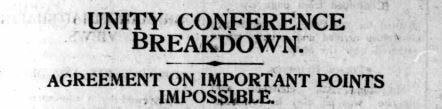
The Unity Conference nominated another committee known later as the Simla Unity Committee, which convened from 16 to 22 September, however, no conclusions were reached on some of the principal points. After some further discussions, the President was requested to summon a meeting if he received a requisition within six weeks from certain members. (The Indian Quarterly Register, July-Dec 1927, Vol. II, p. 40, The Annual Register Office, Calcutta)
A summary of the conference in Huzoor’sra words
Mentioning this conference, during a speech on 27 December 1927, Hazrat Musleh-e-Maudra said:
“A conference was held in Shimla, for which I was also invited as a member. […] During the conference, I would speak very little and instead assess the character of everyone. […] Thus, I am fully acquainted with them, and can say that there are some among them who are sincere in their efforts, however, there are some others who only act superficially. Nonetheless, I am pleased to see that there are some amongst the Muslims as well, who put their sincere efforts for the betterment of the Muslims, in accordance with whatever their intellect suggests.” (Taqrir Dilpazir, Anwar-ul-Ulum, Vol. 10, p. 78)
The only pathway to peace
Huzoorra further said:
“The truth of the matter is that true peace between different religions can only be achieved by utilising the means that have been taught by the Promised Messiahas. That is, the followers of all religions should narrate about the distinctive features of their respective religion, instead of raising objections over the others.” (Ibid)
Insincerity of political leaders
The purpose for which various leaders gathered at the Conference, required sincerity and true zeal from them to reach a solution. However, as Huzoorra said, many of those leaders were not sincere in their efforts and acted superficially. Due to the lack of much-needed sincerity from all of the political leaders, no significant solution could be achieved, however, there were many positive outcomes as well, particularly for the Muslims, which manifested their fruits later.
Significance of Huzoor’sra guidance to leaders and officials and its impact, in the long run
Hazrat Musleh-e-Maud’sra view in favour of the separate electorates had a great impact on Jinnah and other Muslim leaders, who were initially unable to realise how crucial this demand was under the prevailing circumstances. As a result, later on, Jinnah realised the importance of this demand and stood firm on it.
For instance, in 1928-1929, leaders of the Hindu Maha Sabha opposed the Muslims’ demand for the reservation of seats in Punjab and Bengal, and asserted that the Muslims did not require reservations in Punjab and Bengal as they were the majority there. In response to this, MA Jinnah pleaded that “the small numerical superiority of the Muslims in these two provinces could be outweighed by the social power of Hindu Banias in Punjab and Hindu zamindars in Bengal since universal suffrage was not being introduced.” (Modern India, 1885-1947, Sumit Sarkar, p. 309, Macmillan India Limited, 1959)
It is crystal clear that Hazrat Musleh-e-Maudra considered that, though the idea of joint electorates was principally correct, it was not favourable amidst the situation of British India. Therefore, after the creation of Pakistan, when the question arose in regard to the introduction of joint electorates in West Pakistan, Huzoorra spoke in favour of the joint electorates. While mentioning this development, The Civil and Military Gazette reported:
“Muslim League and Jamaat-i-Islami circles yesterday criticised the National Assembly decision to have joint electorates for West Pakistan while its introduction was justified by the head of the Ahmediya Community, Mirza Bashiruddin Mahmood, due to changed conditions in the country. […]
“In a telegram from Rahmat to the Foreign Minister of Pakistan, Malik Firoz Khan Noon, Mirza Mahmood said that at one time he was of the opinion that a separate electorate should be continued in India. But now, he said, conditions had completely changed.” (The Civil and Military Gazette, 27 April 1957, p. 12)
Nonetheless, Hazrat Musleh-e-Maud’s guidance during his various speeches in Shimla and meetings with the Muslim leaders, helped instil a new passion and zeal among them to improve the political, social, and economic situation of the Muslims and to foster a sense of unity among them.
For instance, during his Friday Sermon on 9 September 1927, Huzoorra advised the Muslims that the principle which is required for their progress is in fact their religious progress, thus, “the more their power of faith and conviction grows, the more they will move towards progress.” (Al Fazl, 20 September 1927, p. 5)
Huzoorra granted valuable guidance to the leaders of other communities as well, and advised them as to how they could serve to establish a peaceful and harmonious society. Moreover, he also gave important guidance to various government officials, particularly the Viceroy of India and the Governor of Punjab.
In one of his articles, written on 8 December 1927, Huzoorra mentioned the Unity Conference of Shimla, and said that he became acquainted with various Muslim and Hindu leaders, who had the opportunity to work with him for several hours. Huzoorra said that he considers Jinnah an intelligent, able, and a sincere servant of the nation, and “he is among those very few who do not care for their personal fame as much as they care for the national progress.” However, Huzoorra also expressed his disagreement with Jinnah and his like-minded people about boycotting the Simon Commission, which was expected to arrive from England. (Musalmanan-e-Hind ke Imtihan ka Waqt, Anwar-ul-Ulum, Vol. 10, p. 45)
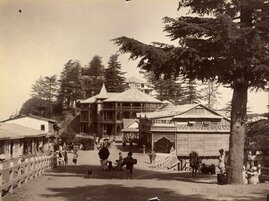
A lecture at the Elphinstone Hall
On 11 September 1927, Huzoorra delivered a lecture at the Elphinstone Hall in Shimla, and made the Muslims aware of their individual and national responsibilities. The session was presided over by Nawab Sir Zulfiqar Ali Khan. The hall was full to its brim even before the fixed time, and it was attended by people from various religions and fields.
The president of the session introduced Huzoorra with the following words:
“Our respected and honourable Mirza Sahib does not require any introduction, since he is a well-known person. The blessings that we are getting from him, and the endeavours that he is making for the reformation of the Muslims are known to everyone. For this reason, I do not feel the need to speak more, but rather, I will now request that he grace us with his advice.” (Al Fazl, 23 September 1927, p. 3)
Huzoorra delivered a three-hour long speech, in which he said that Islam is a religion of peace and harmony, and grants such teachings that are essential to foster a peaceful and harmonious society. However, if any of its followers present a contradictory example that is objectionable, it does not mean at all that Islamic teachings are responsible for that.
Huzoorra continued by expressing his regret over the ongoing conflict between the Hindus and Muslims, and advised both communities that the prevailing rift and disorder is causing harm to the country at large and anyone who loves their country, cannot like it at all.
Advising the Muslims, Huzoorra said that they lack unity, discipline, and diligence, which is very dangerous for their future. Until the individuals of a community make progress, the community as a whole cannot make any progress at all. Further, Huzoorra shed light on the individual and national duties of Muslims.
Huzoorra said that Muslims need to inculcate the true spirit of Islam within them, and for this, they need to read, ponder over, and act upon the Holy Quran. Moreover, they need to instil the love for the Holy Prophet Muhammadsa, and for this, the Muslims should be made aware of the efforts and sacrifices which were rendered by the Holy Prophetsa for the betterment of mankind.
Huzoorra said that contemporary Muslims did not pay heed to prayers [du’a], and thus, advised them to pay attention to this means of success. Another point that Muslims are required to pay heed to is having strong morals and values, such as truthfulness, hard work, and diligence.
Huzoorra then mentioned the Quranic teaching of:
فَاسۡتَبِقُوا الۡخَيۡرٰتِ
meaning ‘Vie, then, with one another in good works.’ (Surah al-Baqarah, Ch. 2: V. 149), and advised the Muslims to instil a passion to leap forward and to make progress in all fields. Some other points toward which Huzoorra called the attention of the attendees, included taking care of health, cleanliness, and punctuality.
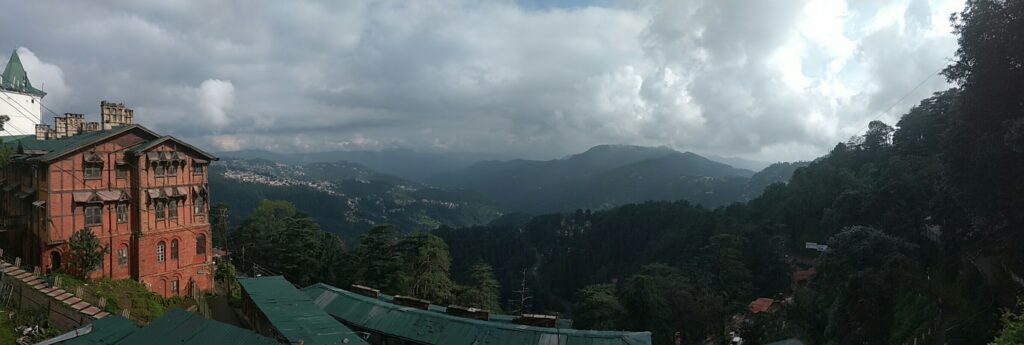
Huzoorra advised all communities to tolerate and respect the points of view of other communities. Unity is the key to success, and all communities should keep this need in mind for the country’s progress and prosperity.
Huzoorra then advised the Muslims to establish local committees in every town and city that should work for the betterment of the local Muslims. Huzoorra added that in order to instil a spirit of unity, these committees should be given a common name, and thus, he himself suggested the name “Jami‘at-ul-Ikhwan”.
Huzoorra also called the attention of the Muslims to their duty to preach the message of Islam far and wide.
In the end, Huzoorra said:
“When I teach about the establishment of peace, I also wish to say to the Hindus, Sikhs, Christians, and everyone who is present here, that though I am ever ready to make every sacrifice for the peace and conciliation, I declare it, and do it with great emphasis, [Hazrat Yaqub Ali Sahib Irfanirasays that at that moment Huzoor’s voice was very powerful and strong] that it is possible for us to make peace with the serpents and animals of the wilderness, but not with those who abuse and attack Muhammad Rasulullah, peace and blessings of Allah be upon him.” (Al Fazl, 23 September 1927, p. 6)
The Governor of Punjab meets Hazrat Musleh-e-Maudra
During this tour, the then Governor of Punjab, Sir William Malcolm Hailey, requested a meeting with Hazrat Musleh-e-Maudra through a letter. Therefore, on 17 September, the governor had the opportunity to meet Huzoorra. During this meeting, a discussion took place as to how the Hindu-Muslim unrest could be alleviated in the country. The meeting lasted for around an hour. (Al Fazl, 30 September 1927, p. 5)
It is important to mention here what views the Governor had towards the Jamaat. On 17 December 1924, when a deputation from the Ahmadiyya Muslim Jamaat presented an address to him, Mr Hailey “spoke of the interest with which he had watched the progress of the movement. While disclaiming any intention to speak of its theological aspects, he emphasised the fact that to the student of comparative religion, the value of movements, usually sectarian, lay mainly in their reaction to the attitude and beliefs of the main body of thinkers. ‘Students of religion,’ he said, ‘will watch with profound interest the effect which their movement may have on the Islamic world […].’ He welcomed the attitude they had adopted in purely temporal matters, for they had, as a community, shown themselves to be disciples of the doctrine that political improvement should be effected by reason and conviction, not by violent agitation or mass movement.” (The Civil and Military Gazette, 18 December 1924, p. 4)
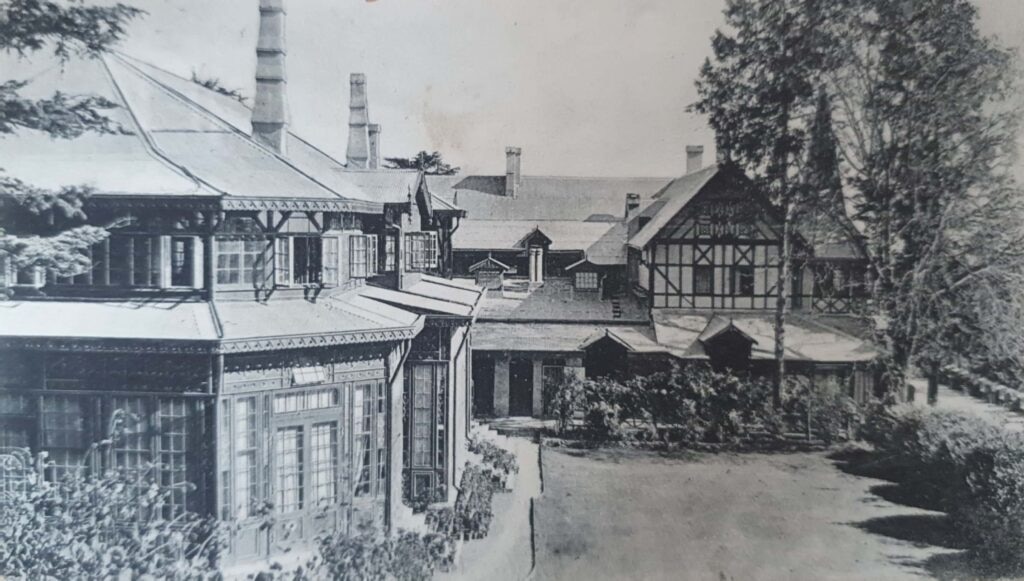
Jamiat-ul-Ikhwan for the unity and prosperity of Muslims
On 25 September 1927, Huzoorra granted an audience to the aggrieved Muslims of Shimla, at Kingsley. This joint session of Ahmadi and non-Ahmadi Muslims was held to establish the Jami‘at-ul-Ikhwan, the idea of which was proposed by Huzoorra himself during his lecture on 11 September. On this occasion, Huzoorra delivered a speech as well. (Al Fazl, 7 October 1927, p. 6)
A testimony
In praising Hazrat Musleh-e-Maud’sra services, particularly in those circumstances, that have been mentioned above, a prominent Muslim leader, Muhammad Ali Jauhar, stated:
“It will be ungrateful if we do not mention respected Mirza Bashiruddin Mahmud Ahmad and his well-disciplined Jamaat, who have devoted all their efforts – irrespective of doctrinal differences – toward the welfare of the Muslims.” (Hamdard, 26 September 1927)
اِک وقت آئے گا كہ كہيں گے تمام لوگ
ملّت كے اس فدائى پہ رحمت خدا كرے
“The time will come when everyone will say, ‘May God have mercy on this devotee of the nation.’” (Al Fazl, 1 January 1955, p. 1).
_____________________________________________________________________________________________
https://www.alhakam.org/india-religious-political-conflicts/
Hazrat Musleh-e-Maud’s services to the Muslim cause: Guiding Muslims of the Indian subcontinent amid religious and political conflicts
Ata-ul-Haye Nasir, Ahmadiyya Archive & Research Centre

History bears witness that Hazrat Musleh-e-Maudra rendered great services to the Muslim Ummah. He granted valuable guidance to the Muslims of Indian subcontinent amid various political and religious conflicts, and advocated for their rights.
Address to Edwin Samuel Montagu
On 20 August 1917, Edwin Samuel Montagu, Secretary of State for India, stated in the House of Commons:
“The policy of His Majesty’s Government […] is that of […] gradual development of self-governing institutions with a view to the progressive realization of responsible government in India as an integral part of the British Empire.” (House of Commons Debates, Vol. 97, cc. 1695-97 [20 August 1917])
After this announcement – while the political activities of the Congress were in full swing – the Muslims got anxious in regard to the future danger. The thought that was causing them huge distress was that if India was granted the right of limited self-government, the Muslims could face severe dangers from the majority, who were Hindus.
It was late 1917 when Edwin Montagu toured India to discuss the introduction of the limited self-government. Hazrat Musleh-e-Maudra sent a delegation to present an address to him on 15 November 1917. Huzoorra advised an appropriate road map towards India’s self-dominion and stated that the elections should not be held in such a way that could consequently harm the minority communities. (The Review of Religions [Urdu], December 1917)

Shuddhi Movement
In 1923, there was a great anxiety among the Muslims of the subcontinent due to the Shuddhi movement, which stood to convert Muslims to Hinduism.
On 7 March 1923, Huzoorra instructed Ahmadis to get ready to offer every possible sacrifice to defeat the Shuddhi movement. (Al Fazl, 12 March 1923, pp. 13-14)
Then, during his Friday Sermon of 9 March 1923, Huzoorra stated a detailed scheme to tackle this issue and instructed the Jamaat to donate 50,000 rupees for this. (Al Fazl, 15 March 1923, pp. 3-6)
A newspaper, Hamdam, on 18 March 1923, wrote that by witnessing Jamaat-e-Ahmadiyya’s passion and spirit of sacrifice, it was almost certain that they would raise 50,000 rupees or even more, but expressed hopelessness for such a sacrifice from the non-Ahmadi Muslims.
More details about the Jamaat’s services in response to the Shuddhi movement can be read in our article, titled “Hazrat Musleh-e-Maud’s response to the Shuddhi movement and the Jamaat’s relentless services for Islam”.
Hindu-Muslim unrest and Anti-Islamic rhetoric
On 23 December 1926, a prominent leader of the Shuddhi movement, Swami Shraddhanand, was assassinated, erupting a nationwide Hindu-Muslim unrest.
On 2 March 1927, Huzoorra delivered a lecture in Lahore, titled, “Hindu-Muslim Fasadat, Inka Ilaaj, Aur Musalmanon ka Ainda Tariq-e-Amal”, i.e. Hindu-Muslim Relations and the Future Line of Muslim Conduct (Al Fazl, 15, 18 & 22 March 1927), about which a newspaper, Tanzim, stated:
“Amir Jamaat-e-Ahmadiyya Qadian delivered an important speech on the causes and remedy of the Hindu-Muslim unrest and Muslims’ future plan […] [He] emphasised that Muslims should unite, otherwise it will be difficult for them to retain their stature.” (Tanzim, 14 March 1927, p. 12)
Lahore’s Hindu newspapers also published summaries of this lecture, including Milap, Partap, Banday Matram and Sau Rajiya.
The Civil and Military Gazette reported:
“Hindu-Muslim Relations
“Powerful Appeal for Mutual Toleration
“Hazrat Mirza Bashir-ud-Din Mahmud Ahmad, Head of the Ahmadiyya community, gave a very significant speech on ‘Hindu-Muslim Relations and the Future Line of Muslim Conduct,’ on Wednesday, March 2. The Hon Sir Muhammad Shafi, K.C.S.I., was in the chair. The hall was packed to its fullest capacity and both communities were amply represented by leading members.
“The lecturer traced the origin of the Hindu-Muslim disturbances to two causes, viz., the absence of religious toleration and political injustice. Both these traits in the Indian character, he remarked, were the inheritance of past Indian history, for which the present generation was not responsible. Therefore, instead of quarrelling amongst themselves and making matters worse, both communities should try to bury the past and make mutual efforts to forget and forgive. He appealed strongly to both communities, in the name of their respective religions and in the name of their country, to cultivate the virtues of broad-mindedness and fair-play which were greatly needed to develop national life in India. The lecturer was listened to with deep attention by an appreciative audience.” (The Civil and Military Gazette, 5 March 1927, p. 5)

During his Friday Sermon of 22 April 1927, Huzoorra advised Muslims to unite and stated that those who claimed love for the Holy Prophetsa, should rise in support of Islam. He added that though only those arguments would be beneficial as had been presented by the Promised Messiahas, but the important thing was to set aside internal disputes and tackle the enemy of Islam united. (Al Fazl, 6 May 1927, pp. 6-9)
During the first week of May 1927, anti-Muslim riots erupted in Lahore and Muslims had to face severe oppression. During his Friday Sermon of 6 May 1927, Huzoorra guided the Muslims in this regard and advised them on how to tackle this issue.
Huzoorra published many articles, posters and announcements. In his first article, titled Imam Jamaat-e-Ahmadiyya’s Comment on the Lahore Riots, he advised Muslims to take heed from the riots and pay attention towards spreading Islam. (Al Fazl, 13 May 1927, p. 2)

The Civil and Military Gazette reported under the title “APPEAL BY RELIGIOUS HEAD”:
“Mirza Bashir-ud-Din Mahmud Ahmad, the Head of the Ahmadiyya Community, Qadian, has circulated a poster reviewing the Lahore riots. […] Sympathising with the wounded and the murdered of both parties, he has subscribed Rs. 200 to be distributed among the afflicted and the survivors of the victims without any distinction of race or religion, and has advised his followers in other towns to raise necessary funds for the purpose. ‘No Muslim must think of taking revenge,’ is his advice to the Mussalmans. ‘A Muslim is to be who keeps his feelings under his control.’” (The Civil and Military Gazette, 13 May 1927, p. 7)
Huzoorra decided to initiate a countrywide movement for not only aiding the oppressed Muslims of Lahore, but also for the Indian Muslims’ economic, political and religious progress. He published a tract as well, titled “Aap Islam aur Musalmanon ke liay kiaa kar saktay hain?”, i.e., What can you do for Islam and Muslims? (Al Fazl, 17 and 24 May 1927), in which he outlined 31 points of the scheme for Islam’s unity.
An Arya Samajist, namely Rajpal, who had published a disrespectful book, titled Rangila Rasul, was initially sentenced to six months’ imprisonment and a fine of 1,000 rupees or six months’ more imprisonment. But on his appeal, the Punjab High Court’s judge, Kanwar Dalip Singh acquitted him, which caused huge distress amongst the Muslims.
Then, Risala-i-Vartman published a disrespectful article, titled Sair-i-Dozakh, in its May 1927 issue.
At that juncture, Huzoorra published a poster, titled “Rusool-e-Karimsa ki Mahabbat ka Da‘wa karnay wale kiaa ab bhi bedaar na honge?”, i.e., Will the Claimants of the Holy Prophet’ssa Love Still Not Wake Up? and stated:
“Could there be any other day of tribulation for Islam? Could our helplessness take any other severe state? Don’t our neighbours [Hindus] know that we love the Holy Prophetsa from depth of our hearts and hold him more dear to us than our lives, for whom every fibre of myself and my family are entirely devoted and each particle of our body is sacrificed upon the dust of the shoes of the Leadersa of the righteous people? […] Our lives are here [to sacrifice], the lives of our children are here [to sacrifice]; harm us as much as you wish, but for God’s sake, do not destroy your[selves in this] world and the Hereafter.”
He continued by advising the Muslims:
“For Islam’s progress, make a pledge of three things: firstly, you will instil within yourself the fear of Allah and will not show carelessness towards the religion; secondly, you will show full interest in preaching Islam and for this task, you will not hesitate from sacrificing your life and wealth; thirdly, you will strive the utmost to save Muslims from cultural and economic slavery.” (Al Fazl, 10 June 1927, pp. 6-8)
The outcome of this poster was recorded by All India Reporter (Lahore, 1927) in the following words:
“Towards the end of May or very early in June a poster made its appearance in Amritsar. It is said to have been sent by the Mirza of Qadian and, to have drawn attention to certain portions of this article and still further excited the Muslims.” It was acknowledged that “had it not been for the part played by the Mirza of Qadian in sending a poster to Amritsar”, the article of Risala-i-Vartman may not have been seen as “highly inflammatory” by the law-enforcement agencies.
GR Thursby mentions the huge impact of this poster in his book Hindu-Muslim Relations in British India:
“Several days after its appearance an Urdu poster was distributed in Amritsar which called the attention of Muslims to what were apparently the particularly objectionable portions of the article. The Mirza or leader of the Ahmadiyya Muslim sect at Qadian was the attributed source of the poster, which provoked protest meetings against the article and led to noticeable unrest among many of the Muslims of the city. Therefore, early in June a Muslim Deputy Superintendent of Police brought the article to the attention of the local government. This resulted in proscription of the May issue of the journal [Vartman] under section 99A of the Criminal Procedure Code. Then, on June 6th, prosecution under 153A of the Indian Penal Code was undertaken by the government. Both Gian Chand Pathak, who was the acknowledged editor, printer, and publisher of Vartman journal, and Devi Sharan Sharma, who was the alleged author of Sair-i-Dauzakh were arrested, and the Amritsar District Magistrate began to hear testimony within days of their arrest.” (Hindu-Muslim Relations in British India, by GR Thursby, 1975, p. 56)
In regard to the acquittal of Rajpal, an Ahmadi editor of the newspaper, Muslim Outlook, Syed Dilawar Shah Sahib Bukhari commented in his editorial of 14 June 1927, upon which he and the owner of the newspaper, Maulvi Nurul Haq Sahib, received a notice of contempt of the court.

Syed Dilawar Shah Sahib requested Huzoorra for his advice, upon which Huzoorra advised him:
“It should be our duty to show appropriate respect to the provincial court, but when you have written an article with honesty and just represented the thoughts which are being emerged in the hearts of every Muslim, so now what else could be your duty other than to just remain firm on this truth. This is a matter of love for the Holy Prophetsa. […]
“My advice to you is that you should respond by stating that if, in the eyes of the High Court’s judges, there is an article in the English law for protecting the honour of Kanwar Dalip Sahib, but no article for protecting the honour of the Holy Prophetsa, then I would be ready to go to the prison.” (Al Fazl, 1 July 1927, p. 3)
After the case proceedings, the court gave a judgement against them.
Huzoorra issued an important message for Muslims, in which he announced that his Jamaat would be ready to do everything, in accordance with Islamic teachings, for protecting the honour of the Holy Prophetsa and thereafter, he advised Muslims to unite. (Al Fazl, 28 June 1927, pp. 1-2)

On 23 June 1927, Huzoorra wrote an article, titled “Rusool-e-Karimsa ki Izzat ka Tahaffuz aur Hamaara Farz”, i.e., Protection of the Holy Prophet’ssa honour and our duty. (Al Fazl, 1 July 1927, p. 3)
Huzoorra suggested the Muslims to organise jalsas on 22 July 1927 in all places, in which Muslims should discuss about their economic and cultural freedom and to take an oath from everyone that they will preach the teachings of Islam in their respective areas. Thus, Muslims of the Indian subcontinent held jalsas in many places.
Dr Saifuddin Sahib, Editor Akhbar Tanzim of Amritsar, suggested to organise a Muslim Parties Conference and asked prominent leaders, including Huzoorra, for their views on it. In response, Huzoorra stated:
“I already had this thought. Is there any doubt that the [internal] disagreement is damaging the Muslims? But the biggest problem is that Muslims are unable to comprehend the damage due to this disagreement. The third problem is that they are leaving aside the real ways of unity and wish to supress every voice other than them.” (Tarikh-e-Ahmadiyyat, Vol. 4, pp. 624-625)
Then came the time for the court’s judgement on Vartman’s case and the author of the article was punished for one year in jail with a 500-rupee fine and the editor, for six months in jail and a 250-rupee fine.

Upon this, Huzoorra stated:
“My heart is distressed because I do not declare a mere one-year jail sentence to be the price for disrespecting my master and leader Hazrat Muhammadsa. Unlike those who say that the punishment for the one who abuses Rasulullahsa is to kill him, I do not even declare a person’s death to be its compensation; I do not even declare its price to be a nation’s destruction; I do not even declare its price to be the whole world’s death; in fact, I do not even declare its price to be the killing of all disbelievers of the past and the future, because my Master’ssa honour is far superior than declaring its price to be the killing of an individual or a community. […]
“The ongoing opposition against Islam is actually the result of Muslims’ laziness in preaching. […] Get ready with courage and perseverance for the preaching of God’s religion and the nation’s progress, then God Himself will descend from the Heavens to help you and His nur [divine light] will guide you.” (Al Fazl, 19 August 1927, pp. 3-6)
In relation to this issue, Hazrat Musleh-e-Maudra issued a press release which was published in The Civil and Military Gazette, on 26 August 1927, in which he granted valuable guidance to the government and advised them to take necessary steps to safeguard the honour and respect of the holy founders of all religions.
The Mashriq newspaper, on 23 September 1927, wrote:
“All the Muslims are obliged to respected Imam Jamaat-e-Ahmadiyya for his favours. It was because of his movement that Vartman [magazine] was prosecuted. It was his Jamaat which pursued the issue of Rangila Rasul [book]. They were fearless and did not hesitate to go to jail. It was his pamphlet which made Governor Sahib deliver justice.”
Shia-Sunni Riots in Tirah
Huzoor’sra struggle for the unity of Muslims was once again damaged by the Shia-Sunni riots in the area of Tirah, upon which Huzoorra published an appeal to the Shia and Sunni Muslims and stated:
“The information about the Shia-Sunni riots in the Frontier Independent Areas have brought great grief to the hearts of those who feel pain for Islam. […] It should be our foremost duty to not let this evil spread more. […] I promise those who have suffered from this fight every kind of financial and moral help that I can offer.” (Tanzim, 14 August 1927, p. 2)

Visit to Simla
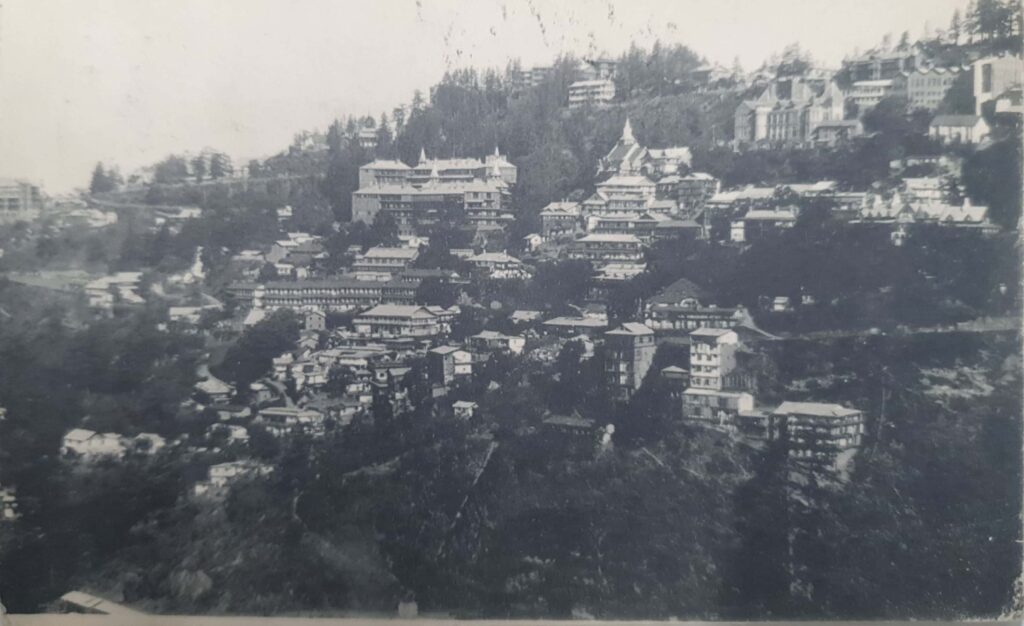
Hazrat Musleh-e-Maudra visited Simla [now Shimla] from 13 August to 2 October 1927. Throughout this tour, Huzoor’sra activities were focused on religious, national, and community matters. Various leaders and dignitaries had the opportunity to meet him, including the then Viceroy of India and the then Governor of Punjab.
Huzoorra advised the government to make specific ammendments to the laws for safeguarding the respect and honour of all religions and their leaders.
During his Friday Sermon of 9 September 1927, Huzoorra advised the Muslims by stating:
“The principle which is needed for the Muslims’ progress is their religious progress. The more their power of faith and conviction grows, the more they will move towards progress.” (Al Fazl, 20 September 1927, p. 5)
On 11 September 1927, Huzoorra delivered a lecture in Simla, in which he made the Muslims aware of their individual and national responsibilities. (Al Fazl, 23 September 1927, pp. 3-6)

Applauding Huzoor’sra services, a prominent leader, Muhammad Ali Jauhar, stated:
“It will be ungrateful if we do not mention respected Mirza Bashiruddin Mahmud Ahmad and his well-disciplined Jamaat, who have devoted all their efforts – irrespective of doctrinal differences – towards the welfare of the Muslims.” (Hamdard, 26 September 1927)
Simon Commission
Under the Montagu-Chelmsford Reform Scheme, the British government had decided that after 10 years, a commission be sent to India to examine the effects and operations of the constitutional reforms and to suggest more reforms for India.
Towards the end of 1927, a commission was announced to be sent whose president was Sir John Allsebrook Simon. This is known as “The Indian Statutory Commission” or “Simon Commission”.
As the commission had no Indian member, Congress and other political parties boycotted it. Even some prominent Muslim leaders like MA Jinnah and Muhammad Ali Jauhar also had the same opinion.
But Hazrat Musleh-e-Maudra wrote a booklet on 8 December 1927, titled Musalmanan-e-Hind ke Imtehan ka Waqt (A Time of Trial for the Indian Muslims), wherein he advised Muslims that the boycott would be detrimental for the Muslims, compared to the Hindus.

Huzoorra stated that since the Reform Scheme had been approved, Hindu leaders knew that India’s future was linked to the English nation; thus, they often visited England to meet with prominent Englishmen and speak about Hindus’ benefits. Huzoorra said that they had made them their likeminded. But the Muslims had not paid any attention towards this matter.
Huzoorra added that if the commission was boycotted, then its report would be based on their previous information provided to them by the Hindus. (Musalmanan-e-Hind ke Imtehan ka Waqt, Anwar-ul-Ulum, Vol. 10, pp. 37-55)
Seerat-un-Nabi Jalsas
As the year 1927 had seen huge anti-Islam rhetoric, Huzoorra initiated a great scheme of holding seerat-un-Nabi jalsas.
Huzoorra stated:
“The reason why people dare to attack [the blessed character of the Holy Prophetsa] is that they are unaware of the true circumstances of his life. […] This has only one remedy, which is to deliver as many lectures as possible with such emphasis that every person of India should become aware of his purity and life’s circumstances. […] So it is our obligation to make all the Muslims and non-Muslims of India aware of the pure life of the Holy Prophetsa. On the same day each year, this matter needs to be highlighted with special arrangement.” (Al Fazl, 10 January 1928, pp. 1-2)
At first, the date for the jalsa was announced to be 20 June 1928, but it was later changed to 17 June.
Upon Huzoor’sra instruction, Al Fazl published a Khatamun-Nabiyyin number on 12 June 1928, which consisted of articles by Huzoorra, Ahmadi scholars, non-Ahmadi scholars, leaders and non-Muslims as well. It also included a few na‘ts (poems in praise of the Prophetsa) as well. 7,000 copies were published at first, but due to high demand, more copies were published.

Many newspapers appreciated the initiative of jalsas and after the proving successful throughout India, the press published applauding headlines.
The Mashriq newspaper of Gorakhpur, on 21 June 1928, stated:
“This date [of seerat-un-Nabi jalsas] will be remembered in India forever because on this date, every Muslim sect commemorated His Highness, the chief of both worlds, Muhammad Rasulullahsa in one aspect or another […] Anyway, we congratulate Imam Jamaat-e-Ahmadiyya, respected Mirza Mahmud Ahmad, on the success of the jalsa held on 17 June. If Shias, Sunnis and Ahmadis gathered at one place two to four times each year, then no power in this country could compete with Islam.”
Few years later, reporting on the seerat-un-Nabi jalsas which were held all over India on 6 November 1932, The Civil and Military Gazette wrote:
“The need for the inculcation of such knowledge in India occurred to Hazrat Mirza Bashir-ud-Din Mahmud Ahmad, Head of the Community of the Ahmadyyas of Qadian, some years ago, when popular feeling had been wrought up to a height by the Rangila Rasul pamphlet.
“Realising that this kind of trouble arose largely from misunderstanding, His Holiness conceived the idea of organising a campaign, on one particular day of the year, and when prominent men of all religions could explain to the people what the teachings of the Prophet really mean.” (The Civil and Military Gazette, 14 November 1932, p. 3)

Nehru Report
On 7 July 1925, the Secretary of State for India, the Earl of Birkenhead stated in the British Parliament:
“We do not claim in Great Britain that we alone in the world are able to frame Constitutions, though we are not altogether discontented with the humble constructive efforts which we have made in this field of human ingenuity. But if our critics in India are of opinion that their greater knowledge of Indian conditions qualifies them to succeed, where they tell us that we have failed, let them produce a Constitution which carries behind it a fair measure of general agreement among the great peoples of India. Such a contribution to our problems would nowhere be resented. It would, on the contrary, be most carefully examined by the Government of India, by myself, and I am sure, by the Commission, whenever that body may be assembled. I gladly recognise that the so-called Liberal Party in India, neither inconsiderable in numbers nor lacking in the leadership of enlightened men, has refused to associate itself with the ill-starred course of non-cooperation. It is still possible that this Party, perhaps to be gradually reinforced by fresh moderate elements, may play a great part in the Constitution fashioning of the future.” (Hansard, HL Debates, 7 July 1925, Vol. 61, cc. 1062-1094, https://hansard.parliament.uk)
He repeated this challenge in 1928.
Upon this, Congress called a session of the All Parties Conference on 19 May 1928 in Mumbai, where a ten-members’ sub-committee was established, chaired by Motilal Nehru, which had only two Muslim representatives. This committee passed a constitution which was pro-Hindus. It is commonly known as the Nehru Report.
Hazrat Musleh-e-Maudra commented on the Nehru Report in detail. Al Fazl published those comments from 2 October to 2 November 1928, which was later published in book form titled, Nehru Report aur Musalmanon ke Masaleh. Its English translation was later published in March 1930, titled The Nehru-Report and Muslim Rights.
Huzoorra stated that this committee could not be deemed representative of India and then shed light on the demands of the Muslims.

Huzoorra stated:
“I do not mean to say that you must not make efforts for the freedom of India. Now when Great Britain herself has decided that India is entitled to representative Government, I fully associate myself with my countrymen in every legitimate effort made for its attainment. But what weighs heavy upon my mind and saddens my heart is the thought, that the Muslims should agree to constitutional reforms without safeguarding their own interests. The consequences of such action are bound to be most bitter and disasterous. The Muslim ought not to agree to any settlement until the proposals of both the sections of the League have been accepted, otherwise it will result in so serious a situation that the very thought of it makes one shudder. This also should be borne in mind that if the above-mentioned proposals of the opponents of the Nehru-Report,–whether Leaguers, Khilafatists or others, are made a basis of any agreement, then the Mussalmans will have little to fear regarding future alteration of the present decisions. In that case their rights will be adequately protected. Thereafter if the safeguards are found superfluous, it will not be difficult to amend the laws, because it will be the Hindus, and not the Muslims, who will benefit by such amendment, and the Hindus will not therefore oppose such change.” (The Nehru-Report and Muslim Rights [Nehru Report aur Musalmanon ke Masaleh], p. 52)

Simon Commission’s Punjab Committee
The Muslim members of the Simon Commission’s Punjab Committee had agreed upon the suggestion that the Punjab Council should have 83 Muslim members out of the total 165, though Muslims deserved 55 percent share. Huzoorra wrote an article, in which he expressed his concerns over this agreement. This article was published in Al Fazl of 30 August 1929.
When this article got published in the newspapers Siasat and Daur-e-Jadid, a non-Ahmadi, Muhammad Hayat Khan Sahib, Superintendent Police Pensioner appreciated the article in his letter to Huzoorra dated 8 September 1929. (Tarikh-e-Ahmadiyyat, Vol. 5, p. 149)

Civil disobedience by Congress
When the Congress initiated civil disobedience on 6 April 1930, some Muslim organisations such as Majlis-e-Ahrar and Jamiat-ul-Ulema favoured this initiation. But with Huzoor’sra efforts, the Muslims as a whole avoided it.
In his Friday Sermon of 2 May 1930, Huzoorra expressed his views about the matter and outlined an appropriate course of action.
On 4 and 5 July 1930, a conference of All Muslim Parties was held, in which Huzoorra also participated upon the invitation of some prominent leaders.
A weekly newspaper, Khawar, wrote in its editorial:
“At the outset of this month [July 1930], an All India Muslim Conference was held in Simla. […] Though Hazrat Mirza Bashiruddin Mahmud Sahib is considered to be a religious leader, I [the editor] have found him to be fully aware of the current politics, truthful and an honest, noble gentleman.” (The Weekly Khawar, 21 July 1930, p. 3)
Nehru Report’s supplement
When the supplement of the Nehru Report was published and some of its previous points were reformed, Huzoorra expressed his views on the reforms, which related to the Muslims, and defended the rights of Muslims. He added that whenever England agrees upon the independence of India, it would be the Muslims’ right to demand for either the supervision of their rights or to make a system themselves, under which they could establish and retain their freedom. (Al Fazl, 11 May 1930, pp. 3-4)

Round Table Conference 1930
A Round Table Conference was announced to be held from 12 November 1930 to 19 January 1931, and the Viceroy of India had stated that the solution for India’s political problems would heavily rely upon the Simon Commission’s report.
Huzoorra wrote his views on this matter, titled Hindustan Ke Maujuda Siyasi Masla Ka Hal (Some Suggestions for the Solution of the Indian Problem) and sent it to England, in which the validity of the Muslims’ demands and rights were addressed in detail.
In February 1932, a sub-committee of the Round Table Conference started working under the presidency of the viceroy of India, in which sectarian disputes, basic rights and many other issues of India were to be discussed. The Muslims were divided in two groups – one wanted to boycott the committee, while the other one passionately supported the committee.
Huzoorra wrote a detailed article, titled Round Table Conference and Muslims, in which he gave valuable guidance to the Muslims. He stated that he considered both groups to be well-wishers of the Muslims, but on this issue, both groups were wrong. (Al Fazl, 6 March 1932, pp. 3-4)

Anarchy in the country
The civil disobedience, which was initiated by the Congress in 1930, increased in severity in 1932 and the country indulged in anarchism. At that juncture, Huzoorra delivered many sermons on this issue and instructed the Jamaat to offer every possible sacrifice for protecting rights of the Muslims.
During his Friday Sermon of 5 February 1932, he stated:
“At this time, various fitnas [disorders] are prevalent here. On the one hand, the supressing of Muslims’ rights is in question, while on the other, the chaos against the government. […] The Muslims ought to tackle both of these fitnas with full care. […] The establishment of peace in a country is God Almighty’s command. Hence, even if the British [Government] itself does not make efforts to establish peace, we are required to establish it, even by risking our lives.” (Al Fazl, 14 February 1932, pp. 8-11)

Controversy of Turkish Delegation
In 1943, a delegation of Turk journalists visited Lahore and their leader stated that they were Turk first, then Muslims and there was no need to offer daily prayers during a journey.
This statement erupted great unrest among the Indian Muslims. The Hindu press started to fuel the fire of this fury among the Muslims. At that time, Huzoorra stated:
“The meaning of this [statement of the Turkish delegation’s leader] was only that though, undoubtedly [Turks] have sympathy for other Muslim nations, if, at some instance, they saw that their nation could be harmed, then they would save their lives first and care about others later. It did not mean that they would give priority to the Turk lineage, instead of Islam. This is because there is no disagreement [of Muslims and non-Muslims] there; they are all Muslims. This disagreement is found in India in fact because here reside people of different religions.” (Al Fazl, 28 February 1943, p. 2)
While addressing the second part of their statement, as regards prayers during journeys, Huzoorra stated:
“If that is true, then it is really regrettable. […] This answer tells us – if it is true – that the Islamic teaching has not yet instilled completely in the hearts of the [members of the] delegation which is visiting India. We cannot conclude from this that the whole Turk nation is like this because this is a statement of a few people and they are responsible for their act themselves.” (Ibid, pp. 2-3)
The fact is that Hazrat Musleh-e-Maudra desired for Muslim unity and strived for their progress and guided them in a great manner.
_____________________________________________________________________________________________Links and Related Essays
https://ahmadiyyafactcheckblog.com/2019/09/03/the-nehru-report-and-muslim-rights-by-mirza-basheer-ud-din-mahmud-ahmad-1930/
https://en.wikipedia.org/wiki/Nehru_Report
https://ahmadiyyafactcheckblog.com/2018/07/29/nehru-and-the-ahmadiyya-movement/
https://ahmadiyyafactcheckblog.com/2018/07/29/who-is-allama-muhammad-iqbal/
https://ahmadiyyafactcheckblog.com/2018/07/29/dr-sir-muhammad-iqbal-and-ahmadiyya/
______________________________________________________________________________________________
Tags
#ahmadiyya #ahmadiyyatrueislam #ahmadiapartheid #Ahmadiyyat #rabwah #qadian #meetthekhalifa #muslimsforpeace #ahmadiyyafactcheckblog #nolifewithoutkhalifa #AhmadiMosqueattack #AhmadiyyaPersecution #trueislam
2 Pingback