Intro
Dr. Muhammad Abdul Hadi Italo Chiussi was born on 13 May 1919, in Trieste, Italy.
Ahmadiyya sources allege that one day (in roughly 1964-1966), during a leisurely walk with his son in front of Nur Mosque of Frankfurt, he casually paid a brief visit to the building.
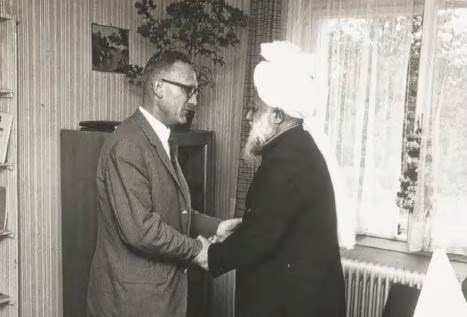
He accepted Ahmadiyya at the hand of Mirza Nasir Ahmad in 1967 in Germany, via the 3rd Khalifa’s first European tour (leaving Rabwah on 6 July and returning home on 24 August, 1967).
The most famous is La Nobla Korano, translated by Dr. Italo Chiussi, published in 1969 as the 10th volume of the prestigious book series “Oriento-Okcidento” (East-West), created as part of Universal Esperanto Association’s efforts to cooperate with UNESCO in translating important eastern and western books, to stimulate international cooperation and understanding.
In 1970, he allegedly went to Mecca and Medina, he then travelled to Qadian via Karachi, then Lahore, then Amritsar, he seems to have crossed the border easily due to his German citizenship. He wrote about this entire trip extensively. He also attended the 1970 Jalsa Salana at Rabwah, this is where he met Mirza Tahir Ahmad and many others. He even gave a speech. Sir Chaudhry Zafarulla Khan used to say: “Dr Chuissi Sahib was a walking angel on earth and a great sufi.”
However, just 3 years later (1973), he died. He allegedly wrote a translation of the Quran in the Esperanto language. Quotes from his memoirs appeared in the Al Fazl, 6 March 1992, and were archived in Tarikh-e-Ahmadiyyat, Vol. 26, p. 258. His memoir, “
_____________________________________________________________________________________________
1919
Coming from every distant track: Dr Abdul Hadi Chiussi’s journey from Frankfurt to Qadian (alhakam.org)
Dr. Muhammad Abdul Hadi Italo Chiussi was born on 13 May 1919, in Trieste, Italy.
______________________________________________________________________________________________
1967
Coming from every distant track: Dr Abdul Hadi Chiussi’s journey from Frankfurt to Qadian (alhakam.org)
In July 1967, he joined the Ahmadiyya Jamaat by pledging allegiance to Khalifatul Masih III. He was among the fortunate souls who accepted Ahmadiyyat through the German mission of the Ahmadiyya Jamaat.
Photo’s

______________________________________________________________________________________________
1969
Has anyone translated the Quran/Koran into Esperanto? – Quora
The most famous is La Nobla Korano, translated by Dr. Italo Chiussi, published in 1969 as the 10th volume of the prestigious book series “Oriento-Okcidento” (East-West), created as part of Universal Esperanto Association’s efforts to cooperate with UNESCO in translating important eastern and western books, to stimulate international cooperation and understanding.
_____________________________________________________________________________________________
1970
Coming from every distant track: Dr Abdul Hadi Chiussi’s journey from Frankfurt to Qadian (alhakam.org)
He visited Qadian in 1970. Following this visit, he attended the Jalsa Salana in Rabwah and then had the honour of performing Umrah and visiting the holy sites in Mecca and Medina.
In the chapter, Dr Abdul Hadi Sahib narrates his journey to Qadian, stating that it is not merely a travel story. He notes that he may, at some point, write about those days in chronological order, but for now, he does not have the focus to do so. However, he is certain that despite his inadequate writing skills, the story of his journey to Qadian, Rabwah, Mecca, and Medina will hold some interest for him. Without any specific chronological or event-based order, he begins writing the account of his journey to let the storm of emotions within him settle a little.
In fact, during this journey, certain events related to himself are of particular importance, and two moments experienced in Qadian are especially worth mentioning.
Dr Chiussi’s journey to Qadian
He writes, “‘Qadian!’ Anyone who has studied the history of the Ahmadiyya Jamaat knows how significant this name is. However, for the outside world, Qadian is a small settlement inhabited by a small community, a sort of island of Darwishes surrounded and suppressed by an environment that, though harmless today, was, not long ago, a scene of hatred, enmity, and violence.”
He then narrates his travel experiences, describing how, after a seemingly peaceful flight from Frankfurt to Karachi, he encountered extraordinary situations on his way to Qadian. Despite meticulously planning every detail of his journey like a mathematician, his arrival in Qadian turned into quite an adventurous mission. This series of surprises began with his flight from Karachi to Lahore, where the flight path was unexpectedly altered for some reason.
The first surprising incident occurred at the Pakistan-India border, where he was supposed to be taken forward by car. However, this arrangement did not materialise due to some misunderstanding.
Eventually, he managed to take a taxi, which was so old that it was literally held together by just a few wires. To make matters worse, the taxi’s tyre punctured three times during the journey. He shares that he is very fond of his Islamic name, ‘Abdul Hadi’, and how Allah guided and assisted him at every step, allowing him to continue his journey despite the difficulties.
When he reached close to Amritsar, during the second puncture of his car, he encountered a Sikh boy who, in exchange for his special Italian watch, gave him his wristwatch. By this time, the condition of his taxi had deteriorated so much that he had to abandon it in Batala. He then continued his journey from Batala to Qadian by bus, under the starry night sky. Later, he somehow reached the Mubarak Mosque in Qadian in a tonga driven by a Hindu intoxicated with alcohol.
The 115-mile journey, which took almost eight hours, had gradually built up an unbearable mental fog throughout the day, like a storm of emotions ready to burst. Immediately upon arrival, after attending to his needs for ablution, he had the honour of praying in the Bait-ud-Dua (a small room attached to the Mubarak Mosque, where the Promised Messiah, Hazrat Mirza Ghulam Ahmad of Qadian, peace be on him, used to spend hours in voluntary prayers). The experience he had at that moment was entirely different, unique, and unexpected.
In that small room, the Promised Messiahas spent hours, days, and months in prayer; there was an atmosphere of peace and tranquillity. He further states that only God knows how long he stayed in that room because, for quite some time, no one called out to him, nor did anyone enter the room, and during that time, he had lost all sense of time and the material world around him.
However, the realisation that the time he spent there was a precious gift, a loving and sincere offering from the entire community for him, who had come from a distant land, filled him with gratitude.
He later realised, he writes, that this room is almost always occupied by two or three worshippers at a time, who continuously seek spiritual solace and refreshment of their faith through prayer there. When he learnt this, he was very happy to have had the opportunity to worship there alone without any disturbances.
He narrates that during his three-day stay in Qadian, the Bahishti Maqbara became a special attraction for him, and he was repeatedly drawn to this place. This is the graveyard where the Promised Messiahas and many of his Companionsra are buried. He spent many hours continuously there. (Al Fazl, 6 March 1992, p. 3)
After this, this esteemed guest mentioned his emotional prayers at the graves of the Promised Messiahas and his noble Companionsra on 22 December, the day before his departure, and the profound spiritual experiences he had as a result, which shook his entire being.
He further states that, as a fundamental aspect of his life and a duty, he continuously sought the nearness of God. The spiritual experiences he encountered in Qadian have a special significance for those pure souls who wander in search of God’s closeness.
In conclusion, he writes, “I only know that whenever I think of this (spiritual experience), my eyes fill with tears. I begin to feel a sense of peace, comfort, and joy within myself. I know nothing more than this, nor do I desire to know anything beyond this, not in this life, certainly not.” ( Al Fazl, 6 March 1992, p. 7)
Finally, he stated, “Then I realised. Yes, I realised with full certainty that this land of Qadian is the source of immense power and endless strength.” (Tarikh-e-Ahmadiyyat, Vol. 26, p. 258)
_____________________________________________________________________________________________
1973
Coming from every distant track: Dr Abdul Hadi Chiussi’s journey from Frankfurt to Qadian (alhakam.org)
He died.


______________________________________________________________________________________________
1981
My-Mother.pdf (alislam.cloud)
Zafrullah Khan mentioned him in his famous book, “My Mother”.
______________________________________________________________________________________________
1992
Coming from every distant track: Dr Abdul Hadi Chiussi’s journey from Frankfurt to Qadian (alhakam.org)
A summary of a chapter from this book was published in Volume 26 of Tarikh-e-Ahmadiyyat and in the 6 March 1992, issue of the daily Al Fazl, Rabwah. In this chapter, he recounts his visit to Qadian and shares some astonishing spiritual experiences that he encountered during the journey. It is noteworthy that the German book was translated into Urdu by Fazl Ilahi Anwari, a former Ahmadi missionary in Germany. The book reveals Dr. Abdul Hadi Sahib’s deep spirituality, his tasawwuf, his love for God, and his extraordinary observations.
______________________________________________________________________________________________
<iframe src=”https://www.facebook.com/plugins/post.php?href=https%3A%2F%2Fwww.facebook.com%2Fgmkhan2034%2Fposts%2Fpfbid0tGtB1uGZwyT5yuRGGtCqrp5ABL78AL5YPG8HrpCEczP5HxfB9odgu6W4AjiJ78zEl&show_text=true&width=500″ width=”500″ height=”756″ style=”border:none;overflow:hidden” scrolling=”no” frameborder=”0″ allowfullscreen=”true” allow=”autoplay; clipboard-write; encrypted-media; picture-in-picture; web-share”></iframe>
Coming from every distant track: Dr Abdul Hadi Chiussi’s journey from Frankfurt to Qadian (alhakam.org)
Dr. Muhammad Abdul Hadi Italo Chiussi (1919-1973) was a remarkable individual who moved from a staunch Catholic upbringing in Trieste, Italy, to becoming a devout Ahmadi Muslim. He earned a doctorate in mathematical sciences from the University of Pisa and served as the managing director of a company in Germany.
He writes, “‘Qadian!’ Anyone who has studied the history of the Ahmadiyya Jamaat knows how significant this name is. However, for the outside world, Qadian is a small settlement inhabited by a small community, a sort of island of Darwishes surrounded and suppressed by an environment that, though harmless today, was, not long ago, a scene of hatred, enmity, and violence.”
_____________________________________________________________________________________________
Coming from every distant track: Dr Abdul Hadi Chiussi’s journey from Frankfurt to Qadian (alhakam.org)
Coming from every distant track: Dr Abdul Hadi Chiussi’s journey from Frankfurt to Qadian
A series looking at the high standard of morals of the Promised Messiahas, his Khulafa and the hospitality of the Ahmadiyya Muslim Community when receiving visitors
Awwab Saad Hayat, Al Hakam

Dr Muhammad Abdul Hadi Italo Chiussi Sahib was born on 13 May 1919, in Trieste, Italy. He was among the fortunate souls who accepted Ahmadiyyat through the German mission of the Ahmadiyya Muslim Jamaat. In July 1969, he joined the Ahmadiyya Muslim Jamaat by pledging allegiance to Hazrat Khalifatul Masih IIIrh.
Dr Muhammad Abdul Hadi Italo Chiussi (1919-1973) was a remarkable individual who moved from a staunch Catholic upbringing in Trieste, Italy, to becoming a devout Ahmadi Muslim. He earned a doctorate in mathematical sciences from the University of Pisa and served as the managing director of a company in Germany. His spiritual journey began with a visit to the Nur Mosque in Frankfurt, leading to his embrace of Ahmadiyyat in 1967 after meeting Hazrat Mirza Nasir Ahmad, Khalifatul Masih IIIrh.
Readers of Al Hakam are already familiar with Dr Abdul Hadi Sahib due to the articles published about him, including the one titled “Al-Haj Muhammad Abdul Hadi Italo Chiussi (1919-1973)”.
Dr Abdul Hadi Sahib’s most significant achievement was translating the Holy Quran into Esperanto. He also authored a book in German, wherein he briefly narrated some aspects of his life, including the unforgettable chapters of his visits to Rabwah and Qadian.
A summary of a chapter from this book was published in Volume 26 of Tarikh-e-Ahmadiyyat and in the 6 March 1992, issue of the daily Al Fazl, Rabwah. In this chapter, he recounts his visit to Qadian and shares some astonishing spiritual experiences that he encountered during the journey. It is noteworthy that the German book was translated into Urdu by Fazl Ilahi Sahib Anwari, a former Ahmadi missionary in Germany. The book reveals Dr Abdul Hadi Sahib’s deep spirituality, his tasawwuf, his love for God, and his extraordinary observations.
This distinguished scholar and new Muslim Ahmadi had the honour of visiting Qadian in 1970. Following this visit, he attended the Jalsa Salana in Rabwah and then had the honour of performing Umrah and visiting the holy sites in Mecca and Medina.
In the chapter, Dr Abdul Hadi Sahib narrates his journey to Qadian, stating that it is not merely a travel story. He notes that he may, at some point, write about those days in chronological order, but for now, he does not have the focus to do so. However, he is certain that despite his inadequate writing skills, the story of his journey to Qadian, Rabwah, Mecca, and Medina will hold some interest for him. Without any specific chronological or event-based order, he begins writing the account of his journey to let the storm of emotions within him settle a little.
In fact, during this journey, certain events related to himself are of particular importance, and two moments experienced in Qadian are especially worth mentioning.
Dr Chiussi’s journey to Qadian
He writes, “‘Qadian!’ Anyone who has studied the history of the Ahmadiyya Jamaat knows how significant this name is. However, for the outside world, Qadian is a small settlement inhabited by a small community, a sort of island of Darwishes surrounded and suppressed by an environment that, though harmless today, was, not long ago, a scene of hatred, enmity, and violence.”
He then narrates his travel experiences, describing how, after a seemingly peaceful flight from Frankfurt to Karachi, he encountered extraordinary situations on his way to Qadian. Despite meticulously planning every detail of his journey like a mathematician, his arrival in Qadian turned into quite an adventurous mission. This series of surprises began with his flight from Karachi to Lahore, where the flight path was unexpectedly altered for some reason.
The first surprising incident occurred at the Pakistan-India border, where he was supposed to be taken forward by car. However, this arrangement did not materialise due to some misunderstanding.
Eventually, he managed to take a taxi, which was so old that it was literally held together by just a few wires. To make matters worse, the taxi’s tyre punctured three times during the journey. He shares that he is very fond of his Islamic name, ‘Abdul Hadi’, and how Allah guided and assisted him at every step, allowing him to continue his journey despite the difficulties.
When he reached close to Amritsar, during the second puncture of his car, he encountered a Sikh boy who, in exchange for his special Italian watch, gave him his wristwatch. By this time, the condition of his taxi had deteriorated so much that he had to abandon it in Batala. He then continued his journey from Batala to Qadian by bus, under the starry night sky. Later, he somehow reached the Mubarak Mosque in Qadian in a tonga driven by a Hindu intoxicated with alcohol.
He writes that this is the mosque that serves as the heart of the local community (adjoining the house of the Holy Founderas of the Ahmadiyya Muslim Jamaat).

The 115-mile journey, which took almost eight hours, had gradually built up an unbearable mental fog throughout the day, like a storm of emotions ready to burst. Immediately upon arrival, after attending to his needs for ablution, he had the honour of praying in the Bait-ud-Dua (a small room attached to the Mubarak Mosque, where the Promised Messiah, Hazrat Mirza Ghulam Ahmad of Qadian, peace be on him, used to spend hours in voluntary prayers). The experience he had at that moment was entirely different, unique, and unexpected.
In that small room, the Promised Messiahas spent hours, days, and months in prayer; there was an atmosphere of peace and tranquillity. He further states that only God knows how long he stayed in that room because, for quite some time, no one called out to him, nor did anyone enter the room, and during that time, he had lost all sense of time and the material world around him.
However, the realisation that the time he spent there was a precious gift, a loving and sincere offering from the entire community for him, who had come from a distant land, filled him with gratitude.
He later realised, he writes, that this room is almost always occupied by two or three worshippers at a time, who continuously seek spiritual solace and refreshment of their faith through prayer there. When he learnt this, he was very happy to have had the opportunity to worship there alone without any disturbances.
He narrates that during his three-day stay in Qadian, the Bahishti Maqbara became a special attraction for him, and he was repeatedly drawn to this place. This is the graveyard where the Promised Messiahas and many of his Companionsra are buried. He spent many hours continuously there. (Al Fazl, 6 March 1992, p. 3)
After this, this esteemed guest mentioned his emotional prayers at the graves of the Promised Messiahas and his noble Companionsra on 22 December, the day before his departure, and the profound spiritual experiences he had as a result, which shook his entire being.
He further states that, as a fundamental aspect of his life and a duty, he continuously sought the nearness of God. The spiritual experiences he encountered in Qadian have a special significance for those pure souls who wander in search of God’s closeness.
In conclusion, he writes, “I only know that whenever I think of this (spiritual experience), my eyes fill with tears. I begin to feel a sense of peace, comfort, and joy within myself. I know nothing more than this, nor do I desire to know anything beyond this, not in this life, certainly not.” ( Al Fazl, 6 March 1992, p. 7).
Finally, he stated, “Then I realised. Yes, I realised with full certainty that this land of Qadian is the source of immense power and endless strength.” (Tarikh-e-Ahmadiyyat, Vol. 26, p. 258).
_____________________________________________________________________________________________
Qur’an translation of the week #143: Qur’an translation into Esperanto – GloQur- The Global Qur’an
Qur’an translation of the week #143: Qur’an translation into Esperanto
How does one go about translating the Qur’an into a constructed language? This week we will be looking at Abdul Hadi Italo Chiussi’s translation of the Qur’an into Esperanto.
Esperanto ranks as the most widely spoken constructed international auxiliary language in the world. It was created by the Warsaw ophthalmologist L.L. Zamenhof in 1887 with the aim of providing an easy-to-learn language that could contribute to world peace by facilitating better international communication and improved understanding between peoples.
Interestingly, the Qur’an has been translated into Esperanto by several translators. Probably the most prominent translation is that composed by Abdul Hadi Italo Chiussi, who was from Trieste in Italy. Chiussi grew up in a devout Catholic family, and earned his doctorate in mathematics in Pisa, following which he began working in Germany as Managing Director for the Italian insurance company Generalis. While visiting the Noor Mosque in Frankfurt, Chiussi came into contact with members of the Ahmadiyya community, which had built the mosque in 1959. After his visit, Chiussi increasingly frequented the mosque and began to develop a deep interest in Islam.
In 1967, he met the third caliph of the Ahmadiyya community, Mirza Nasir Ahmad (d. 1982), and informed him during their conversation that he was translating the Qur’an into Esperanto. Two years after this meeting, Chiussi converted to Islam and became a member of the Ahmadiyya community. In the same year, 1969, Chiussi’s Esperanto translation, ‘La Nobla Korano,’ was published as the tenth volume in the series ‘Oriento-Okcidento,’ under the auspices of the Universal Esperanto Association (UEA). Prior to publication, the draft was proofread by an Egyptian Esperantist named Nasif Ishaq. According to Ahmadi sources, the translation quickly sold out, necessitating the publication of a second edition in 1970. For my analysis of the translation, I consulted this second edition.

The edition is prefaced with a note written by Ivo Lapenna, the President of the UEA, congratulating the translator on the completion of his work and setting out the two goals of the book series: firstly, the study and mutual appreciation of different cultures, and secondly, the enrichment of Esperanto literature through publication of another world-renowned work in the language. The introduction to the translation was written by Sir Zafrullah Khan (d. 1985), who at the time was a judge at the International Court in The Hague, and had previously served as Pakistan’s first foreign minister. Chiussi had good connections with Zafrullah Khan because both were members of the Ahmadiyya community. Khan mentions in the introduction that the translation might prove especially useful to those who are unable to find a translation of the Qur’an in their native language but know Esperanto. This statement underscores the Ahmadiyya’s approach of publishing translations in various languages for proselytizing purposes.
A cursory glance at the translation reveals that it follows the typical layout of Ahmadi translations: the edition is arranged in two columns, with the source text on the right and the target text on the left. Each surah is preceded by its Arabic name in transcription, followed by a literal translation in parentheses. In addition, reference is made to whether the surah was sent down in Mecca or Medina. The verse count also corresponds to the Ahmadi verse count, which is characterized by the fact that the basmalah is treated as the first verse in every surah except Sūrat al-Tawbah.
Chiussi has included footnotes in a few places to clarify the context of certain verses, or to justify his choice as a translator. This is evident, for example, in his rendition of Q 27:18, which Yusuf Ali translates as follows: ‘At length, when they came to a (lowly) valley of ants [wādi al-Naml], one of the ants [namla] said: ‘O ye ants [naml], get into your habitations, lest Solomon and his hosts crush you (under foot) without knowing.’
Chiussi makes the following choice: ‘Until they came to the valley of Naml. A woman of Naml said: ‘O you people of Naml …’
Like some Ahmadi translators before him, he points out that ‘Naml’ is not to be understood literally as referring to an ant, but rather denotes the name of a tribe that was referred to as Naml.

It stands to reason that Chiussi made use of existing Ahmadi translations when working on his own translation. However, differences also emerge, indicating that Chiussi also consulted the Arabic source text and at least a few exegetical works. For instance, Q 12:97, which talks about a man who is returning to Jacob with Joseph’s shirt, is translated by the Ahmadi scholar Sher Ali as follows: ‘And when the bearer of glad tidings came, he laid it before him and he became enlightened (irtadda baṣīran). Then he said, “Did I not say to you: I know from Allah what you know not?”’
The Ahmadi translation thus suggests that Jacob did not regain his sight by touching the shirt, but was ‘enlightened’ by seeing it that his son was still alive. In contrast, Chiussi makes the following choice: ‘When the bearer of the good news arrived he placed it on the father’s face and he regained his sight.’
It seems that Chiussi assumed that Joseph’s shirt was placed on Jacob’s face, and that this led him to actually regain his physical sight. This interpretation of the verse is supported by many classical exegetes, and supports the notion that Chiussi delved into the Arabic source text and consulted classical exegeses during the translation process. Nevertheless, for the most part, Ahmadi interpretations and ideas can be seen to be reflected in the translation. For example, Chiussi’s approach to the meaning of the ḥurūf muqaṭṭaʿāt (disjoined letters) corresponds to that found in Ahmadi interpretations of the Quran. Furthermore, since his translation is largely consistent with Ahmadi doctrinal views, this translation is promoted and used by the Ahmadiyya community for proselytizing purposes to this day.
Kamran Khan
_____________________________________________________________________________________________
Links and Related Essay’s
<iframe src=”https://www.facebook.com/plugins/post.php?href=https%3A%2F%2Fwww.facebook.com%2Fgmkhan2034%2Fposts%2Fpfbid0tGtB1uGZwyT5yuRGGtCqrp5ABL78AL5YPG8HrpCEczP5HxfB9odgu6W4AjiJ78zEl&show_text=true&width=500″ width=”500″ height=”756″ style=”border:none;overflow:hidden” scrolling=”no” frameborder=”0″ allowfullscreen=”true” allow=”autoplay; clipboard-write; encrypted-media; picture-in-picture; web-share”></iframe>
Coming from every distant track: Dr Abdul Hadi Chiussi’s journey from Frankfurt to Qadian
Who is Mirza Nasir Ahmad? The 3rd Khalifa of the Ahmadiyya Community – ahmadiyyafactcheckblog
The history of #Ahmadiyya in #Germany – ahmadiyyafactcheckblog
Al Haj Abdul Hadi Italo Chiussi – AhmadiPedia
Al-Haj Muhammad Abdul Hadi Italo Chiussi (1919-1973) (alhakam.org)
Who is Zafrullah Khan? – ahmadiyyafactcheckblog
amazon.com/Das-Haus-Mekka-Pilgerfahrt-Nach/dp/392145851X
Holy-Quran-Esperanto.pdf (alislam.org)
_____________________________________________________________________________________________
Tags
#ahmadiyya #ahmadiyyafactcheckblog #messiahhascome #ahmadiyyat #trueislam #ahmadianswers #mirzaghulamahmad #qadiani #qadianism
Leave a Reply