Intro
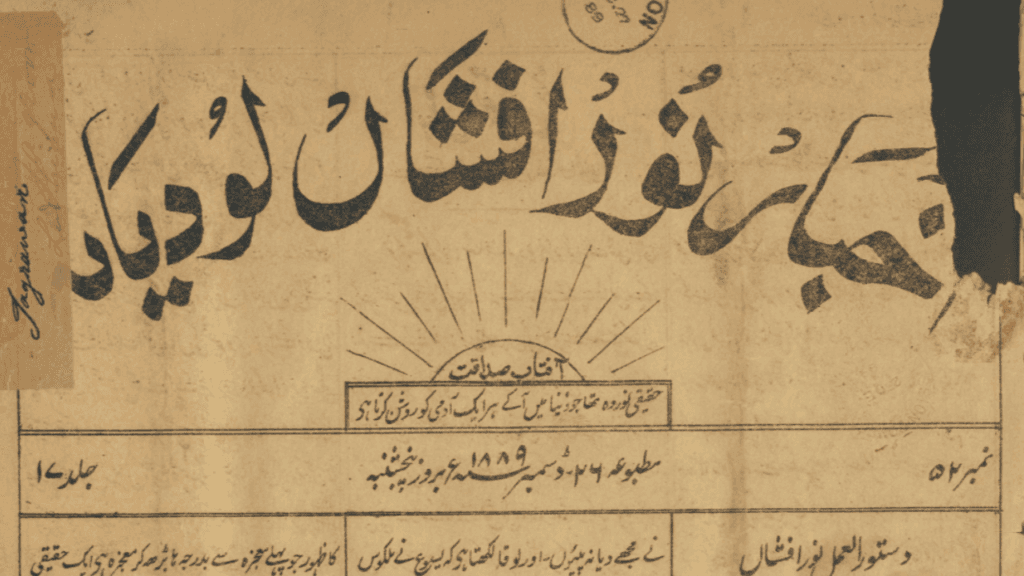
MGA had a long history with the Nur Afshan magazine (a Christian magazine). Nur-i-Afshan, an Urdu language periodical published by the Presbyterian Mission in the Punjab, from 1873 to 1944, from various places of pre-partition India including Ludhiana, Ambala and Lahore. Sometimes published weekly, and other times bi-monthly, Nur-i-Afshan, was a multifaceted news magazine and carried local and international news summaries, government postings, commodity prices, and advertisements, but also opinion articles, essays, proverbs, and poems. The gazette’s acceptance of unsolicited articles and editorial commitment to present contrasting perspectives fostered an early form of ‘information commons’ that was different in style and format to the Urdu and English newspapers that developed during this same period.
The Ewing Memorial Library of the Forman College (A Chartered University) holds Nur-i-Afshan back file from Vol.1 to Vol 73 published in 1944. Details about its discontinuation or further publishing or any additional volumes, is not available. The periodical was mainly published in Urdu with some volumes and supplements in English. However, in year 1897, this was published in Urdu and English simultaneously with different volume numbers. This practice continued till 1908. We have English only versions for the period 1902-03. The missing volumes from Ewing Memorial Library collection are: vol 2-1874, vol 14-1886, vol 16-1888, vols 20-21-1892-93, vol 5-1901 (Eng ver), vol 36-1908, vol 43-1915, vols 47-49- 1919-21, vol 51-1923, vol 56-1928, vol 60-1932, vol 64-1936, vol 68-1940 and vol 71-1943. Total count of the scanned images in this collection is 31401 and total size is 2794 GB. Extent of original material: 1 Weekly News Magazine (61 Volumes available).
The Nur-i-Afshan(نور افشاں) was a Christian weekly from Ludhiana, that:
- tracked the career of Mirza Ghulam Ahmad
- critically reviewed the publications of Mirza Ghulam Ahmad
- took a role in the Abdullah Atham saga
- published articles and letters related to the Muhammadi Begum affair
- was generally involved in the religious debates of the Punjab at the time
Scans of the original paper that are relevant to this site are being reproduced below:

Review of Braheen, Part 4, Page 2

Review of Braheen, Part 4, Page 1

_____________________________________________________________________________________________
1882
(Nur-i-Afshan, 12 October 1882, Vol. 10, No. 41, pp. 323-324)
Hazrat Ahmad’s claim to be the Promised Messiah and opposition from the religious clergy and press (alhakam.org)
It is interesting to mention here that the Christian newspaper Nur-i-Afshan of Ludhiana published an article and mentioned that there are some who say that the second coming of the Messiah will be spiritual, not physical. The article then goes on to present the opposite perspective.
Second Coming of the Messiah: Physical or Spiritual?

______________________________________________________________________________________________
1883
(Nur-i-Afshan, 20 December 1883, Vol. 11, No. 51, pp. 403-404)
Hazrat Ahmad’s claim to be the Promised Messiah and opposition from the religious clergy and press (alhakam.org)
The Nur-i-Afshan published an article, titled “Terahwin Sadi ka Ikhtitaam aur Maujooda Islam” – Conclusion of the 13th century and contemporary Islam.
The article stated that it was a very important day in Islam; the 13th century had concluded according to the Muslim lunar calendar. The next day would be the first of Muharram and the 14th century would commence.

The article stated that the Muslims were awaiting the conclusion of this era and had many hopes for the upcoming one. It mentioned that the Muslims also believed that after the conclusion of this era, a messenger and Mahdi would appear, purify Islam and defeat Christianity.
The article said that the Muslims, however, turned their attention towards certain temporal hopes and aspirations and it was as if they had forgotten the hopes regarding the 14th century.
_____________________________________________________________________________________________
1885
Hazrat Ahmad’s claim to be the Promised Messiah and opposition from the religious clergy and press (alhakam.org)
Response from Rev. Imaduddin
On 19 March 1885, a Christian newspaper, Nur-i-Afshan of Ludhiana, published an article by a Christian missionary Imaduddin, under the heading “Jawaab Ishtihar Maulvi Ghulam Ahmad Sahib Raees-e-Qadian Zila Gurdaspur” – Response to the announcement of Maulvi Ghulam Ahmad Sahib, Chief of Qadian, District Gurdaspur – in which he stated:

“The said Maulvi Sahib has sent that registered ishtihar to me as well. I am publishing its short response in Nur-i-Afshan so that all people may be aware of my response. The gist of that ishtihar is that the religion of Islam and Quran is from God. If anyone has any doubt about this, they ought to come to the Maulvi Sahib and stay for a year, during which he would manifest some miracles testifying to the truthfulness of Islam. In case of witnessing it, the visitor would become a Muslim, otherwise, leave after receiving a settled amount of money. And that God has informed him that the people who would not pay heed to the Truth after receiving the letter would be guilty, dumbfounded and defeated. He published this ishtihar in Urdu and English and sent it to the missionaries in both India and England. My response is that we are not only undoubtful about the truthfulness or untruthfulness of Islam, but also have a firm belief that Islam and the Quran are not from God at all. We are claimants of its untruthfulness, instead of having any doubt about it, as to come to you to alleviate it.” (Nur-i-Afshan, 19 March 1885, Vol. 13, No. 12, p. 95)
He further mentioned Barahin-e-Ahmadiyya and said that it had nothing which needed to be pondered over. He then mocked Hazrat Ahmadas and his claims, as is the practice of opponents of all Appointees of Allah the Almighty, and used foul language as well. (Ibid.)
Response from Rev. GL Thakur Das
Then, on 2 April 1885, the same newspaper published an article by another missionary, GL Thakur Das, under the heading “Jawaab Ishtihar Janaab Mirza Ghulam Ahmad Sahib Raees-e-Qadian Gurdaspur” – Response to the announcement of Respected Mirza Ghulam Ahmad Sahib, Chief of Qadian, Gurdaspur. The author wrote:

“The letter and ishtihar about Barahin-e-Ahmadiyya, both in Urdu and English, from respected Mirza Sahib has reached my humble self as well. He has sought a nice method to publicise Barahin-e-Ahmadiyya. Mirza Sahib has made the following claims in those writings:
“Firstly that he has been appointed as the Reformer of this Age, in likeness to the Messiah, so that he could reform the morals of mankind, and that his spiritual attributes are similar to those of Jesus Christ. Moreover, he has been granted a higher status than other auliya, who came before him, due to his obedience to Muhammad[sa] Sahib, and hence, in his obedience is goodness and harm in opposition.
“Secondly, the objective behind his divine appointment is to inform mankind that there is only one religion in accordance with the Will of God, meaning Islam, and Al-Quran is His Word.
“Thirdly, to prove these two promises, he has authored Barahin-e-Ahmadiyya, after having revelation from God Almighty and being appointed by Him, and there is a reward of 10,000 rupees for refuting it.
“Fourthly, anyone who is doubtful about the truthfulness of Islam, may come to Qadian and stay there with him for a year and witness miracles, and come with an intention to accept Islam.” (Nur-i-Afshan, 2 April 1885, Vol. 13, No. 14, pp. 107-108)
He then goes on to object to the arguments presented in Barahin-e-Ahmadiyya and uses foul language against Hazrat Ahmadas. (Ibid.)
Response from Rev. Abdullah Athim
On 16 April 1885, the same newspaper published a letter from Abdullah Athim, under the heading “Aik Zuroori Khat” – An important letter – in which he wrote:

“Mirza Ghulam Ahmad Sahib, Chief of Qadian, has claimed to manifest his signs under the banner of Islam, provided one ponders over him [i.e., his claims] with the condition of accepting Islam [upon witnessing the truth], and about this he has published announcements in Urdu and English and sent far and wide. And he has also cautioned that anyone who would not accept this challenge of Mirza Sahib, would be defeated. Now, I wish that you also publish whatever has ‘settled’ between me and Mirza Sahib, I will be thankful to you.” (Ibid., No. 16, p. 124)
He then elaborated on the said ‘settlement’ and stated that Mirza Sahib has ‘agreed’ for him to present three objections to the teachings of the Holy Quran, and said that if Mirza Sahib refutes all these objections and manifest a sign, he would accept the Holy Quran to be the Word of God.
He further wrote:
“I firmly believe that the claim of Mirza Sahib about manifesting a sign is in fact based merely on a hidden strategy and is not truthful. Moreover, I cannot acknowledge a faith which is miracle-seeking or based on a certain criterion to be a [true] faith, by compromising my principles. And Mirza Sahib does not agree to manifest a sign unconditionally, thus, I would wait for myself to be defeated if he does not fulfil my conditions, since, at last, I will surely overcome him.” (Ibid., pp. 124-125)
In later years, it was clear as to who stood victorious and who got defeated. There is not much space to narrate all those details here, however, the historical facts speak for themselves.
Another point that must be noted here is that, firstly, he did not agree with the method proposed by Hazrat Ahmadas in seeking the truth, and secondly, the objections raised by Athim against the Holy Quran have been dealt with and refuted by Hazrat Ahmadas in his multiple books written in the later years, and obviously in his early work Barahin-e-Ahmadiyya as well. He has always highlighted the magnificence and perfection of the Holy Quran.
The editor wrote a note at the end that they have published the responses from the above-mentioned three Christian missionaries and are receiving many more as well. However, he appealed that no more letters be sent, as he asserted, that Mirza Sahib was publicising his book through these announcements. (Ibid., p. 125)

These Christian missionaries did not truly accept the challenge posed by Hazrat Ahmadas and refrained from seeking the truth in accordance with the method suggested by Hazrat Ahmadas. Though a few clergymen, like Indarman Moradabadi and Pandit Lekhram, initially showed a willingness to accept the challenge, the later incidents exposed their real intentions.
For more details on this whole episode, see Tarikh-e-Ahmadiyyat, Vol. 1, pp. 253-264, and Chapter 8 of Life of Ahmadas.
______________________________________________________________________________________________
1887
Nur-i-Afshan, 20 January 1887, p. 4
A Christian missionary, Rev. GL Thakur Das, wrote in his review on Barahin-e-Ahmadiyya:
“Mirza Ghulam Ahmad Sahib proves Muhammad Sahib to be the Best among all other prophets in the following way….”
Scan

In its 21 April 1887 issue, Nur-i-Afshan wrote, “The review on Barahin-e-Ahmadiyya has now concluded, let’s see what Mirza Sahib responds to it.” (Ibid., 21 April 1887, p. 3).
A Christian newspaper, Nur-i-Afshan of Ludhiana, published a review on the Promised Messiah’s book Surma-e-Chashm-e-Arya, titled “Risala Surma-e-Chashm-e-Arya” which stated:

“This magazine has recently been written by Mirza Ghulam Ahmad Sahib[as] — author of Barahin-e-Ahmadiyya — with great research and thoughtfulness. If one desires to acquaint themselves with the true reality and nature of beliefs professed by the Arya Samajists and the reality of their Vedas, there is no better way than to read the magazine Surma-e-Chashm-e-Arya from start to end. This magazine has truly exposed the Arya Samajists, and in such a manner that as if this religion has been effaced. Along with this magazine, the author has also included an announcement for a reward of 500 rupees, with the object that in case a refutation is published and Lala Jeevan Das Sahib — who is very prominent among the Arya Samajists in Lahore [Secretary Arya Samaj Lahore] — testifies on oath to the validity and truthfulness of the given refutation, then without any hesitation, 500 rupees would be awarded to the refuter. SubhanAllah [Holy is Allah], how immense purity is this that a reward of such a huge amount is being promised, relying on the oath of the opponent himself. O Arya Smajists! Where are you now? Did you not read the concluding announcement of Surma-e-Chashm-e-Arya? In that, you have been invited to write a refutation of this magazine if you consider the Arya beliefs to be truthful and get a reward of 500 rupees in return. So, O ye who possess jealousy for the Arya Samaj! If you really believe that all those beliefs are true which have been taught to you by Dayanand Sahib, then you ought to manifest the truthfulness of those beliefs by writing a refutation of the said magazine. You should buy this magazine as soon as possible which is available in 1 rupee and 12 annas, excluding tax, or get it from somewhere else and purify Vedas from these objections which are believed by every sensible person that they cannot be alleviated. We ourselves have read this magazine from start to end and we believe, on merits of justice and truthfulness, that in our view, it is not possible at all for anyone to write a refutation to even a single argument from such perfect and decisive arguments. Moreover, we are really anticipating to witness as to how Jeevan Das Sahib could compromise his natural truthfulness, faith and mercifulness, for the sake of Vedas and his community, by taking an oath. And if he refrains from testifying on oath to the truthfulness of that refutation, then this very fact would be a huge proof that he has considered that refutation to be inferior, invalid and false. If one writes a refutation and does not want to prove its truthfulness through the testimony on oath by Lala Jeevan Das, then it makes that person dishonest, as if they do not even trust the prominent leader of their community. Anyway, in our view, there is a huge burden on the shoulders of Lala Jeevan Das Sahib, and undoubtedly, he would be nowadays subject to exceeding distress and agony, and in reality, this is the first trial to assess his natural truthfulness which has been arranged by the act of God Almighty. Is it possible for any wise, honest and just person to testify on oath to each and every teaching of Pandit Dayanand? Not at all.” (Nur-i-Afshan, 6 January 1887, p. 4).
_____________________________________________________________________________________________
1888
See Dard, page 172
See Nur Afshan of 10 May 1888 and pages 2 and 3,
“Ainah Kamalate Islam, online English edition, page 319
https://files.alislam.cloud/pdf/Mirror-of-Excellences-of-Islam.pdf
In 1888, Mirza Ahmad Baig met with MGA and asked MGA to sign over “lucrative” property rights which belonged to MGA’s cousin, Mirza Ghulam Hussain, who’s son, Mirza Ghulam Haider had went missing around 1865 and was co-incidentally married to Mirza Ahmad Baig’s sister. MGA responded by asking to marry Mirza Ahmad Baig’s 13-14-year old daughter, Mirza Ahmad Baig immediately refused. This kicked off a public war wherein the entire Mirza family was opposed to MGA. In fact, it is not too far-fetched to say that the life and career of MGA was shaped by his love of Muhammadi Begum. Birth of sons, death threats against others, Batalvi feud, Christian feud (Christian paper published letters to Muhammadi Begum family) which led to the Atham saga, which then led to the maseel maseeh and maseeh mauood stuff. MGA kept upping the ante. The whole ‘promised son’ seems like a ruse to get Muhammadi Begum’s dad interested in him, implying that if Muhammadi Begum marries MGA, the son would be the inheritor to all of his spiritual and worldly legacy.
_____________________________________________________________________________________________
1890
Anti-Islam rhetoric before and after Surma-e-Chashm-e-Arya: A glimpse into the Indian press (alhakam.org)
On 2 January 1890, Nur-i-Afshan published a remark by a person named Waiz, about the review on Barahin-e-Ahmadiyya by GL Thakur Das. The author used inappropriate words and wrote:
“The respected missionary dealt with only that part wherein Mirza [Ghulam Ahmadas] has presented arguments on Muhammad[sa] being a truthful prophet. […]
“Those who consider Mirza to be a mujaddid and a messenger, and deem Barahin-e-Ahmadiyya to be the completion of proof on his prophethood, for instance, some unwise individuals from Ludhiana and Batala, ought to kindly read this review as well.” (Nur-i-Afshan, 2 January 1890, p. 5).
_____________________________________________________________________________________________
1891
Hazrat Ahmad’s claim to be the Promised Messiah and opposition from the religious clergy and press (alhakam.org)
This article was then mentioned by the Akhbar-i-’Am of 19 January 1891 as well. The Nur-i-Afshan of 29 January 1891 mentioned the article of Akhbar-i-’Am and used inappropriate comments:
“Akhbar-i-’Am of 19 January narrates that ‘Mirza Ghulam Ahmad Qadiani is a strange man. According to a newspaper of Moradabad, he claims to be the Promised Messiah. He also says that its preaching to the whole world is incumbent upon him. He has written this in a book, which he has authored and published, entitled Fath-e-Islam. We call the attention of the Nur-i-Afshan newspaper to deal with Mirza Sahib.’” (Nur-i-Afshan, 29 January 1891, p. 2)

The Nur-i-Afshan went on to use inappropriate language against the Promised Messiahas and said that according to the Gospels, his claim is false. (Ibid.)
Response from GL Thakur Das

On 11 June 1891, Nur-i-Afshan of Ludhiana published an article by GL Thakur Das, titled “Jawaab Ishtihar Mirza Ghulam Ahmad Sahib Qadiani” — Response to the announcement of Mirza Ghulam Ahmad Sahib Qadiani, in which he, as his practice, used foul language and mocked the Promised Messiah’sas claims and revelations. (Nur-i-Afshan, 11 June 1891, pp. 6-7)
An article by Safir-e-Deccan quoted in Nur-i-Afshan
On 25 June 1891, the Nur-i-Afshan of Ludhiana published an article and wrote:

“Safir-e-Deccan has published the views of Mirza Mohid — owner of the Akhbar Wazir-e-Hind — in regards to the Promised Messiah which he wrote in his newspaper, with amazement and wonder, titled ‘Khushkhabri-e-Masih-uz-Zaman’ [glad tiding of the Messiah of the Age], and we too, upon reading it completely, regretted upon the Muslims who believe in certain things hurriedly. Mirza Mohid Sahib wishes for all followers of Islam to accept [Hazrat Mirza Ghulam Ahmad Sahibas] Qadiani as the Promised Messiah. This is the right of Mohid Sahib and the followers of Islam, however, the point which Mohid Sahib has mentioned in his said article that ‘God Almighty sent Masih Ibn Maryam in the world in accordance with His promise, the oppressor Jews put Messiah on the cross and caused his death and he departed to the heaven, and now enjoying the cool breeze of the garden [heaven].’ This is neither the teaching of the Holy Quran and Islam, nor Qadiani Sahib is a believer of the Messiah’s death on the cross. I inquired from Qadiani Sahib that you profess the death of the Messiah against the consensus of Islam, please tell us as to what type of death he had. In response, he recited the Quranic verse: اِنِّیۡ مُتَوَفِّیۡکَ وَرَافِعُکَ اِلَیَّ [I shall cause thee to die a natural death, and shall exalt thee to Myself (Surah Aal-e-Imran, Ch. 3: V. 56)] and said that his death is proven from this verse, and he would have passed away naturally due to an illness.’ It clarifies that Qadiani Sahib does not accept the Messiah’s death on the cross. Mohid Sahib should make him believe in the Messiah’s death on the cross and then advise the Muslims to believe in him. Currently, there is a difference between the statement of the claimant and the witness. It is not a matter of any wonder that Mirza Mohid Sahib and some of his like-minded people are ready to obey and support Qadiani Sahib by accepting him as the Promised Messiah, since such people are always in practice of believing in unauthentic recipients of revelations. Particularly, in a situation when Qadiani Sahib is against the notion of death on the cross, atonement and divinity of the Messiah, and states:
بعد از خدا بعشقِ محمد مخمّرم
گر کفر ایں بود بخدا سخت کافرم
“[Next to God, I am inebriated with the love of Muhammadsa; if this be disbelief, then by God I am a great disbeliever. (Lecture Sialkot [English], p. 69)]
ہر تار و پود من بسرایَد بعشقِ اُو
از خود تہی و از غم آں دلستان پُرم
“Hence, the Muslims require and like this kind of Messiah who is against the notion of the Messiah’s divinity and death as an atonement, and lover and devotee of Muhammad Sahib.”
He then quoted a verse from the Gospel (1 John, 4:1).
He continued:
“The Akhbar As-Siddiq of Ferozepur has also published a Persian poem of Qadiani Sahib, from which we have quoted the couplets above, and promised that they would express their view on the claim of Qadiani Sahib in an appropriate manner, as far as they have understood it.” (Nur-i-Afshan, 25 June 1891, pp. 1-2)

Another article by a missionary
In the same issue, another article was published written by a missionary named Jaimal Singh of Khanna, district Ludhiana. He wrote that for a long time, Mirza Ghulam Ahmad Sahib[as] Qadiani has been claiming to be the recipient of revelation and nowadays staying in Ludhiana and publishing announcements from there, addressing Muslims and Christians. His claim is now to be the Messiah and the likeness of Jesus.
The tone of this article was very harsh and abusive. (Ibid., pp. 5-6)
_____________________________________________________________________________________________
1908
MGA’s death
The Nur Afshan
Ludhiana, June-5th, 1908
The Nur Afshan
Ludhiana, June-12th, 1908
Dowie was mentioned.

_____________________________________________________________________________________________
Nur Afshan About Surma Chashm Arya : Free Download, Borrow, and Streaming : Internet Archive
Nur-i-Afshan, an Urdu language periodical published by the Presbyterian Mission in the Punjab, from 1873 to 1944, from various places of pre-partition India including Ludhiana, Ambala and Lahore. Sometimes published weekly, and other times bi-monthly, Nur-i-Afshan, was a multifaceted news magazine and carried local and international news summaries, government postings, commodity prices, and advertisements, but also opinion articles, essays, proverbs, and poems. The gazette’s acceptance of unsolicited articles and editorial commitment to present contrasting perspectives fostered an early form of ‘information commons’ that was different in style and format to the Urdu and English newspapers that developed during this same period. The Ewing Memorial Library of the Forman College (A Chartered University) holds Nur-i-Afshan back file from Vol.1 to Vol 73 published in 1944. Details about its discontinution or futher publishing or any additional volumes, is not available. The periodical was mainly published in Urdu with some volumes and supplements in Eglish. However, in year 1897, this was published in Urdu and English simultaneously with different volume numbers. This practice continued till 1908. We have English only versions for the period 1902-03. The missing volumes from Ewing Memorial Library collection are: vol 2-1874, vol 14-1886, vol 16-1888, vols 20-21-1892-93, vol 5-1901 (Eng ver), vol 36-1908, vol 43-1915, vols 47-49- 1919-21, vol 51-1923, vol 56-1928, vol 60-1932, vol 64-1936, vol 68-1940 and vol 71-1943. Total count of the scanned images in this collection is 31401 and total size is 2794 GB. Extent of original material: 1 Weekly News Magazine (61 Volumes available).
______________________________________________________________________________________________
Anti-Islam rhetoric before and after Surma-e-Chashm-e-Arya: A glimpse into the Indian press (alhakam.org)
Anti-Islam rhetoric before and after Surma-e-Chashm-e-Arya: A glimpse into the Indian press
Ata-ul-Haye Nasir, Al Hakam

In the late 1870s and early 1880s, the Arya Samajists were running a malicious campaign against Islam in which they were objecting to the teachings of the Holy Quran, mocking the miracles mentioned therein, and attempting to malign the blessed character of the Holy Prophet Muhammadsa.
At that juncture, Hazrat Mirza Ghulam Ahmadas of Qadian undertook to defend the miracles mentioned in the Holy Quran, particularly the splitting of the moon, and to prove its magnificence. Thus, he penned Surma-e-Chashm-e-Arya.
Announcement by Riaz-i-Hind

This book was published from the Riaz-i-Hind Press in Amritsar. While it was being printed, the newspaper Riaz-i-Hind of Amritsar announced:
“Risala Surma-e-Chashm-e-Arya: The printing of this magazine, written by Mirza Ghulam Ahmad Sahib — author of Barahin-e-Ahmadiyya — has commenced in this press. It is hoped that it will be completed by the holy month of Ramadan and available for the public to read, and the Risala Siraj-ul-Munir will be printed without any delay.” (Riaz-i-Hind, 14 June 1886, Vol. 1, No. 34, p. 268)
The same announcement was published on 21 June 1886 as well.
What’s in the book?

This book carries the details of a debate between Hazrat Ahmadas and Lala Murli Dhar, Drawing Master (an Arya Samajist), which took place on 11 to 14 March 1886. At the end of the book, Huzooras invited the whole of the Arya Samaj to a comparative study of the Vedas and the Holy Quran and then suggested another way of settling the dispute by engaging in a Mubahalah (Prayer Duel). Hazrat Ahmadas extended an invitation to the non-Muslims to come to Qadian so that he might show them heavenly signs in favour of Islam and he offered to bear all the expenses for anyone who was prepared to come to Qadian and stay for at least 40 days.
Reaction: Praise and opposition
In the beginning, the Muslim clerics would praise Hazrat Ahmad’sas services for Islam and consider him a great defender of the Islamic faith. When he wrote Surma-e-Chashm-e-Arya in 1886, not only the Muslim clerics, but even the Christian press too commended his work, for instance, Nur-i-Afshan of Ludhiana wrote a review on 6 January 1887 and Maulvi Muhammad Hussain Batalwi published a review in his magazine Ishaat-us-Sunnah (Vol. 9, Number 5, pp. 145-158). Their details shall be presented later in this article.
In his book, while defending the teachings of the Holy Quran and proving the validity of the miracles mentioned therein, Hazrat Ahmadas also questioned certain beliefs of the Arya Samaj which they would attribute to their holy scripture, i.e., the Vedas. This turned them furious and they began to attack Islam more vigorously and falsely alleged Hazrat Ahmadas for initiating controversies between Arya Samaj and Islam.
However, the truth is that Hazrat Ahmadas merely defended Islamic teachings in response to the disrespectful attacks by the Arya Samaj, and showed them their own face in light of the beliefs which they proudly professed. These controversies were, in fact, initiated by the Arya Samajists themselves, even before Hazrat Ahmadas wrote Barahin-e-Ahmadiyya.
Hence, before mentioning the details regarding Surma-e-Chashm-e-Arya it is important to briefly state its background and the attacks on Islam from the Arya Samajists and the Christians.
Arya Samaj’s attacks on Islam before Barahin-e-Ahmadiyya
Hazrat Ahmadas published an announcement in May 1879, wherein he told the world about the objective of writing Barahin-e-Ahmadiyya, and said that the reason behind this book was that Pandit Dayanand, the founder of Arya Samaj had disrespected the Holy Prophet Muhammadsa, Mosesas and Jesusas, and declared the Holy Quran and Bible to be untruthful. (Majmu‘ah-e-Ishtiharat [2019], Vol. 1, pp. 19-20)
In this regard, Bob van der Linden – a historian of South Asia and global history – states:
“Although the main targets of Swami Dayanand Saraswati were orthodox Hindu practices and Christianity, he dedicated more space in his Satyarth Prakash to attack Islam than any other tradition. He further contributed to anti-Islamic agitation when he published” his work “Gokarunanidhi (1880), interestingly based on economic rather than spiritual grounds. […]
“In turn, importantly, large portions of Mirza Ghulam Ahmad’s[as] Barahin-i-Ahmadiyah argued systematically against the statements of the Arya Samaj, especially as proclaimed by Dayanand in the Satyarth Prakash. In fact, he even wrote a letter to Saraswati offering him to send a copy of the Barahin-i-Ahmadiyah to debate the truth of Islam and its superiority over Hinduism. Dayanand however did not respond and sometime later Ghulam Ahmad[as] reported a dream (as he regularly did) in which he saw Dayanand dying (as happened soon afterwards). Before that time, nonetheless, Ahmadiyahs already were considered major enemies of Punjabi Aryas, resulting in the fierce polemic relationship between Pandit Lekh Ram and Mirza Ghulam Ahmad[as].” (Tradition, rationality and social consciousness: The Singh Sabha, Arya Samaj and Ahmadiyah – Moral languages from colonial Punjab [2004], University of Amsterdam, p. 165)
Anti-Islam rhetoric from the Christian and Arya clergy in 1880s
In the 1880s, the attacks on Islam from the Christian and Arya clergy were on the rise. Due to the fact that the opponents of Islam were unable to refute the arguments presented by Hazrat Ahmadas in Barahin-e-Ahmadiyya to prove the truthfulness and magnificence of Islam. They left no stone unturned in opposing Hazrat Ahmadas in an effort to veil the greatness of Islam proved by this champion of Islam and the servant of the Holy Prophet Muhammadsa.

Attacks on the Holy Quran and Holy Prophetsa by Nur-i-Afshan
On 27 May 1880, a series of articles commenced in Nur-i-Afshan of Ludhiana, by Rev. GL Thakur Das, titled “Adam Zuroorat-e-Quran” – The Redundancy of the Quran – in which he asserted that there was no need for the Quranic teachings as the other scriptures, particularly Bible, were enough for mankind’s guidance at all times. He implied that the Quranic teachings were imperfect and not compatible with every era.
Moreover, another series of articles were published by the same newspaper, titled “Wasiyyat-Nama Hazrat Muhammad Sahib” – The Will of Hazrat Muhammad Sahib (referring to the Hadith-e-Qirtas) in which the author asserted that the teaching brought by the Holy Prophetsa was not perfect and wrote on 9 February 1882 that, God forbid, the Holy Prophetsa was doubtful about the Holy Quran being the Word of God and asserted that he did not manifested any sign and miracle in reality. The author mentioned the miracle of the splitting of the moon as well.

A challenge in 1885
In March 1885, Hazrat Ahmadas gave a challenge and invited people of all religions and walks of life, both in India and the West, to stay at Qadian for a year in order to witness the signs in favour of the truthfulness of Islam. However, no one had the courage to truly accept this challenge, though a few clerics showed interest in the beginning but the later incidents exposed their real intentions.
For more details on this, see “Hazrat Ahmad’s claim to be the Promised Messiah and opposition from the religious clergy and press”, at alhakam.org (19 April 2024).
In Surma-e-Chashm-e-Arya, Hazrat Ahmadas shortened the time period to 40 days, inviting the religious clergy once again, including Lekhram, Athim, Imaduddin, Thakur Das, and Jeevan Das, and wrote that instead of one year, they should stay at Qadian for 40 days to witness a sign in favour of Islam, and in case no such sign is manifested, they would be rewarded 500 rupees. (Surma-e-Chashm-e-Arya, Ruhani Khazain, Vol. 2, pp. 309-310)
Demand for a sign from the Arya Samajists
The assaults on Islam and the noble character of the Holy Prophetsa were in full force. The Christian missionaries were exhausting all efforts to defame Islam and the opposition of the Arya Samaj saw no end.
The Arya Samajists, like Indarman Moradabadi and Lekhram were demanding for a sign to be manifested to prove the truthfulness of Islam, hence, Hazrat Ahmadas supplicated to Allah the Almighty in Hoshiarpur for 40 nights in seclusion, seeking Divine manifestation. (“Forty nights of seclusion”, alhakam.org, 19 February 2021)
Mentioning this demand for a sign, Hazrat Musleh-e-Maudra stated during an address in Lahore on 12 March 1944:
“The Promised Messiahas has written that at that time, allegations were being levelled against Islam that it did not possess any power to show any signs. Hence, Pandit Lekhram was claiming that if Islam was a true faith, then a sign should be shown. Indarman Moradabadi was raising the same objection that if Islam was a true faith, then demonstrate a sign. Thus, the Promised Messiahas prostrated before Allah the Almighty and supplicated: ‘O my Lord! Demonstrate a sign that convinces these people of Islam who seek a sign. Show such a sign which would convince people like Indarman Moradabadi about Islam.’” (“‘God has declared me the Promised Son’: Glimpse into Hazrat Musleh-e-Maud’s speeches of 1944 in Hoshiarpur, Lahore, Ludhiana, and Delhi”, alhakam.org, 16 February 2024)
The Prophecy about the Promised Son
Thereafter, on 20 February 1886, Hazrat Ahmadas published an ishtihar, titled “Risala Siraj-e-Munir Mushtamil bar Nishaan-Haaey Rabb-e-Qadeer”, in which he mentioned a glad tiding which he received from God Almighty about a son. (Majmu‘ah-e-Ishtiharat [2019], Vol. 1, pp. 121-127)
Mentioning this ishtihar, the Sahifa-i-Qudsi of Delhi wrote an article on 4 March 1886, about which the Indian Newspaper Reports stated under the heading “So-called prophecies by one Ghulam Ahmad, Punjab”:

“The Sahifa-i-Qudsi (Delhi), of the 4th March, publishes a communication from one Ghulam Ahmad at Hoshiarpur, who is a native of Kadian, Gurdaspur, and has long carried on religious discussions with the Arya Samaj. The writer says that he will shortly publish a book under the name of Siraj-i-Munir, i.e., the Splendid Lamp, which will convince people of the truth of the Muhammadan religion. The book will contain prophecies relating to (1) the writer and his family, (2) his friends and some other persons, and (3) the leading members of the Arya Samaj, such as Munshi Indarman of Moradabad, Pandit Lekhram of Peshawar, &c., and some Hindus of Kadian. The writer is very desirous that God may also make some revelations to him regarding the triumph over Russia of the British Government, which has granted full liberty, peace, and security to the people, and remarks that if any such revelations are received, they will be inserted in the book. In conclusion, Ghulam Ahmad gives an account of one of the prophecies of the first class as an instance. God has promised him a handsome, noble, and learned son who will make miraculous cures, release prisoners, and make four of three, and his fame will spread far and wide. The revelation as to four being made of three by the son is not intelligible to the writer.” (Selections from the Vernacular Newspapers, 1886, pp. 203-204)
Riaz-e-Hind’s article and its supplement
On 1 March 1886, the Riaz-i-Hind wrote under the heading “Risala Siraj-ul-Munir, Musannafa Mirza Ghulam Ahmad Sahib Raees-e-Qadian”:

“Mirza Sahib’s evident characteristics and spiritual magnificence are far greater than what we can write here in our humble paper to commend it. The beautiful and apt way in which he has defended the religion of Islam and presented irrefutable arguments and clear proofs in proving the Truth, compells us to say that in terms of simplicity [salasat] and excellence of writing, he has surpassed the writings of the ulema of the past and the coming times. Hence, those who have read Mirza Sahib’s book Barahin-e-Ahmadiyya, would undoubtedly agree with us in this matter. Despite the fact that the said book has been advertised for many years and announcements for a reward of 10,000 rupees were also published for anyone who could respond to it, the opponents of Islam and those who are doubtful about the prophethood [nabuwwah] could not have the courage to step into the field of truthfulness to receive this reward. Mirza Sahib did not merely rely on written questions and answers [i.e., books in response to each other] and published special announcements in Urdu and English and circulated them in all the major cities of India and the major countries of Europe and America, so that anyone who is doubtful about Islam being from God and Muhammad[sa] Sahib being the truthful prophet, and are not satisfied with reading the [arguments presented in various] books, ought to stay with him for one year and witness the heavenly signs from their own eyes and consequently accept Islam. In case of the absence of any heavenly signs, they could receive 200 rupees per month in accordance with his capacity for the expenditures of the whole year on food and travel fares. However, when he had no response to this, and the waiting period crossed a limit, he began writing this magazine. In the beginning, the author has mentioned all the prophecies which are yet to be fulfilled and has divided them into three categories: (1) In relation to his own self (2) In relation to his friends (3) In relation to the preachers of the other religions. Hence, the gist of this magazine, which is in fact the preface [muqaddamah] of the book, has been sent to us by the author, and it will be published as a supplement at the end of this issue. The complete details could only be known upon reading it fully.” (Riaz-i-Hind, 1 March 1886, p. 138)
Hence, that gist was then reproduced in the supplement of this issue of Riaz-i-Hind.

Rev. GL Thakur Das and Barahin-e-Ahmadiyya, 1886-87
In 1886-1887, the Christian newspaper Nur-i-Afshan of Ludhiana published a series of articles by Rev. GL Thakur Das, in which he objected to the arguments presented by Hazrat Ahmadas in defence of Islam in his book Barahin-e-Ahmadiyya. This series consisted of five parts, which concluded on 14 April 1887.
GL Thakur Das was one of the three Christian missionaries who were settled upon to assist Deputy Abdullah Athim during the between the Promised Messiahas Abdullah Athim, published as Jang-e-Muqaddas. (The Holy War [Jang-e-Muqaddas], p. 3)
GL Thakur Das, in his articles, attempted to malign the beautiful teachings of Islam, the majesty of the Holy Quran, and the blessed character of the Holy Prophetsa. The tone of these articles was very harsh and abusive towards Hazrat Ahmadas as well.
The opponents of Ahmadiyyat must ponder here that Hazrat Mirza Ghulam Ahmadas was facing these reactions and vile language in return for his efforts to prove the magnificence of Islam and the blessed character of the Holy Prophet Muhammadsa.
For instance, in the fourth part of this review, the author commenced in the following words:
“Mirza Ghulam Ahmad Sahib proves Muhammad Sahib to be the Best among all other prophets in the following way….” (Nur-i-Afshan, 20 January 1887, p. 4)

In its 21 April 1887 issue, Nur-i-Afshan wrote, “The review on Barahin-e-Ahmadiyya has now concluded, let’s see what Mirza Sahib responds to it.” (Ibid., 21 April 1887, p. 3)
The author attempted to ‘refute’ the arguments presented by Hazrat Ahmadas in defence of Islam, however, the truth is that Barahin-e-Ahmadiyya comprises unparalleled arguments which cannot be refuted by anyone.
On 2 January 1890, Nur-i-Afshan published a remark by a person named Waiz, about the review on Barahin-e-Ahmadiyya by GL Thakur Das. The author used inappropriate words and wrote:
“The respected missionary dealt with only that part wherein Mirza [Ghulam Ahmadas] has presented arguments on Muhammad[sa] being a truthful prophet. […]
“Those who consider Mirza to be a mujaddid and a messenger, and deem Barahin-e-Ahmadiyya to be the completion of proof on his prophethood, for instance, some unwise individuals from Ludhiana and Batala, ought to kindly read this review as well.” (Nur-i-Afshan, 2 January 1890, p. 5)
Surma-e-Chashm-e-Arya, challenge to Munshi Jeevan Das and Nur-i-Afshan’s review
Hazrat Ahmad’s book Surma-e-Chashm-e-Arya included an ishtihar (announcement), titled “Ishtihar Inaami Paanch So Rupiya” – An announcement for a reward of 500 rupees, in which he wrote:
“This book, meaning the Risala Surma-e-Chashm-e-Arya, has been written – at the occasion of a debate with Lala Murlidhar Sahib Drawing Master of Hoshiarpur, that completely exposes false beliefs of Vedas – with the claim and certainty that no Arya can refute [the arguments presented in] this book because falsehood has no standing in front of the truth. However, if an Arya Sahib considers all the fundamentals and beliefs of the Vedas which have been refuted in this book to be true and still considers the Vedas and such fundamentals to be established by Esher, then in the name of the same Esher, they ought to write a review on this book and get 500 rupees as a reward. These 500 rupees would be rewarded after the approval by an arbitrator, who will be a Christian missionary or a Brahmo Sahib. Moreover, I agree to the extent that once the refutation is written and published publicly, then if Munshi Jeevan Das Sahib, Secretary of the Arya Samaj Lahore – who is a more well-natured, honourable and dignified person among the Arya Sahibs of the surrounding areas – could come to a public gathering of Muslim, Arya and Christian scholars, etc., along with his beloved sons, and swears:
“‘Yes, my heart is certain that all the objections of Risala Surma-e-Chashm-e-Arya, which I have carefully read from the beginning to the end and have carefully understood, have been refuted by this writing. And if I do not say this with heartfelt satisfaction and complete truth, then its harm and disaster may fall on me in this world and on my progeny who is present at this time.’
“After swearing on such a testimony by Munshi Sahib, 500 rupees cash would be rewarded to the refuter in the same gathering. And if Munshi Sahib remained safe from the evil effects of such swearing for a year, then it would undoubtedly be a proof for the Aryas that the said person had sworn with sincerity of heart according to his knowledge and intellect.” (Majmu‘ah-e-Ishtiharat [2019], Vol. 1, pp. 151-152)
A Christian newspaper, Nur-i-Afshan of Ludhiana, published a review on the Promised Messiah’s book Surma-e-Chashm-e-Arya, titled “Risala Surma-e-Chashm-e-Arya” which stated:
“This magazine has recently been written by Mirza Ghulam Ahmad Sahib[as] — author of Barahin-e-Ahmadiyya — with great research and thoughtfulness. If one desires to acquaint themselves with the true reality and nature of beliefs professed by the Arya Samajists and the reality of their Vedas, there is no better way than to read the magazine Surma-e-Chashm-e-Arya from start to end. This magazine has truly exposed the Arya Samajists, and in such a manner that as if this religion has been effaced. Along with this magazine, the author has also included an announcement for a reward of 500 rupees, with the object that in case a refutation is published and Lala Jeevan Das Sahib — who is very prominent among the Arya Samajists in Lahore [Secretary Arya Samaj Lahore] — testifies on oath to the validity and truthfulness of the given refutation, then without any hesitation, 500 rupees would be awarded to the refuter. SubhanAllah [Holy is Allah], how immense purity is this that a reward of such a huge amount is being promised, relying on the oath of the opponent himself. O Arya Smajists! Where are you now? Did you not read the concluding announcement of Surma-e-Chashm-e-Arya? In that, you have been invited to write a refutation of this magazine if you consider the Arya beliefs to be truthful and get a reward of 500 rupees in return. So, O ye who possess jealousy for the Arya Samaj! If you really believe that all those beliefs are true which have been taught to you by Dayanand Sahib, then you ought to manifest the truthfulness of those beliefs by writing a refutation of the said magazine. You should buy this magazine as soon as possible which is available in 1 rupee and 12 annas, excluding tax, or get it from somewhere else and purify Vedas from these objections which are believed by every sensible person that they cannot be alleviated. We ourselves have read this magazine from start to end and we believe, on merits of justice and truthfulness, that in our view, it is not possible at all for anyone to write a refutation to even a single argument from such perfect and decisive arguments. Moreover, we are really anticipating to witness as to how Jeevan Das Sahib could compromise his natural truthfulness, faith and mercifulness, for the sake of Vedas and his community, by taking an oath. And if he refrains from testifying on oath to the truthfulness of that refutation, then this very fact would be a huge proof that he has considered that refutation to be inferior, invalid and false. If one writes a refutation and does not want to prove its truthfulness through the testimony on oath by Lala Jeevan Das, then it makes that person dishonest, as if they do not even trust the prominent leader of their community. Anyway, in our view, there is a huge burden on the shoulders of Lala Jeevan Das Sahib, and undoubtedly, he would be nowadays subject to exceeding distress and agony, and in reality, this is the first trial to assess his natural truthfulness which has been arranged by the act of God Almighty. Is it possible for any wise, honest and just person to testify on oath to each and every teaching of Pandit Dayanand? Not at all.” (Nur-i-Afshan, 6 January 1887, p. 4)
Review in Ishaat-us-Sunnah

Maulvi Muhammad Hussain of Batala also wrote a review of this book and published it in his magazine Ishaat-us-Sunnah. He wrote under the heading “Surma-e-Chashm-e-Arya”:
“This unmatchable book has been written by the author of Barahin-e-Ahmadiyya, Mirza Ghulam Ahmad Sahib, Chief of Qadian, which has been sent to me by the courageous author for writing a review. This includes a debate between the respected author and a member of the Arya Samaj which took place in Hoshiarpur about the miracle of splitting of the moon and the teachings of Vedas. In this debate, the respected author has proven the miracle of the splitting of the moon through historical incidents and intellectual arguments. On the other hand, he has refuted – through sufficient arguments — the teachings and beliefs of the Book of Arya Samaj, i.e., Veda, for instance reincarnation, etc. I would present to the readers some insights from that book, by presenting the actual text, instead of writing a review.” (Ishaat-us-Sunnah, Vol. 9, Number 5, pp. 145-158)
After this, he reproduced some parts from the Promised Messiah’sas book.
Comment by The Paisa Akhbar
The Paisa Akhbar of Lahore stated:
“It would not have been out of place if the Hindus – especially the Aryas – and the Christians, had stood up vigorously in opposition to Mirza Sahib[as], since all of the efforts of Mirza Sahib[as] are in support of the Muslims and against the [anti-Islam efforts of the] Aryas and Christians, as is evident from his famous works such as Barahin-e-Ahmadiyya, Surma-e-Chashm-e-Arya and later writings.” (“Promised Messiah’s 1892 visit to Lahore: A rising tide of opposition”, alhakam.org, 26 April 2024)

Shahna-e-Haqq
In its 21 April 1887 issue, Nur-i-Afshan wrote that they had received two books written by Arya Samajists, one of them being “Surma-e-Chashm-e-Arya ki haqiqat aur fan fareb Ghulam Ahmad ki kaifiyyat”. In this book, vile and abusive language was used against Hazrat Ahmadas. It was written by some Hindus of Qadian, and published from the Chashma-e-Nur Press Amritsar with the help of Pandit Lekhram. The article by Nur-i-Afshan also contained abusive language.

In response, Hazrat Ahmadas wrote Shahna-e-Haq, and refuted all those objections and false notions which were levelled against him in the above stated book. He also dealt with some points raised by Pandit Lekhram in his book Takzib Barahin-e-Ahmadiyya.
The Nur-i-Afshan then remarked on Shahna-e-Haqq, in its 26 May 1887 issue, titled “Remark Risala Shahna-e-Haqq par”, and continuing its practice, used inappropriate language and raised false allegations on Hazrat Ahmadas.
Article by Rev. Thomas Howell Bashir, 1887
On 16 June 1887, an article by Rev. Thomas Howell Bashir of Pind Dadan Khan was published under the heading “Risala Shahna-e-Haqq aur Mirza Ghulam Ahmad Sahib ka Ilhaam”, in which he objected to a revelation of Hazrat Ahmadas and used abusive language.

Thomas Howell Bashir was one of the three Christian missionaries who were settled to assist Deputy Abdullah Athim during the between the Promised Messiahas Abdullah Athim, published as Jang-e-Muqaddas. (The Holy War [Jang-e-Muqaddas], p. 3)
“On Whit-Sunday, the Bishop of Lahore held an Ordination at Simla, when Mr. Thomas Howell, a Native Agent of the C.M.S., was admitted to Holy Orders. He will be in-charge of the Jhelum Mission, Pind Dadan Khan, as a “deacon evangelist,” that is, he will not be a pastor of a congregation under the Native Church Council, but be employed directly by the Society as an evangelistic missionary.” (The Church Missionary Gleaner, Vol. 9, 1882, p. 100)
It is important to mention here that the same missionary wrote a review on Hazrat Hakeem Maulvi Noor-ud-Din’sra book Fasal-ul-Khitab li Maqaddama Ahl al-Kitab. Huzoorra wrote this book in obedience to Hazrat Mirza Ghulam Ahmad’sas instruction that he should write a book to refute the false beliefs of the Christians. (Nur-i-Afshan, 31 October 1889, pp. 2-3)

Hazrat Mufti Muhammad Sadiqra states:
“There was a priest named Thomas Howell in Pind Dadan Khan. In response to his questions, Hazrat Khalifatul Masih Ira wrote the book, ‘Fasal-ul-Khitab li Maqaddama Ahl al-Kitab.’ Thomas Howell was later posted to Lahore. When the debate between the Promised Messiahas and Padri Abdullah Athim took place in 1893 and a prophecy was made public about Athim, I wrote a letter to Priest Thomas Howell about that prophecy. In it, I stated that many debates had taken place between Muslims and Christians in the past, but that very debate had a special superiority over the others because there was a prophecy about Athim. I was in Bhera at the time of writing that letter. I also sent a copy of that letter to my honourable teacher, Hazrat Khalifatul Masih Ira who was in Qadian in those days. Hazrat Maulvi Sahibra presented my letter before the Promised Messiahas. The Promised Messiahas commended the subject of that letter and said, ‘Only Allah helps [him] to write [in such a manner].’” (Zikr-e-Habib, p. 9)
Hazrat Ahmadas inaugurated the Eid Gah in Batala, 1888

While mentioning the events of the 1880s, it will be interesting to present a news report about Eid-ul-Fitr in Batala that was published in Riaz-i-Hind of Amritsar. The report stated under the heading “Batala mein Ahl-e-Islam ki Eid-ul-Fitr”:
“On this occasion, Fakhr-e-Islam Respected Mirza Ghulam Ahmad Sahib, Chief of Qadian – who was in Batala at the time – graced the same Eid Gah. There were around 4,000 people present. […] Haji Ghulam Muhammad Sahib very eloquently read out an ishtihar [of Hazrat Ahmadas which he issued on 9 June 1888], titled ‘Paadri Weitbrecht ke liay Ittmam-e-Hujjat aur Fateh Masih ki Darogh-goie’. Following this, in accordance with the instruction from respected Mirza Ghulam Ahmad Sahib, Maulvi Muhammad Qudratullah led the congregation [in Eid prayer]. Such a great blessing was being showered upon the people who gathered there in huge number that both the common and prominent of those were stating that ‘SubhanAllah, what a nur [divine light] is descending that respected Mirza Sahib has inaugurated this Eid Gah and prayed that may God always keep it populated and may the Muslims be inclined towards the Faith.’ This occasion was a great scene of the grandeur of Islam. It was acknowledged by many prominent and experienced people that such a majestic Muslim gathering has never been witnessed previously in Batala city.” (Riaz-i-Hind, 18 June 1888, pp. 5-6)
Sabz Ishtihar [The Green Announcement], 1888
On 1 December 1888, Hazrat Ahmadas published an ishtihar on the demise of Bashir Awwal, titled “Haqqani Taqrir bar Wafaat-e-Bashir” – A Discourse upon the Demise of Bashir. Since it was published on a green paper, it is known as the “Sabz Ishtihar”, i.e. The Green Announcement. In this announcement, Huzooras said:
“In my case, however, none of the prophecies that I have made on the basis of revelation have turned out to be wrong. Divine revelation had clearly foretold the birth of two boys, and also that some of my children would die in infancy. See the announcements of 20th February 1886 and 10th July 1888. In accordance with the first prophecy, a child was born and he soon died. The second child, whom the revelation refers to as Bashir the Second, and also as Mahmood, has not been born till today, 1st December 1888. But, in accordance with God’s promise, he will most certainly be born within the time stipulated in the prophecy. Heavens and earth may pass, but the word of God can never be averted. Fools laugh at His revelations and ridicule His holy tidings because the end is hidden from their eyes.” (The Green Announcement [Sabz Ishtihar], p. 8 [footnote])
Thereafter, in accordance with the prophecy made on 20 February 1886 and the later announcements by Hazrat Ahmadas, a son was born on 12 January 1889 who was named Bashir-ud-Din Mahmud Ahmad.

Nur-i-Afshan’s response
In response, Nur-i-Afshan published an article on 31 January 1889 and, continuing its practice, mocked the prophecies and revelations of Hazrat Ahmadas. The article mentioned the birth of Hazrat Sahibzada Mirza Bashir-ud-Din Mahmud Ahmadra and wrote that Hazrat Ahmadas named him Bashir and Mahmud as a tafavul. Addressing Hazrat Ahmadas, it wrote, “Your claim to be a prophet has no proof.” (Nur-i-Afshan, 31 January 1889, p. 1)

The article also referenced the statement of Hazrat Ahmadas which he announced in an ishtihar dated 12 January 1889, titled “Takmil-e-Tabligh”, where Huzooras mentioned the birth of his son and stated that he was named Bashir and Mahmud, and that it will be announced after being categorically informed from God whether that son is the Promised Son or someone else. Huzooras wrote that it had not yet been revealed to him as to whether this son was the Musleh-e-Maud and the son who was destined to live a long life. Huzooras then mentioned the following Persian couplet which was revealed to him in relation to the Musleh-e-Maud:
اے فخر رسل قرب تو معلومم شد
دیر آمدۂ زِ راہِ دُور آمدہٖ
“O pride of the messengers! I have been made aware of your high rank in the nearness of Allah; You have come after a wait since you have come from a very far place.”
Huzooras continued:
“Hence, if in accordance with the decree of the Exalted and the Sublime God, this ‘wait’ means the amount of wait which has occurred in the birth of this son who has been named Bashir-ud-Din Mahmud as a tafavul, then it should not be a surprise if this very son is the Promised one.” (Majmu‘ah-e-Ishtiharat [2019], Vol. 1, p. 208 [footnote])
The article of Nur-i-Afshan objected that Hazrat Ahmadas refrained from mentioning any revelation in this regard. However, the answer to their objection has been given by Hazrat Ahmadas in his above-mentioned statement, that he had not yet been categorically revealed by God Almighty about this matter, and would announce upon receiving any divine information. And this is the practice of all the Prophets and Appointed Ones of Allah the Almighty.
Once Allah the Almighty revealed to him the insight on this matter, he made an announcement to the world.
An excerpt from Siraj-e-Munir
In his book Siraj-e-Munir, Hazrat Ahmadas has clearly stated:
“The fifth prophecy which I announced was in regard to the birth of my son Mahmud that he will be born and he will be named Mahmud. And this prophecy was published in the form of an announcement on a green paper that is still preserved and was distributed to thousands of people. Therefore, that son was born within the time period of the prophecy [of 1886], and has now entered his ninth year of age.” (Siraj-e-Munir, Ruhani Khazain, Vol. 12, p. 36 [footnote])
Conclusion
Hazrat Mirza Ghulam Ahmadas came to the battlefield of Jihad by Pen and for this reason, the religious clergy and the press were determined to oppose him and left no stone unturned in maligning his blessed character in their effort to veil the magnificence of Islam and the Holy Quran which were highlighted by this great champion of Islam in his writings. The opponents remained unsuccessful in all of their efforts!
The grand prophecy of 20 February 1886 was fulfilled by Allah the Almighty in 1889, which was a great sign as demanded by the opponents of Islam. Hazrat Ahmadas was blessed with the Promised Son — the Musleh-e-Maud — Hazrat Mirza Bashir-ud-Din Mahmud Ahmadra.
In March 1889, when Hazrat Ahmadas established the Ahmadiyya Muslim Jamaat and then claimed to be the Promised Messiah and Mahdi, it was as if the whole world had begun to oppose him; Christian missionaries, Arya Samajists, and even the Muslim clerics. The Muslim clerics turned into his staunch enemies, instead of joining his efforts in the service of Islam. Its details have been narrated in the following articles:
“Hazrat Ahmad’s claim to be the Promised Messiah and opposition from the religious clergy and press” (published on 19 April 2024)
“Promised Messiah’s 1892 visit to Lahore: A rising tide of opposition” (published on 26 April 2024)
This was just the beginning of an era of severe opposition, and the following years saw an unprecedented rise in the opponents’ efforts to halt his mission and to defame him. However, divine help and succour was with him at all times, hence, he continued to succeed in his mission to prove the magnificence of Islam and highlighting the blessed character of the Holy Prophet Muhammadsa.
_____________________________________________________________________________________________
‘No Faith did we find like the Faith of Muhammad’: Promised Messiah’s response to a Christian claim (alhakam.org)
‘No Faith did we find like the Faith of Muhammad’: Promised Messiah’s response to a Christian claim
Ata-ul-Haye Nasir, Al Hakam
During his concluding address at the Jalsa Salana UK 2024, Hazrat Amirul Momineenaa narrated about the Promised Messiah’sas profound love for the Holy Prophet Muhammadsa, stating it was characterised by complete self-effacement (fana) in the Holy Prophet’ssa love. Huzooraa highlighted how the Promised Messiahas set a path for attaining true love and devotion to the Holy Prophetsa, providing guidance that could enlighten even those who opposed his message. Huzooraa expressed that the ongoing opposition to the Ahmadiyya Muslim Jamaat is based on misconceptions that the Promised Messiahas, God-forbid, sought to diminish the status of the Holy Prophetsa. However, Huzooraa pointed out that these allegations stem from the self-serving motives of certain Muslim clerics.
The Promised Messiah’sas overwhelming love for Allah the Almighty and the Holy Prophetsa is evident from each and every word of his books. It is not only his prose that wears this crown, but his transcendental poetry too has the gold dust of this love on its wings.
It is sometimes thought by his opponents that the Promised Messiahas wrote poetry as worldly poets usually do, but to understand the stature of his poetics, one must know where in his works and for what reason it has occurred. In the ebb and flow of his mighty writings, on occasions when he felt that prose was not the best way to convey his message, his pen began to express his inspirations in poetic verse.
It is also asserted that since he has written poetry, he cannot be a prophet because poets are not in any way worthy of prophethood. The paragraphs above should suffice to negate such notions, however, if anyone wants further elaboration, please read our article, titled “The Promised Messiah’s usage of verse”, at alhakam.org (20 March 2020).
‘No Faith did we find like the Faith of Muhammadsa’

When we look at the Promised Messiah’sas poetry, we find that the purpose of his poetry was to proclaim the Oneness of Allah, express love for the Holy Prophetsa, draw on the Holy Quran’s beauty and the announcement of his claims.
In this article, we will endeavour to mention only one of his poetic works and to narrate its background and objective. In one of his poetic works in praise of the Holy Prophet Muhammadsa, the Promised Messiahas stated:
ہر طرف فکر کو دوڑا کے تھکایا ہم نے
کوئى دِیں دِینِ محمد سا نہ پایا ہم نے
“We wearied our mind by searching all around; No Faith did we find like the Faith of Muhammadsa.” (Aina-e-Kamalat-e-Islam, Ruhani Khazain, Vol. 5, p. 224)
In this poem, Huzooras highlighted the fact that the status which has been granted to him by Allah the Almighty, is purely due to the absolute obedience to the Holy Prophet Muhammadsa and that he is having to endure all kinds of abuses, disrespectful titles and opposition merely because he has immersed himself in the love and obedience to the Holy Prophet Muhammadsa.
This poem makes it crystal clear that the Promised Messiahas did not bring any new religious law, in fact, he was proud in the fact that he is subordinate to the Holy Prophet Muhammadsa. He followed the religion of Islam to the letter and was totally averse to changing even the smallest of its commands. If anything, he spent his entire life proving the excellence of Islam and its superiority over all other religions.
The background: Nur-i-Afshan’s claim
As far as the purpose behind this specific poem is concerned, we find that a Christian newspaper, Nur-i-Afshan of Ludhiana, published an article on 13 October 1892, and presented the following Biblical verse:
“Jesus said unto her, I am the resurrection, and the life: he that believeth in me, though he were dead, yet shall he live.” (John 11:25)
The article stated that whoever believes in Jesusas in this manner, will attain salvation and a spiritual life. It further wrote that since the creation of Adam, no human being has made such a big claim and used such words for himself that “I am the resurrection, and the life”.

The Promised Messiah’sas response
In his book, Aina-e-Kamalat-e-Islam, the Promised Messiahas mentioned this article and gave a detailed refutation to this claim of the newspaper.
Hazrat Ahmadas stated that if Jesusas had actually claimed to be the resurrection and the life, he being a truthful prophet of God, his claim would have been proved true and spiritual life would have spread in the world in his own lifetime as well as after he had passed away. However, the amount of success he achieved in spreading the Oneness of God was so small in comparison to the other Prophets.
Huzooras also refuted the notion that Jesusas performed certain miracles which are often attributed to him, for instance giving life to the dead.
Huzooras then presented a comparison between the Companionsra of the Holy Prophet Muhammadsa with the disciples of Jesusas and proved that, in reality, it was the Holy Prophetsa who had the power to bless people with a spiritual life, not Jesusas.
After presenting a number of arguments to refute this claim of Christians, Huzooras shed light on the magnificence and blessings of the Holy Prophet Muhammadsa, and wrote:
“The claim [da‘wa] of our Holy Prophetsa is shining like the Sun, and one of the major proofs of the Holy Prophet’ssa everlasting [spiritual] life is the fact that his everlasting blessings are still continuing. Moreover, the one who shows obedience to the Holy Prophetsa in this era as well, it is, undoubtedly, as if he is brought to life from the grave and is granted a spiritual life. It is not merely an imagination, but rather, its authentic and true signs are manifested. Therefore, such a person is granted heavenly support and blessings and an unprecedented succour of the Ruh-ul-Qudus.
“In addition, such a person becomes distinct amongst the other people of the world, so much so that he has a communion with God Almighty, and He grants him the information about His special secrets and reveals to him His true knowledge and understanding. Through him, He manifests the shining signs of His love and blessings, descends His support for him, grants him His blessings and makes him the reflection of His Rububiyyat [Lordship]. His tongue begins to utter wisdom, fountains of deep insights emerge from his heart, he is granted the knowledge about the secrets, and God Almighty gloriously manifests Himself upon him and grants His nearness. And hence, he stands superior and victorious over all others in terms of acceptance of prayers, acceptance of supplications, insights into the true understanding of God, revealing of the divine secrets, and the abundance of blessings upon him.
“Hence, with regard to these very matters and for the completion of proof after being appointed by God Almighty, this humble one has sent thousands of registered letters to the prominent opponents in Asia, Europe and America, so that if anyone claims that this spiritual life can be attained by any means other than the obedience to the Khatamul Anbiyaa [Seal of the Prophets], may peace and blessings of Allah be upon him, they ought to contest with me, and if this is not possible, then come as a seeker of truth to witness the blessings and signs. However, no one paid heed to it with truthfulness and sincerity, and by way of staying away, they testified to the fact that they all are engrossed in [spiritual] darkness.
“In addition, some of our contemporary co-religionist brethren, despite being called as Muslims, are denying this divine light. They neither accept it nor come with pure intention to test it, and are adamant on declaring me kafir [disbeliever]. […] If someone closes their home’s door facing the Sun and sits in a dark corner, it will not be the fault of the Sun if its light does not reach them, but rather, it would be their own fault who acted like this. […]
“These are completely absurd claims of the Christians when they say that Jesusas was the spiritual resurrection and that they came to a new spiritual life by immersing themselves in him. The Christians ought to remember that there is not even a slightest of proof of [their claim about] Jesusas being the manifestation of the resurrection. […] Now, you ought to ponder and witness the fact that it is only the Holy Prophet Muhammadsa, the Chosen One, through whom the world has attained all everlasting fountains of spiritual life.” (Aina-e-Kamalat-e-Islam, Ruhani Khazain, Vol. 5, pp. 221-224)
The Promised Messiahas then challenged:
“Is there anyone who could respond to this claim of mine by competing with me in manifesting the blessings and signs?” (Ibid., p. 224)
This was followed by the poem, mentioned in the beginning of this article, wherein he highlighted the grand status of the Holy Prophet Muhammadsa and the magnificence of Islam. Moreover, speaking about his own spiritual status, he made it clear that the status which has been granted to him by Allah the Almighty, is purely due to his absolute obedience to the Holy Prophet Muhammadsa. (Ibid., pp. 224-226)
Conclusion
In short, this is the perfect example of the true purpose behind the Promised Messiah’sas usage of poetry. It is unfortunate that the opponents of the Promised Messiahas raise objections over his poetry just for the sake of opposing him and fail to realise as to why and where he used this method in his writings.
_____________________________________________________________________________________________
The young Yaqub Ali’s encounter with the Nur-i-Afshan’s editor in 1889, before joining Ahmadiyyat | Al Hakam
https://www.alhakam.org/yaqub-ali-nur-i-afshans-editor-1889
The young Yaqub Ali’s encounter with the Nur-i-Afshan’s editor in 1889, before joining Ahmadiyyat
Recently, the Ahmadiyya Archive & Research Centre came across an old postcard – dated 29 January 1894 – from Rev Hassan Ali Safir, Editor of Nur-i-Afshan. This Ludhiana-based Christian newspaper had left no stone unturned in opposing Hazrat Mirza Ghulam Ahmad (as).
Upon searching Rev Safir’s name in the Jamaat’s literature, we found that he is mentioned by Hazrat Sheikh Yaqub Ali Irfani (ra) in an account recorded in Tarikh-e-Ahmadiyyat and also in Hayat-e-Ahmad.
It was interesting to learn that the young Yaqub Ali (ra), during his school days, had an encounter with Rev Hassan Ali Safir – then Assistant Editor of Nur-i-Afshan.
It must be noted that the young Yaqub Ali (ra) had seen1 Barahin-e-Ahmadiyya in 1887 through Maulvi Ghulam Mohiyuddin Sahib – his teacher and headmaster at the Vernacular Middle School – and even met Hazrat Mirza Ghulam Ahmad (as) in 1889. However, he had not done the bai‘at until February 1892.2

It was in 1889 when Hazrat Mirza Ghulam Ahmad (as) established Jamaat-e-Ahmadiyya and took bai‘at (pledge of allegiance) in Ludhiana, the town where Nur-i-Afshan was based and the young Yaqub Ali (ra) was studying.
In March 1889, Nur-i-Afshan mentioned Hazrat Ahmad’s (as) visit to Ludhiana and his announcement to take bai‘at from those who wished to join his Jamaat. In one of its articles, the newspaper questioned the Muslims as to what was the need to pledge allegiance to Hazrat Ahmad (as).3 The Nur-i-Afshan published more comments in the coming issues and used foul language against Hazrat Ahmad (as).4
Without going into details of that episode, this article only intends to narrate the young Yaqub Ali’s (ra) encounter with Rev Hassan Ali Safir, the subsequent interaction with Nur-i-Afshan and the response from the Christian missionaries.
Who was Rev Hassan Ali Safir?
Rev Munshi Hassan Ali Safir was originally a Muslim from the Alwar State in the Rajputana area of British India. He was well-versed in various languages, such as Urdu, Arabic, Persian and English. He later converted to Christianity and actively preached the Christian faith in the Rajputana areas alongside Rev Dr Colin S Valentine.5 He was well-versed in poetry, as evident from various issues of Nur-i-Afshan. A compilation of his ghazals was published entitled Guldasta-e-Safir.6

Rev Imad-ud-Din Lahiz, in the appendix of his paper for the 1893 Parliament of the World’s Religions, has included Safir’s name among the prominent clergy in Punjab Missions as follows:
“Sayad Hassan Ali, Safir. Baptized, American Presbyterian Mission, Lahore. A Christian poet, a descendant of Mohammed, Editor of The Nur Afshan; American Presbyterian Mission, Ludhiana.”7
Mentioning the missionary activities in the Rajputana areas, John Robson DD has written about the conversion of Hassan Ali Safir in the 1860s. He wrote that the first convert at the Nasirabad Mission, named Lachman, was “not a man of brilliant parts”, however, “the next convert was quite a contrast. His name was Hassain [sic.] Ali; he was a Mohammedan, of considerable genius and force of character. His conversion and baptism produced a great sensation in the native community.”8
John Robson DD continued by stating that Hassan Ali Safir “did good service with his pen even more than with his word. Some of the most poetic and literary of the hymns sung by the native Christians throughout the north-west are ‘ghazals’ (a species of Urdu poem) composed by him.”9
Hassan Ali Safir’s early connection with the Nasirabad Mission is evident from Nur-i-Afshan’s 2 March 1876 issue, wherein he has been associated with the said Mission while publishing his ghazal.
John Robson DD further mentioned that in Jaipur, Rev Dr Colin S Valentine was joined by Hassan Ali Safir10 and thereafter, in Alwar State, Rev Henry D St Dalmas “gathered a few native converts, and organised school and other missionary work” where “his chief coadjutor” was Hassan Ali Safir.11
Rev Hassan Ali Safir had been stationed at the Ajmer Mission House,12 before joining the Nur-i-Afshan as the Assistant Editor in October 1889.13 He passed away on 12 August 1895.14 Upon his demise, it was expressed by a Christian writer that “it seems difficult for the newspaper to retain its status after Hazrat Safir.”15
Young Yaqub Ali (ra) and Rev Hassan Ali Safir

Narrating about how he developed an interest in reading the newspapers and writing articles, Hazrat Sheikh Yaqub Ali Irfani (ra) states in his account – recorded in Tarikh-e-Ahmadiyyat – as follows:
“It was due to the editor of Nur-i-Afshan, Mr Hassan Ali Safir, that I grasped a great opportunity to read newspapers.”16
He has explained this point with more detail in Hayat-e-Ahmad, where he states:
“There was an editor of Nur-i-Afshan, namely Hassan Ali Safir. He was around 60 years of age and a very well-versed poet and writer. Once an article was published about him in Manshur-i-Muhammadi. I took that issue to him and asked, ‘Are you the same Safir Sahib who has been mentioned here or someone else?’ He felt a bit embarrassed [mahjub] and said, ‘Sahibzada! You seem to be fond of reading newspapers. I receive many newspapers here, so you may take them [to read].’ In this way, I built some frankness with him and hence, I submitted to him a question to be published [in Nur-i-Afshan].”17
A series of correspondence in Nur-i-Afshan

Mentioning the question, Hazrat Sheikh Yaqub Ali Irfani (ra) did not state the date of Nur-i-Afshan’s issue which published it, however, further research revealed that it was the 26 December 1889 issue. The wording of the question, as published in the newspaper, was as follows:
سوال
توحید کے ماننے والوں کی نجات ہوگی یا نہیں؟ بر تقدیر اول تثلیث ماننے کی ضرورت نہیں اگر نہیں تو انبیائے سابقین مسیح اور اُن کی نجات کا کیا حال ہوگا؟
راقم ایک مستفسر
“Question:
“Will those who believe in Tawhid [Oneness of God] attain salvation or not? If the answer is ‘yes’, there is no need to believe in the Trinity; if the answer is ‘no’, then what will be the status of the previous Prophets prior to Masih [Jesus (as)] and their salvation?
“Author, an inquirer.”
We can make an estimate of the time frame as to when that encounter between the young Yaqub Ali (ra) and Rev Hassan Ali Safir may have taken place.
Rev Hassan Ali Safir took charge as the Assistant Editor of Nur-i-Afshan in October 1889 and the question was published on 26 December 1889, so the meeting might have taken place between early October and 25 December 1889.
Interestingly, there was an announcement on the same page about an incident at the Municipal Board High School Ludhiana, sent by a student named “Muhammad Yaqub Ali”. It is evident from the autobiography of Hazrat Sheikh Yaqub Ali Irfani (ra) that after passing the Vernacular Middle School in 1888, he joined the “Board School of Ludhiana” in 1889.18
Coming back to his question, we learn from Hazrat Sheikh Yaqub Ali Irfani (ra) the following:
“This question got published which initiated a debate in the newspaper. Rahmat Masih Waiz [1857-1935] of Narowal had started a magazine Mubashar [originally started by him entitled ‘Mubashar Injeel’ as a supplement to Nur-i-Afshan and later published separately from Batala as “Mubashar”19], wherein he began publishing articles of Ishaq Kindi which contained a debate on Tawhid.
“Therefore, he posed a question in response to my question as to ‘what kind of Tawhid you believe in?’ My response to it got published […]. At last, Reverend [EP] Newton [Superintendent of Nur-i-Afshan] compelled Munshi Hassan Ali Safir to halt the series [of correspondence].”20

Now, there is no mention of the date on which the response from Rahmat Masih Waiz was published. However, upon looking at the subsequent issues, we find that a response from the said Christian was published in the 9 January 1890 issue, which stated:
“In the previous year’s 26 December issue of Nur-i-Afshan, an inquirer asked whether or not the believers of Tawhid will attain salvation? The inquirer is kindly requested to elaborate as to what he means by believing in Tawhid? In your view, what is meant by believing in Tawhid? […] As long as these points are not explained in detail, this question would be deemed inappropriate. If you explain it, I will be ready to answer.”21
This was followed by an article by Boota Singh Peter from RP Mission Roorkee, who mentioned the question by the young Yaqub Ali (ra) and while answering it, he asserted that “in my view, anyone who believes in Tawhid and rejects Trinity has not truly recognised God.” He concluded by saying that since the beginning of this world, “all those who have attained salvation were believers of the Trinity.”22
In the 13 February 1890 issue, Rahmat Masih Waiz published an article, entitled “Ba-Jawab Khat Muhammad Yaqub Ali, Mut‘allam Board High School Ludhiana” (lit., In response to a letter from Muhammad Yaqub Ali, a student at the Board High School Ludhiana).
Rahmat Masih first mentioned his earlier response to the young Yaqub Ali’s (ra) question about salvation and then stated that he had received a letter from Yaqub Ali (ra). According to Rahmat Masih’s statement, the letter stated that a response was sent to the editor of Nur-i-Afshan, however, the editor returned it without publishing due to prejudice and opposition against Islam.
Rahmat Masih quoted a part from that alleged letter and then wrote that the letter did not define Tawhid, rather, it just says that the Muslims believe in the same Tawhid which was believed by Abraham (as). Rahmat Masih wrote that it is not what he had asked, but rather, he needs to know that in view of Yaqub Ali (ra), what is the definition of Wahid (One) and in what way God is Wahid.
Rahmat Masih concluded his article by saying that once the answer is received, he will request the editor to publish it; however, he has no time to continue this debate back and forth in the personal correspondence.23
The Christian missionaries and their leading newspaper Nur-i-Afshan hesitated in answering the question raised by a 14-year-old Muslim student and – according to the statement of Hazrat Sheikh Yaqub Ali Irfani (ra) – Rev EP Newton instructed Rev Hassan Ali Safir to discontinue the correspondence.
The young Yaqub Ali (ra) later pledged allegiance to the Promised Messiah (as) in 1892 and after a few years, served as the founding editor of the Jamaat’s first-ever newspaper, Al Hakam.
The official records (year 1912) of the Home Department of the British Indian Government, provide a detailed introduction of Hazrat Sheikh Yaqub Ali Irfani (ra) in the following words:
“Yakub Ali, Sheikh, Torab, son of Sheikh Muhammad Ali. He passed his Entrance Examination as a private student in 1893. His father was a subordinate teacher in the Adampur Vernacular Middle School. Resident of Ludhiana, now of Qadian. Worked as a candidate for a Zilladarship in the Irrigation Department. Got employment as a Patwari in that Department, but resigned. In 1894 commenced work as Editor in Amritsar of the Riaz-i-Hind, Feroz, Ahluwalia Gazette, Jahan Numa and Punjab. In 1896 was selected as a special Police Officer to supervise Muharram arrangements. In 1897 started the Hakam [sic.] newspaper in Amritsar, and in 1898 transferred it to Qadian. Was for some time [a] translator in the Paisa Akhbar Office. Age 36 years.”24
Endnotes
1. Maktubat-e-Ahmad, 2008, Vol. 2, p. 499
2. Tarikh-e-Ahmadiyyat, Vol. 18, pp. 637-639
3. Nur-i-Afshan, 14 March 1889, p. 6
4. Ibid., 21 March 1889, 4 April 1889 and 18 April 1889
5. Ibid., 20 March 1896, p. 6
6. Ibid., 9 October 1890, p. 3
7. The Church Mission Intelligencer, Vol. XLIV, London, 1893, p. 585
8. Missions of the United Presbyterian Church, Edinburgh, 1896, Offices of United Presbyterian Church, p. 86
9. Ibid.
10. Ibid., p. 100
11. Ibid., pp. 113-114
12. Nur-i-Afshan, 22 August 1889
13. Ibid., 9 January 1890, p. 3
14. Ibid., 23 August 1895, p. 11
15. Ibid., 13 September 1895, p. 5
16. Al Fazl, 6 May 1958, p. 4
17. Hayat-e-Ahmad, Vol. 3, pp. 213-214, footnote
18. Al Fazl, 6 May 1958, p. 4
19. Nur-i-Afshan, 15 January 1891, p. 5
20. Hayat-e-Ahmad, Vol. 3, pp. 213-214, footnote
21. Nur-i-Afshan, 9 January 1890, p. 12
22. Ibid., 23 January 1890, pp. 5-6
23. Ibid., 13 February 1890, pp. 5-6
24. National Archives of India, Home Department, Political, 1912
_____________________________________________________________________________________________
Links and Related Essay’s
نورافشان Nur-i-Afshan [1873-1944] | Endangered Archives Programme (bl.uk)
_____________________________________________________________________________________________
Tags
#ahmadiyya #ahmadiyyafactcheckblog #messiahhascome #ahmadiyyat #trueislam #ahmadianswers #mirzaghulamahmad #qadiani #qadianism
7 Pingback