Intro
in 1948, before the article on “Al-Kufru Millatun Wahidah” (Kufr is a nation united)(May-1948), there was an article entitled ‘Hay‘atul Umami al-Muttahidati wa Qararu Taqsimi Falastina’, in which those conspiracies of the Western colonial powers and Zionists were disclosed, in which it was planned to hand over the Palestinian ports to the Jews. It should be noted that in 1915, Mirza Bashir Ahmad used the concept of “Al-Kufru Millatun Wahidah” (Kufr is a nation united), which is a fiqhi concept (See Kalimatul Fasl, page-1).
In 1948 (May), as the first Arab-Israel war broke out (aka the British and French invaded Israel), Khalifatul Masih II wrote a treatise titled, “Al-Kufru Millatun Wahidah” (Kufr is a nation united), calling on all Muslims to unite and pull together as one to face this challenge. This article was published on 21 May 1948 in Al Fazl, just six days after the formal establishment of Israel. This article was published in Syria, Lebanon, Jordan and other Arab countries. Syrian radio stations aired its summary and many Arabic newspapers published its excerpts, including Al-Yaum, Al-Akhbar, Al-Nasr and Al-Urdan. A famous and respected journalist of Iraq, Al-Ustadh Ali al-Khayat Affendi stated in an article in his newspaper, Al-Anbaa explained how Muslims objected to Qadiani involvement.
In this article, Mirza Basheer ud Din Mahmud Ahmad argued that the Quran and ahadith predicted the entry of Jews into the Holy Land (aka Palestine). Mirza Basheer ud Din Mahmud Ahmad quoted a hadith of Muhammad (Saw) wherein it was said that ‘Al-Kufru Millatun Wahidah’ (Kufr is a nation united)(we can’t find this). Mirza Basheer ud Din Mahmud Ahmad told Muslims to worry about Mecca and Medina and forget about Jerusalem. Mirza Basheer ud Din Mahmud Ahmad said Arabs don’t have the strength to defeat America and the West. Mirza Basheer ud Din Mahmud Ahmad pointed out how the Russians also agreed to the partition of Israel and Kashmir (See also Akhbar Al-Anbaa‘ [Baghdad], 21 September 1954, with reference of Mujallah Al-Taqwa, September-October 1989).

Al Fazl, 21 May 1948, page-3
_____________________________________________________________________________________________
Al Fazl, 21 May 1948, pp. 3-4
Al-Kufru Millatun Wahidah
Two years later, when Israel was established on 14 May 1948, conspiracies regarding Palestine emerged openly and at that time, Hazrat Khalifatul Masih IIra made efforts to awaken the Muslim ummah. He wrote a masterpiece, titled Al-Kufru Millatun Wahidah and called on all Muslims to unite as one.
He stated:
“The day which was prophesied by the Holy Quran and the ahadith hundreds of years ago; the day which was prophesied in the Torah and Gospels; the day which was told to be painful and dangerous for the Muslims has seemingly arrived. Jews are being inhabited in Palestine.
“America and Russia […] seem to be on the same page. And strangely, they both were united on the Kashmir issue as well. […] It is strange that the disputes of Palestine and Kashmir have emerged at the same time. […]
“So, I draw the Muslims’ attention towards this matter that they should understand this delicate time and remember that today, the saying of the Holy Prophetsa:
اَلْكُفْرُ مِلَّةٌ وَّاحِدَةٌ
“[kufr is one nation] is being fulfilled to the letter.” (Al Fazl, 21 May 1948, p. 3)
He further stated:
“The Arab [world] knows that now, the Jews are considering throwing out the Arabs from the [land of] Arabia […] But do the people of Arabia have any strength [to tackle this]? Does this matter belong only to the Arab?
“Obviously, neither the Arabs have any strength for this competition, nor does this matter only belong to the Arabs.
“The question is not about Palestine; it is about Medina. The question is not about Jerusalem; it is about Mecca al-Mukarrimah itself. The question is not about Zaid [A] or Bakr [B]; it is about the honour of the Holy Prophet Muhammadsa.
“The enemy has united against Islam, despite their [internal] disagreements. Will the Muslim [ummah] not unite despite the thousands of reasons for unity?” (Ibid)
Then, in regard to the impact of America and Russia, he said:
“The wealth of America and Russia’s plans and deceits, both are united against the poor Arabs.” (Ibid)
This article had a great impact in Syria, Lebanon, Jordan and other Arab countries. Syrian radio stations aired its summary and many Arabic newspapers published its excerpts, including Al-Yaum, Al-Akhbar, Al-Nasr and Al-Urdan.
A famous and respected journalist of Iraq, Al-Ustadh Ali al-Khayat Affendi stated in an article in his newspaper, Al-Anbaa‘:
“Foreign governments always try to spread hatred among the Muslims through slogans [of some other Muslims], and [they try to urge] some sects to stand for objecting Ahmadis and declaring them infidels […] A representative of a foreign country’s government, residing in Baghdad, called me for a meeting, and after appreciating my style of objection, for flattering me, asked me to start raising objections against the Qadiani Jamaat in my newspaper, in a hurtful manner, as much as possible, because this Jamaat was out of [the pale of] deen.
“This happened when, in 1948, a part of the Holy Land was divided and handed over to the Zionist government and the Israeli state was established. And in my view, the above-mentioned activity of the embassy was, in fact, the practical reaction of the two tracts, which were published by Jamaat-e-Ahmadiyya during the same year when Palestine was divided.
“One tract was titled ‘Hay‘atul Umami al-Muttahidati wa Qararu Taqsimi Falastina’, in which those conspiracies of the Western colonial powers and Zionists were disclosed, in which it was planned to hand over the Palestinian ports to the Jews.
“The second tract was published as ‘Al-Kufru Millatun Wahidah’, in which the Muslims were advised to instil perfect unity.” (Akhbar Al-Anbaa‘ [Baghdad], 21 September 1954, with reference of Mujallah Al-Taqwa, September-October 1989)
So, from this reference alone, we can easily understand the impact of Hazrat Khalifatul Masih II’s masterpiece and how he created great worry among the ranks of the anti-Muslim powers.
Had the Muslim ummah acted on his advice and called for Islamic unity, Muslims would never be in a situation in which they find themselves now.

_____________________________________________________________________________________________1954, December 28th
The Khalifa claims that 17:104 (17:105 in the Qadiani Quran) means that Jews will get their own country. This was the Jalsa of 1954.
He also said that America and their nuclear bombs (H-bombs and A-bombs) can’t stop Muslims of getting it back. Nor can Russia. The Jews in Israel is temporary (arzi). Muslims of the Ummah will for sure (lazmee) take it back over. The Khalifa claims that this is destiny (taqdir), and keeps saying that the land of Israel was destined to be in Muslim hands.
Scan of page 78, wherein the Khalifa claims

Scan wherein the Khalifa says that America and their nuclear bombs can’t stop Muslims of getting it back. Nor can Russia. The jews in Israel is temporary (arzi).

_____________________________________________________________________________________________
2021
The Ahmadiyya Khilafat’s call for Muslim unity: The solution to Israel-Palestine issue | Al Hakam
https://www.alhakam.org/ahmadiyya-khilafat-muslim-unity-israel-palestine
The Ahmadiyya Khilafat’s call for Muslim unity: The solution to Israel-Palestine issue
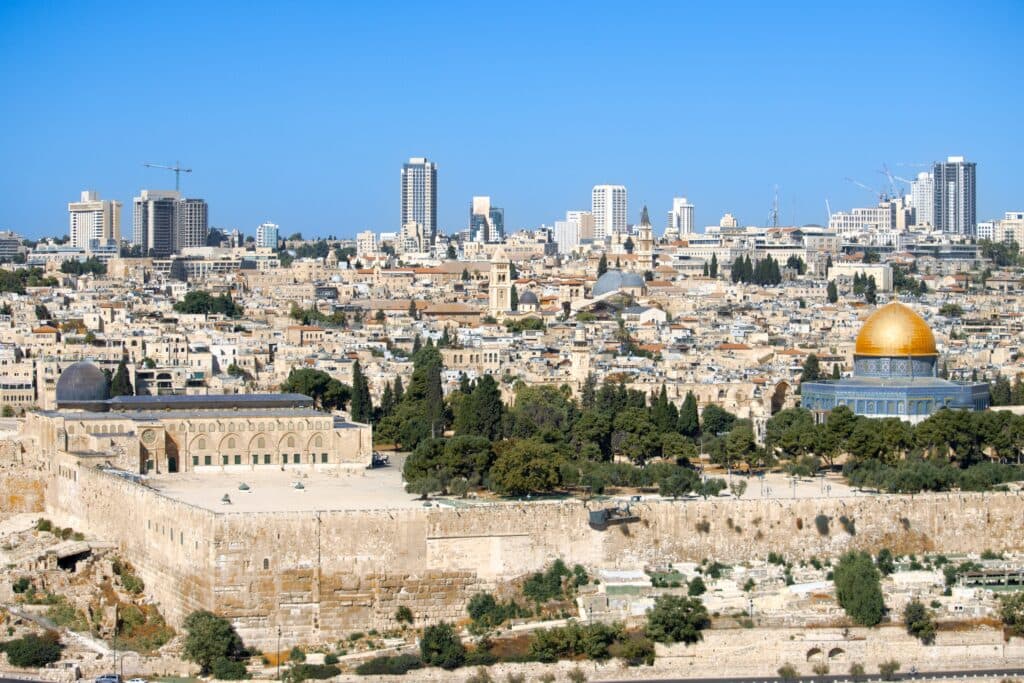
Jeremiah Ross | Unsplash
Ata-ul-Haye Nasir, Ahmadiyya Archive & Research Centre
Following in the footsteps of Hazrat Mirza Ghulam Ahmadas, the Khulafa of Ahmadiyyat have always urged Muslims to unite for the victory and protection of Muslim countries, people and Islam as a whole. The need for this unity is being felt more than ever today and cries for a khilafat have been seen by all even during the current crisis in Palestine.
Need for practical efforts
With recent atrocities against the Palestinians, it is a shame that Muslim countries are not united so as to speak up for them. We don’t see any practical efforts on their part to tackle the issue either.
The OIC (Organisation of Islamic Cooperation) deemed it sufficient to merely “condemn” Israel’s brutal aggression against the Palestinian people, in an emergency meeting on 16 May 2021. Pakistan – whose first foreign minister, Hazrat Sir Zafrulla Khanra strived hard for the Palestinian cause in the United Nations – has now sufficed on merely passing a resolution of condemnation in its parliament.
The current conflict has exposed the differences among the Muslims states. “For the first time in the many clashes between the two foes, regional unity over who is to blame and what should be done to stop the fighting has splintered”, reported The Guardian on 17 May 2021.
Some Muslim majority countries, such as Turkey and Iran, have spoken against Israel’s atrocities, but the UAE, Bahrain, Morocco and Sudan, “which all recently normalised ties with Israel, now find themselves balancing their new relationships against citizens who have been vocal in their anger at Israel’s violence” reported The Guardian.
Historically, the Ahmadiyya Khilafat actually urged Muslims to unite for the protection of Muslim majority lands, especially Palestine.
1939 Palestine Conference in London

In February 1939, when the British government organised a conference of the Arab countries in relation to the issue of Palestine, Hazrat Maulana Jalaluddin Shamsra, an Ahmadi missionary, invited the viceroy of Mecca and representatives of Palestine, Iraq and Yemen to a dinner party in which 200 guests participated, including many dignitaries.
Hazrat Mirza Bashiruddin Mahmud Ahmad, Khalifatul Masih IIra sent a telegram which was read out in both English and Arabic. Huzoorra said:
“Welcome his Royal Highness the Amir Faisal and the Palestine Conference delegates, on my behalf, and tell them that the Community is completely with them, and prays that God may give them success and may help all Arab States on the path of prosperity and give them the leadership of the Muslim world—the leadership which they possessed in the early centuries of Islam.” (South Western Star, 17 March 1939, p. 10; Al Fazl, 16 March 1939, p. 2)

A Quranic prophecy
While commentating on verses 22 to 26 of Surah Saad, Hazrat Khalifatul Masih IIra stated:
“The Holy Quran has stated a prophecy in these verses, which is a similitude and a divine vision in regard to the Latter Days. In this, God Almighty has said that those belonging to the progeny of Davidas, or his followers (who are both Jews and Christians) will possess 99 per cent of the world’s power, and on the opposite, the followers of the Holy Prophetsa would only have 1 per cent. Even then, they [Jews and Christians] would conspire to occupy the remaining 1 per cent [from the Muslims] as well.
“The Holy Quran mentions the word kifalat. […] The European people use the term, ‘Mandate’ for those countries which they have occupied after the recent war [World War II], and the meaning of ‘mandate’ is kifalat [authority]. Nowadays, the same word is being used for Palestine. So, in these verses, it has been told that Christians and Jews would demand from the Muslims in relation to Palestine: ‘Hand over this as well to us’. Now, President [Harry] Truman [of the USA] is sending telegrams that Jews should be allowed to settle in Palestine […].”

Huzoorra raised a pertinent question as to why countries such as America, Australia and England were not ready to let the Jews settle in their respective countries, despite having large areas [of land] in comparison to the area of Palestine. (Al Fazl, 31 October 1945, p. 2)
Al-Inzaar
In 1946, Hazrat Khalifatul Masih IIra, saw a vision in which he was foretold by Allah the Almighty that a delicate time was coming for Islam and Muslims needed to unite to tackle that issue. He wrote an article, titled Al-Inzaar (The Warning), wherein he mentioned his vision in detail and advised the Muslims in this regard. He stated:
“This divine vision has called our attention to the fact that a very delicate time is coming for Islam and Muslims are required to unite in worldly and political matters. Moreover, each person ought to prioritise unity above all other matters because the salvation of Muslims lies in this [unity]. This is a very difficult thing [to achieve], not an easy one. […]
“While narrating this divine vision, I advise each Ahmadi that they should call the attention of the Muslims in their respective circles that ‘Your division will cause your destruction’. At this juncture, you [Muslims] ought to forget about yourselves, your thoughts and your parties and should strive to unite everyone who claims to be a Muslim for the protection of Islam, and should leave aside all differences. […]
“I believe that even now, if the Muslims gather for unity, instead of emphasising the differences, then the future of Islam will not remain dark.” (Al Fazl, 28 August 1946, p. 3)

Pray for the Muslim world
Then, during his Friday Sermon of 30 August 1946, he instructed the Jamaat to especially pray for the Muslim world. He stated:
“The circumstances faced by the Muslims nowadays are very bleak. The identity of the Muslims in places such as India, Palestine, Egypt, Indonesia is in severe danger. […] So, all members [of the Jamaat] should especially pray in these days. The other Muslims [non-Ahmadis] should also be urged to start praying, as there is no other remedy for the Muslims. Until the Muslims step aside from worldliness and the pursuit of luxury and unite for offering all types of sacrifices […] success is impossible.” (Al Fazl, 10 September 1946, p. 2)
Al-Kufru Millatun Wahidah
Two years later, when Israel was established on 14 May 1948, conspiracies regarding Palestine emerged openly and at that time, Hazrat Khalifatul Masih IIra made efforts to awaken the Muslim ummah. He wrote a masterpiece, titled Al-Kufru Millatun Wahidah and called on all Muslims to unite as one.
He stated:
“The day which was prophesied by the Holy Quran and the ahadith hundreds of years ago; the day which was prophesied in the Torah and Gospels; the day which was told to be painful and dangerous for the Muslims has seemingly arrived. Jews are being inhabited in Palestine.
“America and Russia […] seem to be on the same page. And strangely, they both were united on the Kashmir issue as well. […] It is strange that the disputes of Palestine and Kashmir have emerged at the same time. […]
“So, I draw the Muslims’ attention towards this matter that they should understand this delicate time and remember that today, the saying of the Holy Prophetsa:
اَلْكُفْرُ مِلَّةٌ وَّاحِدَةٌ
“[kufr is one nation] is being fulfilled to the letter.” (Al Fazl, 21 May 1948, p. 3)
He further stated:
“The Arab [world] knows that now, the Jews are considering throwing out the Arabs from the [land of] Arabia […] But do the people of Arabia have any strength [to tackle this]? Does this matter belong only to the Arab?
“Obviously, neither the Arabs have any strength for this competition, nor does this matter only belong to the Arabs.
“The question is not about Palestine; it is about Medina. The question is not about Jerusalem; it is about Mecca al-Mukarrimah itself. The question is not about Zaid [A] or Bakr [B]; it is about the honour of the Holy Prophet Muhammadsa.
“The enemy has united against Islam, despite their [internal] disagreements. Will the Muslim [ummah] not unite despite the thousands of reasons for unity?” (Ibid)
Then, in regard to the impact of America and Russia, he said:
“The wealth of America and Russia’s plans and deceits, both are united against the poor Arabs.” (Ibid)
This article had a great impact in Syria, Lebanon, Jordan and other Arab countries. Syrian radio stations aired its summary and many Arabic newspapers published its excerpts, including Al-Yaum, Al-Akhbar, Al-Nasr and Al-Urdan.
A famous and respected journalist of Iraq, Al-Ustadh Ali al-Khayat Affendi stated in an article in his newspaper, Al-Anbaa‘:
“Foreign governments always try to spread hatred among the Muslims through slogans [of some other Muslims], and [they try to urge] some sects to stand for objecting Ahmadis and declaring them infidels […] A representative of a foreign country’s government, residing in Baghdad, called me for a meeting, and after appreciating my style of objection, for flattering me, asked me to start raising objections against the Qadiani Jamaat in my newspaper, in a hurtful manner, as much as possible, because this Jamaat was out of [the pale of] deen.
“This happened when, in 1948, a part of the Holy Land was divided and handed over to the Zionist government and the Israeli state was established. And in my view, the above-mentioned activity of the embassy was, in fact, the practical reaction of the two tracts, which were published by Jamaat-e-Ahmadiyya during the same year when Palestine was divided.
“One tract was titled ‘Hay‘atul Umami al-Muttahidati wa Qararu Taqsimi Falastina’, in which those conspiracies of the Western colonial powers and Zionists were disclosed, in which it was planned to hand over the Palestinian ports to the Jews.
“The second tract was published as ‘Al-Kufru Millatun Wahidah’, in which the Muslims were advised to instil perfect unity.” (Akhbar Al-Anbaa‘ [Baghdad], 21 September 1954, with reference of Mujallah Al-Taqwa, September-October 1989)
So, from this reference alone, we can easily understand the impact of Hazrat Khalifatul Masih II’s masterpiece and how he created great worry among the ranks of the anti-Muslim powers.
Had the Muslim ummah acted on his advice and called for Islamic unity, Muslims would never be in a situation in which they find themselves now.
Lecture at the Law College Lahore

On 12 December 1948, Hazrat Khalifatul Masih IIra delivered a lecture at Law College Lahore, titled “Maujooda Halaat mein Aalam-e-Islam ki Haisiyyat aur uska Mustaqbil” (The Status and Future of the Islamic World in Light of the Current Situation). During the lecture, he stated that the Islamic world’s future is completely safe, provided the Muslims act upon those ways of success which the Holy Quran has prescribed for us.
Huzoorra advised the Islamic countries to dispel their internal enmities and to make trade relations with each other. He added that the Holy Quran has declared tabligh as the best way for Islam’s progress, so the Muslims should pay attention to this. (Al Fazl, 14 December 1948, p. 2)
‘My righteous servants shall inherit the land’
Hazrat Khalifatul Masih IIra stated in his speech of 28 December 1954:
“In the past as well, [the Muslims] had temporarily lost the occupation [of Palestine] twice and have lost it now too. And when we say ‘temporarily’, it necessarily means that the Muslims will again go to Palestine and will rule it. It necessarily means that the Jews will again have to leave it and it necessarily means that Allah the Almighty will enable the Muslims to defeat this whole order which is being established with the help of the UNO and America, and once again let the Muslims settle here. […]
“So, I say ‘temporarily’ because there is a [Quranic] injunction ‘My righteous servants shall inherit the land’ [Ch.21: V. 106]. […] So, the ‘righteous servants’ of God Almighty, the people of Muhammad Rasulullahsa, will surely go to this country [Palestine]. Neither can America’s atomic bombs and H-bombs do anything, nor can the help of Russia do anything. This is God’s decree, which will come to pass eventually, no matter how much power the world exerts.” (Anwar-ul-Ulum, Vol. 25, pp. 80-81)

A heartfelt message to Jamaat-e-Ahmadiyya
Hazrat Mirza Tahir Ahmadrh, after being elected Khalifatul Masih IV on 10 June 1982, sent a heartfelt message to Jamaat-e-Ahmadiyya, in which he urged everyone to pray for the Palestinian Muslims.
He stated that there was a wound in our hearts that was getting more terrifying, deeper and painful by the day, and that was a result of the inhumane atrocities being carried out by Israel against the Muslim world.
He said that Hazrat Khalifatul Masih IIIrh felt this grief severely during the last few days of his life and upon the mention of these oppressions, he would become so grieved that one could see the pain in his eyes.
Hazrat Khalifatul Masih IVrh instructed the Ahmadis:
“So, I call the attention of all Ahmadis – men, women, elders and children – that they should supplicate to Allah with great fervour, that He may have Mercy on everyone who is associated with our master, the Holy Prophet Muhammadsa.” (Al Fazl, 13 June 1982)

Then, during his Friday Sermon of 8 March 1985, Hazrat Khalifatul Masih IVrh stated:
“As far as Jamaat-e-Ahmadiyya’s loyalty to the interest of Islam and the Palestinian Muslims is concerned, it is not a hidden fact or a matter of recent times. By the grace of Allah, Jamaat-e-Ahmadiyya had a deep connection with the Islamic interests of Palestine, even since the time when you [opponents of Ahmadiyyat] did not sense the gravity of the issue and did not even know the true circumstances of Palestine.
“Khulafa of Jamaat-e-Ahmadiyya cautioned the Muslims of Palestine from every danger, and kept them aware, and would present Jamaat-e-Ahmadiyya for every possible help for them.
“And these matters are continuing even prior to the partition [of the Indian subcontinent]; even the Ahrari newspapers had to accept these facts. They have uttered from their mouths and written with their pens that ‘the love showed by Qadian’s Mirza Mahmud Ahmad Sahib[ra] for the people of Islam and the Islamic world, is found very less elsewhere.’
“There was a newspaper of the Ahrar, Zamzam, which was devoted to the opposition of the Jamaat […] wrote in its publication of 19 July 1942: ‘Under the current circumstances, the Khalifa Sahib has shown such righteous indignation for Islam with reference to Egypt and the Holy Land of the Hijaz that we are greatly indebted to him, and by expressing his concern, he has rightly represented the feelings of Muslims.’
“Now, look: if they ever found a spokesperson for the Muslims, he would be an Ahmadi. They considered the leader of Ahmadis to be the best spokesperson [of Islam].” (Khutbat-e-Tahir, Vol. 4, pp. 224-225)

Then, in his next Friday Sermon of 15 March 1985, Hazrat Mirza Tahir Ahmad, Khalifatul Masih IVrh stated that even before the United Nations General Assembly had made the oppressive decision to divide Palestine, Hazrat Khalifatul Masih IIra warned and cautioned the Muslim world, creating a commotion in the Arab and non-Arab countries alike. (Khutbat-e-Tahir, Vol. 4, p. 231)
Huzoorrh continued by stating that Hazrat Mirza Bashiruddin Mahmud Ahmadra wrote a heart-rendering pamphlet and had it circulated in abundance, in which he stated:
“I tell you that today, neither is America your friend, nor is Russia your friend. They have formed a mutual conspiracy against Islam. They have forgotten their own enmities due to the enmity of Islam and have united. Does the Islamic world have any sense of honour? Do they not possess the love for Islam that would allow them to forget their animosity towards each other and unite?”
Huzoorrh added that when that decision of dividing Palestine was passed, Hazrat Musleh-e-Maudra wrote another article, describing the steps Muslims needed to take to help them in winning the lost battle again. (Ibid)
During his Friday Sermon of 11 January 1991, Hazrat Khalifatul Masih IVrh instructed Ahmadis to especially pray that Allah may guide the Muslim world. He stated that the Muslim countries should keep in mind the interests of the Muslim ummah as a whole, instead of only protecting their own interests. He added that if the Arab countries did not remove their internal differences, then there would be no peace in this territory and eventually, Israel would emerge as a bigger power than ever before, and no Arab Muslim power could ever think to act against Israel. (Khutbat-e-Tahir, Vol. 10, pp. 32-33)
Advice to Muslims by Hazrat Khalifatul Masih Vaa
Hazrat Amirul Momineen, Khalifatul Masih Vaa has also called the attention of the Muslim Ummah towards unity and regularly advised them that for removal of the ongoing miseries, Muslims must unite and face the opponents of Islam as a united front by forgetting all internal disputes.

During his Friday Sermon of 23 November 2012, Hazrat Khalifatul Masih Vaa said:
“[…] Israel’s attack on the Palestinians is due to the differences and disunity among the Muslims. There is no Islamic country where all moral values are not being violated due to the religious or political differences, or where horrific stories of oppression against each other are not being created. As a result, in one way or another, we are witnessing oppression [by the Muslims] against each other […] It is my desire that Muslims come to their senses and be united.” (Khutbat-e-Masroor, Vol. 10, p. 719)
Then, during his Friday Sermon of 25 July 2014, Huzooraa stated that the Muslim countries did not have unity and consensus. The governments were oppressing their peoples. Not only was there a lack of unity, but there was also widespread oppression.
Huzooraa added that the result of this lack of unity and consensus was that non-Muslims also had the courage to do whatever they wanted against the Muslims and that was why Israel was now brutally killing innocent Palestinians. If there was unity among Muslims, then there would have been no such oppression. (Khutbat-e-Masroor, Vol. 12, pp. 453-454)
Recently, during his Eid-ul-Fitr Sermon of 14 May 2021, Hazrat Amirul Momineen, Khalifatul Masih Vaa instructed Ahmadis to pray especially for Palestinians who are suffering a great deal. He said:
“Today, we must sincerely pray for the Palestinian people who are currently being subjected to grave cruelties. In recent days, when they went to pray in the Al Aqsa Mosque, they were brutally attacked and beaten by the state authorities. Similarly, they are being forced out of Sheikh Jarrah, a small neighbourhood, which is their own land.
“Certainly, Muslim countries should come together and play their role to protect the Palestinians and other Muslims who are being oppressed in the world. However, the Muslim world is divided and there is a complete lack of unity amongst the Muslim nations. Certainly, in this instance, the Muslim countries have failed to show the reaction they ought to have. They have given weak statements, whereas if they had all come together and given a united statement, it would have had a far greater impact and carried much more weight.
“May Allah grant sense and wisdom to the Muslim leadership. May He also give sense to the Israelis that they may refrain and withdraw from their injustices. Further, may Allah guide the Palestinians who are suffering from a lack of leadership, if there is any injustice from their side – though in reality, this is not the case. If they (the Palestinians) are using sticks they are being subjected to heavy missiles and sophisticated weaponry, which is something I have mentioned before as well. There is no comparison in terms of the force being used by both sides. We must, therefore, pray for the Palestinians. May Allah the Almighty better their situation and create the means for their freedom and may they continue to hold on to their rightful places and land that were allotted to them in the initial treaty.”

So, the Muslim ummah needs to understand the dire need of unity so that they can better their situation. But for this, there is only one way and that is accepting the Imam of the age – the Promised Messiahas – and his Khilafat.
Hazrat Khalifatul Masihaa is the leader who can lead the Muslim ummah towards betterment and victories. May Allah the Almighty guide the Muslim ummah. Amin.
______________________________________________________________________________________________
2024
This Week in History: 17–23 May | Al Hakam
https://www.alhakam.org/this-week-in-history-17-23-may
This Week in History: 17–23 May
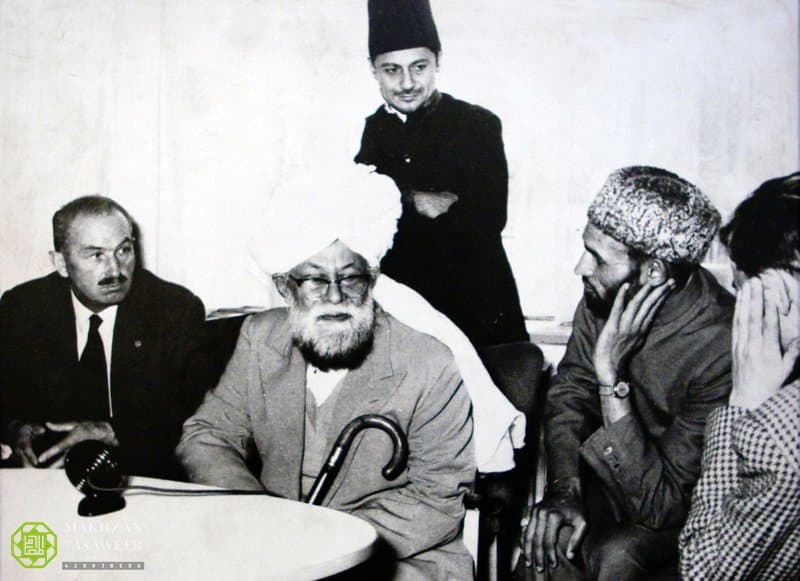
Hazrat Musleh-e-Maudra at a reception in Switzerland
A glimpse into the rich history of the Ahmadiyya Muslim Jamaat
17 May 1927: In light of the anti-Muslim riots in Lahore, Hazrat Musleh-e-Maudra decided to initiate a countrywide movement for not only aiding the oppressed Muslims of Lahore, but also for the Indian Muslims’ economic, political and religious progress. He published a tract as well, titled “Aap Islam aur Musalmanon ke liay kiaa kar saktay hain?” —What can you do for Islam and Muslims? On this day, the first part of this tract was published in Al Fazl, in which he outlined 31 points of the scheme for Islam’s unity.
For more details, see “Hazrat Musleh-e-Maud’s services to the Muslim cause: Guiding Muslims of the Indian subcontinent amid religious and political conflicts” at alhakam.org (26 February 2021, p. 17).
17 May 1989: During his tour of Europe, on this day, a special reception was given by the Zurich City Council in honour of Hazrat Khalifatul Masih IVrh. Huzoorrh addressed the press conference in the afternoon of the same day. In the evening, he delivered a lecture at the University of Zurich. (Silsila Ahmadiyya, Vol. 4, p. 855)
18 May 1900: The Lord Bishop George Alfred Lefroy delivered a series of public lectures and declared that while Prophet Muhammadsa had died and was buried in Medina, Muslims hold that Jesusas is still alive in heaven. On this day, after such a speech, the audience was given the opportunity to discuss the matter. Hazrat Mufti Muhammad Sadiqra stood up and argued against the bishop’s false propaganda.
For more details, see “100 Years Ago… – Demise of Lord Bishop Lefroy” at alhakam.org (11 January 2019, p. 3).
18 May 2005: During his tour of Africa, on this day, Hazrat Khalifatul Masih Vaa visited an Ahmadiyya School in Mbiko, Uganda. (Al Fazl International, 24 June 2005, pp. 10-11)
19 May 1928: On this day, the Indian National Congress held a session of the All Parties Conference and formed a sub-committee, chaired by Motilal Nehru, which had only two Muslim representatives. This committee later passed a proposed constitution for India, commonly known as the Nehru Report.
Hazrat Musleh-e-Maudra commented on the Nehru Report in detail. Al Fazl published those comments from 2 October to 2 November 1928, which was later published in book form titled, Nehru Report aur Musalmanon ke Masaleh. Its English translation was published in March 1930, titled The Nehru-Report and Muslim Rights.
For more details, see “Hazrat Musleh-e-Maud’s services to the Muslim cause: Guiding Muslims of the Indian subcontinent amid religious and political conflicts” at alhakam.org (26 February 2021, p. 17).
19 May 1989: On this day, Hazrat Khalifatul Masih IVrh delivered his Friday Sermon at the Mahmud Mosque of Zurich, in which he highlighted the schemes employed by some Baháʼís in Pakistan to undermine the faith of some economically disadvantaged Ahmadis, enticing them with financial incentives and the allure of material benefits, in an attempt to sway their allegiance away from Islam Ahmadiyyat. Huzoorrh emphatically stated that, despite their economic hardships, Ahmadis possess a resolute and unwavering faith, rendering these tactics ineffective. (Khutbat-e-Tahir, Vol. 8, p. 323)
20 May 1928: Hazrat Sufi Muti-ur-Rahman was sent to serve as the person in charge of the Ahmadiyya Mission in America on this day.
For more details about his career in serving Jamaat, see: “Pioneer Missionaries: Part 2 – Serving till their last days” at alhakam.org (16 September 2022, p. 9).
20 May 1989: During his tour of Switzerland, on this day, Hazrat Khalifatul Masih IVrh attended a tea party arranged in his honour by the Council of Churches in Zurich. (Silsila Ahmadiyya, Vol. 4, p. 855)
21 May 1948: When Israel was established on 14 May 1948, Hazrat Musleh-e-Maudra wrote an article to awaken the Muslim world, titled “Al-Kufru Millatun Wahidah” and called on all Muslims to unite as one. This article was published on this day in Al Fazl.
For more details, see “The Ahmadiyya Khilafat’s call for Muslim unity: The solution to Israel-Palestine issue” at alhakam.org (21 May 2021, p. 21).
21 May 1989: During his tour of Europe, Hazrat Khalifatul Masih IVrh arrived at Saint Prix in France. He inaugurated an exhibition hall and addressed the members of Jamaat. (Silsila Ahmadiyya, Vol. 4, p. 855)
22 May 1948: On this day, Hazrat Musleh-e-Maudra issued a written message under title “Mujhey ap ki talash hei” (I am in search of you).
For the English rendering of this text see: “I need you” at alhakam.org (14 February 2020, p. 6).
22 May 2013: On this day, Hazrat Khalifatul Masih Vaa arrived in Calgary during his historic tour of North America. At the airport, Huzooraa was greeted by four members of Alberta’s Legislative Assembly (MLAs) and by Calgary’s Deputy Mayor, Ray Jones. (“World Muslim Leader Arrives in Calgary”, www.pressahmadiyya.com)
23 May 1982: On this day, Hazrat Khalifatul Masih IIIrh, embarked upon what would become his final journey from Rabwah to Islamabad, the capital of Pakistan. His visit was marked by an episode of profound significance on 26 May; while leading the Isha prayer in Islamabad, he experienced a moment of physical unsettlement caused by elevated blood pressure, heralding the onset of his last illness. Huzoorrh later passed away on 9 June 1982. (Hayat-e-Nasir, by Mahmud Mujib Asghar, p. 427)
______________________________________________________________________________________________
2021
Hazrat Musleh-e-Maud’s services to the Muslim cause: Guidance for Turkey, peace in the Arab world and the Kashmir Movement
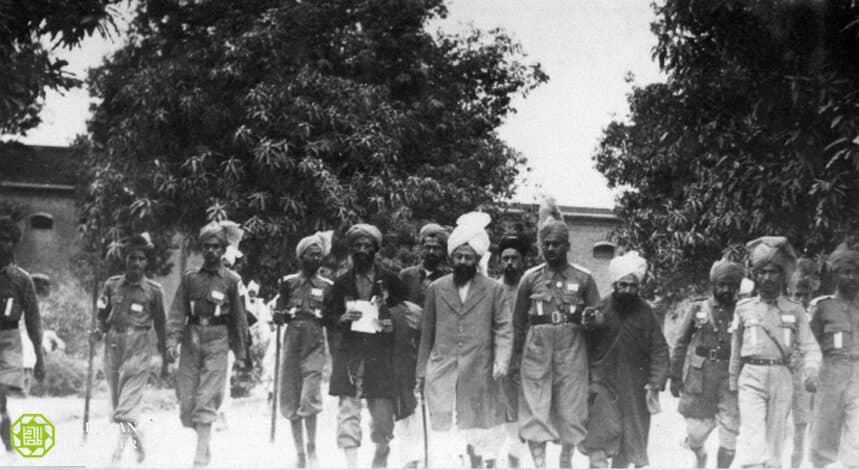
Ata-ul-Haye Nasir, Ahmadiyya Archive & Research Centre
History bears witness that Hazrat Musleh-e-Maudra rendered great services to the Muslim Ummah. He always advocated for peace and autonomy of the Arab Muslim countries and played a pivotal role in the Kashmir Movement.
This article seeks to present some glimpses of such services.
Treaty of Darin
In 1915, the ruler of Nejd signed the Treaty of Darin with the British government, which meant that he would not hinder any military operations against the Muslim states of the region. In return he was granted weapons and financial aid.
Sharif Hussein Ibn Ali of the Hedjaz was also granted financial aid on the condition of assisting the British against the Ottomans. It not only threatened the autonomy of these two Arab states, but also initiated their conflict with the other Muslim states.
Therefore, Hazrat Musleh-e-Maudra wrote to Lord Chelmsford, the Viceroy of India, that such grants to the Hedjaz and Nejd would lead to an uprising from other Muslim states and Muslims would never tolerate the suzerainty of the British government on Arab lands.
Turkey’s misery
A few years later, when World War I ended, Turkey was in a miserable state. In such a time, a pan-Islamic force in India arose in 1919, in an effort to salvage the Ottoman Caliph as a symbol of unity among the Indian Muslims. It is known as the Khilafat Movement. Fears of Muslim disunity were aroused by the decline of the Ottoman Empire – the preeminent Islamic power whose Sultan, as Caliph, was seen by pan-Islamists as the leader of the worldwide Muslim community.
On 21 September 1919, a Jalsa of the All India Muslim Conference was held, to which Hazrat Musleh-e-Maudra was also invited, but he could not attend. So, he sent a detailed article, titled Turkey ka Mustaqbil aur Musalmanon ka Farz, which was published in Al Fazl, 27 September 1919.

This article was later translated into English as The Future of Turkey and published in The Moslem World, Vol. 10, pp. 274-281.
Huzoorra stated:
“The question of the future of Turkey can not fail to possess an interest for every one who calls himself a Mussalman. This is at once natural and a fact. And so long as such sympathy and friendliness do not conflict with the commands of religion, such a sentiment is both a duty and a necessity. […]
“There is no doubt that the whole Islamic world has been looking upon the future of the Turks with doubt and misgivings and there is no doubt that the complete extinction of the empire or any curtailment of its independence will deeply wound the Moslem feeling.” (The Moslem World, Vol. 10, p. 274)

Huzoorra also suggested to the Muslims a scheme to protect Turkey from the upcoming dangers.
The following year, the Indian Muslims decided to hold a conference about Turkey’s issue, on 1 and 2 June 1920 in Allahabad. Upon the request of Maulvi Abdul Bari Sahib Farangi Mahali, Hazrat Musleh-e-Maudra wrote an article, titled “The Agreement of Turkey and Muslims’ Future Plan”.
Huzoorra stated that the Muslims were presenting many suggestions, including migration, jihad-e-am [open warfare] and civil disobedience etc., but all these suggestions were invalid and inapplicable. He advised the Muslims to devise a practical plan. (Al Fazl, 7 June 1920, pp. 3-8)

The Civil and Military Gazette reported:
“In his letter, addressed to the members of the Khilafat conference which met at Allahabad in June last, a printed copy of which has been sent to us, Mirza Basheer-ud-Din Mahmud, Khalifat-ul-Masih II, head of the Ahmadiyya community, presents the Khilafat question in its practical aspects. A zealous Mahomedan, imbued with all the ardour of his faith, and a stout champion of the rights of Turkey, Mirza Basheer-ud-Din criticises the Turkish Peace terms in several well-reasoned pages; but he does not allow his feelings to overpower his commonsense and self-respect. […] While extremists sought suicidal relief for their grievances, this advocate of moderation propounds a practical remedy in the formation of a ‘League of Islam’ to protect Mahomedan interests all over the world by constitutional means. While this suggestion will give his co-religionists ample scope for the ventilation of their case, it is at the same time an opportune moment for all those who have been perturbed by the present fanatical agitation to study closely Mirza Basheer-ud-Din’s arguments against Hijrat and non-co-operation.” (The Civil and Military Gazette, 30 July 1920, p. 6)

Address to Lord Reading
Huzoorra not only guided the Muslims on the issue of Turkey, but also called the attention of the British government towards this issue and the Hedjaz as well. He sent a delegation of Ahmadis to present an address to Lord Reading, Viceroy of India, on 23 June 1921.

The address mentioned the issue of Turkey and advocated the autonomy of the Hedjaz and the greater interests of the Muslims:
“Notwithstanding that we do not acknowledge the Sultan of Turkey as the Khalifa of the Muslims and have thereby exposed ourselves to the reproaches of our fellow countrymen, we fully sympathise with the Turkish government in its affliction, for we feel that Turkey has not received fair treatment; and as it is a wrong which can be righted at any time, there is no reason why the Indian government should give up its efforts to secure a fair treatment for Turkey. If, after a lapse of fifty years, Alsace Lorraine could be restored to France through the efforts of the British government, the provinces of Smyrna and Thrace where the Turkish population certainly preponderates, may similarly be restored to Turkey in spite of the present settlement.
“But more important still, in our opinion is the question of the independence of Hedjaz, which must remain free from outside interference.
“When this question arose every Muslim entertained the misgiving that the freeing of Hedjaz from Turkish control might mean the bringing of it under the control of a European power. Hedjaz being a sterile country would, it was feared, be unable to produce sufficient income to defray the expenses of its administration and the Hedjaz government would be compelled to borrow money from a foreign country, thus placing itself under the control of a European power.” (The Review of Religions, June 1921)
The Viceroy replied to the address, which, according to The Leader of Allahabad, was seen to have touched upon “some of the burning issues of the day”. (“Viceroy’s Reply to the Ahmadiyya Community”, The Leader, 26 June 1921)

A detailed report was published in The Pioneer Mail and Indian Weekly News on 30 June 1921.

Syria’s Freedom Movement
Then comes the issue of Syria, which was occupied by France post-World War I and took France three years – from 1920 to 1923 – to gain full control over. Though many insurgencies broke out from time to time, but the freedom movement started in 1925.
Then, between 18 and 21 October 1925, Damascus was heavily attacked for more than 57 hours.
During his Friday Sermon of 13 November 1925, after narrating the Promised Messiah’sas revelation “Balaa-e-Dimashq” (Calamity of Damascus), Hazrat Musleh-e-Maudra stated:
“This is an act of great oppression upon the people of Damascus, who were already helpless. […] In my view, it is the Syrians’ right to get independence. It is their own country, so their leaders should also be their own. […]
“They are being oppressed and I have sympathy for those oppressed people. […] I also pray for those who strived and got killed for the freedom and independence of the nation. I also pray for those who are alive and striving for this cause, that may they be saved from destruction and be successful.
“As it is our duty to have sympathy for everyone, I also pray for the European people that may Allah open their eyes, so they may do justice, avoid oppression and establish freedom and independence instead of suppressing it.” (Al Fazl, 21 November 1925, pp. 8-10)

The early years of the Kashmir Movement
Hazrat Musleh-e-Maudra was desirous of the freedom of Kashmir’s oppressed Muslims. His efforts for the rights of the Kashmiri Muslims were highly commended by prominent Muslim leaders of the time. On one hand, Huzoorra was advocating the rights of Kashmiri Muslims through peaceful methods, but on the other, Majlis-e-Ahrar was damaging the cause through violent and unlawful actions. The details of this whole episode can be found in our article, titled “Historical analysis of Ahrar’s anti-Ahmadiyya agitation”, published in three parts.
Hazrat Musleh-e-Maudra wrote an article, titled The Condition of Muslims in Kashmir and Jammu State, outlining the importance of Kashmir and the demands of Kashmiri Muslims. He added that the issue of Kashmir could be solved if all the Muslims strived with unity. (Al Fazl, 16 June 1931, pp. 3-4)
A famous leader of the Freedom Movement, Mufti Ziauddin Sahib, wrote in his Persian poetic booklet that in the beginning of the Freedom Movement, many letters were sent to the prominent leaders of India, including Allama Iqbal, Sheikh Sadiq Hasan, Khawaja Hasan Nizami and Hazrat Musleh-e-Maudra, who were all requested to offer their help. All of them, excluding Hazrat Musleh-e-Maudra, responded by asking why he had got involved in such a dangerous act. Huzoorra, however, sent a heavy amount for this cause. (Noha-e-Kashmir, pp. 12-13, published by Punjab National Press Lahore in 1963)
On 13 July 1931, dozens of Kashmiri Muslims were killed and many suffered severe injuries as a result of the inhumane treatment by the local police. Upon this, Hazrat Musleh-e-Maudra sent a telegram to the Viceroy of India, notifying him of the situation, and informed him of the details as to how the Muslims of Kashmir were being oppressed. (Al Fazl, 18 July 1931, pp. 1 & 12)

In regard to the reaction from the Muslim leaders, Suhail-ul-Rehman Lone states:
“Barely a week after the July 13 massacre, several leaders […] laid the foundation of the Kashmir Committee (subsequently known as the All India Kashmir Committee) in Simla which aimed at speaking on the behalf of Kashmiri Muslims. The founding members of the Committee included Fazl Hussain, Khawaja Hassan Nizami, Mirza Bashir-ud-Din […]. The members chose Mirza Bashir-ud-Din as the president of the Committee and his personal assistant, Moulvi Abdul Rahim Dard as the Secretary. Immediately after its formation it began to pressurize the Maharaja and the Government of India to appoint an enquiry committee in order to bring forth the facts about the central jail incident. It decided to celebrate the Kashmir Day on August 14.” (Indian National Movement And The Freedom Struggle Of Jammu And Kashmir [1931-1947 A.D.], pp. 63-64)

Ravinderjit Kaur, in her book, Political Awakening In Kashmir, has also stated details of the early days and activities of this committee. She wrote:
“The All India Kashmir Committee was formed on July 25, 1931 at Simla. The members of this Committee were: Sir Sheikh Mohammad Iqbal, Nawab Sir Zulfiqar Ali Khan, Khawaja Hassan Nizami, Nawab Ibrahim Ali Khan of Khanjpura, Mirza Bashir-ud-Din Mahmood Ahmad, the President of the Committee […] and Maulvi Abdur Rahim Dard who was the Secretary of the Committee.
“The dynamic forces behind the Kashmir Committee were Sheikh Mohammad Iqbal and Mirza Bashir-ud-Din Mahmood Ahmad.” (Political Awakening In Kashmir, p. 156)

Muhammad Yusuf Ganai states:
“Mirza Bashir-ud-Din Mahmud Ahmad, Amir of the Jamat-i-Ahmadiya took initiative in convening a meeting of some leading Muslims at Simla on 25 July 1931 to consider the situation. It was in this historical meeting that the foundation of All India Kashmir Committee was laid.” (Kashmir’s Struggle For Independence (1931-1939), p. 95)
C. Bilqees Taseer states:
“After the July 1931 riots, it was at the request of Dr. Iqbal – who knew that he and the members of his organisation would have a considerable number of disciplined volunteers and adequate funds at their disposal – that Mirza Bashiruddin Mahmud Ahmed[ra] took the initiative in organising the work of the All India Kashmir Committee, starting from 1931. At Garhi Habibullah Rest House a meeting was arranged between Mirza Bashiruddin[ra] and Sheikh Abdullah in which it was decided that the latter should be the leader of the movement and Chaudhry Ghulam Abbas Khan, Secretary. Funds were collected from all over India for the Kashmir cause.
“The Committee was formed as a result of a meeting held at Fair View, Simla on July 25th, 1931, sponsored by Dr. Iqbal, at Which Mirza Bashiruddin Mahmud Ahmed[ra] presided. The All India Kashmir Committee was formed with eminent persons from all over India. Moulvi Abdur Rahim represented the Kashmir Valley and Allah Rakhar Saghar represented Jammu province.” (The Kashmir of Sheikh Muhammad Abdullah, Ferozsons Pvt. Ltd, Lahore, 1986, pp. 9-10)

In June and July 1931, Huzoorra wrote detailed articles in regard to the Kashmir Movement and gave valuable guidance to the Muslim leaders. He also wrote many special messages and letters addressed to the Muslims of Kashmir, which greatly uplifted them and created a new passion for freedom.
As the All India Kashmir Committee had given a call for observing Kashmir Day on 14 August 1931, Huzoorra wrote an article on 6 August 1931, in which he advised all to celebrate Kashmir Day with full zeal and passion.

“In response to a call given by the All India Kashmir Committee, Kashmir Day was observed on August 14, 1931 with tremendous enthusiasm both within and outside the State.” (Kashmir’s Struggle For Independence (1931-1939), p. 96)
On 14 August, when Kashmir Day was being observed peacefully, the local police in Kashmir did not stop its unjust attitude. This inhumane treatment continued and hence, Huzoorra sent a letter to the Viceroy of India.

In this letter, Hazrat Musleh-e-Maudra mentioned the ongoing situation of Kashmir and the oppression against the innocent Muslims, particularly highlighting his proposals for resolving the issue of Kashmir, which he had previously presented to the Viceroy in a meeting held in August.

This letter has been presented just as a glimpse, as we have found multiple letters and telegrams which were sent by Hazrat Musleh-e-Maudra or his representatives to the Viceroy and other government officials in regards to the issue of Kashmir. (National Archives of India, Foreign and Political Department, File 133-P (Secret) 1932)
On 26 September 1931, Hazrat Musleh-e-Maudra was interviewed regarding the latest occurrences in Srinagar, in which he “expressed regret at the mass of anti-Muslim propaganda which was being issued.” He further said:
“Unwarranted bloodshed and indiscriminate arrests of Muslim leaders have considerably changed the situation. If the imprisoned leaders are at once released, representatives of Kashmir Muslims, I hope, will spare no pains to create an atmosphere of peace.” (The Civil and Military Gazette, 28 September 1931, p. 7)

Hazrat Musleh-e-Maudra sent a telegram on 5 October 1931 to the Viceroy of India, stating how the State of Kashmir was persecuting innocent Muslims. He also highlighted the anti-Islam rhetoric which was intensifying in Kashmir. (National Archives of India, Foreign and Political Department, File 133-P (Secret) 1932)
The telegram concluded with the following words:
“A belated justice is no justice at all.” (Ibid.)


Another meeting of the Committee was held on 13 October 1931:
“ALL-INDIA KASHMIR COMMITTEE
“Efforts to be Redoubled
“MEETING IN LAHORE
“An emergency meeting of the All-India Kashmir Committee was held in Lahore on Tuesday, the President, Mirza Bashir-ud-din Mahmood Ahmad Sahib, being in the chair. […] Sir Zulfiqar Ali Khan reiterated on behalf of the Committee, the complete confidence of members in the President and praised his services in the cause of Kashmir Muslims.” (The Civil and Military Gazette, 16 October 1931, p. 6)

In another meeting on 24 October 1931, the ongoing situation of Kashmir was discussed:
“Muslim Demands in Kashmir
“Independent Riots Inquiry Proposed
“(From A Correspondent)
“An emergency meeting of the All-India Kashmir Committee was held at Lahore, on Saturday, to consider the situation arising out of the reply given by the Maharaja of Kashmir to the Muslim demands presented on October 19. Mirza Bashir-ud-Din Mahmood Ahmad presided.
“The following resolutions were passed:
“‘That this meeting agrees with the Kashmir Muslims that the findings of the Dalal Commission are one-sided, incomplete, unsatisfactory and unacceptable.
“‘That the meeting disapproves of the appointment of the new Dalal Commission which will also not inspire confidence. Sir B Dalal has already formed his opinion and besides his findings will prejudice the court in the trial of political cases, as he is also the head of the State judiciary.
“‘That an absolutely independent Commission should be appointed to inquire into the history of the disturbances. This Commission should include a majority of non-official Muslim members appointed after consulting Kashmir Muslim representatives.
“Reforms
“‘That the proposed Commission on constitutional questions should also have a majority of non-official Muslim members, acceptable to and enjoying the full confidence of Kashmir Muslims, and its terms of reference should be settled after consulting them.
“‘That in order to create a better atmosphere for the Inquiry Commission the State should suspend the trial of cases arising out of the disturbances, pending the report of the Commission.
“‘That the Kashmir Government should immediately make a declaration granting the elementary rights demanded in the Muslim memorial, as there is absolutely no justification for their postponement.’” (The Civil and Military Gazette, 28 October 1931, p. 11)

On 16 November 1931, Maulvi Farzand Ali Sahib sent a letter to the Secretary of State for India and presented a summary of the recent telegrams sent by Hazrat Musleh-e-Maudra in regards to the issue of Kashmir, particularly about the above-mentioned commission.

Hazrat Musleh-e-Maudra initiated a scholarship fund for Kashmiri Muslim students and also established the Kashmir Relief Fund for helping the oppressed Muslims of Kashmir.
In regard to this, Adil Hussain Khan states:
“On May 23, 1932, Mirza Mahmud Ahmad — this time on behalf of Jama’at-i Ahmadiyya — established a new scholarship fund for Muslim students studying in Kashmir […] Mahmud Ahmad appropriated funds to the Kashmiri cause from every accessible channel including Jama’at-i Ahmadiyya. As Khalifat al-masih II, he established the Kashmir Relief Fund, a mandatory charitable donation (chanda) levied upon each wage-earning Ahmadi within his Jama’at.” (From Sufism to Ahmadiyya: A Muslim Minority Movement in South Asia, published by Indiana University Press, p. 102)
In mid-1932, when Sheikh Muhammad Abdullah and other Kashmiri leaders were facing imprisonment, Huzoorra cautioned the Kashmiri people by stating that if their leaders did not get freed soon and meanwhile, the Assembly’s elections were held, it would be their duty to nominate those contestants who had an interest in the national cause. Huzoorra advised not to boycott the elections.
Though Sheikh Abdullah Sahib was freed, still many leaders were in prison, so he thought about compromising with the state. Huzoorra, however, emphasised upon contesting the elections. So, the “Muslim Conference” nominated its contestants and all of them won.

While the Kashmir Movement was achieving great success, the opponents of Jamaat-e-Ahmadiyya started a campaign against Huzoorra, without thinking about the interest of the Kashmiri Muslims, and demanded that the president of the All India Kashmir Committee should not be an Ahmadi.
Observing this situation, Huzoorra called a session of the Kashmir Committee on 7 May 1933 and during the meeting, resigned from the presidency. This was a big loss to the Kashmir cause, but Huzoorra did not stop his efforts for the Kashmiri Muslims.
The Civil and Military Gazette reported that a meeting of the All-India Kashmir Committee was held on 7 May 1933 at the Cecil Hotel, Lahore, presided over by Hazrat Musleh-e-Maudra.

During this meeting, a resolution was passed, in which it was stated:
“This meeting deems it its duty to place on record its genuine and sincere appreciation of the valuable and sincere services rendered by Hazrat Mirza Bashir-ud-Din Sahib Mahmud to the cause of Kashmiri Mussalmans.
“That in view of the fact that Mirza Bashir-ud-Din Mahmud has volunteered to resign the Presidentship of the Kashmir Committee, this Committee regretfully accepts that resignation.” (The Civil and Military Gazette, 16 May 1933, p. 8)

A Muslim Political Correspondent of The Civil and Military Gazette wrote:
“It is, I think, a matter of regret that Mirza Bashir-ud-Din Mahmud Ahmad should have retired, as I understand he has, from the Presidentship of the Kashmir Committee, where his counsels were always those of moderation and prudence. Quietly, but nonetheless with determination, he fought the battle of the Muslims of Kashmir. It was due to his efforts very largely that the important right of peasant proprietorship was conceded to the Muslim agriculturists of Kashmir and Jammu, that lawyers were sent who defended something like two thousand cases arising out of the riots free of charge—and, I think, not least important of all—he combatted the mischievous Ahrar influence.” (The Civil and Military Gazette, 15 May 1933, p. 3)
A newspaper, Siasat, wrote on 18 May 1933:
“At the time, when the condition of Kashmir was critical, those who chose Hazrat Mirza Sahib, despite doctrinal differences, made a perfect choice. Had they not chosen Mirza Sahib because of the differences in their beliefs, this movement would have ended in utter failure and would have resulted in a major loss for the Muslim Ummah.”
Sheikh Abdul Hamid Sahib, Advocate Jammu stated that the Muslims of Kashmir succeeded in getting their rights to an extent, with the help of the great services of Huzoorra, his Jamaat members and the Kashmir Committee. (Tarikh-e-Ahmadiyyat, Vol. 5, p. 656)
Following Huzoor’sra resignation, the new president, Allama Iqbal, also resigned on 18 June 1933, by stating that the Ahmadi members of the committee would not be loyal to anyone other than their imam (Huzoorra).
Then, Allama Iqbal suggested his close friends to hold a public jalsa [gathering], which was then held in Lahore on 2 July 1933. The dissolution of the old committee was announced there and a new committee was formed, which also could not last long.

Then, on 3 September 1933, some prominent leaders had a meeting in Lahore – chaired by Hazrat Musleh-e-Maudra – in which keeping the unity intact was discussed. It was decided to revive the old committee and for the presidency to be offered to Allama Iqbal, but he refused.
So, a new committee, namely “All India Kashmir Association” was formed under the presidency of Syed Habib Sahib, Editor Siasat, which had 45 members, including Huzoorra. Its activities started on 28 March 1934 and it continued work for nearly four years, striving hard for the Kashmir cause.
On 5 April 1934, a statement from the All-India Kashmir Association was published, in which it was stated:
“It is an undeniable fact that the A.I. Kashmir Committee has done meritorious work in aid of the Kashmir sufferers under the Presidentship of Mirza Bashir-ud-Din Mahmud Ahmad Sahib for over two years. This work has been appreciated by all sections of thought.” (The Civil and Military Gazette, 6 April 1934, p. 6)

The statement also mentioned a meeting which was held on 28 March, and Hazrat Musleh-e-Maudra was also present there. The following resolutions were passed during the meeting:
“(1) That the All-India Kashmir Committee should continue its work regarding Kashmir.
“(2) That henceforth the Committee shall be known as the All-India Kashmir Association to avoid confusion with the committee under the presidentship of Dr Sir Muhammad Iqbal.
“(3) That provisionally Syed Habib Sahib shall be President and M. Mohd. Din Sahib Fauq shall be the Secretary of the Association.” (Ibid)
Huzoorra continued his efforts for the betterment of the Kashmiri Muslims. Mentioning a meeting of the All-India Kashmir Association, held on 29 April 1936, The Civil and Military Gazette reported that Hazrat Musleh-e-Maudra was also present there. (The Civil and Military Gazette, 2 May 1936, p. 4)

Abdul Majid Salik Sahib writes:
“Sheikh Muhammad Abdullah (Sher-i-Kashmir) and other workers used to keep open contact with Mirza Mahmud Ahmad Sahib and some of his workers. […] The only reason for their contact was the fact that Mirza Sahib had many resources and he was helping the Kashmir Movement in many respects and workers of Kashmir Movement were naturally obliged to him.” (Zikr-e-lqbal, p. 188)
London Conference of 1939 on the Palestine issue
From 7 February to 17 March 1939, the British government organised a conference of the Arab countries in relation to the issue of Palestine. At that time, Maulana Jalaluddin Shams Sahib invited the viceroy of Mecca and representatives of Palestine, Iraq and Yemen at a party, in which 200 guests participated, including many dignitaries.
Hazrat Musleh-e-Maudra sent a message through telegram, which was read out in both English and Arabic. Huzoorra stated:
“Welcome his Royal Highness the Amir Faisal and the Palestine Conference delegates, on my behalf, and tell them that the community is completely with them, and prays that God may give them success and may help all Arab States on the path of prosperity and give them the leadership of the Muslim world—the leadership which they possessed in the early centuries of Islam.”
For more details, see “Ahmadiyya advocacy for Palestinian rights: A historical examination of Arab-Jewish tensions in 1939”, http://www.alhakam.org.
The chaos in Iraq
During World War II, Iraq had to face a new issue when Sheikh Rashid Ali al-Gaylani and like-minded people initiated chaos in the country, which endangered the sacred places of the Muslim world. At that juncture, on 25 May 1941, Huzoorra delivered a speech, titled Comments on Iraq’s Situation on the All India Radio Station Lahore.
The Civil and Military Gazette announced under the heading “Broadcast on Iraq”:
“Hazrat Mirza Bashir-ud-Din Mahmood Ahmed of Qadian will broadcast a talk in Hindustani on ‘Iraq’ from All India Radio, Lahore, on Sunday, May 25, at 8:50 pm.” (The Civil and Military Gazette, 25 May 1941, p. 10)

Mentioning this speech, The Indian Listener (English Programme Journal of All India Radio) wrote:
“Among those who spoke on the various aspects of the Iraq problem were Hazrat Mirza Bashiruddin Mahmud Ahmad, Amir Jamaat-i-Ahmadya, Sir Abdul Qadir, Sir Sultan Chinoy […].” (The Indian Listener, 22 June 1941, p. 13)

Huzoorra stated:
“The present unfortunate rising in Iraq is naturally causing deep anxiety to Muslims all over the world, including the Muslims in India. […] Iraq contains the sacred places of both the Sunni and the Shi‘ah Muslims; moreover this country is situated in the very heart of the Muslim world, its prosperity and peace therefore is the heart’s desire of every Muslim. But this dear land now lies exposed to the horrors of a war of which the devastation in other lands wrung our hearts even when there was no special tie between us and its victims. In the face of this peril the Muslims cannot remain silent; and, indeed, they are not silent over it. All over the world they are giving expression to the deep anxiety knawing at their hearts, and their apprehensions over this unfortunate situation are fully justified. […]
“In consequence of this revolt Turkey has been encircled; the war has been brought to the very door-steps of Iran; and as for Syria that country now lies in the direct line of the conflict; Iraq has become the epicentre of the war; while, at the rate the storm moves, Afghanistan is not far out of its reach. The greatest danger, thus, lies in the fact that the furies of war are now hovering on the very borders of places which to us are dearer far than our own native lands, our lives and our honour. Our sacred places which are guarded by no ramparts – which, as far as material means are concerned, have no defence at all, are now fully exposed to the danger. Those slender walls to which cling our hearts with inexpressible love, no matter where we are, now lie in the reach of dive-bombers and high explosive missiles of which a single hit can shatter rock-like fortifications to the ground.
“All this has come to pass through a mistake on part of a few of our own brothers; for, before the trouble broke out in Iraq the war front was hundreds of miles away from these places. In these circumstances it is the duty of each single Muslim to try to nip the mischief while it is still in the bud. […] In this crisis the Muslims everywhere should unite in working for the speedy restoration of peace in Iraq. […] This is the only way to keep the flames of war at a distance from Mecca and Medina, from Turkey, Syria, Iraq and Afghanistan. […] At the end of this war the question should be settled not only of the independence of Czechoslovakia and Poland, but of the Arab lands as well. Justice demands it.” (The Review of Religions, Vol. 40, June 1941, pp. 218-223 [Edited by Al Hakam])

WWII and a threat to the Hedjaz
During the Second World War, the Middle East was under severe pressure and there was a big threat to the sacred land of the Hedjaz. At that critical juncture, in his Friday Sermon of 26 June 1942, Huzoorra stated:
“Now the war has reached such a dangerous point that Islam’s sacred places have become vulnerable. No matter how much we disagree with the belief of Egyptians, no matter how much we disagree with their justification and interpretation of Islam, we cannot deny that they are the followers of our God, our Rasul [the Holy Prophetsa] and our book [the Holy Quran]. […] So, Egypt’s suffering and destruction should bring grief to every Muslim, no matter which sect they belong to, and regardless of how much they disagree with the Egyptians. Moreover, from Egypt, that Holy Land begins whose each and every particle is beloved to us more than our lives. Hence, though Allah the Almighty has promised to protect those places, it does not free the Muslims from their responsibility in relation to their protection, but rather, it is essential for every true Muslim to make utmost efforts to protect them.” (Al Fazl, 3 July 1942, pp. 2-4)
The newspaper, Zamzam, on 19 July 1942, wrote:
“Under the current circumstances, the Khalifa Sahib has shown such righteous indignation for Islam with reference to Egypt and the Holy Land of the Hedjaz that we are greatly indebted to him, and by expressing his concern, he has rightly represented the feelings of Muslims.”
All Jammu and Kashmir Welfare Association
In 1944, under the guidance of Huzoorra, the All Jammu and Kashmir Welfare Association was established for uniting Muslims and conveying their voice to the government.
A delicate time for the Muslim World and establishment of Israel
Hazrat Musleh-e-Maudra saw a vision, in which he was foretold by Allah that a delicate time was coming for Islam and Muslims needed to unite for tackling that issue. Huzoorra wrote an article, titled Al-Inzaar (The Warning), wherein he stated his vision in detail and advised the Muslims in regard to this. (Al Fazl, 28 August 1946)

During his Friday Sermon of 30 August 1946, Huzoorra instructed the Jamaat to specially pray for the Muslim World.
Two years later, when Israel was established on 14 May 1948, the conspiracies regarding Palestine emerged openly and at that time, Hazrat Musleh-e-Maudra tried to awaken the Muslim Ummah. Huzoorra wrote a masterpiece, titled Al-Kufru Millatun Wahidah (kufr is a nation united) and called on all Muslims to unite as one to deal with that issue.
Huzoorra stated:
“The day which was prophesied by the Holy Quran and ahadith hundreds of years ago; the day which was prophesied in the Torah and Gospels; the day which was told to be painful and dangerous for the Muslims has seemingly arrived. Jews are being inhabited in Palestine.
“America and Russia […] seem to be on the same page. And strangely, they both were united on the Kashmir issue as well. […] It is strange that the disputes of Palestine and Kashmir have emerged at the same time. […]
“So, I draw the Muslims’ attention towards this matter that they should understand this delicate time and remember that today, the saying of the Holy Prophetsa:
اَلْكُفْرُ مِلَّةٌ وَّاحِدَةٌ
“[kufr is one nation] is being fulfilled to the letter.” (Al Fazl, 21 May 1948, pp. 3-4)

This article had a great impact in Syria, Lebanon, Jordan and other Arab countries. Syrian radio stations aired its summary and many Arabic newspapers published its excerpts, including Al-Yaum, Al-Akhbar, Al-Nasr and Al-Urdan.
For more details, see “The Ahmadiyya Khilafat’s call for Muslim unity: The solution to Israel-Palestine issue”, http://www.alhakam.org.
On 12 December 1948, Hazrat Musleh-e-Maudra delivered a lecture at the Law College Lahore, titled “Maujooda Halaat mein Aalam-e-Islam ki Haisiyyat aur uska Mustaqbil” – The Status and Future of the Islamic World in light of the current situation. Huzoorra stated:
“In my view, the Islamic world’s future is completely safe, provided we [Muslims] act upon those means of success which the Holy Quran has prescribed for us.”
Narrating those means of success, Huzoorra outlined various proposals, which included:
(1) If European powers themselves acknowledge the Islamic world as a separate entity whenever they are faced with any issue regarding Muslim countries, why should not the Muslim countries foster a true unity and create a Muslim World in its true essence, and in addition to declaring themselves a part of their respective country’s nationalism, why should they not consider themselves as part of a bigger ‘nationalism’ — meaning the Islamic world.
(2) Islamic countries ought to dispel their internal enmities and instil a passion to offer sacrifices for each other.
(3) The people of Muslim countries are required to visit each other’s countries. In this regard, the youth should make collective efforts by establishing societies.
(4) The Muslim countries ought to have trade relations with each other.
(5) We ought to assist the Muslims of those areas that are more underdeveloped — for instance, Western and Eastern Africa, etc. — by establishing supportive anjumans.
(6) The Holy Quran has declared tabligh as the best means for Islam’s progress, so we should pay attention to this. (“Unity is key to Muslim progress: Hazrat Musleh-e-Maud’s lecture at Law College Lahore, 1948”, http://www.alhakam.org)

A testimony
Beirut’s newspaper, Al-Yaum, published an introductory article about Hazrat Musleh-e-Maudra, in which it stated:
وقد لعب هذا الزعيم الديني المسلم دورًا هامًا فی كشمير و فی تأسيس دولة باكستان
“This Muslim religious leader has played an important role for Kashmir and the formation of Pakistan.” (Al-Yaum, 22 December 1949)
Freedom of Tunisia and Morocco
For a long time, the Muslims of Tunisia and Morocco were striving for independence and it was announced that on 21 November 1952, the Muslims of the whole world should hold Tunisia and Morocco Day.
Hazrat Musleh-e-Maudra, expressing his love for the Muslim Ummah, instructed the Jamaat to pray and hold gatherings in favour of the oppressed Islamic countries’ independence. Foreign Minister of Pakistan, Sir Zafrulla Khan Sahibra raised his voice in the United Nations. Finally, both these countries got independence in 1956.
These were only a few of those great services for the Muslim world rendered by Hazrat Musleh-e-Maudra, which depicts his love for the Muslim Ummah and desire to see its progress and prosperity.
_____________________________________________________________________________________________
Links and Related Essay’s
https://x.com/Ahmadiyyafacts/status/1974117756607037647
The history of #Ahmadiyya in #Israel – ahmadiyyafactcheckblog
_____________________________________________________________________________________________
Tags
#ahmadiyya #ahmadiyyafactcheckblog #messiahhascome #ahmadiyyat #trueislam
Leave a Reply