Intro
Abdullah Quilliam allegedly converted to Islam in 1887 in Morocco. His name at birth was William Henry Quilliam (10 April 1856 – 23 April 1932), who changed his name to Abdullah Quilliam (1887) and later Henri Marcel Leon or Haroun Mustapha Leon (1913-1915). When he died (1932), he was mentioned as Professor Henri Marcel Leon, Dean of the London College of Physiology (See The Surrey Advertiser and County Times, Saturday 30 April 1932, p. 6, col. 5 [2nd from last item in column], under the heading Muslim Funeral at Woking). He was fast friends with Khalid Sheldrake too.
In the 1870’s, Quilliam began joining Masonic organizations and by the early 1880s was heading the Liverpool-based Ancient Order of Zuzimites, a fringe group that was featured in The Kneph, Yarker’s Ancient and Primitive Rite journal edited by Mackenzie. The circumstances of Quilliam’s late 1880s conversion to Islam are rather vague, but it was probably influenced by the various Muslim-Masonic theories as well as Quilliam’s 1880s travels in North Africa. Bowen called him a Masonic Islamophile and explained how Quilliam was an important member of John Yarker’s para-Masonic Sat B’hai and Ancient and Primitive Rite groups. He was also in communication with Muslim Masons from around the world and was perhaps the first white Western Mason to identify exclusively as a Muslim (See Bowen, A History of Conversion to Islam in the United States, Volume 1, White American Muslims before 1975)(See also “Islam in Interwar Europe” by Clayer and Germain, it is also on the Ahmadiyyafactcheckblog).
In 1885, Quilliam, Shaykh Abdullah (1885). “The Mysteries of Moslem Theology,” The Kneph, November 1885: 58-60. The Kneph was a well known Masonic newspaper.
In 1889, he first published “The Faith of Islam”, which was concerned with dawah to Islam and its key principles. Initially, 2,000 copies were published, but a further 3,000 copies were produced in 1890. The third edition was published in 1892 after 5000 copies had sold out.
In 1889 (Nov), the Moslems of the Liverpool institute allege that women should share mosques with men with no separation. They allege that permission was given by “Shaikh ul Islam” at Constantinople (Ottoman Empire)(See the Daily News of Sat, Nov 02, 1889 ·Page 5).
In 1890 (June), the “Liverpool Moslem Institute” was mentioned (See the Liverpool Mercury, etc. of Mon, Jun 02, 1890 ·Page 6).
In 1890 (Aug), an advertisement by the Liverpool Mahomedan Institute appeared in the Evening Express of Fri, Aug 29, 1890 ·Page 4. An address is given, Brougham Terrace, West Derey Road. Speeches will be given on Sunday, Next, 11 am and 7 pm by Maulvi Rafinddin Ahmed.
In 1890 (Oct), Rafiuddin Ahmad, Vice President of the “Liverpool Moslem Association”, wrote a letter to the editor of “The Times” of Mon, Oct 13, 1890 ·Page 3.
In 1891 (Apr), the Liverpool Daily Post of Mon, Apr 20, 1891 ·Page 7, reported about the First Moslem Marriage in England. The pseudo-Muslims in Liverpool represent the center of Islam in England. The mosque at Woking is also mentioned and described as simply lodging for college students. Mr. W.H. Quilliam, a well known lawyer is the leader and there seem to be 50 members. All white converts. Maulvi Mohammed Barkatullah was there too. The minister of Education for Armenia was there too, a man named Mohammed Ubeid Ullah. The Ottoman consul general was there too, a man named Mr. D. Mavrogordato. The marriage ceremony was read by Mr. Rafiuddin Ahmad.
In 1891 (Jun), the Liverpool Echo of Fri, Jun 05, 1891 ·Page 3 reported that Mr. Quilliam had returned from Turkey. Mr. W.H. Quilliam, solicitor, is the leader of the Liverpool Mahomedans. Quiliiam was in Constantinople for 2 months. April-May-June-1891. Quilliams son was made into an honorary Turkish soldier. His son’s new name is R. Ahmad Quilliam Bey, Bimbi Raeehi in the Household cavalry of his Imperial Majesty, the Sultan of Turkey. Bey is a rank. Quilliams son is getting paid too. They both wore the fez.
In 1891 (Dec), The Colonies and India newspaper of Sat, Dec 05, 1891 ·Page 24 reported about Mahomedanism in Liverpool and gave a list of converts, of which W.H. Quilliam is also mentioned. 14 women and 24 men. No woman from the Quilliam family have converted to Islam.
In 1893 (Sep), the St. Louis Globe-Democrat of Sun, Sep 03, 1893 ·Page 30 called Webb as “Islam’s Champion” and gave his conversion to Islam story. The headlines allege that Webb‘s studies in Manila and his reception in India made him convert to Islam. The newspaper also alleges that the origin of Webb as a missionary as a valid idea will also be told and how Webb plans to spread Islam in America via the benefits of polygamy. In the article, Webb is interviewed, Webb alleges to have made more converts in America than any Christian missionary in any foreign country. Webb alleges to have started “study” circles in Colorado, NY and Washington DC. Webb alleges that his converts have converted to Islam on their own, Webb has not seen many of these alleged converts. Webb alleges that as early as 1885, he had secured the job as American consul in Manila. Webb alleges that he studied Islam while in Manila and converted alone. Webb admits to being funded by Indians. Webb alleges to not be the first ex-Christian turned Muslim and mentions Quilliam and his mosque in Liverpool and alleges that they have a membership of 800. Webb says that he met Haji Abullah Arab through Budrudin Abdullah Kur, Webb alleges to have converted to Islam 4 years prior (1889, he would have been in Manila). Budrudin Abdullah Kur is a member of the municipal council in Bombay. Webb says that he had been corresponding with Budrudin Abdullah Kur while in Manila. In March of 1892, Webb says he was visited in Manila by Haji Abdullah Arab and Maulvi Seraj uddin Ahmad. Webb was requested to make a budget of costs for a mission in America. At which point, Haji Abdullah Arab and Maulvi Seraj uddin Ahmad returned to India and collected the monies. They then sent Webb a letter and Webb immediately came to Bombay, India. Thus, a committee was formed with a man named Hajee Nur Jan Mohammed as the President. Webb then alleges to have arrived in Calcutta and was greeted by 5000 Muslim men. Webb alleges that the British government sent spies to watch him. Webb alleges to have went to the Madrassa College in Calcutta and gave a speech. However, the local authorities stopped all of this and Webb found a bungalow from where he spoke and people met him. Webb alleges to have travelled to Hyderabad (Deccan) thereafter and was received well, in fact, Webb alleges that the prince of Hyderabad (Deccan) regularly entertains notable Europeans. Webb says he was in Hyderabad (Deccan) for 3 weeks, however, he never met the prince and commented that the British Government watches him via spies when he eats. Webb says that the prince is totally controlled by the British government. Webb alleges to have lectured in the state pavilion at Hyderabad (Deccan) in the public gardens and got huge ovations. Webb also alleges to have spoke at the Great mosque in Hyderabad (Deccan) and Indians were ready to die for him. Webb alleges that the British Government has totally brainwashed Indians to believe that the Russians will attack at anytime, thus, the British aren’t that bad, even though the taxes are really high. Webb explains how the majority of the population at Hyderabad (Deccan) are Buddhist and Hindu’s and with the British if the Muslims ever revolted. Webb says he doesn’t teach polygamy. Webb argues that in American, women are homeless and living on the streets and thus polygamy would be better. Webb alleges that most Muslims only acknowledge one wife and the others are simply wives. Webb then alleges that his friend and financier, Haji Abdullah Arab was the son of a rich man and gave away all of his money to charity. Haji Abullah Arab was then homeless. However, everything changed recently and he became rich again and has homes in Caclutta, Jeddah and Medina. Webb alleges that Haji Abdullah Arab owns several iron steamers via a Hajj business. Webb says that he expects the arrival of a new helper named Mullah Mirza Khan next week as well as his team, which includes a Hafiz, an English clerk, a Maulvi and a cook. Webb says that this other visitors are Hajee Rahmatullah, Hajee Dawood, Maulvi Hassan Ali. Additionally, Webb alleges that some other people might come, Hajee Mohammed Abdus Salam of Madras (he is a wealthy merchant and his brother is the Turkish council), Jan Mohammed is another potential visitor, and a rich merchant of Calcutta and another person, Hajee Haroon Joffer Yusuf, a wealthy merchant from Poona. Webb alleges that when he arrived in Burma, some Muslims asked him to take the name of Abdullah, however, he arrived in India and ended up taking the name of Muhammad. Webb confirmed that Muhammad (Saw) was the comforter that was described in the Bible by Jesus (as) and would come specifically after the death of Jesus (as).
Somewhat surprisingly, Quilliam’s Institute continued to have a small American presence for a few years, even after the departure of Lant, Nabakoff, and Keep. It seems, judging by the number of appearances of Americans in Quilliam’s journal, the Crescent, by 1895 it had become the main competitor for Webb’s Islamic newspaper. That year, Quilliam’s magazine published
numerous stories and news briefs concerning Nabakoff, Lant, and Keep, as well as several letters from Americans—including converts, Muslim immigrants, and non-Muslim sympathizers—known to be associates of the three Webb dissenters (See Bowen, A History of Conversion to Islam in the United States, Volume 1, White American Muslims before 1975).
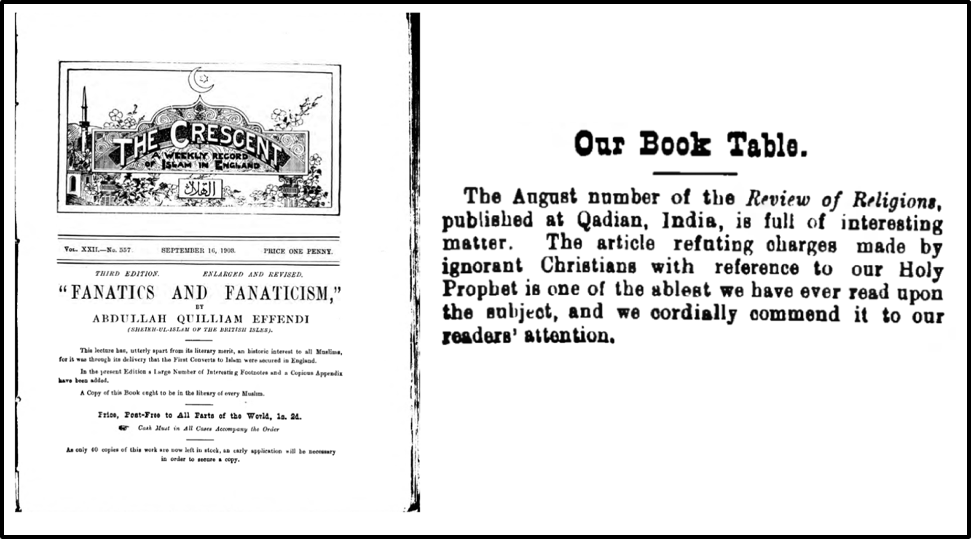
In 1903, Abdullah Quilliam was promoting the Ahmadiyya newspaper Review of Religions to his own customers, thus proving that there was collusion between the Ahmadiyya Movement at Qadian and “White Prophets” like Abdullah Quilliam (See “The Crescent” of 16th September 1903).
In 1907, MGA mentioned Quillam and said that he was better than Alexander Webb. (See Malfuzat-9, online English Edition, pages 137-139, via Al-Hakam, vol. 11, no. 8, p. 9, dated 10 March 1907). MGA seems to dislike Alexander Webb, since he quit Ahmadiyya in 1891-1892. After joining Islam, he seems to have disappeared in 1908 and returned to the UK under a fake name. He then allegedly hid out with the Lahori-Ahmadi’s and other liberal Muslim converts. In reality, he seems to be a double agent and was working politically for the British Government and spying on the Ottomans.
In March 1920 Quilliam presided over a meeting at the Woking Mosque addressed by the visiting Indian Khilafat Delegation led by the famous nationalist leader Mohamed Ali Jauhar. See at this link a brief report of the visit.
There is a short, silent newsreel film clip of this occasion available made by British Pathe in which Quilliam (as Prof. Leon) can be seen, which is on YouTube at this link:
- From 13 secs to 17 secs, Quilliam can be seen sitting behind the impassioned speaker, Mohamed Ali Jauhar.
- From 30 secs to 34 secs, Quilliam can be seen coming out of the Mosque, along with other people.
2. There is a similar newsreel film clip of Eid-ul-Fitr at the Woking Mosque in 1924. Correlating this with The Islamic Review for June 1924, this would be the Eid-ul-Fitr on Sunday 4th May 1924. This is on YouTube at this link:
- From 16 secs to 21 secs Quilliam is seen sitting on the ground, wearing hat.
- From 24 secs to 35 secs, in the scene of the prayer, Quilliam is in the front row behind the Imam, three places to the right of the Imam (as you look at picture).

______________________________________________________________________________________________
Writings by Quilliam in The Islamic Review
We find learned articles by Prof. Leon regularly appearing in early issues of The Islamic Review. A list of his first few articles and the issues in which they appeared is as follows:
- Acrimu-al-Hirrah! — Respect the cat. A poem. December 1914 issue, p. 546–547.
- Islam, A Rational Faith. January 1915, p. 24–25.
- The Prophet and the Jew. A poem. February 1915, p. 73–74.
- The Second Pledge of Akaba. April 1915, p. 182–187.
- Review of Leaves from Three Ancient Qurans. May 1915, p. 239–250.
- In praise of the Prophet. A poem. June 1915, p. 286.
- Islam and Temperance. A lecture delivered in London on 10th April 1915. Part 1 in June 1915 issue, p. 310–321.
- Islam and Temperance. Part 2 in July 1915 issue, p. 368–378.
- Id-ul-Fitr in England. Report of Eid at Woking in August 1915, in the September 1915 issue, p. 445–447.
The article The Second Pledge of Akaba listed above, in the April 1915 issue, is headed by a note from the Editor containing some biographical details about the author. Its scanned image is displayed below:
______________________________________________________________________________________________
His first interaction with Ahmadiyya happened in 1905 (See the ROR of Nov-1905, page 448)
He heard about the ROR being a free journal and provided a list of people who might benefit from this. The ROR acknowledged his title as Shaykh al-Islām for the British Isles. Abdul Hamid II, the 26th Ottoman Caliph, granted Quilliam the title of Shaykh al-Islām for the British Isles in the early 1890’s. The Emir of Afghanistan recognised him as the Sheikh of Muslims in Britain and he was appointed as Persian Vice Consul in Liverpool by the Shah. However, his knowledge of Islam is totally unknown. I haven’t read his English newspapers either. In 1889, he first published The Faith of Islam, which was concerned with dawah to Islam and its key principles. Initially, 2,000 copies were published, but a further 3,000 copies were produced in 1890. Quilliam also published The Crescent, a weekly account of Muslims in Britain, and Islamic World, a monthly publication with a worldwide audience. Quilliam purchased numbers 8, 11 and 12 Brougham Terrace, Liverpool, following his conversion, thanks to a donation from Nasrullah Khan, Crown Prince of the Emirate of Afghanistan. 8 Brougham Terrace became the Liverpool Muslim Institute, the first functioning mosque in Britain; it opened on Christmas Day, 1889. Quilliam also opened a boarding school for boys and a day school for girls, as well as an orphanage, Medina House, for non-Muslim parents who were unable to look after their children and agreed for them to be brought up as Muslims.
Quilliam’s work in Liverpool stopped when he left England in 1908 in advance of being struck off the Roll of Solicitors for unprofessional conduct as a solicitor. His son swiftly disposed of the property that had been used as a mosque and Islamic centre. Without Quilliam’s influence and funding, the Muslim community in Liverpool dispersed.
_____________________________________________________________________________________________
1870’s
See Bowen, A History of Conversion to Islam in the United States, Volume 1, White American Muslims before 1975)(See also “Islam in Interwar Europe” by Clayer and Germain, it is also on the Ahmadiyyafactcheckblog
In the 1870’s, Quilliam began joining Masonic organizations and by the early 1880s was heading the Liverpool-based Ancient Order of Zuzimites, a fringe group that was featured in The Kneph, Yarker’s Ancient and Primitive Rite journal edited by Mackenzie. The circumstances of Quilliam’s late 1880s conversion to Islam are rather vague, but it was probably influenced by the various Muslim-Masonic theories as well as Quilliam’s 1880s travels in North Africa. Bowen called him a Masonic Islamophile and explained how Quilliam was an important member of John Yarker’s para-Masonic Sat B’hai and Ancient and Primitive Rite groups. He was also in communication with Muslim Masons from around the world and was perhaps the first white Western Mason to identify exclusively as a Muslim (See Bowen, A History of Conversion to Islam in the United States, Volume 1, White American Muslims before 1975)(See also “Islam in Interwar Europe” by Clayer and Germain, it is also on the Ahmadiyyafactcheckblog).
_____________________________________________________________________________________________
1885
Nov
Quilliam, Shaykh Abdullah (1885). “The Mysteries of Moslem Theology,” The Kneph, November 1885: 58-60
https://www.academia.edu/42735082/_The_Mysteries_of_Moslem_Theology_Sheikh_Abdullah_Quilliams_First_Published_Writing_on_Islam_from_1885_in_the_Kneph_Freemasonry_journal_
https://www.everydaymuslim.org/blog/the-mysteries-of-moslem-theology-sheikh-abdullah-quilliams-first-published-writing-on-islam-from-1885/
In 1885, Quilliam, Shaykh Abdullah (1885). “The Mysteries of Moslem Theology,” The Kneph, November 1885: 58-60. The Kneph was a well known Masonic newspaper.

_____________________________________________________________________________________________
1889
Click to access Faith-of-Islam-Abdullah-Quilliam.pdf
https://www.newspapers.com/image/391356274/?match=1&clipping_id=new
In 1889, he first published “The Faith of Islam”, which was concerned with dawah to Islam and its key principles. Initially, 2,000 copies were published, but a further 3,000 copies were produced in 1890. The third edition was published in 1892 after 5000 copies had sold out.
In 1889 (Nov), the Moslems of the Liverpool institute allege that women should share mosques with men with no separation. They allege that permission was given by “Shaikh ul Islam” at Constantinople (Ottoman Empire)(See the Daily News of Sat, Nov 02, 1889 ·Page 5).

_____________________________________________________________________________________________
1890
Liverpool Mercury, etc. of Mon, Jun 02, 1890 ·Page 6
https://www.newspapers.com/image/815357214/?match=1&clipping_id=new
In 1890 (June), the “Liverpool Moslem Institute” was mentioned (See the Liverpool Mercury, etc. of Mon, Jun 02, 1890 ·Page 6).

_____________________________________________________________________________________________
1890
Aug
Evening Express of Fri, Aug 29, 1890 ·Page 4
https://www.newspapers.com/image/962425576/?match=1&clipping_id=new
In 1890 (Aug), an advertisement by the Liverpool Mahomedan Institute appeared in the Evening Express of Fri, Aug 29, 1890 ·Page 4. An address is given, Brougham Terrace, West Derey Road. Speeches will be given on Sunday, Next, 11 am and 7 pm by Maulvi Rafinddin Ahmed.

_____________________________________________________________________________________________
1890
Oct
The Times of Mon, Oct 13, 1890 ·Page 3
https://www.newspapers.com/image/33186322/?match=1&clipping_id=new
In 1890 (Oct), Rafiuddin Ahmad, Vice President of the “Liverpool Moslem Association”, wrote a letter to the editor of “The Times” of Mon, Oct 13, 1890 ·Page 3.

_____________________________________________________________________________________________
1891
Apr
Liverpool Daily Post of Mon, Apr 20, 1891 ·Page 7
https://www.newspapers.com/image/800108940/?match=1&clipping_id=new
In 1891 (Apr), the Liverpool Daily Post of Mon, Apr 20, 1891 ·Page 7, reported about the First Moslem Marriage in England. The pseudo-Muslims in Liverpool represent the center of Islam in England. The mosque at Woking is also mentioned and described as simply lodging for college students. Mr. W.H. Quilliam, a well known lawyer is the leader and there seem to be 50 members. All white converts. Maulvi Mohammed Barkatullah was there too. The minister of Education for Armenia was there too, a man named Mohammed Ubeid Ullah. The Ottoman consul general was there too, a man named Mr. D. Mavrogordato. The marriage ceremony was read by Mr. Rafiuddin Ahmad.

_____________________________________________________________________________________________
1891
Liverpool Echo of Fri, Jun 05, 1891 ·Page 3
https://www.newspapers.com/image/796848739/?match=1&clipping_id=new
In 1891 (Jun), the Liverpool Echo of Fri, Jun 05, 1891 ·Page 3 reported that Mr. Quilliam had returned from Turkey. Mr. W.H. Quilliam, solicitor, is the leader of the Liverpool Mahomedans. Quiliiam was in Constantinople for 2 months. April-May-June-1891. Quilliams son was made into an honorary Turkish soldier. His son’s new name is R. Ahmad Quilliam Bey, Bimbi Raeehi in the Household cavalry of his Imperial Majesty, the Sultan of Turkey. Bey is a rank. Quilliams son is getting paid too. They both wore the fez.

_____________________________________________________________________________________________
1891
Dec
The Colonies and India of Sat, Dec 05, 1891 ·Page 24
https://www.newspapers.com/image/35682376/?match=1&clipping_id=new
In 1891 (Dec), The Colonies and India newspaper of Sat, Dec 05, 1891 ·Page 24 reported about Mahomedanism in Liverpool and gave a list of converts, of which W.H. Quilliam is also mentioned. 14 women and 24 men. No woman from the Quilliam family have converted to Islam.

______________________________________________________________________________________________
1893
St. Louis Globe-Democrat of Sun, Sep 03, 1893 ·Page 30
https://www.newspapers.com/image/571311606/?match=1&clipping_id=new
In 1893 (Sep), the St. Louis Globe-Democrat of Sun, Sep 03, 1893 ·Page 30 called Webb as “Islam’s Champion” and gave his conversion to Islam story. The headlines allege that Webb‘s studies in Manila and his reception in India made him convert to Islam. The newspaper also alleges that the origin of Webb as a missionary as a valid idea will also be told and how Webb plans to spread Islam in America via the benefits of polygamy. In the article, Webb is interviewed, Webb alleges to have made more converts in America than any Christian missionary in any foreign country. Webb alleges to have started “study” circles in Colorado, NY and Washington DC. Webb alleges that his converts have converted to Islam on their own, Webb has not seen many of these alleged converts. Webb alleges that as early as 1885, he had secured the job as American consul in Manila. Webb alleges that he studied Islam while in Manila and converted alone. Webb admits to being funded by Indians. Webb alleges to not be the first ex-Christian turned Muslim and mentions Quilliam and his mosque in Liverpool and alleges that they have a membership of 800. Webb says that he met Haji Abullah Arab through Budrudin Abdullah Kur, Webb alleges to have converted to Islam 4 years prior (1889, he would have been in Manila). Budrudin Abdullah Kur is a member of the municipal council in Bombay. Webb says that he had been corresponding with Budrudin Abdullah Kur while in Manila. In March of 1892, Webb says he was visited in Manila by Haji Abdullah Arab and Maulvi Seraj uddin Ahmad. Webb was requested to make a budget of costs for a mission in America. At which point, Haji Abdullah Arab and Maulvi Seraj uddin Ahmad returned to India and collected the monies. They then sent Webb a letter and Webb immediately came to Bombay, India. Thus, a committee was formed with a man named Hajee Nur Jan Mohammed as the President. Webb then alleges to have arrived in Calcutta and was greeted by 5000 Muslim men. Webb alleges that the British government sent spies to watch him. Webb alleges to have went to the Madrassa College in Calcutta and gave a speech. However, the local authorities stopped all of this and Webb found a bungalow from where he spoke and people met him. Webb alleges to have travelled to Hyderabad (Deccan) thereafter and was received well, in fact, Webb alleges that the prince of Hyderabad (Deccan) regularly entertains notable Europeans. Webb says he was in Hyderabad (Deccan) for 3 weeks, however, he never met the prince and commented that the British Government watches him via spies when he eats. Webb says that the prince is totally controlled by the British government. Webb alleges to have lectured in the state pavilion at Hyderabad (Deccan) in the public gardens and got huge ovations. Webb also alleges to have spoke at the Great mosque in Hyderabad (Deccan) and Indians were ready to die for him. Webb alleges that the British Government has totally brainwashed Indians to believe that the Russians will attack at anytime, thus, the British aren’t that bad, even though the taxes are really high. Webb explains how the majority of the population at Hyderabad (Deccan) are Buddhist and Hindu’s and with the British if the Muslims ever revolted. Webb says he doesn’t teach polygamy. Webb argues that in American, women are homeless and living on the streets and thus polygamy would be better. Webb alleges that most Muslims only acknowledge one wife and the others are simply wives. Webb then alleges that his friend and financier, Haji Abdullah Arab was the son of a rich man and gave away all of his money to charity. Haji Abullah Arab was then homeless. However, everything changed recently and he became rich again and has homes in Caclutta, Jeddah and Medina. Webb alleges that Haji Abdullah Arab owns several iron steamers via a Hajj business. Webb says that he expects the arrival of a new helper named Mullah Mirza Khan next week as well as his team, which includes a Hafiz, an English clerk, a Maulvi and a cook. Webb says that this other visitors are Hajee Rahmatullah, Hajee Dawood, Maulvi Hassan Ali. Additionally, Webb alleges that some other people might come, Hajee Mohammed Abdus Salam of Madras (he is a wealthy merchant and his brother is the Turkish council), Jan Mohammed is another potential visitor, and a rich merchant of Calcutta and another person, Hajee Haroon Joffer Yusuf, a wealthy merchant from Poona. Webb alleges that when he arrived in Burma, some Muslims asked him to take the name of Abdullah, however, he arrived in India and ended up taking the name of Muhammad. Webb confirmed that Muhammad (Saw) was the comforter that was described in the Bible by Jesus (as) and would come specifically after the death of Jesus (as).


______________________________________________________________________________________________
1895
Bowen, A History of Conversion to Islam in the United States, Volume 1, White American Muslims before 1975
https://books.google.com/books/about/A_History_of_Conversion_to_Islam_in_the.html?id=DYljCgAAQBAJ
Somewhat surprisingly, Quilliam’s Institute continued to have a small American presence for a few years, even after the departure of Lant, Nabakoff, and Keep. It seems, judging by the number of appearances of Americans in Quilliam’s journal, the Crescent, by 1895 it had become the main competitor for Webb’s Islamic newspaper. That year, Quilliam’s magazine published
numerous stories and news briefs concerning Nabakoff, Lant, and Keep, as well as several letters from Americans—including converts, Muslim immigrants, and non-Muslim sympathizers—known to be associates of the three Webb dissenters (See Bowen, A History of Conversion to Islam in the United States, Volume 1, White American Muslims before 1975).
_____________________________________________________________________________________________
1900
Quilliam, Abdullah (1900). “The Islamic Path,” The Islamic World Vol. 6. No. 63: 33-52
_____________________________________________________________________________________________
1901
Quilliam, Abdullah (1901). “Islam the Absolute Religion,” The Islamic World Vol. 6, No. 66: 140-160. Vol. 6. No. 67: 141-182.
______________________________________________________________________________________________
1903
The Crescent 16th September 1903
In 1903, Abdullah Quilliam was promoting the Ahmadiyya newspaper Review of Religions to his own customers, thus proving that there was collusion between the Ahmadiyya Movement at Qadian and “White Prophets” like Abdullah Quilliam (See The Crescent of 16th September 1903).
______________________________________________________________________________________________
1904
Abdullah Quilliam < The Woking Muslim Mission, England, 1913-1960s
Review of Religions, February 1904, pages 65–66.
In the issue of the Review of Religions for February 1904, the death of Lord Stanley of Alderley, a convert to Islam, is reported and an account of his funeral and burial is quoted from The Crescent. This is as follows.
Death of a Muslim member of the House of Lords
That the late Henry Edward John Stanley, third Baron Stanley of Alderley, was a sincere and devout Muslim, was known to very few men. Readers of the Safwat-ul-Itbar (Travels of Sheikh Muhammad Bairam Fifth of Tunis), however, knew very well that Lord Stanley had long been a sincere believer in the principles of Islam. But his faith was not limited to a profession by word of mouth. The author of the Safwat-ul-Itbar relates incidents which show how deeply Islam had entered into his heart. He found him not only regular in the five daily prayers, but also constant at tahajjud (the midnight prayers); and what is still more wonderful, he found him very humble in his prayers, and far above most born Muhammadans. When he talked of the Holy Prophet, it was with profound love and deep respect that he mentioned or named him. He found him also very well versed on the principles of Muslim theology, and in his conversation with him he found that the deep conviction of his mind was the result of a comprehensive knowledge of the principles of Islam. This was about the year 1880. Who could imagine that such a sincere and devout worshipper of the true God was living in the heart of Christendom?
Lord Stanley breathed his last on Friday, the 21st day of Ramadan (corresponding with 11th December 1903). It appears from the “Crescent” that his Muslim name was Abdul Rahman. The Crescent gives the following account of his interment:
“On Tuesday, the 25th Ramadan (15th December) his mortal remains were laid silently to rest in a secluded plantation in Alderley Park, his late lordship’s ancestral home. The interment took place at an early hour, and was conducted strictly according to Muslim usage, in which Holy and Imperishable Faith his lordship lived and died (Alhamd-o-lillah!) The corpse was inclosed in a plain deal coffin, and borne from the hall by workmen on the Alderley estate. Following it on foot were the successor to the title (the Hon’ble Lyulph Stanley), his wife, their two sons, and other relatives. By the late Lord Stanley’s special direction there was also present as chief mourner his Excellency Hamid Bey, Premier Secretaire to the Ottoman Embassy in London. The Islamic prayers were recited over the grave by the Imam to the Turkish Embassy. A Janaza service in memory of the deceased was held at the Liverpool Mosque, and was conducted by His Honour Abdulla Quilliam Effendi, Sheikh-ul Islam of the British Isles.”
So lived and passed a noble soul, and this must no doubt be a “terrible blow” to the orthodox Christians as the Freethinker says, which corroborates this account of Lord Stanley’s death and burial. May God receive him into His mercy and open the eyes of other Christians to the shining lights of the true and living faith of Islam! Amen!
______________________________________________________________________________________________
1904
Shaykh Abdullah Quilliam (June 22, 1904). “as-Zahir-ud-Deen,” The Crescent, Vol. XXIII.—No. 597: pages 387-391, 394-396.
_____________________________________________________________________________________________
1905
Quilliam writes in the ‘Review of Religions’
In the November 1905 issue of the Review of Religions an item appears under the title Islam in England which runs as follows:
‘ Learning of the free offer of our journal to inquirers in Europe, America, Japan and other countries, Sheikh Abdulla Quilliam, Sheikh-ul-Islam of the British Isles, writes to us:
“I enclose you a preliminary list of a few persons who I feel sure would greatly appreciate your offer of supplying your journal free. I only wish that we could offer to do the same with our journals, the Crescent and Islamic World, but unfortunately our funds do not permit, in fact we run both our papers at a loss and we find it most difficult to get subscriptions in for the same. As for contributions to the maintenance of the work here, we do not receive any from abroad and have not done so for many years. I understand that there are people in India who are professing to make collections for the Liverpool Muslim Institute. All I have to say is that such persons are utterly unauthorised by us so to do and that no funds are being remitted to us and have not been for many years now last past.”
I am sorry to see that even such a paper in which the whole Muhammadan world should have interest does not pay its expenses. From the vast number of English-knowing Muhammadans in India, one should have expected a circulation of thousands in this country alone. The cause of Islam in England should be the cause of every Muhammadan. ’
— Review of Religions, November 1905, p. 448.

On the page opposite in the above issue of the Review of Religions, among the advertisements there is one about The Crescent and The Islamic World. Given below is its scanned image:

_____________________________________________________________________________________________
1906
The Teachings of Islam.—Self-Reliance. A lecture delivered at the Liverpool Mosque, on Sunday evening, the 25th Dhulkaada, 1323 ( January 21, 1906), by His Excellency Sheikh Abdullah Quilliam Bey Effendi, Sheikh-ul-Islam of the British Isles. The Crescent January 31, 1906: pp. 67-71
_____________________________________________________________________________________________
1907
Malfuzat-9, online English Edition, pages 137-139
Al-Hakam, vol. 11, no. 8, p. 9, dated 10 March 1907
13 February 1907
(At the time of Zuhr)
Mention of Mr Webb
Mufti Sahib read a letter to the Promised Messiah as from Mr Webb, a resident of America.
The Promised Messiah as said:
If Webb had made a heartfelt effort, it would surely have affected people because:
د لاجرم بر دل ی نش ن ید د سخن کز دل برون آ
A statement that comes from the heart certainly affects the heart of others.
Why does Webb curse the people of America, he should curse his own heart. He did not pay full attention to our Movement, rather, he went back from India uttering abuse. In my view, Abdullah Quilliam is far better than him for he has established a community of Muslims.
The learned [Maulawi Muhammad Ahsan] Amrohi submitted: At the time when Webb had intended to visit Qadian, Hudur had prophesied that he will not come here and will turn back. Moreover, he did not attain the objective for which he had turned back. Accordingly, he was regretful after returning.””
______________________________________________________________________________________________
1908
Quilliam’s work in Liverpool stopped when he left England in 1908 in advance of being struck off the Roll of Solicitors for unprofessional conduct as a solicitor. His son swiftly disposed of the property that had been used as a mosque and Islamic centre. Without Quilliam’s influence and funding, the Muslim community in Liverpool dispersed.
______________________________________________________________________________________________
1914
http://www.wokingmuslim.org/work/bm-soc1.htm
He returned to the UK before December 1914 under the name of H. M. Leon. A Henri Mustapha Leon, aged 55, living in St Pancras, London, appears in the Census of April 1911.
______________________________________________________________________________________________
1915
The Islamic Review, January 1915
First public meeting of the British Muslim Society at Woking Mosque, December 1914
|
In The Islamic Review for January 1915, pages 4 to 7, there is a report of the first public meeting of the British Muslim Society. One notable point is that this meeting was addressed by Prof. H. Mustafa Leon, who was in fact the same person as Abdullah Quilliam. After leaving England in 1908, his departure bringing his Liverpool Muslim centre to an end, he returned back to England within a few years and used the name Professor H.M. Leon. We find him participating in functions at the Woking Mosque and writing in The Islamic Review.
Below we reproduce in text form the report of the meeting of the British Muslim Society. It can also be read in the scanned image of the January 1915 issue of The Islamic Review available on this website.
THE BRITISH MUSLIM SOCIETY.
PUBLIC MEETING IN THE MOSQUE, WOKING.
A large gathering assembled in the Mosque, Woking, on Sunday, December 20, on the occasion on the first Public Meeting of the British Muslim Society, a gathering which included many distinguished people. The proceedings opened by the reading of a letter from Yehya-en-Nasr Parkinson, F.G.S., M.B.A.S., the Hon. Vice-President of the Society, who was unfortunately unable to be present. It is to be found upon another page.
Then the Right Hon. Lord Headley, B.A., M.I.C.E.I., F.S.E., delivered the Presidential Address, which is printed in full elsewhere in the Islamic Review. He was followed by our brother, Prof. H. Mustafa Leon, Ph.D., LL.D., P.S.P., who spoke with intense feeling. He pointed out that he had belonged “to the Faith most excellent” for thirty-one years, and gave us an account of the meeting in Morocco at the table of a Jew, a Muslim, and a Christian (as he was then), where, in a friendly way, they commenced to investigate those points upon which they agreed. One learned brother pointed out that all consented to the belief in the One Supreme Ruler of the Universe, the Provider of everything, and consented in the revelation made to Adam for the guidance of mankind. Further, they all accepted the Divine mission of Noah. The Professor showed that when the needs of the time demanded a further revelation from Allah, He sent a guide to teach mankind His will. Then Abraham came; and Muslim, Jew and Christian still were in complete accord. Then the great Law was revealed through the Prophet Moses, and each still agreed. Thus far Muslim, Jew, and Christian were in complete harmony; but then came the point of divergence. Yet another revelation was made by Allah through the person of the Prophet Jesus; here the Jew could not travel with the others, but still the Muslim and Christian were in accord; each accepted the Injil, the Gospel of Jesus. Then the Muslim said to Prof. Leon:
“You think your creed superior to that of the Jew because you have a later revelation, but Islam is superior to your creed, for we have an imperishable revelation in the Holy Quran given through our Blessed Prophet Muhammad (peace be ever to his soul !).”
The Professor pointed out that this is Islam; it is the same creed, the same simple guidance given by Allah to man since the commencement of time, and Islam confirms the earlier revelations, and Muhammad brought everything to perfection, and he was the “Seal of the Prophets,” as the Holy Quran is the final Word of Allah. He recounted when a man came to our Holy Prophet and said that he was an unlettered, an uneducated man, and he desired to know one thing about Islam which he could follow, and he promised to try his utmost to do so. Our Holy Prophet replied, “Do no evil.” The man departed, and in a year’s time returned and said to Muhammad, “It was hard, very hard, but I managed to act up to your words, I have done no evil, tell me more.” Then Muhammad replied, “Speak no evil,” and again the man departed. He returned after another year had elapsed and said, “It was a harder task, but I have succeeded; I have spoken no evil, tell me more.” Then Muhammad said to him, “Think no evil,” and the man again left the place. He came to the Prophet at the end of another year and said, “The task was the hardest of all, but I have accomplished it; I have thought no evil, tell me more.” The Holy Prophet replied with a smile, “There is no more, thou art a Muslim.” The Professor asked those present if this was not a creed to be proud of, a creed that taught us to “Do no evil, speak no evil, think no evil,” and was it not a creed to teach in the West?
He urged those present who had not accepted Islam, but who by their presence showed their sympathy with the movement, to study Islam for themselves, and to remember that Islam was the fulfilment and final completion of those revealed religions, Judaism and Christianity, which preceded the final revelation made to man from Allah by our Holy Prophet Muhammad.
The next speaker was our brother, Captain Abdur Rahman Stanley Musgrave, who wore uniform. He proposed a vote of thanks to the President, Lord Headley, and said that he had been a nominal follower of the Church of England, and on reading a copy of Samuel Laing’s book, “A Modern Zoroastrian,” he began seriously to consider his own beliefs. He placed himself in the hands of good teachers, and the rev. father of the Holy Catholic Church said to him, “You will never make a Catholic, you want to know too much.” Captain Musgrave pointed out that he could progress up to a certain point and then he was required to probe no further, but to “believe.” He again studied the teachings of the Anglican Church, and felt that he was not a Churchman. He went to the Congregationalists and the other sects, studying seriously their tenets, but with no satisfaction. He then read a book on “Islam,” by Major Leonard, and came to study it deeply. He had served in South Africa, India and Egypt, and he placed these writings side by side with his own personal knowledge of Muslims in the East. He found that the simplicity, the lack of dogma, the high plane of spiritual thought which Islam promulgated found an echo in his own thoughts — that he was a Muslim. He appealed to those present to investigate Islam, to study the life of Muhammad, and to think seriously for themselves about religions matters which are so vital to our prosperity. He was very happy to be present and wished to propose a vote of thanks to their President, Lord Headley.
He was followed by a Woking Muslim, our brother Ahmed Welch, M.B.M.S., who seconded the vote of thanks. He pointed out that Islam was cosmopolitan, and that all were brethren who embraced its teachings. He remarked how happy we were to have with us our brothers Lord Headley, Prof. Leon, Captain Musgrave and others, and paid a tribute to Khwaja Kamal-ud-Din, whose efforts had made this movement possible. He had laboured, and the present gathering was a visible sign of the success of his efforts. He hoped a great future for the British Muslim Society, which would bring more closely together all those British Muslims, who, though separated by distance, were yet one fraternity.
He was followed by Maulvi Sadr-ud-Din, B.A., B.T., the Imam of the Woking Mosque, who supported the vote of thanks to the President. He pointed out the democratic spirit of Islam, where all men meet as brothers, whether of high rank or simple men, white or coloured, all Muslims from whatever part of the world they came. This spirit of brotherhood made us sympathise with the Turks, who are Muslims. Whether Indian or Turk, yet this bond of brotherhood made us feel for them. He said that it was a matter for great regret that Muslim was pitted against Muslim; but Islam also teaches us loyalty, and so we must serve his Majesty the King, whose subjects we are. He agreed with Lord Headley that the essentials of Islam were the necessary factors, and recounted how Muhammad (on whom be peace !), when sending forth Mu‘az as the Governor to the Province of Yemen, told him to preach first of all the Unity of God, not mentioning the name of Muhammad even, then, when the people had firmly grasped this central belief, to teach them the prayers and the other beliefs of Islam. He said that many people of enlightenment had embraced Islam after a careful study of its teachings, and the community in the West was increasing daily. The misrepresentations were being exposed, and the truth of Islam reached many hearts. Many people were really Muslim although they themselves were ignorant of Islam. He was happy to inform them that last week three people embraced Islam, thus swelling the already large number of British Muslims, and that only that very morning in the presence of Prof. Leon, Captain Musgave, Muhammad Woodward, Khalid Sheldrake, and Mr. Perkins of London, a gentleman had made a declaration of faith in Islam, and the name Yahia was given to him.
During this day the full force of Islamic Brotherhood was brought home to all. In the daily prayers Lord Headley, Prof. Leon, Captain Musgrave, Muhammad Woodward joined with the rest of the community, following Maulvi Sadr-ud-Din in the prostrations. Those who take exception to the Islamic prayer should have been present and seen the complete accord of East and West in the fold of Islam. At the table, in conversation, there was no rank, whether that of private or captain, peer or commoner, professor or student, rich or poor, but all were on terms of equality, fraternising with true Islamic feeling. Here was an object-lesson for the people in the West. Islam has succeeded in abolishing all those invidious caste distinctions which form a barrier between man and man, and whilst others preach brotherhood, we in Islam practise it in our daily life. In Islam the brotherhood of man is an actual reality. It was a happy day, and one felt that this inaugural meeting of the Society boded well for its future.
Lord Headley rose, thanking those present, and concluded the proceedings with prayers, in which he prayed for the successful guidance of his Majesty the Sultan of Egypt, for the spiritual sustenance of all Muslims, and for the proper guidance of mankind so that this terrible war should cease and mankind again be dwelling in amity.
KHALID SHELDRAKE, M.S.P.
(Hon. Secretary).
The letter from Yehya-en-Nasr Parkinson read at the meeting, as mentioned in the above report, is printed in the same issue as below:
Byres Road, Kilwinning, December 17, 1914.
Glad to hear that the meeting of the British Muslim Society will be held on Sunday first, and regret that I cannot be with you on the auspicious occasion. Islam has now gained a secure footing in Britain, thanks principally to the energy and self-sacrifice of our brother Kamal-ud-Din and a few pioneers, who laboured hard for the same end some years previously. His generous action was the deciding factor; it gave us a periodical to expound our views in, and to draw the aims and ideals we held to the attention of others; while his personal power acted as a cementing-link between us and the brethren in the East. The tree of Islam is flourishing in Britain; it has borne fruit, and the British Muslim Society is the first offerings of its activity. May it flourish more abundantly in the future. Such a society was badly wanted — urgently needed to fulfil in reality the command of the Prophet on the hill without Mecca after the fall of the city; the command that all Muslims should be brothers. The Society will, I trust, keep us in touch with each, though separated by miles of land; bind us together into one great brotherhood; help us along the Islamic pathway; and strengthen each and all of us to play our part in the battle of life and the defence and exposition of those eternal principles of human conduct and Islamic religion and doctrine for which we are fighting. It. will, I hope, also serve to keep us in touch with the other parts of our world-wide brotherhood. Union is strength. May it be a uniting link not only between every British Muslim but between us and the Muslims everywhere, consolidating and binding the whole into one unbroken and unbreakable chain, stretching through the Orient and Occident, Africa, and the South and North American States. We have now planted the banner of Islam in the heart of the British Empire, its silken folds are fluttering on the breeze, good and noble men and true and gentle women are rallying beneath it. Let us keep it flying on the winds unstained, untarnished, as spotless as when it was first unfurled on Arabia’s burning sands over fourteen hundreds years ago. We are all privileged to do so — privileged to be among the first of our race to defend the principles for which it stands, to fight for truth against calumny and misrepresentation, and to declare undaunted the faith that is in us and of us. Our heritage is a glorious one; be it ours to maintain it unsullied, and to hand it on undimmed to those who may follow after us, leaving to the generations yet to be an example of which they may be proud, and which will enable them to tread more securely the paths of justice and truth, and help them to climb to higher heights than we shall ever climb and limn ideals we never saw or dreamt of. “Fear not, the future shall be better for thee than the past.” Be earnest, be honest in your endeavours in the cause you have pledged yourselves thereto. Work, for by work only can the aim be realised and the duty accomplished. Strong of heart and steady of hand, and faithful in all your dealings, even as he was, whom the Arabs of the desert called Al-Amin, and victory will crown your efforts. On for Islam!—Yala-al-Islam! let that be your war cry, that your watchword, and ye shall prevail. May Allah be with you all!
As-Salam Aliekoum,
YEHYA-EN-NASR PARKINSON.
_____________________________________________________________________________________________
1920
https://www.wokingmuslim.org/pers/khilafat.htm
Quilliam in photographs and newsreel film clips of Woking Mosque
1. In March 1920 Quilliam presided over a meeting at the Woking Mosque addressed by the visiting Indian Khilafat Delegation led by the famous nationalist leader Mohamed Ali Jauhar. See at this link a brief report of the visit.
There is a short, silent newsreel film clip of this occasion available made by British Pathe in which Quilliam (as Prof. Leon) can be seen, which is on YouTube at this link:
- From 13 secs to 17 secs, Quilliam can be seen sitting behind the impassioned speaker, Mohamed Ali Jauhar.
- From 30 secs to 34 secs, Quilliam can be seen coming out of the Mosque, along with other people.
______________________________________________________________________________________________
1924
https://www.youtube.com/watch?v=OLb3np3m5Ws&feature=youtu.be
There is a similar newsreel film clip of Eid-ul-Fitr at the Woking Mosque in 1924. Correlating this with The Islamic Review for June 1924, this would be the Eid-ul-Fitr on Sunday 4th May 1924. This is on YouTube at this link:
- From 16 secs to 21 secs Quilliam is seen sitting on the ground, wearing hat.
- From 24 secs to 35 secs, in the scene of the prayer, Quilliam is in the front row behind the Imam, three places to the right of the Imam (as you look at picture).
At this link you can read the full report of this Eid in The Islamic Review for June 1924. The Imam, according to the report, was Khwaja Nazir Ahmad, son of Khwaja Kamal-ud-Din.
______________________________________________________________________________________________
1929
Abdullah Quilliam < The Woking Muslim Mission, England, 1913-1960s
In 1929 a brief booklet Islam in England was published, written by Sheikh Mushir Hosain Kidwai of Gadia, who was closely involved in the Woking Muslim Mission. Kidwai was living in England during the latter part of Quilliam’s Liverpool activities and afterwards, and had met him.
______________________________________________________________________________________________
1931
At this link Quilliam (as Prof. Leon) can be seen in a large group photograph of those present at Eid-ul-Fitr, 19th February 1931, printed in The Islamic Review, March-April 1931 issue.
At this link there is another large group photograph showing Quilliam (as Prof. Leon) at a function at the Woking Mosque in on 7th June 1931, printed in The Islamic Review, August 1931 issue.
(The Islamic Review, August 1931)

Group photo from Id-ul-Fitr, February 19th, 1931
(The Islamic Review, March-April 1931)

At the request of the Imam, the prayers were led by His Excellency Sheikh Hafiz Wahba, the Ambassador of Saudi Arabia to London.
This photograph was reprinted in The Islamic Review, January 1967, as a centre spread on pages 20–21. In that printing, the names of four people in the photograph are pointed out. One of them is Dr M. Leon, i.e. W.H. Quilliam. He is the first on the left in the row of people seated on chairs. Below is an expanded view:

______________________________________________________________________________________________
1932
Death
 This section ‘Death’, added 9 March 2023
Quilliam died on 23 April 1932. His funeral took place on 28 April. A report of it appeared in The Surrey Advertiser and County Times, Saturday 30 April 1932, p. 6, col. 5 (2nd from last item in column), under the heading Muslim Funeral at Woking. It reads as follows:
The funeral took place at the Muslim burial place in Brookwood Cemetery on Thursday of Professor Henri Marcel Leon, Dean of the London College of Physiology, whose death was announced on Monday. Professor Leon was well known among Muslims who are connected with the Shah Jehan Mosque at Woking, and a gathering of about 30 attended the funeral, which was conducted by Aftab-ud-Din Ahmad, the Imam of the Mosque. Lord Headley, president of the British Muslim Society, was among those who attended.
(Note: Maulana Aftab-ud-Din Ahmad was, in fact, Assistant Imam of the Shah Jehan Mosque at the time.)
A lengthy obituary appeared in The Liverpool Echo, which we have made available at this link.
Report of death of Quilliam in Lahore Ahmadiyya Urdu organ Paigham Sulh
The Urdu organ of the Lahore Ahmadiyya Movement, Paigham Sulh, published in
Lahore, also used to carry Woking Muslim Mission news. The issue for 27 May 1932 carries the news of the death of Quilliam as the main news on the front page.
Click here to view that page as a pdf file.
The translation of the article is given below:
‘
Death of Shaikh Abdullah Quilliam
Famous English Muslim convert who used a different name for 24 years
It is learnt by post from England that Shaikh Abdullah Quilliam has died at Newton Street, Gordon Square, Holborn, London.
Forty years ago the whole of the Islamic world was echoing with the fame of Shaikh Abdullah Quilliam. His original name was Mr William Henry Quilliam. He was born on the Isle of Man and was educated in Liverpool. In 1878 he became a solicitor. After becoming a Muslim, he went to Iran in 1879, where the Shah treated him as his own guest. In 1890 Sultan Abdul Hamid called him to Constantinople and later the Amir of Afghanistan invited him. In Liverpool he served as vice-consul of Iran. He visited Turkey several times. He had such close relations with Sultan Abdul Hamid that during the war someone said that if the Sultan had not been deposed, the efforts of Abdullah Quilliam would probably have prevented the war. He had comprehensive knowledge of eastern religions. Usually he dressed very simply. During his lectures he was like a river of knowledge and learning.
He knew the French, Spanish, German, Arabic and Turkish languages. He was a specialist in theology, physiology and ornithology.
Change of name
Probably in 1908 a revolution occurred in his life and he changed his name. He became Dr Henry Marcel Leon. It is not known why he changed his name. Some say it was to benefit from a will. Some say that Dr Leon was the name of a French friend of his, who died in his arms, so in memory of his friend he took his name. Anyhow, during the past 24 years no one heard the name Quilliam and it came to be generally believed that Quilliam had died. In fact, Quilliam had become Dr Leon. At the time of his death, Shaikh Quilliam was the Dean of the London School of Physiology.
Islamic work
The News of the World writes that during the war Quilliam conveyed top secret information to the British government. The accuracy of this report is not known. The Shaikh was a fervent Muslim. As Quilliam he regularly led prayers in the mosque in Liverpool, and brought about two hundred English persons into the fold of Islam. After becoming Dr Leon too, he continued to take part in Islamic activities. He maintained connection with the Woking Muslim Mission, and participated in Islamic lectures and prayers. He had an intense interest in reading. He was one of the permanent readers of the world famous British Museum Library.
The Shaikh had a wife named Maryam, an elderly, dignified lady. We have no information about her.
It is our heart-felt prayer that Allah the Most High grant the late Shaikh a place in His mercy. ’
______________________________________________________________________________________________
1940
Convert mentions attending Quilliam’s mosque
In the March 1940 issue of The Islamic Review, there is an article by a Mr. Frederick Hameedullah Bowman of Liverpool about his acceptance of Islam. He writes in it:
“When I was at school, there was a Muslim mosque in Liverpool and I attended many services there with my mother. So interested did I become that I even tried to emulate the local Sheikh, and, in a home-made robe, I mounted a box at home to address my own meeting of neighbours and spread the truths of the Muslim Faith. The mosque eventually closed, and, for some time, I was out of touch with the Faith.” (See this link for the full article.)
______________________________________________________________________________________________
Abdullah Quilliam < The Woking Muslim Mission, England, 1913-1960s
Abdullah Quilliam
as mentioned in contemporary Ahmadiyya and Woking Muslim Mission literature
Featuring historic newsreel film clips and photographs
(See below for the new material relating to his death, added on 9 March 2023.)
As is well-known and documented in several sources, William Henry Quilliam (b. 1856, d. 1932), a Liverpool solicitor, converted to Islam in the 1880s after a visit to Morocco, and upon his return began to preach Islam in the Liverpool area, gaining a small community of converts. He founded the Liverpool Muslim Institute, within whose building was a prayer room known as the mosque. This mosque is widely described as the first mosque in the U.K. He published two periodicals The Crescent Weekly and The Islamic World Monthly. This movement remained active from the early 1890s to 1908, when Quilliam left England for reasons that are not clear. The work of his mission then came to an end.
The following link on the BBC website contains information about Quilliam: BBC Legacies | Liverpool.
Quilliam in Ahmadiyya sources
Quilliam and his work is mentioned in contemporary Ahmadiyya sources of his time. The Ahmadiyya Movement, founded in the 1880s by Hazrat Mirza Ghulam Ahmad (d. 1908) in Qadian, India, regarded it as a vital part of its mission to propagate Islam in the West. Hence it established contacts with converts to Islam in the West such as Quilliam in England and Alexander Russell Webb in the U.S.A.
The Review of Religions was an English-language monthly started from Qadian in 1902 at the direction of Hazrat Mirza Ghulam Ahmad who appointed Maulana Muhammad Ali as its first editor (he was later famous as translator of the Holy Quran into English, author of numerous books on Islam, and Head of the Lahore Ahmadiyya). This periodical was regularly sent to Western countries. Following are three articles in the Review of Religions with reference to Quilliam:
- Letter by Quilliam to the Review of Religions, 1905, and advertisement of his magazines.
- Death of Lord Stanley of Alderley reported in the Review of Religions from Quilliam’s paper
- Account of Quilliam’s work by an English convert, who knew him well, in the Review of Religions, 1912
The Woking Muslim Mission and The Islamic Review
1. After Khwaja Kamal-ud-Din founded the Woking Muslim Mission and The Islamic Review in 1913, some persons earlier connected with Quilliam’s mission now became associated with the Woking Mission and began to write for this magazine. In The Islamic Review for May 1914 Yehya-en-Nasr Parkinson (the man mentioned near the end of the last account above) wrote an article entitled The Liverpool Muslim Movement. Parkinson had been connected with Quilliam’s movement.
2. In 1914 (most likely in October, but perhaps September) the Imam of the Woking Mosque, Maulana Sadr-ud-Din, went to Liverpool to trace the remains of Quilliam’s mission. His report is available at this link.
3. In 1929 a brief booklet Islam in England was published, written by Sheikh Mushir Hosain Kidwai of Gadia, who was closely involved in the Woking Muslim Mission. Kidwai was living in England during the latter part of Quilliam’s Liverpool activities and afterwards, and had met him.
Convert mentions attending Quilliam’s mosque
In the March 1940 issue of The Islamic Review, there is an article by a Mr. Frederick Hameedullah Bowman of Liverpool about his acceptance of Islam. He writes in it:
“When I was at school, there was a Muslim mosque in Liverpool and I attended many services there with my mother. So interested did I become that I even tried to emulate the local Sheikh, and, in a home-made robe, I mounted a box at home to address my own meeting of neighbours and spread the truths of the Muslim Faith. The mosque eventually closed, and, for some time, I was out of touch with the Faith.” (See this link for the full article.)
Quilliam as Professor H.M. Leon
Quilliam returned to England and thereafter went under the name Professor H. M. Leon. There are several articles in The Islamic Review by Prof. Leon. His initials H.M. usually stand for Haroun Mustapha, although his name appears sometimes as Henri M. Leon.
See here his address to the first meeting of the British Muslim Society, December 1914
Quilliam in photographs and newsreel film clips of Woking Mosque
1. In March 1920 Quilliam presided over a meeting at the Woking Mosque addressed by the visiting Indian Khilafat Delegation led by the famous nationalist leader Mohamed Ali Jauhar. See at this link a brief report of the visit.
There is a short, silent newsreel film clip of this occasion available made by British Pathe in which Quilliam (as Prof. Leon) can be seen, which is on YouTube at this link:
- From 13 secs to 17 secs, Quilliam can be seen sitting behind the impassioned speaker, Mohamed Ali Jauhar.
- From 30 secs to 34 secs, Quilliam can be seen coming out of the Mosque, along with other people.
2. There is a similar newsreel film clip of Eid-ul-Fitr at the Woking Mosque in 1924. Correlating this with The Islamic Review for June 1924, this would be the Eid-ul-Fitr on Sunday 4th May 1924. This is on YouTube at this link:
- From 16 secs to 21 secs Quilliam is seen sitting on the ground, wearing hat.
- From 24 secs to 35 secs, in the scene of the prayer, Quilliam is in the front row behind the Imam, three places to the right of the Imam (as you look at picture).
At this link you can read the full report of this Eid in The Islamic Review for June 1924. The Imam, according to the report, was Khwaja Nazir Ahmad, son of Khwaja Kamal-ud-Din.
3. At this link Quilliam (as Prof. Leon) can be seen in a large group photograph of those present at Eid-ul-Fitr, 19th February 1931, printed in The Islamic Review, March-April 1931 issue.
4. At this link there is another large group photograph showing Quilliam (as Prof. Leon) at a function at the Woking Mosque in on 7th June 1931, printed in The Islamic Review, August 1931 issue.
5. Only a week before his death, Quilliam attended the ‘Id-ul-Adha prayers at Woking held on 16th April 1932. See report of the occasion here, which mentions in the last paragraph, “Among those present”, the name Prof. Haroun Mustafa Leon. There is a large group photograph of this occasion in which Quilliam can be seen in the background; see this link.
Writings by Quilliam in The Islamic Review
We find learned articles by Prof. Leon regularly appearing in early issues of The Islamic Review. A list of his first few articles and the issues in which they appeared is as follows:
- Acrimu-al-Hirrah! — Respect the cat. A poem. December 1914 issue, p. 546–547.
- Islam, A Rational Faith. January 1915, p. 24–25.
- The Prophet and the Jew. A poem. February 1915, p. 73–74.
- The Second Pledge of Akaba. April 1915, p. 182–187.
- Review of Leaves from Three Ancient Qurans. May 1915, p. 239–250.
- In praise of the Prophet. A poem. June 1915, p. 286.
- Islam and Temperance. A lecture delivered in London on 10th April 1915. Part 1 in June 1915 issue, p. 310–321.
- Islam and Temperance. Part 2 in July 1915 issue, p. 368–378.
- Id-ul-Fitr in England. Report of Eid at Woking in August 1915, in the September 1915 issue, p. 445–447.
The article The Second Pledge of Akaba listed above, in the April 1915 issue, is headed by a note from the Editor containing some biographical details about the author. Its scanned image is displayed below:

— From The Islamic Review, April 1915, p. 182
It is evident from the biographical details provided in this note that Prof. H.M. Leon was the same person as Quilliam.
Death
This section ‘Death’, added 9 March 2023
Quilliam died on 23 April 1932. His funeral took place on 28 April. A report of it appeared in The Surrey Advertiser and County Times, Saturday 30 April 1932, p. 6, col. 5 (2nd from last item in column), under the heading Muslim Funeral at Woking. It reads as follows:
The funeral took place at the Muslim burial place in Brookwood Cemetery on Thursday of Professor Henri Marcel Leon, Dean of the London College of Physiology, whose death was announced on Monday. Professor Leon was well known among Muslims who are connected with the Shah Jehan Mosque at Woking, and a gathering of about 30 attended the funeral, which was conducted by Aftab-ud-Din Ahmad, the Imam of the Mosque. Lord Headley, president of the British Muslim Society, was among those who attended.
(Note: Maulana Aftab-ud-Din Ahmad was, in fact, Assistant Imam of the Shah Jehan Mosque at the time.)
A lengthy obituary appeared in The Liverpool Echo, which we have made available at this link.
Report of death of Quilliam in Lahore Ahmadiyya Urdu organ Paigham Sulh
The Urdu organ of the Lahore Ahmadiyya Movement, Paigham Sulh, published in
Lahore, also used to carry Woking Muslim Mission news. The issue for 27 May 1932 carries the news of the death of Quilliam as the main news on the front page.
Click here to view that page as a pdf file.
The translation of the article is given below:
‘
Death of Shaikh Abdullah Quilliam
Famous English Muslim convert who used a different name for 24 years
It is learnt by post from England that Shaikh Abdullah Quilliam has died at Newton Street, Gordon Square, Holborn, London.
Forty years ago the whole of the Islamic world was echoing with the fame of Shaikh Abdullah Quilliam. His original name was Mr William Henry Quilliam. He was born on the Isle of Man and was educated in Liverpool. In 1878 he became a solicitor. After becoming a Muslim, he went to Iran in 1879, where the Shah treated him as his own guest. In 1890 Sultan Abdul Hamid called him to Constantinople and later the Amir of Afghanistan invited him. In Liverpool he served as vice-consul of Iran. He visited Turkey several times. He had such close relations with Sultan Abdul Hamid that during the war someone said that if the Sultan had not been deposed, the efforts of Abdullah Quilliam would probably have prevented the war. He had comprehensive knowledge of eastern religions. Usually he dressed very simply. During his lectures he was like a river of knowledge and learning.
He knew the French, Spanish, German, Arabic and Turkish languages. He was a specialist in theology, physiology and ornithology.
Change of name
Probably in 1908 a revolution occurred in his life and he changed his name. He became Dr Henry Marcel Leon. It is not known why he changed his name. Some say it was to benefit from a will. Some say that Dr Leon was the name of a French friend of his, who died in his arms, so in memory of his friend he took his name. Anyhow, during the past 24 years no one heard the name Quilliam and it came to be generally believed that Quilliam had died. In fact, Quilliam had become Dr Leon. At the time of his death, Shaikh Quilliam was the Dean of the London School of Physiology.
Islamic work
The News of the World writes that during the war Quilliam conveyed top secret information to the British government. The accuracy of this report is not known. The Shaikh was a fervent Muslim. As Quilliam he regularly led prayers in the mosque in Liverpool, and brought about two hundred English persons into the fold of Islam. After becoming Dr Leon too, he continued to take part in Islamic activities. He maintained connection with the Woking Muslim Mission, and participated in Islamic lectures and prayers. He had an intense interest in reading. He was one of the permanent readers of the world famous British Museum Library.
The Shaikh had a wife named Maryam, an elderly, dignified lady. We have no information about her.
It is our heart-felt prayer that Allah the Most High grant the late Shaikh a place in His mercy. ’
Footnote by Website Editor: The “war” referred to in the above article was the First World War, 1914–1918.
_____________________________________________________________________________________________
Maulana Sadr-ud-Din visits Quilliam’s home and family in Liverpool in 1914
Maulana Sadr-ud-Din (d. 1981) arrived in England from Lahore in June 1914 to take charge of the Woking Muslim Mission, to enable Khwaja Kamal-ud-Din to return to India till 1916. Later in 1914 Maulana Sadr-ud-Din paid a visit to Liverpool to trace any remains of Quilliam’s mission, and wrote a report about his visit which was published in the Lahore Ahmadiyya Urdu organ Paigham Sulh (20 October 1914, front page). This report is translated below:{1}
“Ever since my arrival here [in England] it occurred to me again and again to check up on the Liverpool Islamic organization, to restart the work there, and re-awaken the spirit of Islam in those people. It is only by the favour of Allah that newcomers are joining the banner of the Holy Prophet Muhammad, but as regards those who have previously adopted this holy faith it is very important and useful to establish contact with them and bind them in a relationship. I mentioned this to the honourable Khwaja Kamal-ud-Din many times, and once or twice he made a plan to go to Liverpool, but could not do so due to pressure of work. With difficulty I spared only two days of the week to spend there.
Liverpool was at one time the centre of Islamic activities in this country, and we had heard that there are some fifty to sixty Muslim homes there. We also knew that a house in the city was used as a mosque. All this information rendered it necessary to pay a visit to that city, to meet the Muslims there, and to gladden one’s own heart by seeing this house of God the fame of which has spread far and wide.
In view of this information, it was naturally expected that something of Islam would be seen there. However, when I arrived there, the situation was as if there had never been an Islamic movement in that city. I had knowledge of only three households. Residents from two of these had come to Liverpool railway station, while those from the third one did not know of my coming. It was because of my arrival that these three households had the opportunity to meet one another, and it was with astonishment that I heard from them that since the departure of Shaikh Abdullah Quilliam they had never met together even once, nor did they know of any other Muslim household — absolutely astonishing.
Anyhow, I asked them for names of Muslims of old. There are some thirty of these. I have given the sons of Shaikh Abdullah Quilliam the task of tracing these thirty Muslims and to send me their addresses so that we can send literature to them and establish correspondence with them.
I intend to produce a list of the Muslim converts of England from the past, and by publishing this list to facilitate communication among British Muslims and to make them aware of their community. This is no doubt a means of strength. I have perhaps not mentioned before, that besides Mr Khalid Sheldrake and Yahya Parkinson, there is another very learned Muslim in England who possesses doctorates in philosophy and other branches of knowledge. His name is Professor Haroun Mustapha Leon.{2} He does work of propagation of Islam in his own way, and in his city of residence Nottingham{3} there are three Muslims.
In Woking a British Muslim Society has been established. Forty of its members are those British Muslim converts who have joined Islam through our Mission. Among the earlier converts there are: Mr Usman al-Mahdi, Mr Omar, Mr Khalid and Mr Yahya, and the Dr Haroun Mustapha mentioned above who has been made Vice President. Lord Headley is President of this association. The Imam of the Woking Mosque is Patron, and the association carries out all its activities under his supervision.
It will be of interest to you to hear about the present three households in Liverpool and about the mosque. In one house lives a 70 years old woman who has one son. Both mother and son are staunch Muslims. They are both writers, and do no other work. In their writings they bear in mind the opportunity to mention some teaching of Islam or reply to some objection. The second house is in the city adjacent to Liverpool, and a man by the name of Mr Mortimer lives there. The third house is known to the entire Islamic world. It is that of the family of Shaikh Abdullah Quilliam. One of his sons, Bilal Quilliam, is a lawyer. The other, Ahmad Quilliam, M.A., is now only a clerk but was previously the vice-consul for Turkey. When trouble came upon his father, he suffered too. Quilliam has two very able daughters, Halima Quilliam and Hanifa Quilliam.
Our friends will be pleased to know that Shaikh Abdullah Quilliam is still alive and I have his address. I am about to correspond with him. His sons showed me his photo. He is just under 5 and a half feet tall, slim, with a small beard and considerable moustaches. He was a lawyer, and was editor of an Islamic magazine entitled Hilal.{4) He wrote several books on Islam. His religious mission was started in 1889. As his scholarly ability was of a very high order, and he was an accomplished speaker and very articulate, and being a lawyer he had an impressive personality, Allah enabled him to bring some fifty to sixty persons into the fold of Islam.
Six years ago there was a court case against him, due to which he fled. The house which he left, which was used as a mosque, was confiscated by the authorities. It is possible that readers, hearing the words ‘court case’, will think of all sorts of things, so I will explain it briefly. In some court case he had said that in 1906 at a certain time he was in court in Glasgow. Informers provided proof to the authorities that he was in Liverpool that day. God knows well the real matter, but cases have to be decided on evidence. He was a proud man. When he saw that the evidence was strongly against him, he thought it better to leave his country.
The Shaikh, besides being eloquent, was also strong willed. A weak man, not firm in his opinions, cannot lead others successfully. Muslim converts here have to be treated with the tendermost love and sympathy. But great firmness of opinion is also necessary. Their whims have to be borne and they have to be brought under supervision. There must be no policy, but only transparency of the heart, like the clarity of glass. It should be that the more these people observe what we are like on the inside, the greater should be their love. They must also feel that better guidance is found in Islam than through their own knowledge and experiences.
Now about the mosque. From the moment I arrived there, at mid-day, I passionately wanted to visit the mosque. This house is located in a well known shopping area. We went there and tried much, but no one allowed us in. The following day I had a meeting with an official. With great kindness he passed me to his assistant, who showed me the house. Now the vaccination department is located in it. It is a three storey building, with two rooms on each floor. There is a basement, where sometimes the poor are fed. Behind the house is a small hall where lectures used to take place. There is a board on the house, still there, with a crescent and other Islamic symbols on it. In the house I met another official. It was the work of God that both of them, after our conversation about Islam, began to show interest. In the end they said clearly: Send us your magazine, we like Islam.
My intention is that, besides compiling a list of people in Liverpool and joining them together in brotherhood, and leaving them to it, some means of meeting them should be set up. An Islamic movement is there, and rapid progress can be expected. If Allah wills, He will provide the means. The problem is that this work is important and I am alone here. There are many sorts of matters requiring attention.”
Translator’s Notes
1. A summary of this report appeared in the monthly Urdu magazine of the Woking Muslim Mission entitled Isha‘at Islam (November 1914, p. 204–206), written by the editor of the magazine.
2. We can speculate that Maulana Sadr-ud-Din has mentioned the name of Prof. H.M. Leon here because he knew that this was Quilliam.
3. In the Urdu article the initial letters of this name are not printed legibly, while the final letters “tingham” can be read clearly. It must be Nottingham since Quilliam as Prof. Leon was residing there at this time (see Loyal Enemies by Jamie Gilham, published by Hurst and Company, London, 2014, p. 76, 78).
4. The title of the magazine given in this article is Hilal, and obviously refers to The Crescent, the weekly started by Quilliam in 1893.
_____________________________________________________________________________________________
https://www.everydaymuslim.org/blog/the-mysteries-of-moslem-theology-sheikh-abdullah-quilliams-first-published-writing-on-islam-from-1885/
Since the publication of Prof. Ron Geaves’s commendable book, Islam in Victorian Britain, in 2010, in which he noted the existence of “The Mysteries of Moslem Theology”,[1] based on a handwritten chronicle of Quilliam’s earlier life of unknown provenance, Prof. Patrick D. Bowen could not source the article despite searching for it. Years went by and the article appeared to have been lost. When the Abdullah Quilliam Society recently re-uploaded the chronicle of William Henry Quilliam,[2] I got a chance to see this reference for the first time. The second entry for the year 1885 notes,
“Nov. W.H.Q published an article on “The Mysteries of Moslem Theology in the Kneph of this date.”

No date was written but the name of the journal – Kneph – was. With that in hand, I decided to search the University of Manchester archives and on the 9th October 2019, I found the article just before 10am. Without question, I was elated. What this discovery proved, to me at least, is that the dairy is indeed trustworthy and was written by someone close to Abdullah Quilliam, or even Quilliam himself. Then I started to double-check each claim the diary makes with external evidence (mainly newspapers) and realised further that many of the claims it makes are indeed verifiable from an external source.
Just a year prior to the publication of “Mysteries”, Quilliam was at the Gibraltar Straits, where his eyes set upon a group of Hajjis – pilgrims – praying on a steamer. That was enough to get his attention and arouse his curiosity. In the words of a contemporary, they introduced Quilliam to some rudiments of Islamic theology and he even memorised few chapters of the Qur’an.[3] Nothing much is known about Quilliam between 1884 till 2nd August 1885 (the day he finished writing the article though it was published in November 1885) except his sharp rise as a lawyer when he defended the then notorious “Black Doctor” and “Quack Doctor” Etheus de Tomanzie and defended the two Irish bombers James G. Cunningham and Patrick Henehan, among other legal work.[4]
Coming to the article itself, it seems, from the first glance, to be a work produced solely by Quilliam after further home study and reflection over the previous year after his return from Gibraltar. Once you begin reading it, you realise there are many garbled transliterated Arabic or even Turkish terms, such as “Jdjhay-ummeth”, “yatebs” and “kaims”. Then, right at the bottom, Quilliam lists his sources. After I rummaged through those sources, hoping to find out what these words might mean, I realised instead that the vast majority of the article was ‘borrowed’ from three main sources that Quilliam cited: John Reynell Morell’s Turkey, Past and Present; Washington Irving’s Life of Mahomet; and George Sale’s translation of and commentary on the Koran. Not only were chunks of passages “borrowed” from these three sources but, even at times, their structure as well. Besides two tiny paragraphs near the end, not a single paragraph is Quilliam’s own prose. All of them are either directly copied verbatim or paraphrased. Even Morrel and Irving copied Sale, and, in this article, Quilliam followed the tradition.

This begs the question, why did Quilliam feel the need to copy? Was it crude plagiarism? Well not of the most egregious kind because, as noted above, Quilliam mentions these three sources among others that he believed would be conducive to learning about Islam. Doubtlessly, this list of sources is also direct evidence in reconstructing Quilliam’s earliest research on Islam and how this shaped his early thinking. Does it also reflect his very basic knowledge of Islam at the time, and, therefore, a lack of intellectual confidence shown by Quilliam, in copying from these three sources to avoid errors (and in fact inadvertently reproducing mistakes in these same sources) to present a credible article in a journal? Probably.
It should also be noted that copying older sources without referencing was a common-enough practice at the time. Many encyclopaedias, including authors such as Morrel and Irving, directly copied George Sale’s translation and commentary on the Koran since it was viewed as the standard work on Islam.[5] In this light, it would be unfair to judge Quilliam for a commonplace Victorian practice through the lens of strict, contemporary standards against plagiarism.
Comparing “Mysteries” (1885) with his first book, The Faith of Islam (1889), there is a clear and distinct change in Quilliam’s understanding of Islam. In short, it was maturing. Gone are the verbatim unattributed sentences; quotations are referenced in the latter work. In addition, Quilliam had realised that Morrel was untrustworthy on the history of Islam, thus he no longer referenced him. By 1895, when he published Studies in Islam: A Collection of Essays, Quilliam’s range of historical references had profoundly changed: the essays ranged from the poet Firdausi to science to the “Moorish conquest of Spain”.
In presenting this first essay by Quilliam on Islam, I have kept the spelling the same as it appears in the original. All the numbered references in square brackets are mine whilst the letters in round brackets are Quilliam’s. Every time I reference a paragraph or sentence, I compare it to the original source that I have evidence Quilliam borrowed from. Thus, under the heading of “References and Notes”, all the notes are by me.

The Mysteries of Moslem Theology
To form anything like a correct judgement of the Moslem system of theology and the rites in connection therewith, it becomes necessary to examine briefly into the state of Arabia prior to the advent of Mahomet.[6] Before the birth of the prophet the Arabs possessed divers religions; some were Christians (a), others Jews (b), others fire and star worshippers (c), and many idolaters (d), others an immense idol of paste (e), and one tribe blocks of stone (f).[7]
Among the djahylia (or idolater) every head of a family had protecting deities in his tent or house, which he saluted on either entering or issuing from the habitation [8]. In the kaaba of Mecca and its precincts were placed, moreover, 360 idols each of whom presided over one of the days of the Arab year [9]. The Moslems trace the history of the worship of idols as resulting from the grieving of the living for the dead, and ascribe its origin to Jaouk and Nesrane, two of the sons of Adam, forming a copper image of their deceased brother Jakout to remind them constantly of the dead. When the great Creator called them to Himself in turn, their children did the same thing for them they had done for their brother, and gradually the following generations confounded in a common worship their ancestors and the true God, and lost at length the traces and traditions of the primitive and true religion.[10]
he history of the faith of Islam commences with the Hegira (the flight) of Mahomet in the year 622 of the Christian era. It is not for us here to enter into the dispute as to whether the prophet of Islam was inspired of God, or merely a deluded man, or an arch-cunning impostor; but without venturing to dissect the mysteries of instinct and inspiration it will suffice to say that the Arabian seer was evidently gifted with a sublime genius, and was actuated by divine principles. He regarded himself as an ambassador of heaven, who was sent to his people to lead them into the knowledge of the only true God; and he was convinced that the work in which his doctrines were inscribed was a book written from and for all eternity, and in accordance with this conviction the prophet required unlimited faith and obedience to the Koran.[11]
The broad principles and convictions that impressed the mind of the Moslem prophet are inscribed on almost every page of the book and fall under the following heads: —
The doctrine of one only God.
The immortality of the soul.
The duty of man and thankfulness to his all-wise and beneficent Creator,—not to regard afflictions or external prosperity, if the object is to convert men to God; to make use of reason, which has been lent to us by God, to acquire knowledge, and to honour wisdom and science, and in general to provide for well-being and honour in this world and the next.[12]
In many, in fact in most points, the Moslem system is analogous to the theology entertained by Unitarian Christians.[13]
The sacred book of the followers of Islam is the Koran which all Moslems believe to be a book of divine revelation.
According to their creed a book was treasured up in the seventh heaven, and had existed there from all eternity, in which were written down all the decrees of God, and all events, past, present, and the future. Transcripts from these tablets of the divine will were brought down to the lowest heaven by the angel Gabriel, and by him revealed to Mahomet. As these are the direct words of God, they were all spoken in the first person.[14]
Besides the Koran, a number of precepts and apologues which casually fell from the lips of Mahomet were collected after his death by his disciples, and these are transcribed in a book called by some the “Hadiff”, by others the “Sunneth,” but generally the “Sonna.”
This work is held by one sect of the Moslems, the Sonnites, as equally sacred with the Koran; the other great sect, the Schiites, reject it as apocryphal.[15]
A third work deeply reverenced by the Moslems is the “Jdjhay-ummeth”, or the explanations and decisions of the most eminent disciples of Mahomet, especially the first four Caliphs.[16]
Another work read with reverence is the “Kiyas,” which consists of a collection of the canonical decisions of the Imams or teachers of the first centuries after the Hegira.[17]
The religion of Islam is divided into two parts; Faith and Practice.
Faith is divided under six heads, or articles.
1st, Faith in God; 2nd, Faith in God’s angels; 3rd, in His scriptures or Koran; 4th, in His prophets; 5th, in the resurrection and final judgement; 6th, in predestinations. Of these we will now briefly treat in their order.[18]
FAITH IN GOD. —This is the belief that there is, ever was, and always will be, one only God, the Creator and ruler of all things, who is single, immutable, omniscient, omnipresent, omnipotent, incomparable, all merciful and eternal. This unity of God is specifically and strongly argued in contradistinction to the Trinity of the Christians. It is designated in the “El Chehada” or Moslem creed by raising one finger (the forefinger of the right hand) towards heaven and exclaiming, “La il Alla il Allah!” There is no God but God, to which is added “Mohamed resoul Allah!” Mahomet is the prophet of God.[19]
FAITH IN ANGELS. —The beautiful doctrine of angels or ministering spirits, one of the most ancient and universal of oriental creeds, is interwoven through the Islam system; and he who denies their existence, their purity, or hates any of them, or asserts any distinction of sex among them, is deemed an infidel (g).[20]
These angels are believed to have pure and subtle bodies, created of fire (h); they neither eat nor drink, nor propagate their species; they have various forms and offices; some adoring God in different postures, others singing praises to Him, or interceding for mankind; some are employed in writing down the actions of men, and others in carting the throne of God and other holy services. [21]
The four principal angels are Gabriel, Michael, Azraël and Israfil.[22]
FAITH IN THE HOLY SCRIPTURES: —The principal of these is the Koran, to which we have already alluded; but in addition to this Moslems believe that God in divers ages of the world, gave revelations of His will in writing to several prophets, the whole and every word of which it is absolutely necessary for a good Moslem to believe. The number of these sacred books was 104; of which 10 were given to Adam, 50 to Seth, 30 to Edris or Enoch, 10 to Abraham; and the other 4[23] are the “Thourat,” or “Pentateuch, which was delivered to Sidna Moussa (Moses); the “Zabour,” or Psalms, to Sidna Daoud (David); the “Lendjil,” or Gospels, to Sidna Aissa (Christ), and the Koran to Sidna Mahommed (Mahomet),[24] which last being the seal of the prophets, those revelations are now closed, and no more are to be expected. All these divine books except the four last are now entirely lost and their contents unknown, though the Sabians have several books which they attribute to some of the antediluvian prophets. And of the four still extant the Pentateuch, Psalms, and Gospels have undergone so many alterations and corruptions, that though there may possibly be some part of the true word of God therein, yet no credit is to be given to the present copies in the hands of the Jews and Christians.[25]
FAITH IN GOD’S PROPHETS: —The number of prophets which from time to time have been sent by God into the world, amounts to 224,000, among whom 313 were apostles, sent with specials commissions to reclaim mankind from infidelity and superstition : but only six are super-eminent as having brought new laws and dispensations upon earth, each successfully abrogating those previously received wherever they varied or were contradictory; these were Adam, Noah, Abraham, Moses, Christ and Mahomet. All the prophets in general are believed to have been free from great sins and errors of consequence, and professors of one and the same religion, that is Islam, notwithstanding the slightly different laws and institutions which they observed.[26]
FAITH IN THE RESURRECTION OF FINAL JUDGEMENT: —The Moslem ideas on this subject are so similar to that of the Christian belief, blended with the notions of the Arabian Jews, that it would be a useless expenditure of space for us to give them in detail.[27]
It is well to observe however that the place of punishment is divided into 7 stages or floors, for different classes of delinquents,[28] and the future place of happiness is called “Jannat,” or garden, corresponding to the Greek word Paradise.[29]
FAITH IN PREDESTINATION: —This sixth and last great point of Moslem faith is the belief in God’s absolute decree and predestination of good or evil, the orthodox being that whatever hath or shall come to pass in this world, whether it be good, or whether it be bad, proceedeth entirely from the divine will, and is irrevocably fixed and recorded from all eternity in the preserved table; God having secretly predetermined not only the adverse and prosperous future of every person in this world, in the most minute particulars, but also his faith or infidelity, his obedience or disobedience, and consequently his everlasting happiness or misery after death; which fate or predestination it is not possible by any foresight or wisdom to avoid.[30]
RELIGIOUS PRACTICE: —The articles of religious practice are fourfold : Prayer, including Ablution, Alms, Fasting and Pilgrimage.[31]
THE MINISTERS OF RELIGION : —The ministers of religion consists of Scheiks, Yatebs (or Chatebs) Imams, Muezzins, and Kaims.[32]
1st. The Scheiks. These dignitaries are the ordinary preachers of the mosques. The name Scheik, i.e. the elder signifies like our term presbyter or priest, a man advanced in life and superior in virtue. Every Mosque has a scheikh, or preacher of this description.[33]
2nd. The Yatebs (or Chatebs). It is the office of the Yateb to read the “Yutba” or public prayers which are offered up for the reigning sultan in the Mosques every Friday. The Yatebs are also occasionally styled Friday Imams, “Imamot dschumaa,” because the Yutba is only offered offered up on that day.[34]
3rd. The Imams. Imam signifies, properly, the director of prayer, because the whole congregation are expected to direct their eyes by his movements. His office consists in reciting the five usual prayers in the Mosque, at the hours prescribed, save on Friday when that of the Yateb is read. Several Imams are attached to each Mosque (generally two).[35]
4. The Muezzins : — The Muezzins or callers to prayer proclaim the five prayers according to the prescribed form (i), from the minarets of the Mosques.[36]
5. The Kaims : —These officials are like our sextons or beadles only performing the lowest Church services. The eldest of these is called kaim-bashi, (the upper Kaim).[37]
Although these five degrees are recognized as adjuncts to the proper carrying out of the ceremonies of religion, still there is no order of priesthood analogous to that of the Christian Church, each Moslem being a priest for himself.[38]
There are however certain mystic sects of Moslem believers who practice occult rites; these are known as the Dervishes, and they attribute their origin to the Caliphs Abubeker (k) and Ali (m) who took the initial in instituting these fraternities. Though this genealogy may be apocryphal, it is certain that the sufis or mystics of Islam began their rites in the first century of the Hegira, when the Moslem system sustained various modifications by the mixture of Persian, Christian and even Indian ideas. In some respects the Moslem dervish corresponds to the Christian Monk; and the sofi of Islam is clearly analogous to the mystics of Christendom, and of Egyptian mythology. It is estimated that the sects of the dervishes amount to 30. Those which are held in the highest repute, and whose institutions are more or less connected with the civil government, on which they exert considerable influence, are the Nakschbendi, Mewlewi, Begtaschi, Kadri, Chalweti and Rufaai. All these orders have a special costume, of which the headdress is the characteristic feature. Most if not all these orders are divided into seven degrees, each one of which has its own mystic word; these words generally are the mysterious names of attributes of the Deity, as: — 1st. La Ilah illalah (There is no God but God). 2nd. Jallah (Oh God). 3rd. Jah Hu (Oh He). 4th. Ha Hak (Oh, all truthful). 5th. Ja Hajj, (Oh ever living). 6th. Ja Kajum (Oh self-existent). 7th. Ja Kahhar (Oh, all revengeful).[39]
These seven words have a symbolical reference to the seven heavens, sevens hells, seven earths, seven seas, seven colours, seven planets, seven metals and seven tones.[40] The statutes of these order generally provide that each dervish should repeat seven times per day the mystic words of the degrees he has already attained to. The Turkish Sultan Mahmoud the Second, who in 1826 at the head of an already prepared and faithful army of 50,000 men, destroyed the entire body of Janissaries, then numbering some 20,000 men, issued about the same time an imperial decree abolishing the various orders or dervishes[41]; but although strenuous efforts were made to disperse and destroy these sects, still they were but partially successful, and the orders still continue to flourish, and propagate their doctrines and practise their mysterious rites, with the tacit consent, if not the actual approval of the Sublime Porte.
In conclusion it may be of interest to state that the numbers of the adherents of the Moslem religion in 1874 were estimated at from 160 to 200 millions, of which Europe contributed its quota of about 6½ millions.
Those of our readers who desire to pursue this subject further will obtain much valuable information from the following works, Sale’s “Koran,” Irving’s “Life of Mahomet.” The Abbé de Marigny’s “History of the Arabians,” Conde’s “Arabs in Spain,” Gibbon’s “Rise and Fall of the Saracen Empire,” Ockley’s “History of the Saracens,” Morell’s “Turkey past and present,” and Lake’s “Islam.”
WILLIAM QUILLIAM,
Purt-y-Chee, Fairfield, Liverpool.
August 2nd, 1885.
a. The Rabeaa, the Guessane, and a part of the Kodâa [7].
b. The Houmayr, the Beni Kenanet, the Beni Haret, the Beni Kab and the Koudat.[7]
c. Tamimes (sometimes called the Madjoucia),[7]
d. Koreiches,[7]
e. Beni Hanifa,[7]
f. Beni Ismail.[7]
g. Koran, Chap. 1.
h. Koran, Chapters 7 & 38.[42]
i. Very true Moslem is required to pray five times in twenty-four hours. The five orthodox Mussulman prayers are styled—
Salat el fedger…. Prayer at daybreak.
Salat el dohor…. Prayer at 1 o’clock, p.m.
Salat âaseur…. Prayer at 3 o’clock,
Salat el mogrheb…. Prayer at sunset,
Salat el eucha…. Prayer at 8 p.m.
The prayers are earlier or later according to the season.[43]
k. Abubeker was the first Caliph after Mahomet A.D. 632 to 634
m. Ali was 4th Caliph (A.D. 656).
References and Notes:
Source: The Kneph, November 1885, 58-60. Thanks to University of Manchester for providing the journal. The catalogue code is R206125. Thanks to Yahya Birt for editing the article. First published on my Academia page.
- Geaves, R. 2013. Islam in Victorian Britain: The Life and Times of Abdullah Quilliam. 3rd impression. Kube Publishing. p. 60. See also Khan, M. M. 2017. Great Muslims of the West: Makers of Western Islam. Kube Publishing. p. 188.
- It is not known who wrote the diary, however, Geaves argues it may be the mother of Abdullah Quilliam. Geaves, 2013, p. 316n1.
- See Anonymous. 1893. [Untitled]. al-Ustadh. Issue: 30. Pp. 766-768; Abouhawas, A. 2020. An Early Arab View of Liverpool’s Muslims. Also in 1928, Quilliam repeated his conversion story in Cairo, see Cairo Speech – 1928 and for the Arabic transcript, see Anonymous. 1930. Nisf qarn ‘ala al islami fi inkiltra. 7: 200-211.
- Garrard, J. 1882. Quack doctors and their doings: a warning to invalids. Sheffield, UK: James S. Garrard; Manchester and London, UK: John Heywood. p. 19. Geaves, ch. 2; Quilliam, W. H. 1891. Islam in England. The Religious Review of Reviews. 1(3): 159-166.
- Voltaire, the French historian and philosopher, considered the Koran to be “more beautiful than all the Alcorans in the world.” See, Gunny, A. 2017. The Prophet Muhammad in French and English Literature, 1650 to the present. The Islamic Foundation. p. 61.
- Compare to Morrel, J. R. 1854. Turkey, Past and Present. London, UK: G. Routledge & Co. p. 68. “To form a correct judgement of the system and reforms introduced by Mohammed, we shall briefly examine the state of Arabia previous to his advent, as described by an Arab and a Mussulman.”
- Compare to ibid, “Before our lord Mohammed, the Arabs professed divers religions. Some, like the Rabeaa, the Guessane, and a part of of the Kodâa, were Christians; others, like the Houmayr, the Beni Kenanet, Beni Haret, Beni Kaal, and the Koudat, were Jews; others again, like the Tamimes, were Madjoucia, or fire and star worshippers; some including the Koreiches, who kept the keys of the Kaaba, were djahylia – idolaters.
The Beni Hanifa worshipped an immense idol of paste… Finally, the worship of stones were peculiar to the Benu Ismail.” - Compare to ibid, “Among the djahylia every head of a family had protecting deities in his tent or house, which he saluted; the latter in issuing, the former on entering.”
- Compare to ibid, “In the kaaba of Mecca and its precincts were placed, moreover, 360 idols each of whom presided over one of the days of the Arab year.”
- Compare to ibid, pp. 68-69, “The worship of idols has resulted from the grieving of the living for the dead. It is related that Jakout, Jaouk, and Nesrane, sons of Adam, had retired to solitary places, far from their brothers and sisters, in order to consecrate themselves entirely to God. Jakout being dead, Jaouk and Nesrane, by the insinuations of the devil, cast his image in copper, mixed with lead, and placed it in their temple, to have constantly before their eyes the image of their lamented brother. When the Lord called them to himself in their turn, their children did the same thing for them that they had done for their brother, and gradually the following generations confounded in a common worship their ancestors and the true God, and lost at length the traces and tradition of the primitive religion.”
- Compare to ibid, pp. 71-2, “The history of Islam commences with the flight (Arabic, Hegira) of Mohammed, in the year 622 of the Christian era… It has been a matter of dispute among the thinkers of the West, if Mohammed was the deluder of others, or the victim of his own delusions… Without venturing to dissect the mysteries of instinct and inspiration, it will suffice here to say that the seer of Arabia was evidently gifted with a sublime genius, and that he was actuated by divine principles. He regarded himself as an ambassador of heaven, who was sent to his people to lead them to the knowledge of the only true God; and he was convinced that the work in which his doctrine was inscribed, was a book written from all eternity. His adherents maintain that it was imparted to him by the angel Gabriel. In accordance with this conviction, the Prophet required unlimited faith and obedience to the Koran.”
- Compare to ibid, p. 72, “The broad principles and convictions that impressed the mind of the Prophet, and are inscribed on almost every page of his book, fall under the following heads : The doctrine of one only God, of the immortality of the soul, of the duty of man, and to be thankful to his wise and beneficent Creator—not to regard afflictions or external prosperity, if the object is to convert men to God; to make use of reason, which has been lent to us by God, to acquire knowledge, and to honour wisdom and science; and, in general, to provide for well-being and honour in this world and the next.”
- Compare to ibid, p. 72, “In short, if we subtract some exceptional factors from his doctrine, we have a system on most points identical, or analogous to, the simple, sublime, and reasonable theology of Unitarian Christians.”
- Compare with Irving, W. 1874. Life of Mahomet. London, UK: George Bell & Sons. p. 203, “According to the Moslem creed a book was treasured up in the seventh heaven, and had existed there from all eternity, in which were written down all the decrees of God and all events, past, present, or to come. Transcripts from these tablets of the divine will were brought down to the lowest heaven by the angel Gabriel, and by him revealed to Mahomet from time to time, in portions adapted to some event or emergency. Being the direct words of God, they were all spoken in the first person.”
- Compare to ibid, “Besides the Koran or written law, a number of precepts and apologues which casually fell from the lips of Mahomet were collected after his death from eye-witnesses, and transcribed into a book called the Sonna or Oral Law. This is held equally sacred with the Koran by a sect of Mahometans, thence called Sonnites; others reject it as apocryphal; these last are termed Schiites.”
- Compare to Morrel, p. 73, “The third canonical work is the Jdjhay-ummeth, or the explanations and decisions of the most eminent disciples of Mohammed, especially of the four first khalifs.”
- Compare with ibid, “The fourth sacred book is the Kiyas, consisting in a collection of the canonical decisions of the imams, or priests, of the first centuries after Mohammed.”
- Compare with Irving, p. 201, “The religion of Islam, as we observed on the before-mentioned occasion, is divided into two parts : FAITH AND PRACTICE: – and first of Faith. This is distributed under six different heads, or articles, viz: 1st, Faith in God; 2nd, in his angels; 3rd, in his scriptures or Koran; 4th, in his prophets; 5th, in the resurrection and final judgement; 6th, in predestinations. Of these we will now briefly treat in the order we have enumerated them.”
- Compare with ibid, “FAITH IN GOD. —Mahomet inculcated the belief that there is, ever was, and ever will be, one only God, the Creator and ruler of all things; who is single, immutable, omniscient, omnipotent, all merciful, and eternal. This unity of God was specifically and strongly urged, in contradistinction to the Trinity of the Christians. It was in the profession of faith, by raising one finger and exclaiming, “La illaha il Allah!” There is no God but God, to which was added “Mohamed Resoul Allah!” Mahomet is the prophet of God.”
- Compare with ibid, “The beautiful doctrine of angels or ministering spirits, which was one of the most ancient and universal of oriental creeds, is interwoven throughout the Islam system…” and also with Sale, George. 1734. The Koran. London, UK: C. Ackers. Sect IV, p. 71, “…he is reckoned an infidel who denies there are such beings, or hates any of them…”
- Compare with Sale, Sect IV, p. 71, “They believe them to have pure and subtil[sic] bodies, created of fire; that they neither eat nor drink, nor propagate their species; that they have various forms and offices; some adorning GOD in different postures, others singing praises to him, or interceding for mankind. They hold that some of them are employed in writing down the actions of men; others in carrying the throne of GOD and other services.”
- Compare with ibid, pp. 71-72, “The four angels whom they look on as more eminently in GOD’s favour, and often mention on account of the offices assigned them, are Gabriel… Michael… Azräel… Israfil…”
- Compare with ibid, p. 73, “As to the scriptures, the Mohammedans are taught by the Koran that God, in divers ages of the world, gave revelations of his will in writing to several prophets, the whole and every word of which it is absolutely necessary for a good Moslem to believe. The number of these sacred books, were, according to them, 104. Of which ten were given to Adam, fifty to Seth, thirty to Edrîs or Enoch, 10 to Abraham; and the other 4…”
- Compare with Morrel, p. 79, “The Thourat, which was delivered to Sidna Moussa (Moses); the Zabour, to Sidna Daoud (David); Lendjil (the Gospel), to Sidna Aissa (Jesus Christ); the Koran, to Sidna Mohammed.”
- Compare with Sale, Sect IV, p. pp. 73-74, “which last being the seal of the prophets, those revelations are now closed, and no more are to be expected. All these divine books except the four last, they agree to be now entirely lost, and their contents unknown; tho’ the Sabians have several books which they attribute to some of the antediluvian prophets. And of the four, the Pentateuch, Psalms, and Gospels, they say, have undergone so many alterations and corruptions, that tho’ there may possibly be some part of the true word of God therein, yet no credit is to be given to the present copies in the hands of the Jews and Christians.”
- Compare with ibid, p. 75, “The number of prophets which have been from time to time have been sent by God into the world, amounts to no less than 224,000, according to one Mohammedan tradition, or to 124,000, according to another; among whom 313 were apostles, sent with specials commissions to reclaim mankind from infidelity and superstition : and six of them brought new laws and dispensations which successively abrogated the preceding; these were Adam, Noah, Abraham, Moses, Jesus and Mahommed. All the prophets in general the Mohammedans believe to have been free from great sins, and errors of consequence, and professors of one and the same religion, that is Islam, notwithstanding the different laws and institutions which they observed.”
- Compare with Irving, p. 204, “On this awful subject Mahomet blended some of the Christian belief with certain notions current among the Arabian Jews.”
- Compare with Morrel, p. 76, “It is well to observe that the Mussulman’s place of punishment is divided into seven stages or floors, for different classes of delinquents…”
- Compare with ibid, p. 79, “The future place of happiness is called Jannat, a garden, corresponding to the Greek word Paradise…”
- Compare with Sale, Sect IV, p. 103, “This sixth great point of Mohammedans are taught by the Koran to believe is God’s absolute decree and predestination both of good or evil. For the orthodox doctrine is, that whatever hath or shall come to pass in this world, whether it be good, or whether it be bad, proceedeth entirely from the divine will, and is irrevocably fixed and recorded from all eternity in the preserved table; God having secretly predetermined not only the adverse and prosperous future of every person in this world, in the most minute particulars, but also his faith or infidelity, his obedience or disobedience, and consequently his everlasting happiness or misery after death; which fate or predestination it is not possible by any foresight or wisdom to avoid.
- Compare with Irving, p. 211, “RELIGIOUS PRACTICE: —The articles of religious practice are fourfold : Prayer, including ablution, Alms, Fasting and Pilgrimage.”
- Compare with Morrel, p. 139, “The priestly order consists of scheiks, chatebs, imams, muesins, and kaims.”
- Compare with ibid, “The Scheiks. —These dignitaries are the ordinary preachers of the mosques. The name scheik — i.e., the elder—signifies, like our term Πρεσβuτεροι, presbyters, priests, a man advanced in life and superior in virtue… Every mosque has a scheik, or preacher, of this description.
- Compare with ibid, “The Chatebs.—It is the office of the chateb to read the chutba — i.e., public prayers, which are offered up for the reigning sultan, in the mosques, every Friday… The chatebs are also occasionally styled Friday imams, imamot dschumaa, because the chutba is only offered up on that day.”
- Compare with ibid, “The Imams.—Imam signifies, properly, the director of prayer, because the whole congregation are expected to direct their eyes by his movements. His office consists in reciting the five usual prayers in the mosque, at the hours prescribed, save on Friday, when that of the chateb is read. Several imams are attached to each mosque.”
- Compare with ibid, “The muezzins, or callers to prayer, proclaim the five prayers according to the prescribed form, from the minarets of the mosques.”
- Compare with ibid, “The Kaims.—These officials are like our sextons or beadles, only performing the lowest church services. The eldest of these is called kaim-bashi, the upper sexton (or sacristan).”
- It appears that only the last few words were borrowed from ibid, p. 142, “…every Moslem being a priest unto himself.”
- Compare with ibid, p. 138-139, “The dervishes attribute their origin to Abubeker and Ali, who took the initial in instituting these pious fraternities, under the eyes of the Prophet. Though this genealogy may be apocryphal, it is certain that the sufis or mystics of Islam began their heresies in the first century of the Hegira, when the Mohammedan system sustained various modifications by the mixture of Persian, Christian, and even Indian ideas. The dervish of the Mohammedans corresponds to the monk of the Christians; and the sofi of Islam is analogous to the mystics of Christendom. It is estimated that the sects of dervishes amount to thirty. Those which are held in the highest repute, and whose institutions are more or less connected with the civil government, on which they exert considerable influence, are the Nakschbendi, Mewlewi, Begtaschi, Kadri, Chalweti, and Rufaai. All these orders have a special costume, of which the head-dress is the characteristic feature. The statutes of the orders direct that every dervish should repeat, more than once per day, the mysterious names or attributes of God, which constitute, moreover, the usual form of consecration. These words are—1. La Ilah illalah (there is no other God but Allah); 2. Jallah (O God) ! 3. Jah Hu (Oh, He) ! 4. Ha Hak (O, all truthful) ! 5. Ja Hajj (O ever-living) ! 6. Ja Kajum (O self-existent) ! 7. Ja Kahhar (O, all-revengeful) !”
- Compare with ibid, p. 139, “These seven words have a symbolical reference to the seven heavens, seven earths, seven seas, seven colours, seven planets, seven metals, and seven tones.”
- Compare with ibid, p. 47, “Mahmoud, at the head of an already prepared and faithful army of 50,000 men, destroyed the entire body of the Janissaries, of whom at least 20,000 fell. Another imperial decree was also issued at the same time against the dervishes.”
- Copied directly from the notes by Sale, Sect IV, p. 71.
- Compare with Morrel, p. 81, “…and every true Moslem is required to pray iive times in twenty-four hours. The five orthodox Mussulman prayers are styled :—Salat el fedjer ….. Prayer at daybreak.
Salat el dohor ….. Prayer at 1 o’clock, p.m.
Salat el âaseur ….. Prayer at 3 o’clock.
Salat el mogrheb …. Prayer at sunset.
Salat el eucha ….. Prayer at 8, p.m.The prayers are earlier or later according” to the season.”
_____________________________________________________________________________________________
Links and Related Essay’s
Quilliam writes in the ‘Review of Religions’
https://www.wokingmuslim.org/pers/quilliam/rev-rel1.htm
Abdullah Quilliam < The Woking Muslim Mission, England, 1913-1960s
The Lahore Ahmadiyya Movement Blog » Blog Archive » “Great British Islam”
_____________________________________________________________________________________________
Tags
#ahmadiyya #ahmadiyyafactcheckblog #messiahhascome #ahmadiyyat #trueislam #ahmadianswers #mirzaghulamahmad #qadiani #qadianism
9 Pingback