Intro
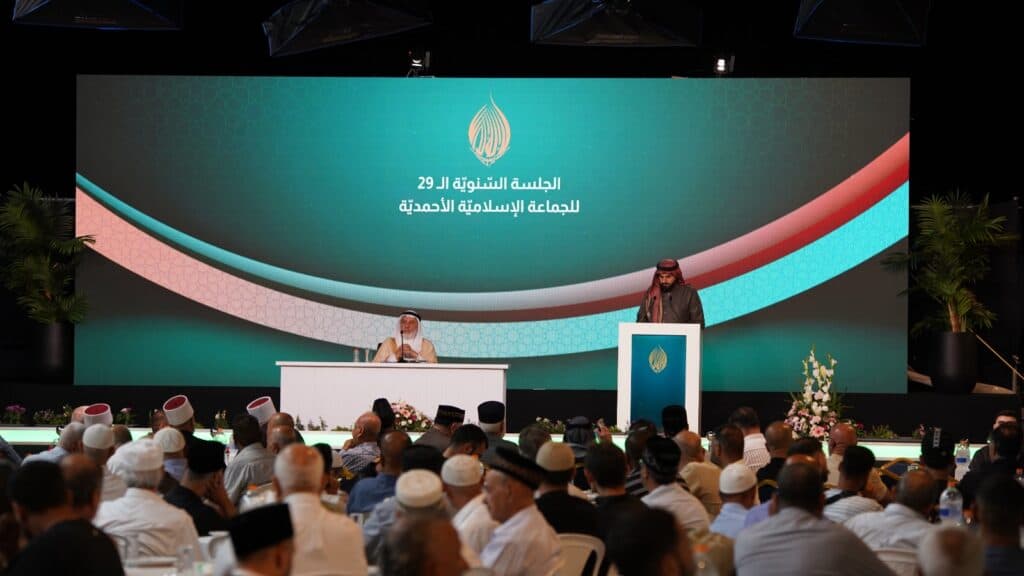
Sharif Odeh has announced that the 29th Jalsa Salana in Haifa, Israel will happen this weekend (Sep-2026). With the presence of the President of the State, Herzog, and religious leaders from various sects who promote coexistence between the sects. Check out my video herein. Check out free palestine (aka Khatam) engaging Ahmadi’s about this Jalsa. In Oct-2026, the Ahmadiyya team at Al-Hakam wrote an article wherein they defended the fact that a mass murderer (Isaac Herzog) was VIP at an Ahmadiyya Jalsa. They even defended the hug that was given to Isaac Herzog from Sharif Odeh.
Here is a video of Sharif Odeh, wherein he introduces the Jalsa. The Ahmadi murrabi who recently went viral for saying that Ahmadi’s are safe in Israel can also be seen in this video, his speech can be found herein. You can listen to Sharif Odeh’s speech herein.
The President of Israel (since 2021) and a mass murderer, Isaac Herzog is VIP at the 2026 Ahmadiyya Jalsa in Israel (#2026IsraelJalsa #2026JalsaIsrael #jalsa). Also in this photo are the Mayor of Haifa Mr. Yona Yahav, Amir and Head of the Ahmadiyya Community in Israel, Muhammad Sharif Odeh, and Imam Shamsuddin Sahib.
At the #2026IsraelJalsa, Isaac Herzog speaks on behalf of the Israeli Government and tells how he loves the Ahmadiyya and how they are an example of good Muslims (@Jalsa_Kababir and Twitter). He praises Ahmadiyya immensely. Isaac Herzog says he wishes that the world could see this, the interfaith harmony. He also gave his greetings to the Khalifa, Mirza Masroor Ahmad and to all Ahmadi around the world.
Here is a video which shows some of the attendees and herein, on instagram you can see additional Jewish speakers and attendees. See the photo’s posted in the below too.

______________________________________________________________________________________________
https://www.facebook.com/muhammad.s.odeh/posts/pfbid02bnBj6uezk8hnaEY5UcHx66gA6z2i8amGwV1zCdcZdcVoUVkRbozw9ipZUMbgwGpsl
______________________________________________________________________________________________
Additional photo’s


_____________________________________________________________________________________________
My video
Script
1. How the Ahmadiyya is fully aligned with Israel and their position as state ruler.
See the 2026 Israeli Jalsa. Why did the President show up? Sharif Odeh and Kababir are doing great…young Ahmadi’s have run off however.
2. How Humanity First UK and HF-International are being used in Gaza.
Beware of the Ahmadiyya school in Gaza in Deir al-Balah – ahmadiyyafactcheckblog
3. What about Karim Khan? Qadiani’s are put in positions of power all around the world. Nabeel Munir is another one. Netanyahoo at the UN? Is that a joke?
The Government of #Israel wanted Karim Khan to be in-charge of the ICC – ahmadiyyafactcheckblog
Who is Karim Ahmad Khan? – ahmadiyyafactcheckblog
4. The Isabella bar
Who is Hussein Abdullah Odeh? An Ahmadi who owns the restaurant Isabella Bar – ahmadiyyafactcheckblog
5. Mirza Masroor Ahmad on Gaza?
_____________________________________________________________________________________________
Was the Kababir Jamaat wrong to host President Herzog of Israel and how did it come about? | Al Hakam
https://www.alhakam.org/kababir-jamaat-host-president-herzog-of-israel
Was the Kababir Jamaat wrong to host President Herzog of Israel and how did it come about?
The visit of President Herzog of Israel to the mosque of the local Ahmadiyya Muslim Jamaat in Kababir, Haifa, has raised alarm about why Ahmadis are meeting with an Israeli leader overseeing a state that is waging a war against the Palestinians and is responsible for the widespread killing of thousands of women and children. Most of this outrage stems from a few social media posts that don’t show the full picture or context. Social media is a reactive and emotion-driven platform, only giving us a snippet of what really happened.
This event has indeed raised questions about the true nature of the Kababir Jamaat’s relationship with Israel and whether it condones its government. The Jamaat has also long been accused of being “Israeli agents” and this incident has resurfaced such claims.
But let us look at the history, context and the facts.
History of Ahmadiyyat in Palestine

The Ahmadiyya Muslim Jamaat has been in the Holy Land since 1928, long before Israel was created. That fact alone is sufficient to disprove claims of the Jamaat being “Israeli agents” or working for Israeli interests. If such a conspiracy were true, we would try to conceal Herzog’s visit rather than publicise it. Conspiracies don’t happen in plain sight.
The Jamaat also has a history of standing up for Palestinian rights. Prominent Ahmadis like Sir Zafrulla Khan (ra) have been outspoken for the Palestinian cause in the past. As Pakistan’s first Foreign Minister, he spoke at the United Nations in 1947 when the partition of Palestine was under discussion. He said:
“Since the start of the Jewish persecution in Nazi Germany, Palestine has taken almost three hundred thousand Jewish refugees. This does not include illegal immigrants who could not be counted. One has observed that those who talk of humanitarian principles, and can afford to do most, have done the least at their own expense to alleviate this problem. But they are ready – indeed, they are anxious – to be most ‘generous’ at the expense of the Arab […] Partition will create a dozen new problems dangerous to peace and international relations. It is much better to let Palestine alone than to attempt to enforce a solution which will bear bitter fruit.”
The resolution to partition Palestine was nonetheless passed, and Israel was created.
Current status of the Jamaat in Haifa

We must remember that the Jamaat in Haifa is under the governance of the state of Israel. Whether one considers it legitimate or illegitimate, it is the ruling government. Around 1.8 million Muslims live in Israel. They work and engage in public life in the country. This includes MPs, healthcare workers, teachers and businessmen. The Haifa Jamaat is not the only Muslim group living in Israel and engaging with its current leadership and society.
Citizens may disagree with a state’s leadership, but they must comply with it as far as is practically possible, especially if it does not interfere with their religious freedoms; otherwise, there would be chaos and more bloodshed. We must also understand the circumstances in which Palestinian citizens live. Engagement is not an abstract political exercise; it is part of a necessity of daily life. If speaking directly to someone in authority can alleviate even a small amount of suffering for their people, then doing so is a great service. Only through engagement can change happen.
For Palestinians who live with these realities every day, there is also a deeper purpose. Israeli society has developed profound fear and suspicion towards Palestinians.
Simply increasing hostility will not remove that fear. One means of breaking down prejudice is direct human engagement: reminding people that Muslims and Jews have lived alongside one another for centuries and confronting injustice without abandoning dialogue.
And so, across the world, the Jamaat often hosts political and civic leaders from across society and the political spectrum. The Haifa Jamaat follows this model like other jamaats around the world. On this occasion, the president Herzog expressed his desire to attend the event, which was actually the Jalsa Salana. This wasn’t an event specially created to host him.
The Jamaat in Haifa is not dependent upon the Israeli government, or indeed any worldly government or power. Whatever progress it has made has come through the sacrifices and efforts of its own members and, above everything else, through the blessings of Allah. It neither seeks nor requires worldly favour in return for speaking to anyone.
So the purpose of such engagement was never to gain political favour. It was to preach Islam, defend the honour of the Holy Prophet (sa), speak truth directly to those in positions of influence, advocate for people who are suffering, challenge prejudice and attempt to open a path towards peace.
The Jamaat’s position has always been to wage a non-violent Jihad by resorting to prayer, patience and dialogue, not rebellion and violence, since violence will breed more violence. This was the practice of the Holy Prophet (sa) in his early ministry in Mecca.
Precedent from the Holy Quran
If we look beyond social media optics and online outrage, we find that the Jamaat in Haifa is only following the practice and teachings of the prophets.
In the Holy Quran, we read that Allah instructed Moses (as) and Aaron (as): “Go, both of you, to Pharaoh, for he has transgressed all bounds. But speak to him a gentle speech that he might possibly heed or fear.” (Surah Ta Ha, Ch.20: V.43-44)
Pharaoh was a tyrant of the highest order. He would kill newborn infants and enslave the people of Moses (as). The Quran describes it: “And remember the time when We delivered you from Pharaoh’s people who afflicted you with grievous torment, slaying your sons and sparing your women; and in that there was a great trial for you from your Lord.” (Surah al-Baqarah, Ch.2: V.50)
So Allah didn’t just instruct Moses (as) to go to Pharaoh; He told him to speak gently or kindly, as this may have a greater chance of being heard and taken seriously. Emotive, angry language rarely bears fruit and is seen as a threat rather than advice that will be heeded.
Example of the Holy Prophet Muhammad (sa)
The Holy Prophet (sa) said: The greatest Jihad is speaking a word of truth to a tyrant ruler. He further stated that if you see an injustice, you should stop it with your hands; if you cannot with your hands, then you should stop it with your tongue. If you cannot even do that, then you should at least revile it in your heart, but that would be the lowest form of faith.
He also taught that when a representative or leader of a people comes to you, he should be treated with due respect. If they are a noble and well-respected person of their nation, they should be given respect. Showing someone courtesy does not mean endorsing everything they have done or everything their government represents. Hospitality and disagreement can coexist.
We also find the following incident during the life of the Holy Prophet (sa), which was narrated by Hazrat Aisha (ra) and is reported in Sahih al-Bukhari:
“A man sought permission to come in to the Prophet (sa). When he saw him, he said, ‘What an evil brother of the tribe, and what an evil son of the tribe!’ When the man sat down, the Prophet (sa) met him with a cheerful countenance and spoke with him freely and without formality. When the man had left, Hazrat Aisha (ra) said to him, ‘O Messenger of Allah! When you saw this man, you said such and such about him, and then you met him with a cheerful countenance and spoke with him freely and without formality.’ The Messenger (sa) of Allah said, ‘Aisha! When have you ever known me to depart from high morals? On the Day of Resurrection, the worst of people in rank in the sight of Allah will be the one whom people abandon to protect themselves from his evil.’” (Sahih al-Bukhari, Kitab al-Adab, Hadith 6032)
A meeting is not an endorsement of policies or character. Rather, only through meeting those you are hostile to or disagree with can you make your viewpoint known and invite them to Islam. Did the Holy Prophet (sa) not try his utmost to reform his worst enemies and those who wanted to murder him? Did he not continue to invite them to Islam and speak to them right till the end? Many converted because of his kindness and forgiveness. Hence the wisdom in Allah teaching us to speak a kind word, even to a cruel ruler.
Speech of Sharif Odeh Sahib

At the event, the President of the Ahmadiyya Muslim Jamaat in the Holy Land, Sharif Odeh Sahib, declined to raise the Israeli flag or sing the Israeli national anthem. We may have dialogue with those we disagree with, but our principles never waver.
Those accusing the Jamaat of collusion with Israel or criticising it for hosting Herzog did not pay attention to the speech of Muhammad Sharif Odeh Sahib. As Herzog sat there, Sharif Odeh Sahib said directly to him, quoting the Holy Prophet Muhammad (sa): “The human being is the edifice of God, cursed is one who destroys it.”
He further said: “Blood ties are not enough [to lay claim to the Holy Land], Mr President, because God says in the Psalms of David: ‘My righteous servants shall inherit the land and dwell in it forever’. The Quran says, My covenant does not apply to the evildoers, those who do wrong, commit crime, the wicked.” He went on to add that Jews previously had been expelled from the Holy Land for doing wrong and the same fate would await them if they continue.
Many people have also questioned why Sharif Odeh Sahib embraced the Israeli President. This was initiated first by Mr Herzog and not by Odeh Sahib. In a public moment like this, it would create more resentment towards Palestinians and Muslims if Odeh Sahib were to withdraw from this embrace. Sometimes, for the sake of the protection of Arab Muslims inside of Israel, it is required to keep a level of basic manners and relationship with those to whom you are opposed. Further, this was a side hug and not a hug indicative of any approval or intimate friendship at all.
Others have questioned why Herzog’s speech and other clips of his attendance were promoted so much by the Haifa Jamaat. In response, Odeh Sahib explained that the community in Haifa has nothing to hide and its interfaith efforts for dialogue and peace are well known. If they hadn’t posted it, someone else would have, and people would start assuming Haifa Jamaat was hiding something or a conspiracy was taking place. By being open and upfront, the local Jamaat sought to remove any such opportunity for further criticism or suspicion. The intention of publicising Herzog’s visit was to highlight the local Jamaat’s efforts towards peace and an end to warfare and bloodshed.
Praise by opponents
President Herzog also praised the Ahmadiyya Muslim Jamaat, which drew further criticism from the naysayers. However, this is no surprise either. It’s telling when even those with whom you have fundamental disagreements praise you. There’s no greater testimony of your goodness. The opponents of the Holy Prophet (sa), despite torturing his Companions (ra), despite killing his loved ones, despite inflicting the worst cruelties on him and his Companions (ra), would fear lest he prayed against them. They were fully cognizant that the Holy Prophet (sa) was near to Allah and a righteous man. They would testify that he had never lied before and was given the label of the “Truthful and Trustworthy” by the people who later opposed him.
If an opportunity arises to educate non-Muslims about Islam and deliver the message of the Holy Prophet (sa) to a ruler, what Muslim would reject such a fundamental duty of every Muslim? This is why, when the opportunity arose to host the Israeli President, the Jamaat in Haifa used it to explain to him that injustice never leads to prosperity.
Within Israeli society, Muslim leaders themselves recognise the work being done by the Jamaat in defending Islam and the honour of the Holy Prophet (sa) in the Hebrew language. Representatives of various Islamic movements have publicly expressed appreciation for this.
The President was not the only person present; people from academia, the military and other influential parts of Israeli society were also there. The opportunity was therefore used to tell people directly, in their presence, what is wrong and what must change. Muslim political figures themselves have mentioned that Sharif Odeh Sahib may be among the few people capable of bringing different sides together around one table.
What is the Muslim contribution to the Palestinian cause?
Muslims living in Europe or America strongly disagree with many policies of their governments. Major Western powers are complicit in Israel’s war on Gaza and bombed Iraq, Libya, Afghanistan and Iran, killing thousands of Muslims. Many are now implementing burqa bans and attempting to create anti-Muslim policies. Do Muslims in Western nations not speak to their political leaders? Do they not air their disapproval? They live as citizens and meet their leaders. So why should the Ahmadis of Haifa be expected to do something different? After all, Ahmadis were there long before Israel was created; the Israeli government was imposed on them.
The non-Ahmadi Muslims who have criticised the Jamaat for hosting Herzog should be asked: how often do they condemn the relationship of wealthy Muslim countries with Israel? Despite the massacre in Gaza, many Arab states are continuing to trade with Israel and even increasing diplomatic relations. They occasionally condemn Israel to appease their own citizens, but in practice, they continue to cooperate with it.
Those who are in uproar about Herzog attending an event hosted by the Ahmadiyya Muslim Jamaat should consider: what have they done for the Palestinian cause? Could they host an event that the president would attend, where he would listen attentively as the message of Islam is delivered to him and the words of the Holy Quran are spoken to him? Did the Holy Prophet (sa) not recite the Quran to the disbelievers?
Dialogue, therefore, should not be confused with approval. Sometimes the easiest thing is simply to shout from a distance. The harder task is to sit across from someone, look them in the eye and tell them clearly and courageously that injustice is taking place.
The Ahmadiyya Muslim Jamaat has always been standing up for human rights and justice and delivering the message of Islam – even to those we strongly disagree with.
_____________________________________________________________________________________________
Links and Related Essay’s
Sharif Odeh, head of the Ahmadiyya community in Israel, EXPOSED!!! – ahmadiyyafactcheckblog
Sharif Odeh, head of the Ahmadiyya community in Israel, EXPOSED!!!
https://x.com/Ahmadiyyafacts/status/2101776117300609509
_____________________________________________________________________________________________
Tags
#ahmadiyya #ahmadiyyafactcheckblog #messiahhascome #ahmadiyyat #trueislam
#Ahmadis #Israel and #haifa #kababir #2026IsraelJalsa or #2026JalsaIsrael #jalsa #JalsaConnect
10 Pingback