Intro
Its really hard to trust Ahmadiyya sources. The Khalifa wasn’t able to walk much of the early part of the 1950’s. Rashid Ahmad, the first African-American Ahmadiyya missionary tells us from his memories that the Khalifa suffered from gout and was thus unable to walk around Rabwah. Then, in the 1954, they claim that the Khalifa was stabbed in the neck and then was forced to visit Europe as he seeked treatment. Ahmadiyya sources tell us that even though the knife had been removed, there was still a small piece of the knife that was almost touching the Khalifa’s neck bones.
The 2nd Khalifa had decided to go to Europe in 1955 (Ahmadiyya sources allege that this was for medical treatment after he had got stabbed). Thus, the story starts on the night between 29 and 30 April 1955, the 2nd Khalifa and his entourage departed for Damascus from Karachi via a KLM flight.
On May 1st, 1955, the 2nd Khalifa and his entourage landed in Damascus from Karachi. He was received at the airport by Syed Muneer Al-Husni and allegedly scores of Arab members of the Damascus Jamaat and representatives from Pakistan’s embassy to Syria came to welcome the 2nd Khalifa. Those present included the sadr of Syria Jamaat, Munir al-Husni Sahib. Munir al-Husni Sahib’s wider family, who were successful Ahmadi Syrian businessmen, personally hosted the 2nd Khalifa with great love, sincerity and sacrifice. Badruddin al-Husani Sahib, the younger brother of Munir al-Husani Sahib, gave his large family home to the 2nd Khalifa and his family/entourage. The al-Husni family received special prayers and praise from the 2nd Khalifa. After arrival at the airport, Badruddin al-Husani Sahib’s female family members welcomed the 2nd Khalifa’s wives and female members of the family and took them to their home shortly after arriving. In 1955-56, Zafrullah Khan married a teenage palestinian refugee (Bushra Rabbani), who was already married, had hella sex with her, then let her go).
The 2nd Khalifa was accompanied by two of his wives, Maryam Siddiqa Sahiba (Umm-e Mateen), Syeda Bushra Begum (Mehr Apa), his son Sahibzada Dr. Mirza Munawar Ahmad Sahib, his two daughters, Amatul Jameel Sahiba, and Amatul Mateen Sahiba. Also accompanying the 2nd Khalifa was Sir Chaudhary Zafrulla Khan. (Tarikh-e-Ahmadiyyat, Vol. 16, pp. 502-503).
On 6 May 1955 the 2nd Khalifa met with some Syrian and Palestinian Ahmadis and discussed the issue of Palestine while speaking in Arabic. During the meeting, the 2nd Khalifa also discussed plans for the progress of the Jamaat in the Middle East and took counsel from Jamaat members. Due to his God-given planning qualities, the 2nd Khalifa established the Jamaat as an extremely well-organized body. In Damascus, he even planned for an Ahmadi school to be built there. (Silsila-e-Ahmadiyya, Vol. 2, p. 467).
On May 7th, he left Damascus for Beirut. He seems to have only stayed in Bierut, Lebanon for a day or so and quickly flew to Italy via Greece.
May 8th to June are unaccounted for.
June-4th to June 29 he was in Switzerland. Italy, Austria, Germany, the Netherlands and even Sweden?
By July 1955, he was in London and seems to have been in London. On July 29th, 1955, he led the Eid prayer at the Fazl Mosque. This speech was reproduced in the Muslim Sunrise of the 4th-Quarter-1955.
By Sep-1955, the 2nd Khalifa was back in Pakistan and at the Luxury Beach Hotel in Karachi and giving speeches. The speech was on Sep-21-1955, its unclear when the 2nd Khalifa arrived.
The Khalifa returned to Pakistan in 1955 and made his final public appearance in 1956. The next 9 years of his life were spent in pain and agony. The Khalifa appointed his eldest son, Mirza Nasir Ahmad to lead all the Friday sermons and to manage the day-to-day operations of the Ahmadiyya Movement. This data was posted by an Ahmadi on his twitter account. The Khalifa also seemed to start the process of getting a mission opened in Sweden.

_____________________________________________________________________________________________Before going to England, here is the Khalifa’s condition
Reference: Al-Fazl April 26, 1955
On 26th February, around Mughrib Time (sunset time), I had an attack of paralysis on the left side of my body. For sometime I was absolutely disabled with my hand and foot. There was a pause in my mental activity. And my brain has stopped working. At this time I am absolutely sick and I can not think even for a single minute”
______________________________________________________________________________________________Reference: Al-Fazil April 12, 1955
“Because of this nutrition does not get to my brain. Physicians were of the opinion that with in few weeks my mental condition will get back to normal. So far what ever, improvement took place, its speed is not fast enough���.I can walk couple of steps with people’s help, that too is with difficulty. Condition of my brain and tongue is such that I cannot deliver sermon even for few moments. Physicians have strictly prohibited me from doing any such work that require mental exercise.”…… “I had the stroke (paralysis). Now I am disabled even for ‘Paakhana, Peshab’ (to shit and urinate), and depend on others for this. I can not walk even two steps”.
______________________________________________________________________________________________Briefly staying in Lebanon, Mahmood Ahmad travelled to Switzerland via Athens and Rome. He continued travelling and received some medical treatment in Zurich, the Netherlands, Hamburg and London. After consulting with his doctors, it was concluded by that the tip of the knife had broken and embedded itself in the jugular vein and that no attempt should be made to remove it
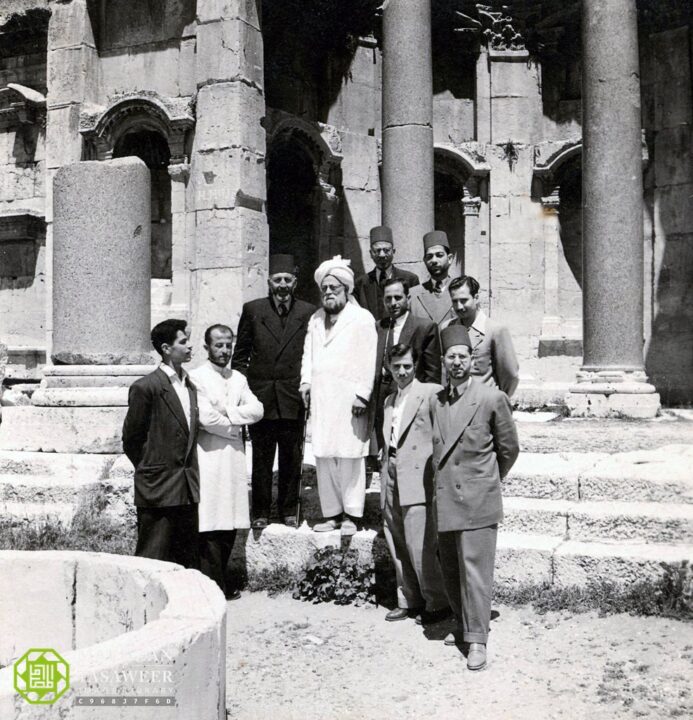
7 May 1955: Hazrat Musleh-e-Maud (ra) arrived at Beirut, Lebanon, and went to visit the ancient remains of the Baalbek.

8 May 1955: he left Lebanon for Italy
4 June 1955: Mirza Basheer-uddin Mahmud Ahmad was in Europe and some glimpses of his activities recorded are as follows: On this day, Mirza Basheer-uddin Mahmud Ahmad inspected the mission house of Zurich.
On 5 June, Mirza Basheer-uddin Mahmud Ahmad gave a speech in English in Zurich.
On 8 June, Mirza Basheer-uddin Mahmud Ahmad interview was televised by a Swiss television channel in English. On the same day, a Yugoslavian man entered the fold of Ahmadiyyat. On 10 June, Mirza Basheer-uddin Mahmud Ahmad went to Switzerland’s southern city of Lugano via car.
On 11 June, Mirza Basheer-uddin Mahmud Ahmad reached Italy’s port city of Venice.
On 14 June, Mirza Basheer-uddin Mahmud Ahmad landed in Austria.
On 15 June, Mirza Basheer-uddin Mahmud Ahmad was in Nuremberg, Germany.
On 17 June, Mirza Basheer-uddin Mahmud Ahmad was in The Hague. His stay in the Netherlands is reported between 19 to 24 June.
On 25 June, Mirza Basheer-uddin Mahmud Ahmad was in Hamburg, where a famous journalist conducted his interview for his newspaper.
On 26 June, an orientalist performed initiation at the hand of Hazrat Musleh-e-Maud; he was given the name of Zubair. Mirza Basheer-uddin Mahmud Ahmad addressed a reception in English. During this, he extended his heartfelt desire to build a mosque in Germany.
On 27 June, Mirza Basheer-uddin Mahmud Ahmad received some government officials. Later that day, Mirza Basheer-uddin Mahmud Ahmad attended a gathering arranged by locals and spoke in English for half an hour. Many newspapers covered the above-mentioned events.
Hamburger Anzeiger of 28-June-1955 published a report along with a photograph of the 2nd Qadiani-Ahmadi Khalifa. Read herealhakam.org/hamburg-german

On 29 June, Mirza Basheer-uddin Mahmud Ahmad arrive at the Netherlands.
Jul 22nd, Ahmadiyya sources claim that the Ahmadiyya mission in Sweden was started on this day (see Ahmadiyya Muslim Mosques Around the World – A Pictorical Presentation. Ahmadiyya Muslim Community; Khilafat Centenary Edition. 2008. p. 70. ISBN 978-1882494514.).
Eastern World, September 1955
1925 Eid: Historic Eid receptions at the London Mosque
The 1925 Eid-ul-Fitr: Press reports of historic Eid receptions at the London Mosque (1925-1955)

_____________________________________________________________________________________________
1956
June 29th, 1956
Anwarul Aloom
See also Tahreek-e-Ahmadiyya, Volume-5, page 400 onwards
Rough Summary
“….I remember those days very well (referring to 1914), when we didn’t even have enough money to publish our announcements vs. the Lahori-Ahmadi’s. My maternal Grandfather (Mir Nasir Nawab) had been collecting money for a hospital and masjid, put a bag of money before us, this was the chanda that he had collected for other means, he gave us the money and we promised to pay him back……..last year (referring to 1955), i fell sick and the jamaat arranged a special chanda for me and my health, the jamaat collected 100k rupees for my trip to London.”
Scan

_____________________________________________________________________________________________
1955–July
First-ever international conference of Ahmadiyya missionaries, London, 1955 (alhakam.org)
On 22-24 July 1955, the first-ever international conference of the Ahmadi missionaries was held in London, which was presided over by Hazrat Musleh-e-Maud, Mirza Bashir-ud-Din Mahmud Ahmadra.
Mentioning this conference, The Civil and Military Gazette wrote:
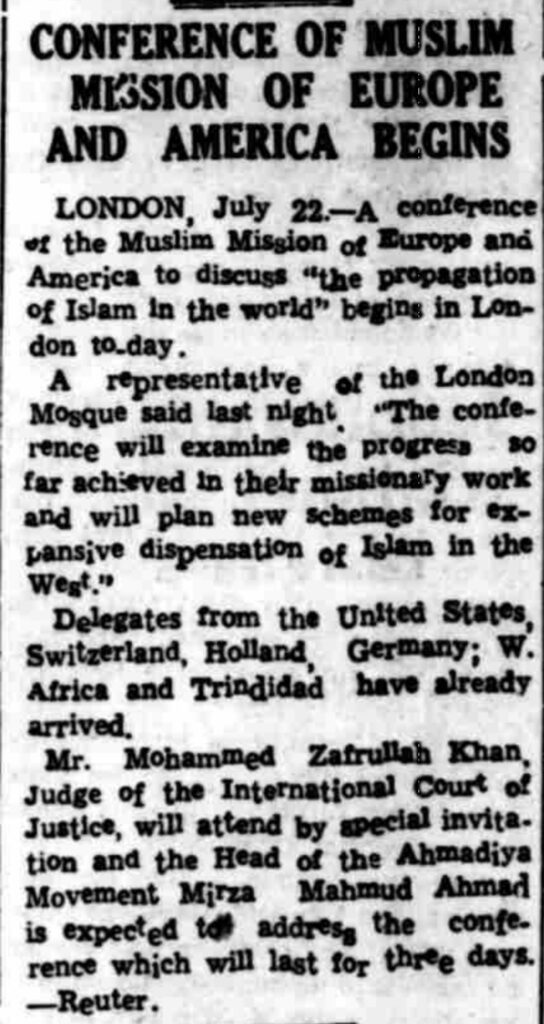
“Conference of Muslim Mission of Europe and America Begins
“London, July 22 – A conference of the Muslim Mission of Europe and America to discuss ‘the propagation of Islam in the world’ begins in London today.
“A representative of the London Mosque said last night, ‘The conference will examine the progress so far achieved in their missionary work and will plan new schemes for expansive dispensation of Islam in the West.’
“Delegates from the United States, Switzerland, Holland, Germany, W. Africa, and Trinidad have already arrived.
“Mr Mohammed Zafrullah Khan, Judge of the International Court of Justice, will attend by special invitation and the Head of the Ahmadiya Movement, Mirza Mahmud Ahmad is expected to address the conference which will last for three days. – Reuters.” (The Civil and Military Gazette, 23 July 1955, p. 6)
Hazrat Musleh-e-Maudra expressed his intention to hold such a conference while he was in Zurich in June 1955. Thus, an agenda of the conference along with a questionnaire was sent to the missionaries serving in Europe, America, and Nigeria, and they were advised to consult with the other missionaries and members and then prepare a scheme before coming to the conference. (Al Fazl, 14 October 1955, p. 3)
On 21 July 1955, Huzoorra sent a telegram in which he conveyed a special English message to the members of the Jamaat. Al Fazl published its Urdu translation on 24 July 1955. In this message, Huzoorra stated that since the era of the Holy Prophet’ssa Companionsra, this would be the first occasion of its kind that a great conference would be held in London to ponder over the proposals for the propagation of Islam to all corners of the world. The conference would comprise the Ahmadi missionaries who are serving in the major countries of America, the West Indies, Africa, and Europe. Sir Zafrulla Khan Sahibra will also attend the event on 22 July. In the end, Huzoorra called the attention of all Ahmadis to pray for the success and fruitful results of this blessed event. (Al Fazl, 24 July 1955, p. 1)
The conference took place at the mission house at 63 Melrose Road, London. The proceedings continued for three days and included group consultations under sub-committees. The conference consisted of five sessions, which were all graced with the presence of Hazrat Musleh-e-Maudra. A steering committee was formed to run the proceedings of the Conference, including Sahibzada Mirza Mubarak Ahmad Sahib, Khalil Ahmad Nasir Sahib, Naseem Saifi Sahib, and Sheikh Nasir Ahmad Sahib. (Al Fazl, 6 August 1955, p. 3)
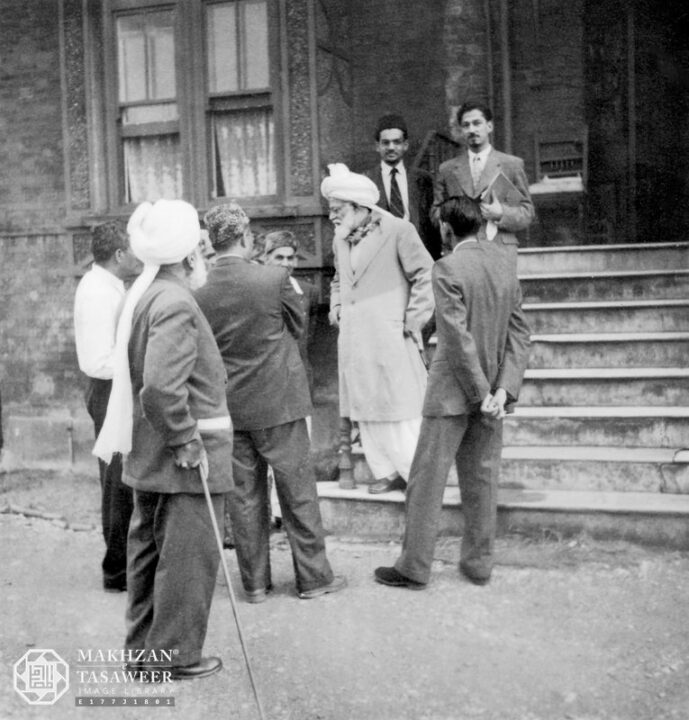
During this conference, the Ahmadi missionaries had the blessed opportunity to get valuable guidance from Hazrat Musleh-e-Maudra, which played a great role in their tabligh efforts in the times to come.
Upon the conclusion of this Conference, Al Fazl published detailed reports in its 26 and 27 July 1955 issues.
During various sessions of the Conference, reports from Ahmadiyya missions around the world were discussed. The topics that were extensively discussed during the Conference included various proposals to speed up efforts to propagate Islam in Europe, Africa, and America. Various schemes were suggested to expand the publication of Islamic literature throughout the world, to build mosques and missions in new places, and to expand the already existing missions. All the missionaries once again affirmed their pledge to devote their lives to the propagation of Islam the world over, in accordance with the desires and expectations of Hazrat Musleh-e-Maudra. (Al Fazl, 14 October 1955, p. 3)
“Zarreen Hidayaat Bara’ey Muballighin”
As stated by Hazrat Musleh-e-Maudra in his special message to the Jamaat, this was a very significant chapter in the history of Islam. However, one ought to remember that even before this conference, Hazrat Musleh-e-Maudra granted valuable guidance to the missionaries on many occasions, and this practice continued in the following years as well.
During his address at the Jamia Ahmadiyya UK’s convocation in 2023, Hazrat Khalifatul Masih Vaa said that the guidance and advice to the missionaries granted by Hazrat Musleh-e-Maudra on various occasions has been compiled in book form under the title of “Zarreen Hidayaat Bara’ey Muballighin” and emphasised that all missionaries should obtain a copy of this book and study it. (“Essential traits of a successful missionary: Huzoor addresses graduates at Jamia Ahmadiyya UK convocation 2023”, Al Hakam, 19 May 2023, Issue 270, p. 2)
Hazrat Khalifatul Masih Vaa said:
“During his lengthy tenure as Khalifatul Masih, Hazrat Musleh-e-Maudra not only assured the spiritual advancement of the Community, but also consolidated its administrative system while propagating the Faith. He also provided excellent guidance to the murabbian [missionaries] and consolidated and organised their system too. He also gave advice at various times to the students and to the murabbian of Jamia Ahmadiyya. This advice, if followed by murabbian and muballighin, could serve as a catalyst for revolution. His advice was not only for the old murabbian but also for those Companionsra who had seen the era of the Promised Messiahas. When they were sent as murabbian and muballighin, he generally gave advice to them.
“This advice and guidance from Hazrat Musleh-e-Maudra has also been published in book form under the title ‘Zarreen Hidayaat Bara’ey Muballighin…’ [Golden Advice for Missionaries…]. Every murabbi and muballigh should indeed have this book at their disposal. They should study it and make notes for themselves. Then, as they continue to look at these notes, extract summaries and create points from them to keep at hand, and continue to view them, their attention will remain on improving their conditions, and it will serve as a reminder. Therefore, make sure that you consult it.” (“Zarreen Hidayaat (Bara’ey Muballighin wa Tulaba)”, www.ahmadipedia.org)
Khulafa-e-Ahmadiyyat have continued to provide a pathway to the Ahmadi missionaries serving in various countries, who have played a great role in propagating the message of Islam to all corners of the world.
Another point that is worth mentioning here is that since the migration of Khilafat-e-Ahmadiyya to the United Kingdom, the Jalsa Salana UK has become the markazi (central) Jalsa. After the conclusion of Jalsa Salana UK, the Ahmadi missionaries and life devotees who are in attendance from various countries of the world are usually blessed with the opportunity to have a collective meeting with Hazrat Khalifatul Masihaa. During the meeting, missionaries present their reports to Huzooraa about the tabligh efforts in their respective countries, and more importantly, they get valuable guidance from Huzoor-e-Anwaraa in order to improve their work.
_____________________________________________________________________________________________1961
Al-Fazl, 19th Aug 1961, see page–2, also published in Truth Triumphs by Mumtaz Ahmad Faruqi, Lahori-Ahmadi, see page–38
Diagnosis by Mirza Munawar Ahmad (son of Mahmud Ahmad).
“””Nervous prostrations like the loss of memory, and emotional outbursts (like at the mention of holy names, places and events), are more or less prevalent. Some days the symptoms dwindle, but again they intensify : and so the trouble goes on. Because of remaining in prostrate position, there is tension followed by numbness in the leg muscles. All the possible efforts to make his holiness walk a litter, have failed all along…..”
______________________________________________________________________________________________
1925 Eid: Historic Eid receptions at the London Mosque
The 1925 Eid-ul-Fitr: Press reports of historic Eid receptions at the London Mosque (1925-1955)
Ata-ul-Haye Nasir, Ahmadiyya Archive & Research Centre

In the last 100 years, the Fazl Mosque in London has hosted various receptions attended by dignitaries from all walks of life – from religious circles to the worldly spheres. These receptions would be held to mark certain occasions such as the Eid-ul-Fitr and Eid-ul-Adha.
Though the London Mission had been hosting the Eid gatherings even before the foundation of the Fazl Mosque, the 1925 Eid-ul-Fitr possesses a special significance, as it was the first Eid prayer offered at the premises of the Fazl Mosque since its foundation that was laid in October 1924 by Hazrat Musleh-e-Maudra.
In addition to presenting a glimpse of the press coverage received by this historic Eid-ul-Fitr in 1925, the article aims to highlight the press coverage of the later years’ Eid gatherings at the Fazl Mosque – from 1925 to 1955. The 1955 Eid-ul-Adha was the first-ever Eid led at the Fazl Mosque by a Khalifatul Masih.
1925: First Eid since the Fazl Mosque’s foundation
The historic Eid-ul-Fitr of 1925 was covered by multiple periodicals of England, Canada and America, along with photographs. The Sunday Pictorial of 26 April 1925 wrote, “For the first time the ‘Happy Feast’ of Islam Eed-Ul-Fitr, was celebrated yesterday, on the chosen site for the first mosque in London, at Melrose-road, Southfields.”
The Evening Standard of 25 April 1925 reported under the heading “Cairo in London: Picturesque Scenes at Moslem Service” and The Daily Express of 27 April 1925 reported under the heading “Prayers in a Garden”.

Multiple American and Canadian newspapers reported on this Eid-ul-Fitr gathering, along with photographs. For instance, The Saskatoon Phoenix published a photograph on 21 May 1925 with the caption, “In Constantinople, commonplace, but in London, novel. Members of the Ahmadiyya Community at prayer on the grounds of the new London Mosque, during the recent celebrations of Eid.” St Louis Globe-Democrat of 24 May 1925, The Toronto Daily Star of 16 May 1925 and The Leader of 21 May 1925 also published photographs. The most detailed report was published by the South Western Star of London on 1 May 1925, under the heading “Islam at Southfields”.
Ten weeks later, the first Eid-ul-Adha was offered at the proposed Fazl Mosque’s premises in July 1925.
1926-1927: Eid-ul-Fitr and Eid-ul-Adha

Reporting on the 1926 Eid-ul-Fitr, The Daily Mirror of 15 April 1926 published a photograph with the caption, “Moslems at their devotions in the grounds of the mosque at Southfields, near London, yesterday, when the Islamic festival of Eid-ul-Fitr was celebrated.” The Daily Herald of 15 April 1926 and Diario de la Marina of 23 May 1926 also published photographs.
Capturing a moment at the 1927 Eid-ul-Adha, The Sphere of London, dated 25 June 1927, published a photograph with the caption, “The Mecca of London: The embracing ceremony which ends the Moslem festival of Eid-ul-Azha, in which many Mohammedan Londoners took part. The Imam of the London Mosque Mr. A. R. Dard, is on the extreme right.” The Jewish Missionary Magazine gave news about this gathering by quoting an excerpt from The Palestine Weekly. The Evening Despatch of 11 June 1927 and South Western Star of 17 June 1927 also published a report.

1928: Viscount Allenby at the Eid-ul-Adha reception
On 31 May 1928, the Eid-ul-Adha reception was attended by various dignitaries including Viscount Allenby (1861-1936) – a senior British Army officer and Imperial Governor, and Sir E Denison Ross (1871-1940) – an orientalist and the first Director of the School of Oriental Studies (now SOAS) London. The Daily Mirror of 1 June 1928 published a photograph with the following caption:
“Field-Marshal Viscount Allenby and Viscountess Allenby arriving at the London Mahomedan Mosque at Southfields yesterday for a garden party, and welcomed by the Imam (priest), Mr. A. R. Dard.”

The Scotsman of 1 June 1928 reported under the heading “Moslem Festival in London: Lord Allenby Present” and The Palestine Bulletin of 25 June 1928 also published a detailed report. The Sunday Mercury of 3 June 1928 published an interesting story as it states, “A number of M.P.s and their wives attended a garden party at the London mosque one day this week in celebration of a Mohammedan festival, and the Imam or priest who received them surprised and even offended the ladies by refusing to shake hands with them though he did so with all the men visitors. Later he explained that it was against his religion to shake hands with women.”
1929: Sarojini Naidu and Maharajah of Burdwan at the Eid-ul-Adha reception

On 20 May 1929, the Eid-ul-Adha reception was attended by the Maharajah of Burdwan – Sir Bijay Chand Mahtab (1881-1941), and Sarojini Naidu (1879-1949) – an Indian political activist who served as the first Governor of United Provinces, after India’s independence.
A French newspaper, L’Homme Libre of 21 May 1929 reported under the heading “A Muslim Festival at the London Mosque” and stated that with the Maharajah of Burdwan presiding over the reception, both Muslims and Hindus will take advantage of this example to put an end to the sectarian conflicts that lie at the root of almost all the unrest occurring in British India.
The South Western Star of 24 May 1929 declared “the presence of these prominent Hindus at a Moslem festival in London” a “unique” event.
According to The Norwood News of 17 May 1929, an invitation was sent to the Balham Rotary Club as well. The Evening News of 20 May 1929 gave details of this reception.
1930: Sir Francis Younghusband presides the Eid reception

The 1930 Eid-ul-Adha reception was attended by various dignitaries, including Sir Francis Younghusband (1863-1942) – a well-known orientalist of the 20th century.
The Christchurch Star of 28 June 1930 published a photograph with the caption, “The Moslem Festival of Id-ul-Azha was carried out with customary ritual at the London Mosque at Southfields on May 9. Here are some faithful at prayer. They include a number of white women.”
The Labor Daily of Australia published the same photograph on 21 June 1930. The Civil and Military Gazette of 12 May 1930 reported under the heading “Id-uz-Zuha in London: Sir F. Young Husband at Wandsworth Mosque”. The Palestine Bulletin of 12 May 1930 also published a report.
1932: Eid-ul-Fitr
Mentioning the Eid-ul-Fitr in 1932, The Daily Telegraph of 17 March 1932 published a photograph with the following caption:
“Shoes lined up outside the Southfields Mohammedan Mosque, London, told that the faithful had entered to celebrate the feast of Eid-El-Fitr.”
1933: Jinnah at the Eid-ul-Adha reception

In April 1933, the Eid-ul-Adha reception was attended by various dignitaries including Muhammad Ali Jinnah (1876-1948), who was later known as the Founder of Pakistan.
The Daily Mirror of 7 April 1933 published a photograph of this gathering with the following caption:
“At London’s Mosque.–Moslem worshippers at prayer at the Woking [sic., Fazl] Mosque yesterday during the festival of Eid-ul-Azha, commemorating Abraham’s great sacrifice.”
During this reception, Jinnah delivered a speech on the future of India which attracted many newspapers of the British and Indian press, including The Statesman, Madras Mail, Hindu, Sunday Times, etc.
It is believed that it was after this reception that he decided to return to Indian politics and continue his strive for Muslim rights and later the formation of Pakistan.
1934: British MP presides the Eid-ul-Adha reception

Reporting on the 1934 Eid-ul-Fitr, The Western Mail of 22 February 1934 published a photograph with the following caption:
“Towards Mecca: Muslims at prayer inside the London Mosque, Southfields, during the celebration of a festival by the Muslim Society of Great Britain.”
On 27 March 1934, the Eid-ul-Adha reception was presided over by the Earl Winterton, P.C., M.P. The Eastern Post and City Chronicle of 10 March 1934 announced, “The Earl Winterton, P.C., M.P., will preside at the London Mosque on Tuesday, March 27th, on the occasion of the Moslim festival of ‘Id-ul-Azha, when Sir John Wardlaw-Milne, M.P., K.B.E., will speak on ‘British Empire and Islam.’”
The Evening Standard published an article on 28 March 1934, stating, “A friend of mine attended the celebration of the ‘Feast of Sacrifice’ at the London Mosque yesterday.” The Palestine Post also published a report in its 9 April 1934 issue.
1935: High Commissioner for India presides over the Eid-ul-Adha reception

On 17 March 1935, Eid-ul-Adha reception was attended by various dignitaries, including Sir Francis Younghusband and presided over by the High Commissioner for India. Reporting on this, the South Western Star of 22 March 1935 wrote under the heading “Muslims at Southfields: A Great Festival”:
“The High Commissioner for India, who was in the chair, introduced Sir Francis Younghusband as a great explorer and one of the sincerest advocates of a better understanding between East and West. There was, he said, nothing more hopeful than the prevalence of religious tolerance. Religion might still be a stumbling block in politics, but no-one now believes it can be promulgated by violence.”
Towards the end, it wrote:
“The London Mosque has been founded and endowed by the Ahmadiyya Movement, the founder of which, Prophet Ahmad of Qadian (India) has been the most energetic and spiritual figure in the history of Islam since Mohammad. The foundation stone of the mosque was laid in 1924 by the Commander of the Faithful, the present head of the community, and the mosque was formally opened in 1926.”
1936: Lord Lloyd and LS Amery meets Hazrat Mirza Nasir Ahmadrh at Eid reception

In 1936, an Eid-ul-Adha reception was held which was attended by LS Amery (1873-1955), the then-member of the British Parliament who later served as the Secretary of State for India and Burma in the 1940s. The dignitaries also included George Ambrose Lloyd (1879-1941), a British Conservative politician and colonial administrator.
The South Western Star of 13 March 1936 published a detailed report along with a photograph with the following caption:
“Lord Lloyd (left) and Lieut.-Col. Amery (right) at tea with Imam Maulvi A. R. Dard at the London Mosque, Southfields, on Sunday.”
The report was titled “A Festival at the Mosque: Big Gathering at Southfields” and stated:
“In the afternoon a reception was held in a large marquee in the grounds of the mosque. […] The company, numbering about 200, were received by the Imam, who was assisted by Mr. Ahmad [Hazrat Mirza Nasir Ahmadrh], [grand]son of his Holiness the founder of the community. This young gentleman is an under-graduate of Balliol College, Oxford. Having qualified in theological and oriental subjects he intends to take modern greats at the premier English university. Both Lord Lloyd and Mr. Amery greeted him with great cordiality.”
The Daily Telegraph of 9 March 1936, The Morning Post of 9 March 1936, The Times of 10 March 1936 and Edinburgh Evening News of 14 March 1936 also reported.
1937: Secretary of State for India at the Eid-ul-Adha reception

On 22 February 1937, an Eid-ul-Adha reception was presided over by Lord Zetland (1876-1961), the then Secretary of State for India.
The Yorkshire Post of 23 February 1937 reported under the heading “Great Experiment in India: Lord Zetland’s Tribute to Moslems”:
“Because both rested on a democratic basis, Britain had much in common with the Islam world, said Lord Zetland, Secretary of State for India, at the London Mosque, Southfields, last night.
“In the great experiment in constitutional government which was being carried out in India the Moslem community was being given the opportunity of playing a great part in the future government of the country, he said. He paid tribute to the contribution which Islam has made to the culture of the world.”
The South Western Star of 26 February 1937 reported under the heading “The London Mosque: Festival at Southfields”.
1938: Eid-ul-Fitr

In 1938, reporting on the Eid-ul-Fitr reception, the South Western Star of 2 December 1938 published a photograph with the following caption:
“Muslims grouped outside the Mosque. Among those in the picture are the Imam (Maulvi J. D. Shams), Prof. M. A. Butt, Dr. Sulaiman and Dr. Omar, of South Africa, Mr. Sayce, brother-in-law of a Muslim Nawab in India), Sirdar Iqbal Ali Shah (a well known writer), Chaudari M. Naqi (Son of the Financial minister of the Maharajah of Jodhpur), and Messrs Ahmadullah, W. Booth, Salam, Bilal Nuttall, Gregory, W. Nivashauda, and A. Aziz. All ladies except three are Muslims.”
The article stated:
“The Muslim festival of Eid ul Fitr was celebrated at the London Mosque, Southfields, on Thursday. This festival marks the end of Ramadan, the Muslim month of abstinence. Nearly 100 people were present, including Professor M. Butt, of Aligarh University, Mr. W. Nivashauda, of Siam, and Mr. W. Booth, vice-chairman of Putney Literary Debating Society, and a number of English Muslims. Prayers were led by the Imam (Maulvi J. D. Shams). The former Imam (the Rev. A. R. Dard) left for India a month ago.”
1939: Eid-ul-Fitr and Eid-ul-Adha

On 31 January 1939, Eid-ul-Adha reception was attended by various dignitaries. The South Western Star of 3 February 1939 wrote under the heading “Muslim Festival: A Meeting at Southfields Mosque”:
“Among the large number of people present, including Muslims, Christians, Hindus, and men and women from many nations, were Sir Telford Waugh, Sir Findlater Stewart, Major-General J. H. Beith, Sir Arthur Wauchope (former High Commissioner for Palestine), Countess Carlisle, the Rev. S. Hopkinson, the Rev. Mr. Stevenson, Dr. and Miss Hatherby, and Capt. Ataullah, I.M.S. Members of the delegation from Saudi Arabia had accepted invitations to be present, but could not attend because arrangements were being made for the talks on Palestine.”
On 13 November 1939, Eid-ul-Fitr was offered at the Fazl Mosque and the same newspaper, on 17 November 1939, reported it under the heading “Muslims at Southfields: A Festival Gathering”.
1940-1947: Various Eid gatherings at the Fazl Mosque

The Eid gatherings during the years 1940-1947 also caught considerable attention from the British press. Most prominent news reports were published by the South Western Star. For instance, the 1940 Eid-ul-Fitr was reported on 8 November 1940, under the heading “Muslim Celebration at Southfields: Festival of Eid ul Fitr”; the 1941 Eid-ul-Fitr was reported on 24 October 1941, under the heading “The London Mosque: Eid-ul-Fitr Celebrations”; the 1944 Eid-ul-Fitr was reported on 22 September 1944, under the heading “Islamic Festival in Southfields Mosque”; the 1944 Eid-ul-Adha was reported on 1 December 1944, under the heading “The Festival of Sacrifices: Celebration at the London Mosque” and the 1945 Eid-ul-Fitr was reported on 14 September 1945, under the heading “Muslim Festival at London Mosque Southfields”.
On the occasion of Eid-ul-Adha in 1945, Hazrat Maulana Jalal-ud-Din Shamsra spoke about the Palestine conflict and advised the British Government that “in making its decision, the Government should not however, overlook the fact that the inhabitants of Palestine had the right to rule themselves.” (Leicester Evening Mail, 17 November 1945, p. 5)

A French newspaper, France-soir of 4 September 1946, reported on the 1946 Eid-ul-Fitr and published a photograph. The South Western Star reported it on 6 September 1946, under the heading “Muslim Festival Gathering”.
The 1947 Eid-ul-Fitr reception was attended by various dignitaries, including a representative of the Mayor of Wandsworth. (South Western Star, 22 August 1947, p. 4)
1948: Delegates of the African Conference at the Eid reception
On 14 October 1948, Eid-ul-Adha was offered at the Fazl Mosque. In those days, an African Conference was taking place in England, hence, the African dignitaries attended an Eid reception at the Fazl Mosque.
Le Soir illustré of Belgium published a photograph capturing guests who had gathered for the reception, with the following caption:
“Presence of the Orient, in London – Maulvi Mohd. Siddique, representing the colony of Sierra Leone in the English capital (right), and the Emir of Abuja […] at the London Mosque, during the Eid-ul-Adha festival.” (Le Soir illustré, 21 October 1948)

In the above-mentioned photograph, the 6th Amir of Abuja, Suleimanu Barau (1903-1979), is having a discussion with Maulvi Muhammad Siddique Sahib Amritsari.
L’Indépendance of Belgium – in its 1 December 1948 issue – published another photograph of the same event. The same photograph was published by Greymouth Evening Star of New Zealand on 8 November 1948 as well.
1949-1954: Various Eid gatherings at the Fazl Mosque

Reporting the 1949 Eid-ul-Fitr reception, the South Western Star published a photograph on 5 August 1949, with the caption, “Curry during the heat-wave did not bother Ald. G. T. Rowe, pictured here facing the camera, during the Muslim festival of Eid-ul-Fitr at which he was a guest, at the LondonMosque, Southfields, last week.”
The Civil and Military Gazette of 15 August 1949 published an article under the heading “Id Celebration at Putney Mosque”.
Reporting on the 1950 Eid-ul-Fitr reception, the South Western Star of 21 July 1950 wrote, “The present Imam, Mr. M. A. Bajwa, who has been in this country for five years, is returning to Pakistan and among those who paid tribute to his work in this country was Mr. Hugh Linstead, local Member of Parliament. The Mayor of Wandsworth, Cllr. R. W. K. Edgley, was also present.”
Reporting on the 1950 Eid-ul-Adha, the South Western Star of 29 September 1950 wrote:
“The Muslim Festival of Eid-ul-Adha (the Festival of Sacrifice), was celebrated at the London Mosque, Southfields,” and “after luncheon a meeting was held in which representatives of five different religions, including Mr. Shaw Desmond, the famous writer, paid tribute to the noble character of the Holy Prophet Muhammad.”
Reporting on the Eid-ul-Adha of 1952, The Manchester Guardian of 1 September 1952 wrote under the heading “At the London Mosque”:
“For Moslems everywhere this has been the day of Eid-ul-Adha – the celebration of the sacrifice by Abraham of his son Ishmael. It is a day for them to pray together and to eat together, and this some two hundred did at the London mosque in Wandsworth. Cream painted, with a dome of streaky turquoise, the mosque is a rare shell thrown up from the East on a beach of English terraced houses. Turks and Africans, Egyptians and Indians, and Pakistanis and English crowded into it this morning – guests on chairs to the rear, Moslem men on the floor across the front, and Moslem women, chairless also, hidden from the rest of the congregation by sheets pinned to a wire by clothes pegs.”

An Australian newspaper published a photograph captured during the Eid-ul-Adha prayer at the Fazl Mosque, with the following caption:
“Members of the Muslim Faith filled the London Mosque at Putney for the celebration of the Muslim Festival of Eid-ul-Adha. All footwear is removed before the congregation enter the mosque for the celebrations.” (The Morning Bulletin, 28 August 1954, p. 1)
1955: First-ever Eid led at the Fazl Mosque by a Khalifatul Masih
During his visit to Europe in 1955, Hazrat Musleh-e-Maudra led the Eid-ul-Adha prayer at the Fazl Mosque, on 30 July 1955. This was the first-ever Eid at the Fazl Mosque, led by a Khalifatul Masih and also the first-ever Eid-ul-Adha led in Europe by a Khalifatul Masih.
The total attendance was around 500, including various non-Muslim dignitaries, such as a Soviet attaché Mr Ivan Skripov, ambassadors of Argentina, Chile, Haiti, and the Dominican Republic; and Shaw Desmond (1877-1960) – an Irish author, spiritualist, and founder of the International Institute of Psychical Research. Moreover, Ald E Whitlock conveyed the greetings of the Wandsworth Rotary Club as well.

On 23 July 1955, The Civil and Military Gazette announced under the heading, “Id-ul-Azha in London”:
“At the London Mosque, Mirza Bashiruddin Mahmud Ahmad, head of the Ahmadiyya community, will lead the prayers.”
The Evening Standard of 30 July 1955 published a report under the heading “A Moslem Occasion”. The South Western Star of 5 August 1955 reported under the heading “Middle East in SW18”:
“Deep in the heart of the Southfields suburban scene rises the dazzling white dome of the London Mosque. […]
“Last Saturday,” scores of “fezzed and turbaned men walked through quiet suburban streets on their way to celebrate the festival of Eid-ul-Adha commemorating the offer of Abraham to sacrifice his son as commanded by God.
“Inside the Mosque, which was completely devoid of all decoration and painted a cool green, Hazrat Khalifatul Masih II[ra] who is visiting England from Pakistan, preached the sermon. A venerable white-bearded figure, he wore a white turban with his beige tunic and trousers. His talk, a simple little homily on the virtues of giving up luxury, was relayed to the garden, where a score of Muslims knelt on prayer mats with their faces turned towards Mecca.
“Then, putting on their shoes, which they had abandoned before entering the Mosque, the worshippers filed into a huge marquee for the traditional feast of lamb stew and rice. […]
“Non-Muslim visitors included a Soviet attaché, Mr Ivan Skripov, the Ambassadors of Argentina and the Dominican Republic, and Irish author Shaw Desmond. Greetings of the Wandsworth Rotary Club were conveyed by Ald E. Whitlock.”

The Eastern World of September 1955 also gave a detailed report along with a photograph of Hazrat Musleh-e-Maudra.
_______________________________________________________________________________________________
A brilliant sign of ‘the devotees of Syria’: Hazrat Musleh-e-Maud’s 1955 visit to Damascus
Last Updated on 17th February 2023
Ataul Fatir Tahir and Tahmeed Ahmad, UK
يدْعُونَ لَكَ اَبْدَالُ الشَّامِ وَعِبَادُ اللّٰهِ مِنَ العَرَبِ
“The abdal [devotees] of Syria and the servants of Allah from among the Arabs are supplicating on your behalf.” – A revelation to the Promised Messiah and Imam Mahdi (Tadhkirah [English], p. 160)
In 1924, Hazrat Musleh-e-Maudra went on his famous journey to Europe and visited Arab countries along the way. Huzoorra visited Egypt, Palestine, and Syria (including modern-day Lebanon) and preached the message of Ahmadiyyat.
While in Damascus, Hazrat Musleh-e-Maudra and his entourage initially faced great opposition, and there were no Syrian Ahmadis at the time. A famous Muslim scholar, Sheikh Abdul Qadir al-Maghrabi, even challenged Hazrat Musleh-e-Maudra and said that he should not expect any Arab to accept Ahmadi beliefs as “we are of Arab lineage and Arabic is our mother tongue. And an Indian, no matter how great a scholar he may be, can never have the ability to understand the Quran and the Hadith more than us.” In response, Hazrat Musleh-e-Maudra negated Sheikh Abdul Qadir’s views and, while smiling, said:
“We are to send preachers to every corner of the earth; however, now after returning to India, my first task will be to send [Ahmadi Muslim] preachers to your country and then I will witness your courage in front of those who wave the Divine flag.” (Tarikh-e-Ahmadiyyat, Vol. 4, pp. 443-444)
Though, eventually, Muslim Syrians flocked to visit Hazrat Musleh-e-Maudra in Damascus, even in 1924, upon returning from his trip, Hazrat Musleh-e-Maudra set up an Ahmadiyya mission in Damascus: Hazrat Syed Waliullah Shah Sahib and Maulana Jalaluddin Shams Sahib were sent as missionaries.
Hazrat Musleh-e-Maudra visited Damascus, Syria and Beirut, Lebanon, again in 1955, when he was en route to Europe, among other reasons, also to seek medical treatment following a vicious attack on him by an opponent.
His journey to Damascus after 31 years showcased the great acceptance of Islam Ahmadiyyat amongst the Syrians and showed their sincerity and belief in Khilafat-e-Ahmadiyya. Huzoor’sra visit proved Sheikh Qadir al-Maghrabi’s words to be incorrect and decades later we now witness how Islam Ahmadiyyat has spread amongst Arabs all across the world.
The account of Hazrat Musleh-e-Maud’sra journey to Damascus and Beirut was covered by Al Fazl from March 1955 onwards. Jamaat members back in Pakistan and India were kept up to date on Huzoor’sra tour in this way and almost 70 years later, we are able to find detailed information on Huzoor’sra travel from these issues of Al Fazl. A compilation of these references can also be found in Tarikh-e-Ahmadiyyat, Silsila-e-Ahmadiyya and Masaleh al-‘Arab, available on alislam.org, which have all been consulted for this article.
(We have previously published some details of Hazrat Musleh-e-Maud’sra 1924 visit of Damascus under “‘This is the son of the Mahdi’: When the Messiah’s son arrived in Damascus near the white minaret” –The Editor)
Visiting Europe and Syria in 1955
The reason for Huzoor’sra visit to Damascus stemmed from his planned visit to Europe for medical reasons.
On 10 March 1954, immediately after leading the Asr prayer at the Mubarak Mosque, Rabwah, Hazrat Musleh-e-Maudra was stabbed in the neck by a person called Abdul Hameed – a non-Ahmadi youngster who travelled to Rabwah under the guise of converting to Ahmadiyyat.
The stab wound was more than two inches deep and three inches wide; it was an extremely narrow escape. (Silsila-e-Ahmadiyya, Vol. 2, p. 440) To seek better medical attention, the doctors in Pakistan strongly recommended Huzoorra travel to Europe for better medical care.
After praying and seeking further advice from members of the Jamaat, Hazrat Musleh-e-Maudra decided to follow the medical advice. On 23 March 1955, Huzoorra left Rabwah and began his journey, staying in Lahore before departing from Karachi towards Europe.
Hazrat Sir Chaudhary Zafrulla Khanra – who had finished his term as the First Foreign Minister of Pakistan in 1954 – joined this journey and suggested that Huzoorra travel to Europe via Arab countries; Hazrat Musleh-e-Maudra accepted the suggestion. (Silsila-e-Ahmadiyya, Vol. 2, p. 466) Sir Chaudhary Zafrulla Khanra flew from Europe to Pakistan to aid Huzoorra on the journey.
There was a large entourage with Hazrat Musleh-e-Maudra for his journey, which had been split into three groups. A group travelled from Pakistan directly to Europe, while Hazrat Musleh-e-Maud’s group travelled to England via Arab countries. (Al Fazl, 16 April 1955, p. 1)
Hazrat Musleh-e-Maudra said that he was taking members of Tehrik-e-Jadid and the Sadr Anjuman because they were to stay in parts of Europe for further studies. Also with them were missionaries, along with their families, who were going to remain in various countries. On doctors’ advice, Hazrat Musleh-e-Maudra took his wives and children with him so that he would not stress and worry about them while he undertook this long and arduous journey towards Europe for medical attention. (Tarikh-e-Ahmadiyyat, Vol. 16, p. 469)
Of course, with all Khulafa, a journey always involves meeting Ahmadis and Jamaat members. Even though Hazrat Musleh-e-Maudra was unwell, his decision to visit the Ahmadis in Damascus and Beirut in 1955 shows how the Khulafa worry and care for Jamaat members; they are anguished to meet them and attend to their personal, spiritual and educational needs.
An arduous flight ending in joy
On the night between 29 and 30 April 1955, Hazrat Musleh Maudra and his entourage departed for Damascus from Karachi via a KLM flight. Huzoorra was accompanied by his two wives, Maryam Siddiqa Sahiba (Umm-e Mateen), Syeda Bushra Begum (Mehr Apa), his son Sahibzada Dr Mirza Munawar Ahmad Sahib, his two daughters, Amatul Jameel Sahiba, and Amatul Mateen Sahiba. Also accompanying Huzoorra was Hazrat Sir Chaudhary Zafrulla Khanra. (Tarikh-e-Ahmadiyyat, Vol. 16, pp. 502-503)
During this sojourn, Hazrat Musleh-e-Maud’s first stop was Damascus, where he stayed for a whole week. The weather was bitterly cold on his journey to Damascus, which added to Huzoor’sra ailment. In an attempt to keep Huzoorra comfortable, Hazrat Sir Zafrulla Khanra and Sahibzada Mirza Munawar Ahmad Sahib tended to Huzoorra all night in the plane. In a letter to Hazrat Mirza Bashir Ahmadra MA, Hazrat Musleh-e-Maudra mentioned how Sir Zafrulla Khan Sahib would try to cover him at night with a blanket to protect him from the cold and how Sir Zafrulla Khan Sahib’s own face seemed like he was ill himself. (Al Fazl, 10 May 1955, p. 1)
At the airport, scores of Arab members of the Damascus Jamaat and representatives from Pakistan’s embassy to Syria came to welcome Hazrat Musleh-e-Maudra. Those present included the sadr of Syria Jamaat, Munir al-Husni Sahib. Munir al-Husni Sahib’s wider family, who were successful Ahmadi Syrian businessmen, personally hosted Huzoorra with great love, sincerity and sacrifice. Badruddin al-Husani Sahib, the younger brother of Munir al-Husani Sahib, gave his large family home to Hazrat Musleh-e-Maudra and his family to stay in. The al-Husni family received special prayers and praise from Huzoorra which we will refer to further in the article.
Mushtaq Ahmad Bajwa Sahib, a missionary, set out and reached Damascus on 28 April, to assist in Huzoor’sra visit, and was also present to welcome Huzoorra at the airport.
After arrival at the airport, Badruddin al-Husani Sahib’s female family members welcomed Huzoor’sra wives and female members of the family and took them to their home shortly after arriving.
On 6 May 1955 Hazrat Musleh-e-Maudra met with some Syrian and Palestinian Ahmadis and discussed the issue of Palestine while speaking in Arabic. During the meeting, Huzoorra also discussed plans for the progress of the Jamaat in the Middle East and took counsel from Jamaat members. Due to his God-given planning qualities, Hazrat Musleh-e-Maudra established the Jamaat as an extremely well-organised body. In Damascus, he even planned for an Ahmadi school to be built there. (Silsila-e-Ahmadiyya, Vol. 2, p. 467)
During his stay, Hazrat Musleh-e-Maudra visited various areas of Damascus. The reports tell us that he went to a place called Damar and sat at a café that was on the banks of a river. (Ibid.) He also went to a garden called Al-Munishia with his family, where they sat on the banks of the river. (Masalih al-‘Arab, Vol. 2, p. 3)
Hazrat Musleh-e-Maudra sent a letter to Hazrat Mirza Bashir Ahmadra MA, who was amir muqami in Rabwah on 3 May 1955, in which he spoke about his journey. In the letter, Hazrat Musleh-e-Maudra praised the family of Munir al-Husni Sahib for their sincerity. Huzoorra also expressed how Chaudhary Zafrulla Khan Sahib had helped him in the plane to Damascus and that he was a source of ease for Huzoor: “Chaudhary Zafrulla Khan Sahib spent the whole night covering me with blankets, but this was beyond his control. At last, when I was completely worn out, I looked in the direction of Chaudhary Sahib, who was seated beside me and saw that his face was also worn out. I got uneasy and thought Chaudhary Sahib too might have gotten ill.”
Regarding the Husani family, Hazrat Musleh-e-Maudra wrote in the letter:
“At the airport, members of the Jamaat in Damascus had come, they all met with complete sincerity and brother Munir al-Husni also came with the members. […] For the women, the wife of Sayyid Badrudin al-Husni Sahib – the younger brother of Munir al-Husni – was available. She took the women home and we eventually followed them. Out of his love and sincerity, Badruddin al-Husni Sahib has vacated the entire house for us, and we are in it now. The love with which this whole family is serving us is difficult to find in Pakistan. Brother Syed Badruddin al-Husni is a great businessman in Syria, but he is so intense in his service, that due to his sincerity, he is seen more as a servant and less as a noble. Because it is very cold here and there is no heating system like in Europe, I have suffered more from the cold. […] Now the programme is that, God willing, we will go to Beirut on the 7th and leave for Italy on the 8th. Chaudhary Sahib, God willing, will be with me, his company has been a source of comfort and ease. May Allah reward them well.
“Creating such love in hearts is only the work of Allah the Almighty. Man has no power, so we are thankful to Allah the Almighty that He has created for us something that other human beings are not capable of having, even though they are thousands of times more powerful than us. […]
“Peace be upon all the friends of the Ahmadiyya Jamaat, dear ones and relatives.
“Mirza Mahmood Ahmed” (Al Fazl, 10 May 1955, pp. 1-2)
The first Syrian Ahmadi marriage announced by Hazrat Musleh-e-Maudra
During this visit, it was the first time Huzoorra led the nikah of a Syrian Ahmadi couple. The nikah was between Sayyida Najmia (daughter of deceased al-Hasan al-Jabi) with Sayyid Saeed al-Qabani Sahib. (Al-Fazl, 15 May 1955, p. 3)
Reports show Huzoorra would have light-hearted discussions with the Syrian Ahmadis and also speak about the religious situation of Damascus, for example, he enquired about the Bahá’í movement from Sayed Rushdi al-Bisti Sahib. During these sittings, Syrian Ahmadis would also recite portions of the Holy Quran in beautiful voices. On one occasion, Syed Nuruddin al-Husni did a melodious recitation of Surah ad-Duha. (Al Fazl, 15 May 1955, p. 3)
The Friday sermon and the last meeting in Damascus
6 May 1955 was a Friday and since Huzoorra was leaving for Beirut on Saturday, members started visiting Huzoor’sra accommodation in the morning. The community arranged for a photographer to preserve the memory of this historic occasion.
Eventually, it was time for the Friday prayers. Badrudin al-Husni Sahib was also blessed that Hazrat Musleh-e-Maudra led the Friday sermon at his house. Huzoorra recited a short sermon in eloquent and articulate Arabic language, the meaning of which was that Allah Almighty inspired the following to the Promised Messiahas almost half a century before, when those present were not even born:
يدْعُونَ لَكَ اَبْدَالُ الشَّامِ وَعِبَادُ اللّٰهِ مِنَ العَرَبِ
(“The abdal [devotees] of Syria and the servants of Allah from among the Arabs are supplicating on your behalf.” (Tadhkirah [English], p. 160)
Hazrat Musleh-e-Maudra said the existence of the Syrian Ahmadis present on that day was a sign of how this prophecy was fulfilled.
After the Friday prayer, Huzoorra remained among the Jamaat members for some more time. During this occasion, Syed Muhammad Zaki Sahib recited the Holy Quran, Syed Muhammad al-Rabbani Sahib recited an Arabic qasida of the Promised Messiahas, and then Syed Ibrahim al-Jaban Sahib recited a wonderful Arabic poem in the glory of Hazrat Musleh-e-Maudra, which was a mirror of his heartfelt feelings and a sign of his sincerity. Many photos were taken of this memorable event and the event ended with prayer.
When Huzoorra visited Damascus, 31 years ago, in 1924, there were no Arab Ahmadis present and the locals showed opposition. However, with Allah’s grace and Hazrat Musleh-e-Maud’s great determination and planning, there was now a whole Jamaat of Syrian Ahmadis who were eager to quench their spiritual thirst by meeting Hazrat Musleh-e-Maudra. They were anxious to catch a glimpse of him, to kiss his hand, to hear his words, and to pray behind him. They used to yearn to introduce themselves to him with pride and get his prayers.
During his stay there, these new Ahmadi Arabs were proud and honoured for even guarding the door of this Promised Khalifa of God. (Al Fazl, 15 May 1955, p. 3)
Hazrat Musleh-e-Maud’sra prayer for Jamaat-e-Ahmadiyya Damascus
Hazrat Khalifatul Masih IIra left Damascus for Beirut on 7 May 1955. Before leaving, Huzoorra wrote the following words in the visitors’ book of Jamaat-e-Ahmadiyya Syria with his blessed hand:
يَرْحَمُكُمُ اللّٰهُ وَيُبَارِكُ فِيكُمْ وَفِي كُلِّ أَعْمَالِكُمْ وَأَشْغَالِكُمْ
“May Allah have mercy on you and bless you in all your deeds and occupations.”
_____________________________________________________________________________________________
‘Prince of the Faithful received at Town Hall’: Hazrat Musleh-e-Maud in Hamburg, Germany, 1955 (alhakam.org)
‘Prince of the Faithful received at Town Hall’: Hazrat Musleh-e-Maud in Hamburg, Germany, 1955
Last Updated on 25th August 2023
Ata-ul-Haye Nasir, Al Hakam
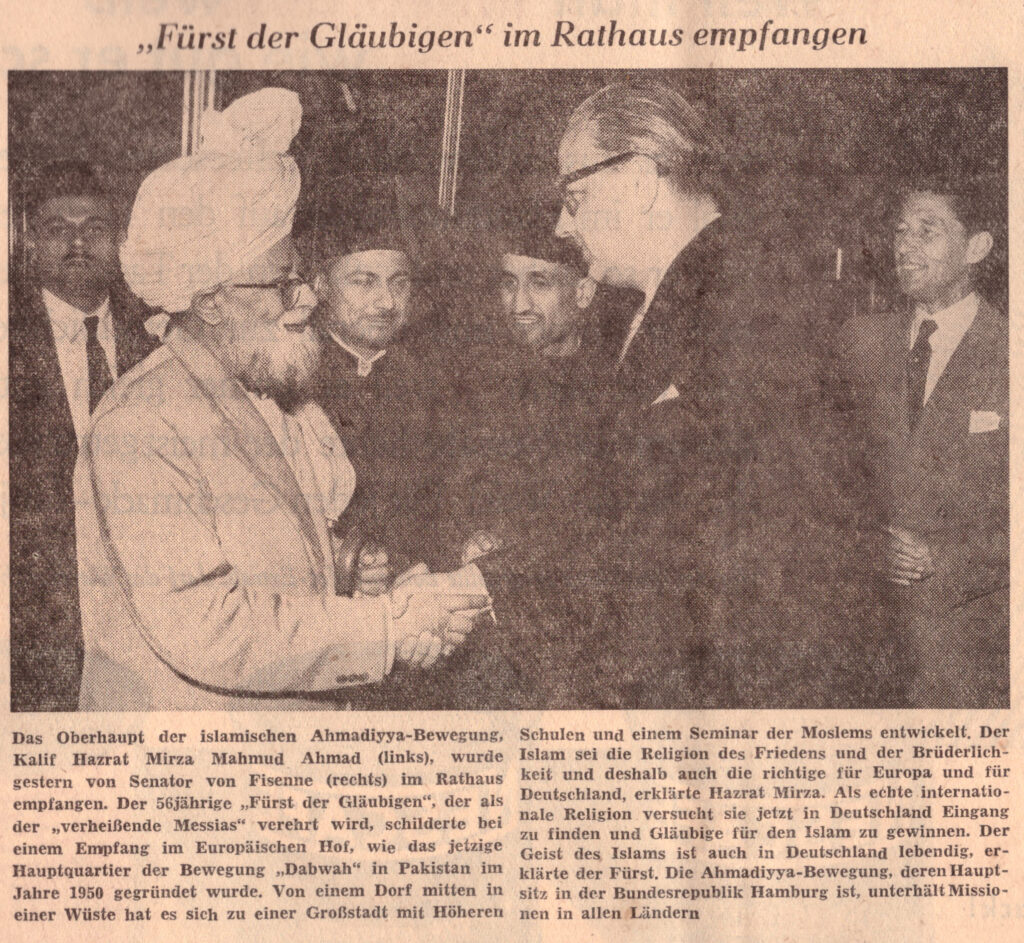
During his visit to Germany, Hazrat Musleh-e-Maudra attended a reception at the Hamburg Town Hall on 27 June 1955, which was organised by the local government in Hamburg.
Hazrat Musleh-e-Maudra reached the town hall at 10:45 am local time and granted audience to various officials of the Hamburg government, including a Senator, Mr Joseph Johann August Maria von Fisenne. The meeting continued for around 20 minutes. Various press correspondents were present there as well.
On the same evening, the local jamaat organised a tea party in honour of Huzoorra, which was attended by various local dignitaries and press representatives as well. After an address by the local jamaat, Huzoorra delivered a speech in English for around 30 minutes.
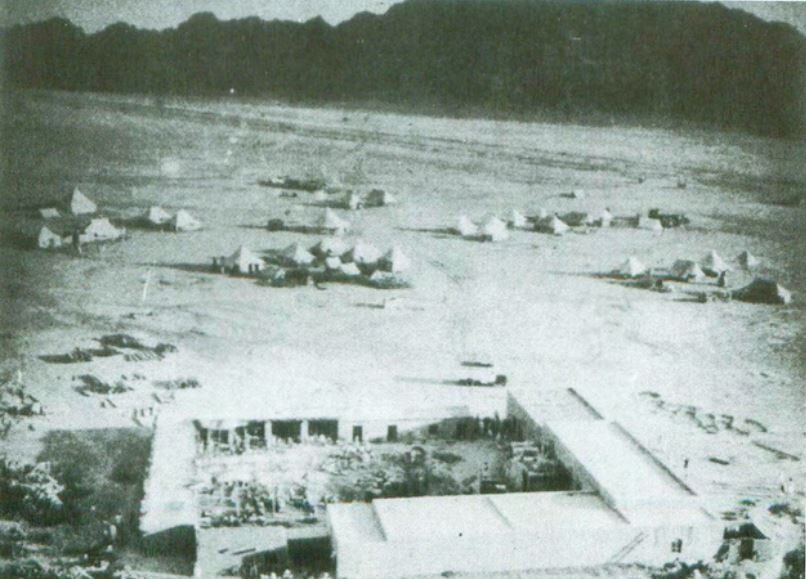
During his speech, Huzoorra narrated the details of the newly-established Markaz of Ahmadiyyat, Rabwah, and narrated how Allah the Almighty enabled the Jamaat to establish an astonishing town on barren land, which comprised only three tents at the outset. In the beginning, there was very little drinkable water, and when the water samples were sent to Lahore for assessment, the doctors declared it to be harmful to humans. At that time, Huzoorra stated, Allah the Almighty told him through a revelation that drinkable water would surely be available there, and now, in accordance with the promise of Allah, there is enough drinkable water. Huzoorra said that it was a great sign of the existence of Allah and the truthfulness of Ahmadiyyat.
Further, Huzoorra said that the German nation held a dignified character and that they had rebuilt the city of Hamburg in a short period of time. The German nation, with its lively spirit, would rapidly accept Islam, which itself encourages the same spirit.
Huzoorra said that he is a follower of that prophet, the Holy Prophet Muhammadsa, who made great efforts to establish peace and harmony across the globe and, being triumphant, showed remarkable forgiveness towards his enemies, who had left no stone unturned in their opposition after they put the Muslims to the sword. Islam, Huzoorra continued, professes a great teaching of harmony that is not found in any other religion. Islam is above all kinds of discrimination, whether it is on the basis of nationality, colour, or race, and presents golden principles to establish worldwide harmony and brotherhood. (Al Fazl, 15 July 1955, p. 3)
Chaudhry Abdul Latif Sahib, the then missionary in Germany, presented the German translation of Huzoor’sra speech.
A local newspaper, Hamburger Anzeiger, published a detailed report of this event, along with a photo of Hazrat Musleh-e-Maudra:
[Translation]
“‘Prince of the Faithful’ received at Town Hall
“The head of the Islamic Ahmadiyya Movement, Caliph Hazrat Mirza Mahmud Ahmad (left), was received by Senator von Fisenne (right) at the Town Hall yesterday. The 66-year-old ‘Prince of the Faithful’, revered as the ‘Promised Reformer’, described at a reception in the Europäischen Hof how the current headquarters of the movement ‘Rabwah’ in Pakistan was founded in 1950 [sic, 1948]. From a village in the middle of a desert, it has developed into a large city with secondary schools and a seminary for Muslims. Islam is the religion of peace and brotherhood and therefore also the right one for Europe and for Germany, Hazrat Mirza explained. As a true international religion, it is now trying to find its way into Germany and win believers for Islam. The spirit of Islam is also alive in Germany, the Prince explained. The Ahmadiyya Movement, whose headquarters in the Federal Republic is in Hamburg, maintains missions in all countries.” (Hamburger Anzeiger, 28 June 1955, p. 4)
Joseph Johann August Maria von Fisenne
Joseph Johann August Maria von Fisenne (1902-1987) was a German pharmacist and politician. He initially worked as a pharmacist in Küstrin, Berlin, and Hamburg for a few years. After World War II, he joined the CDU (Christlich Demokratische Union Deutschlands). In the Senat Sieveking (Senate of the Free and Hanseatic City of Hamburg), von Fisenne served as the Senator of the Building Authority from December 1954 to December 1955 and as the Senator of the Police Authority from January to March 1956.
_______________________________________________________________________________________________
‘Turn towards God instead of materialism to attain world peace’: Hazrat Musleh-e-Maud’s address at a reception in London, 1955 (alhakam.org)
‘Turn towards God instead of materialism to attain world peace’: Hazrat Musleh-e-Maud’s address at a reception in London, 1955
Ata-ul-Haye Nasir, Al Hakam

On 22 August 1955, Hazrat Musleh-e-Maud, Mirza Bashir-ud-Din Mahmud Ahmadra, addressed a reception at the Grosvenor Hotel in London which was organised in his honour by Jamaat-e-Ahmadiyya UK.
The Civil and Military Gazette reported:
“London Reception for Ahmadiyya Chief
“London, Aug. 24 – ‘Turn towards God instead of materialism to attain world peace,’ was the theme at a reception held on Monday afternoon at Grosvenor Hotel here in honour of Mirza Bashiruddin Mahmud Ahmad, head of the Ahmadiyya movement. The reception was arranged by the Ahmadiyya community of Great Britain. Members of the movement arrived not only from different parts of the country to attend the function but also from Africa and the United States.
“Mr Maulood Ahmad Khan, Imam of London Mosque, presented a formal address. Other speakers included Sir Francis Low on behalf of the East India Association, Sir Harold Shoobert on behalf of the Pakistan Society and Rev. Mr Mason on behalf of Central Rotary Club. The Imam emphasised the importance of Islamic spiritual values and hoped that the members of the movement would live up to them and provide an example to others.
“The head of the Ahmadiyya movement expressed pleasure at the high spiritual standard intended to be set up in practice by the community. Since most of the members in Great Britain came from Pakistan he felt sure that their fine example would not only elevate them spiritually but would also be a matter of pride for Pakistan.
“He hoped that the terrifying atomic destructive forces would be completely harnessed for the benefit of mankind and the world thus assured of everlasting peace. – Reuters.” (The Civil and Military Gazette, 25 August 1955, p. 2)

During this reception, Sir Francis Low, Sir Harold Shoobert, and Rev. Mr Mason warmly welcomed and expressed their gratitude to Hazrat Musleh-e-Maudra on behalf of the East India Association, Pakistan Society, and London Rotary Club, respectively.
During his speech, Huzoorra called on the members of the Jamaat to follow the Islamic principles in all fields, and as a piece of advice for the people of Pakistan, Huzoorra said that they ought to always keep in mind the interest of their country and to prove their loyalty and honesty through their actions. Advising the Europeans, Huzoorra urged them to pay heed to God Almighty instead of inclining towards materialism. Huzoorra emphasised that if this principle is acted upon, then a peaceful and harmonious society can surely be established. (Al Fazl, 25 August 1955, p. 1)
Hazrat Musleh-e-Maud’sra speech was translated into English by Hazrat Sir Chaudhry Muhammad Zafrulla Khanra.
The Civil and Military Gazette reported:

“Ahmadiyya Chief’s Plea for Patriotism
“An impassioned appeal to the people of Pakistan to keep the interests of the country above everything else and to act as patriotic and loyal citizens was made here by Hazrat Mirza Bashiruddin Mahmood Ahmad, head of the Ahmadiyya movement.
“He was speaking at a largely attended reception held in his honour by the Ahmadies of London. Among those present were Sir Muhammad Zafrulla Khan, Judge of the International Court of Justice, Sir Francis Low of the East India Association, the Pakistan High Commissioner, Mr Ikramullah, Mr Muhammad Mir Khan, permanent delegate of Pakistan at UN, the Lord Mayor of London, Sir Harold Schubert of the Pakistan Society and Sir Haviland.
“Mirza Bashiruddin also called upon his followers to lead their lives according to the tenets of Islam.
“Speaking to the Europeans there he urged them to seek strength and inspiration from God instead of entirely material sources. He said this was the only way to save the world from the blight of the atom and hydrogen bombs.” (The Civil and Military Gazette, 31 August 1955, p. 4)
_____________________________________________________________________________________________
‘Middle East in SW18’: Hazrat Musleh-e-Maud leads Eid-ul-Adha at the Fazl Mosque in London, 1955 (alhakam.org)
‘Middle East in SW18’: Hazrat Musleh-e-Maud leads Eid-ul-Adha at the Fazl Mosque in London, 1955
Ata-ul-Haye Nasir, Al Hakam

During his visit to Europe in 1955, Hazrat Musleh-e-Maud, Mirza Bashir-ud-Din Mahmud Ahmadra led the Eid-ul-Adha prayer at the Fazl Mosque in London. This is the only Eid-ul-Adha that Hazrat Musleh-e-Maudra has led in Europe. The total attendance was around 500, including various non-Muslim dignitaries, such as a Soviet attaché Mr Ivan Skripov, ambassadors of Argentina, Chile, Haiti, and the Dominican Republic; and Shaw Desmond (1877-1960) – an Irish author, spiritualist, and founder of the International Institute of Psychical Research. Moreover, Ald E Whitlock conveyed the greetings of the Wandsworth Rotary Club as well.

On 23 July 1955, The Civil and Military Gazette announced under the heading, “Id-ul-Azha in London”:
“At the London Mosque, Mirza Bashiruddin Mahmud Ahmad, head of the Ahmadiyya community, will lead the prayers.—Star.”

Reporting on this gathering at the Fazl Mosque, the South Western Star of London reported under the heading “Middle East in SW18”:
“Deep in the heart of the Southfields suburban scene rises the dazzling white dome of the London Mosque. […] Last Saturday,” scores of “fezzed and turbaned men walked through quiet suburban streets on their way to celebrate the festival of Eid-ul-Adha commemorating the offer of Abraham to sacrifice his son as commanded by God.
“Inside the Mosque, which was completely devoid of all decoration and painted a cool green, Hazrat Khalifatul Masih II[ra] who is visiting England from Pakistan, preached the sermon. A venerable white-bearded figure, he wore a white turban with his beige tunic and trousers. His talk, a simple little homily on the virtues of giving up luxury, was relayed to the garden, where a score of Muslims knelt on prayer mats with their faces turned towards Mecca.
“Then, putting on their shoes, which they had abandoned before entering the Mosque, the worshippers filed into a huge marquee for the traditional feast of lamb stew and rice. […]
“Non-Muslim visitors included a Soviet attaché, Mr Ivan Skripov, the Ambassadors of Argentina and the Dominican Republic, and Irish author Shaw Desmond. Greetings of the Wandsworth Rotary Club were conveyed by Ald E. Whitlock.” (South Western Star, 5 August 1955, p. 5)

During his Eid Sermon, Hazrat Musleh-e-Maudra said that this Eid is called Eid-ul-Adha by the Muslims, which means the Eid of sacrifices. It is commemorated in the remembrance of Hazrat Ismailas, son of Hazrat Ibrahimas.
Huzoorra then mentioned that Allah the Almighty had commanded Hazrat Ibrahimas to sacrifice his son. The Bible says that it was Hazrat Ishaqas, however, the Holy Quran states that it was Hazrat Ismailas. Nonetheless, Huzoorra said, the Quranic view is the correct one. Huzoorra said that despite the fact that there is a debate as to which son was commanded to be sacrificed, the categorical truth is that Allah the Almighty had commanded Hazrat Ibrahimas to sacrifice his son, and he submitted to it.

After mentioning the details of that incident, Huzoorra continued:
“Today, we have gathered here to remember that incident. Moreover, hundreds of thousands of people have convened in that uncultivable valley [Mecca] and calling out loudly:
لَبَّيْکَ اَللّٰهُمَّ لَبَّيْکَ لَا شَرِيْکَ لَکَ لَبَّيْکَ
“It meas ‘O our Lord, I submit just like Ibrahimas had said, ‘I submit.’ There is none equal to You in Your attributes, and there is none worthy of worship except You. I have submitted to propagate Your Unity.’ […] [Hazrat Ibrahim’sas] act of leaving Ismailas there in Mecca, not only benefited Ismailas but the whole world as well. Ismailas became a great ‘teacher’ to teach Tawhid, and through him, the world succeeded in worshipping the One God. If one removes Mecca from the map of the world, there remains no other centre of Tawhid in the whole world, and if one discards the sacrifice of Ismailas, there remains no other way in the world to create a passion to dedicate lives for the sake of God. […] We can say that Ismailas dedicated his life for the sake of Tawhid, which was an act of benevolence for the world, and the place where he had made this sacrifice, became an everlasting centre of Tawhid. Hence, Ismailas is deserving of God Almighty’s blessings.
“Moreover, Mecca is also deserving of God Almighty’s blessings where [Ismailas] made these sacrifices, and the flag of God’s Unity will always remain established there. Nations will overpower other nations; the flags of various nations will fall one after another, however, the flag of Tawhid, which was raised in Mecca by Ismailas, will remain aloft till the Day of Judgement, no one can ever break or degrade it. […] This is a Divine decree that can never be altered by anyone. One after another, the [nations of the] world would come under this flag of tawhid. At last, the world will unite there, and a time will come when – just like the slogans of God’s Unity are being raised on this day in Mecca – the slogans of tawhid will be raised from all corners of the world and the takbir [supremacy] of the One God will be announced. […]
“In the end, I pray to Allah the Almighty that may that day come soon, may the whole world learn the lesson of this Eid, may all the people submit to God, their Creator, and may every dispute, conflict and disagreement efface from the world, may every heart become ‘Ka’bah’ – i.e., the abode of God – and may [the love of] God reside in people’s hearts.” (Khutbat-e-Mahmud, Vol. 2, pp. 386-387)

Al Fazl, in its 3 August 1955 issue, reported that during his Eid Sermon, Hazrat Musleh-e-Maudra called the attention of the Western nations to devote their lives – to establish peace in the world – for the sake of God Almighty, following in the footsteps of His chosen personages like Hazrat Ibrahimas and Hazrat Ismailas. (Al Fazl, 3 August 1955, p. 1)
After the Eid-ul-Adha prayer, the Irish author Shaw Desmond had the opportunity to meet Hazrat Musleh-e-Maudra and ask various questions as well. Huzoorra himself mentioned this meeting during his Eid-ul-Fitr Sermon on 12 May 1956. (Al Fazl, 18 April 1958, p. 4)

_____________________________________________________________________________________________
Europe seeks Islam: Hazrat Musleh-e-Maud’s lecture at a reception held in Karachi, 1955 (alhakam.org)
Europe seeks Islam: Hazrat Musleh-e-Maud’s lecture at a reception held in Karachi, 1955
Ata-ulHaye Nasir, Al Hakam

On 21 September 1955, Hazrat Musleh-e-Maud, Mirza Bashiruddin Mahmud Ahmadra delivered a lecture at a reception held in his honour after his tour of Europe. The event was organised by Jamaat-e-Ahmadiyya Karachi at the Beach Luxury Hotel, Karachi, Pakistan.
The reception was attended by various ambassadors, high government officials, notable locals, press correspondents and other dignitaries.
In this lecture, Huzoorra called on the Muslim world to leave aside their internal disagreements and unite to carry out the important task of propagating Islam.
Huzoorra said Muslims needed to refute the allegations that were raised by the people of Europe and other countries against the teachings of Islam and the blessed character of the Holy Prophet Muhammadsa.
Huzoorra quoted the following verse of the Holy Quran:
قُلۡ يٰۤاَهۡلَ الۡكِتٰبِ تَعَالَوۡا اِلٰي كَلِمَةٍ سَوَآءٍۢ بَيۡنَنَا وَبَيۡنَكُمۡ اَلَّا نَعۡبُدَ اِلَّا اللّٰهَ وَلَا نُشۡرِكَ بِهٖ شَيۡئًا وَّلَا يَتَّخِذَ بَعۡضُنَا بَعۡضًا اَرۡبَابًا مِّنۡ دُوۡنِ اللّٰهِ ؕ فَاِنۡ تَوَلَّوۡا فَقُوۡلُوا اشۡهَدُوۡا بِاَنَّا مُسۡلِمُوۡنَ
“Say, ‘O People of the Book! come to a word equal between us and you—that we worship none but Allah, and that we associate no partner with Him, and that some of us take not others for Lords beside Allah.’ But if they turn away, then say, ‘Bear witness that we have submitted [to God].’” (Surah Aal-e-Imran, Ch.3: V.65)
Commenting on this verse, Huzoorra said that if the staunch opponents of the Holy Prophetsa – Jews and Christians – could be invited to “come to a word equal between us and you”, then what was the excuse for the Muslims not to leave aside their internal disputes in order to strive with mutual cooperation for spreading the truthfulness of the Holy Prophetsa and Islam.
Huzoorra mentioned his recent tour of Europe and said it was his observation that Europe was inclining towards Islam and the Europeans were beginning to acknowledge the greatness of Islam and the Holy Prophet Muhammadsa.

Huzoorra said the need of the time was to propagate Islam in those countries by offering sacrifices of wealth and devotion of lives so that we could witness the time when those people who had uttered disrespectful views about the Holy Prophet Muhammadsa in the past, began to send salutations and durood on him.
He expressed that it was unfortunate to see various sects of Muslims disputing over trivial matters, whereas, the most crucial issue was to find ways to eradicate the vile attacks carried out against Islam and the blessed character of the Holy Prophetsa.
Huzoorra hoped that if the Muslim organisations and sects made efforts to establish missions to propagate Islam in the West, then within a few years, a huge number of Europeans would certainly gather under the flag of the Holy Prophet Muhammadsa.
Huzoorra continued by saying that it was a dire need of the time for the Muslims to realise what Islam required of them in this day and age and that they needed to eradicate their laziness and shortcomings. (Tarikh-e-Ahmadiyyat, Vol. 17, pp. 29-34)
Hazrat Musleh-e-Maud’s lecture was published by various Urdu and English newspapers, such as The Civil and Military Gazette, Roznama Inqilab of Karachi, Roznama Jang of Karachi, The Daily Evening Star of Karachi, The Daily Pakistan Standard of Karachi, Roznama Imroze of Karachi, Roznama Millat of Lahore, Roznama Nawa-i-Kashmir of Lahore, and Roznama Pasbaan of Dhaka.

The Civil and Military Gazette wrote:
“AHMADIA CHIEF URGES SENDING OF ISLAMIC MISSIONS TO EUROPE
“KARACHI, Sept 22: Mirza Bashiruddin Mahmood Ahmed, Head of the Ahmadia Community yesterday laid stress on sending Islamic missions to the European countries.
“Mirza Bashiruddin Mahmood who has returned from a tour of Europe was giving his impressions at a function held in his honour at the Beach Luxury Hotel.
“He said that the people in Europe were anxious to know a lot about Islam. Wherever he went he said people asked him to send missions to their countries so that they could know about Islam.
“He added that a large number of people in Europe were ready to embrace Islam provided the teachings of Islam were brought to them.
“In London, he said, he found a number of people in favour of purdah and polygamy.
“Mirza Bashiruddin Mahmood appealed for funds and said that this could help in sending missions abroad.” (The Civil and Military Gazette, 23 September 1955, p. 3)

The Australasian Record and Advent World Survey of Warburton, Victoria, reported:
“Missions in Reverse
“A familiar plea was voted recently in Karachi, Pakistan – a plea for missionaries. Here’s the switch: the pleader was a Muslim leader. The mission field he named was America.
“Said Hazrat Khalifatul Masih II at a large gathering of the Ahmadiyya Community: ‘The world seems to be thirsty to know more about the teachings of Islam. We need men to take it upon themselves to spread the message of Islam everywhere. Do you think that if you give contributions (to the community) here the people of America will become Muslims themselves?’
He called upon every Ahmadi family to dedicate one of its members as a propagator (missionary) of Islam. – Christian Life, January, 1956.” (The Australasian Record and Advent World Survey, 2 April 1956, p. 9)

Roznama Inqilab of Karachi reported on 23 September 1955:
“The Imam of Jamaat-e-Ahmadiyya Mirza Bashiruddin Mahmud Ahmad said that today Europe is starving for Islam, since they are unable to find peace anywhere else. Therefore, we just need to carry out tabligh and convey to them the message of Islam, and they will be ready to accept it. He said that a time will come when America and Europe will accept Islam [in large numbers]. He appealed to the Muslims telling them to leave aside their internal disputes and unite to preach the Unity of God. He proposed that if every citizen of Karachi donated five rupees each, two million people could raise an amount of ten million rupees, which could be utilised to carry out tabligh in Europe on a large scale. While narrating his tour of Europe, he told:
“‘In every European country where I visited, the people would meet me and inquire about Islam with great interest. I delivered a speech at a college in Switzerland that was translated into various languages. A student expressed that “if there are such great features of Islam, then why can’t the Muslims and Christians jointly preach the message of Unity of God in those areas where people do not believe in God?”’

“Mirza Sahib continued by saying that ‘We are required to send tablighi missions [to Europe] as much as possible, which may not necessarily be sent by Ahmadis, rather by Sunnis, Shias, Ahl-e-Hadith, and Aga Khanis as well. […] Our Jamaat is a small community, thus, if we send 10 [tablighi] missions, the others should send 10,000 missions, creating a spirit of competition in tabligh, which will surely be beneficial [for the cause of Islam].’”
The Roznama Millat of Lahore reported on 24 September 1955:
“While speaking at a reception held at the Beach Luxury Hotel, Head of the Ahmadiyya Jamaat, Mirza Bashiruddin Mahmud emphasised the need to send Muslim delegations to the European countries [for tabligh]. Mirza Sahib, who just recently returned from his tour of Europe, was narrating his impressions about the tour. He said that the Europeans are very eager to learn about Islam since wherever he visited, the people insisted that Muslim delegations be sent there in order to teach them about Islam. He stated that a huge number of people are ready to accept Islam, provided arrangements are made to convey to them the true teachings of Islam. He found there were many who favoured [the Islamic teachings of] purdah and polygamy. Towards the end of his speech, Mirza Sahib emphasised the need to raise funds for sending Muslim delegations to foreign countries.”

Roznama Jang of Karachi reported on 24 September 1955:
“While speaking at a private gathering, Mirza Bashiruddin Mahmud stated there is a need to send tablighi [preaching] delegations to the European countries to propagate Islam. […] He said that amongst those who met with him in London, many were in favour of the [Islamic teachings of] purdah and polygamy. He also advised raising funds for sending tablighi delegations to foreign countries.”
Roznama Pasbaan of Dhaka wrote on 24 September 1955:
“While speaking at a gathering in Karachi, the Imam of the Ahmadiyya Community, Mirza Bashiruddin Mahmud Ahmad, said there are many opportunities for propagating Islam in Europe, particularly in Germany, where the people desire to learn a lot about Islam. He further said that those people are continuing to come closer to Islam, since they have an eagerness and quest for searching the truth, and it is only Islam which can satisfy them. Therefore, this is the time to show them the true and correct pathway towards Islam.”
اِک وقت آئے گا كہ كہيں گے تمام لوگ
ملّت كے اس فدائی پہ رحمت خدا كرے
“The time will come when everyone will say, ‘May God have mercy on this devotee of the nation.’”
_____________________________________________________________________________________________
Links and Related Essays
Who is Rashid Ahmad? The first African-American Ahmadi imam?
https://ahmadiyyafactcheckblog.com/?s=1956
https://ahmadiyyafactcheckblog.com/2017/01/25/the-slow-agonizing-death-of-mahmud-ahmad/
_____________________________________________________________________________________________Tags
#ahmadiyya #ahmadiyyatrueislam #ahmadiapartheid #Ahmadiyyat #rabwah #qadian #meetthekhalifa #muslimsforpeace #ahmadiyyafactcheckblog #nolifewithoutkhalifa #AhmadiMosqueattack #AhmadiyyaPersecution #trueislam
Some pics

29 Pingback