Intro
A few months before MGA made his claim to be “Maseeh-e-Maud” (Promised Messiah)(See Izala Auham, Part-1, 1890, page 124-125), MGA added words (bal huwa)(instead he) to the famous hadith about the Imam Mahdi in Sahih Bukhari (Hadith #3449)(See Bro Imtiaz explaining this herein, 1:32:36, TikTok-32)(See full translation via google lens in the below). Imam Bukhari (RH) had brought this hadith in his Sahih under the chapter (Baab) Nuzul Isa ibn Maryam (as). It should be noted that in Izala Auham Part-1, MGA denied being “Maseeh-e-Maud” and declared it, in the same book. This argument comes from the era wherein MGA denied all hadith on the Mahdi.
Bro Imtiaz explained how MGA added three new ideas into this hadith. #1-MGA added the word “Vo”(1:50:28). #2-MGA added the words “bal huwa”(1:54:40). #3-MGA–MGA added the words he will be born (paida) amongst you (1:55:32). Bro Imtiaz also presented hadith #156 from Sahih Muslim (1:58:00), which gives more information on how Eisa (As) will meet a commander of a Muslim army and also allow this commander to lead the prayer (out of respect). Sahih Muslim 155f says that Eisa (as) will lead the Ummah, via Quran and Sunnah, this is another piece of evidence against the Qadiani’s. Even Sahih Muslim 155e says that Eisa (as) will lead Muslims in terms of government and religious life. Sahih Muslim 155d says that when Eisa (as) will descend, our Imam will be amongst Muslims.
In 1898, via “Raz-e-Haqiqat (see pages 55-56) and Shahadtul Quran (1893)(the words minkum appears 17 times in this book), MGA and his team of writers quoted a hadith from Abu Hurrairah, however, they didn’t give Abu Hurrairah‘s name, since he hated him. See Malfuzat-1, online English edition (page 262). Also see “Kitab ul Barriya” (1898), (online English edition by the Lahori-Ahmadi’s). See Ayyam us Sulah too (1898).
In 1903, via the Al-Badr newspaper, MGA was asked as to why he doesn’t lead the prayers at Qadian or anywhere else. MGA quoted the famous hadith “imamukum minkum” and argued that the Messiah won’t lead prayers, others will. Minkum was also quoted in the BA-5 (see page 135)(1908).
Recently (2014–2022) Maulvi Farhan Iqbal quoted 24:55 and connected it to “imamukum minkum” (Many of the arguments presented in this article are paraphrased from the Ahmadiyya Taleemi Pocket Book written by Qazi Muhammad Nazeer sahib, Tablighi Pocket Book written by Malik Abdur Rahman sahib Khadim, Tafseer-e-Sagheer, Short Commentary of the Holy Quran and Five Volume Commentary of the Holy Quran).
In Feb of 2025, a silly Ahmadi brought a similar narration from Musnad-e-Ahmad (See Bro Imtiaz explaining this herein, 1:32:36, TikTok-32).
In June of 2025, Ahmadi’s discussed this hadith on the True Islam Uk Urdu stream vs. Bro Imtiaz.
_____________________________________________________________________________________________
1890
Izala Auham, Part-1, pages 124-125
MGA adds words to the famous hadith from Bukhari, Imam ukum minkum.
Translation via google lens
“Now I have presented all the outlines that my people have drawn of the biography of Christ that will pass upon them after coming down to earth twice. To what extent is there a gathering of defects in it? How far is this glory far from prophethood? But at this place it should also be remembered that all this collection is not in Sahih. Imam Muhammad Ismail Bukhari, may God have mercy on him, did not even indicate that this coming one will be the first match in reality, but he has written two hadiths on the part of the Prophet, peace be upon him, who have decided that the Messiah is the first and the Prophet is the second, and because the subject of one hadith is that the son of Mary will descend among you, and then he has explained/revealed it to us in a sermon that he will be your Imam who will be from among you. Therefore, we should carefully consider the words that the Holy Prophet (peace and blessings of Allah be upon him) says in the explanation of the word Ibn Maryam, that he will be your Imam who will be from you and will be born from you “Bal Hu Imamkam Minkum” and the second hadith that decides this is that the Holy Prophet (peace and blessings of Allah be upon him) has said a description of the first Messiah and has mentioned a different description of the second Messiah, which is exactly in accordance with the description of this humble person. Now, one should think that the clear contradiction between these two rules is not a strong argument that in fact the first one is correct and the second is correct. Another thing worth noting is that the objection of our scholars is that the hadith about the descent of Ibn Maryam should be based on the truth. If they are asked that Ibn Maryam will come down and break the cross and kill the pigs, then they take the words of Ibn Maryam as the truth and start using metaphors and metaphors like ours about the cross and pigs. Therefore, those people are guilty of their actions because in this case, this evidence comes to them that out of the three words, which are the descent of Ibn Maryam, the breaking of the cross, and the killing of pigs, you yourself have convinced yourself that other meanings are meant by them as a metaphor. Now I ask whether it is wisdom and wisdom to hold on to these ideas on a set of contradictions or are those teachings close to understanding and in accordance with the intellect that have been revealed to this humble person. Apart from this, in many ways, there are strong objections to those old ideas from which there is no way to gain sincerity”.
Scans


_____________________________________________________________________________________________
1893
https://www.alislam.org/library/books/Testimony-of-the-Holy-Quran.pdf
Page 45
“””And to say that the word مِنْکُم [minkum—from among you] signifies that the Khulafa’ will be solely from among the Companions because they are the sole addressees of the word minkum, then such thinking would be a blatant mistake. Such words can only be uttered by a person who has never read the Holy Quran with reflection and has failed to understand its manner of expression. If it were true that the only intended addressees were those believers
who were alive and present at the time [of its revelation], then such a view would render the interpretation of the entire Quran upside down.”””
_____________________________________________________________________________________________
1898
Raz-e-Haqiqat, online english edition, pages 55-56
“”Muhammad Husain firmly believes that when the Messiah descends, the Promised Mahdi will surely be raised from among the Quraish; he will be the Khalifah of the age and the Promised Messiah will serve him along with those who pledge allegiance at his hand. For this reason, in their view the Hadith in Sahih Bukhari, i.e. اِمَامُکُمْ مِنْکُمْ 1 , alludes to the Promised Mahdi due to the words اِمَِامْ [imam] and مِنْکُمْ [minkum]; whereas, in my estimation, the word imam here refers to the Messiah who has been conferred spiritual authority. My view on this stands in stark contrast to that of Muhammad Husain and all his like-minded clerics who reside in the Punjab and throughout India. According to them the word imam in this Hadith alludes to the Awaited Mahdi who will be from the Quraish and who will wage war; and the Promised Messiah will serve him as an adviser and counsellor, but the Khalifah of the time will be the Mahdi.”””
________________________________________________________________________________________________
1903
Malfoozat 21-oct-1903. Vol. 3, also reported in Al-badr
“Regarding leading in prayers, one guy question that why hazrat do not lead the prayers? Answered that it is written in hadees that Maseeh that has to come will pray behind others”
The scans
 ______________________________________________________________________________________________1908
Minkum was also quoted in the BA-5 (see page 135).
_____________________________________________________________________________________________
Musnad e Ahmad
Vol-2, page 411
Conclusion of the 14th Century and A Moment of Reflection for the Muslims
“Whosoever lives from among you shall meet Isa, son of Mary who is Imam, Mahdi, Arbiter and Judge.”
_____________________________________________________________________________________________
Sahih Muslim 156 – The Book of Faith – كتاب الإيمان – Sunnah.com – Sayings and Teachings of Prophet Muhammad (صلى الله عليه و سلم)
Jabir b. ‘Abdullah reported:
_______________________________________________________________________________________________
2014-2022
Establishing the Truthfulness of the Promised Messiah (as) from the Holy Quran (alislam.org)
Establishing the Truthfulness of the Promised Messiah(as) from the Holy Quran
by Farhan Iqbal, Missionary, Ahmadiyya Muslim Community Canada
The Holy Quran makes an unqualified assertion and tells the Prophet(sa) to:
قُلۡ اِنۡ کُنۡتُمۡ تُحِبُّوۡنَ اللّٰہَ فَاتَّبِعُوۡنِیۡ یُحۡبِبۡکُمُ اللّٰہُ وَ یَغۡفِرۡ لَکُمۡ ذُنُوۡبَکُمۡ ؕ وَ اللّٰہُ غَفُوۡرٌ رَّحِیۡمٌ ﴿۳۲﴾
“Say, ‘If you love Allah, follow me: then will Allah love you and forgive you your faults. And Allah is Most Forgiving, Merciful’” (3:32). This verse emphatically declares that the goal to attain Divine love is now only possible by subservience to and following the Prophet(sa). This verse also implies that the Promised Messiah and Imam Mahdi(as) would therefore be a follower of the Prophet(sa). It further implies that the second coming of all those prophets that other religions expect would also be fulfilled in the person of the Promised Messiah and Imam Mahdi(as). We know for a fact that, to date, no one who has passed away, gone up to heaven, or disappeared, has returned to earth. It is against the law of God. Any second coming or re-advent would be in likeness and spirit only. The Promised Messiah and Imam Mahdi, Hazrat Mirza Ghulam Ahmad Qadiani(as), precisely made this claim. Any man who claims he is from God and makes prophecies and shows divine signs must be looked at seriously and honestly. The Holy Quran reminds us of this as it states:
وَ قَالَ رَجُلٌ مُّؤۡمِنٌ ٭ۖ مِّنۡ اٰلِ فِرۡعَوۡنَ یَکۡتُمُ اِیۡمَانَہٗۤ اَتَقۡتُلُوۡنَ رَجُلًا اَنۡ یَّقُوۡلَ رَبِّیَ اللّٰہُ وَ قَدۡ جَآءَکُمۡ بِالۡبَیِّنٰتِ مِنۡ رَّبِّکُمۡ ؕ وَ اِنۡ یَّکُ کَاذِبًا فَعَلَیۡہِ کَذِبُہٗ ۚ وَ اِنۡ یَّکُ صَادِقًا یُّصِبۡکُمۡ بَعۡضُ الَّذِیۡ یَعِدُکُمۡ ؕ اِنَّ اللّٰہَ لَا یَہۡدِیۡ مَنۡ ہُوَ مُسۡرِفٌ کَذَّابٌ ﴿۲۹﴾
That is, “And a believing man of Pharaoh’s family, who hid his faith said, ‘Would you kill a man because he says, My Lord is God, and he (Moses) has come to you with clear signs (proofs) from your Lord? And if he is a liar, upon him will be (the sin of) his lie; but if he is telling the truth, then some of that calamity wherewith he threatens you will befall on you’”. (40:29)
Let us review the Holy Quran and see what it says about the coming of a prophet from the Ummah (followers) of The Prophet(sa).[i]

Verse #1
فَقَدۡ لَبِثۡتُ فِیۡکُمۡ عُمُرًا مِّنۡ قَبۡلِہٖ ؕ اَفَلَا تَعۡقِلُوۡنَ
Translation: I have indeed lived among you a whole lifetime before this. Will you not then understand? [10:17]
Proof: The Holy Prophet(sa) was told by God to tell the people that his life before prophethood is proof for the truthfulness of his claims. The same is the case with the Promised Messiah(as). When his life before his claims is assessed, it becomes as clear as daylight that he was a very truthful person. He himself received the revelation, “I have spent a whole lifetime among you before this, then do you not understand?” (Tadhkirah, p. 111). He also writes, “You cannot find any fault, imposture, lies, or fraud in my life (prior to my claim) such that you may think that a person who is accustomed to lying and defrauding others has lied again (about his claims). Who among you can allege such a fault in my life? Hence, it is the grace of God that He has kept me righteous from the beginning and this is an argument for those who ponder” (Tadhkiratush Shahadatain, Ruhani Khaza’in, vol. 20, p. 64).
Verse #2
وَ مَنۡ اَظۡلَمُ مِمَّنِ افۡتَرٰی عَلَی اللّٰہِ کَذِبًا اَوۡ کَذَّبَ بِاٰیٰتِہٖ ؕ اِنَّہٗ لَا یُفۡلِحُ الظّٰلِمُوۡنَ ﴿۲۲﴾
Translation: And who is more unjust than he who forges a lie against Allah or gives the lie to His Signs? Surely, the unjust shall not prosper. [6:22]
Proof: In this verse, the enemies of the Holy Prophet(sa) are told that those who forge lies against Allah are never successful. The Holy Prophet(sa) is successful and this means that he has come from God. The same is the case with the Promised Messiah(as) who challenged his opponents and none of them proved successful against him.
Verse #3
کَتَبَ اللّٰہُ لَاَغۡلِبَنَّ اَنَا وَ رُسُلِیۡ ؕ اِنَّ اللّٰہَ قَوِیٌّ عَزِیۡزٌ ﴿۲۲﴾
Translation: Allah has decreed: ‘Most surely I will prevail, I and My Messengers.’ Verily, Allah is Powerful, Mighty. [58:22]
Proof: It is stated clearly in this verse that the community established by God through His Messengers always prevails over their opponents. The enemies of the Promised Messiah(as) have also made numerous attempts in the last 130 years to destroy it but they have never succeeded. The Jama’at has instead always prevailed over them.
Verse #4
فَاَنۡجَیۡنٰہُ وَ اَصۡحٰبَ السَّفِیۡنَۃِ وَ جَعَلۡنٰہَاۤ اٰیَۃً لِّلۡعٰلَمِیۡنَ ﴿۱۶﴾
Translation: But We saved him and those who were with him in the Ark; and We made it a Sign for all peoples. [29:16]
Proof: During the time of Noah(as), a flood came which destroyed the opponents of Noah(as). Only Noah(as) and his followers survived in the Ark. In the same way, at the time of the Promised Messiah(as), a great epidemic of plague spread in accordance with the prophecies. A large number of people died including many opponents of the Promised Messiah(as). It was in the midst of this epidemic that the Promised Messiah(as) was given the revelation, “I shall protect everyone who is within the four walls of your home”. Explaining this revelation, he writes, “This should not be taken to mean only such people who dwell in my house made of brick and mortar; rather, this also refers to all those who follow me completely and dwell in my spiritual home” (Noah’s Ark, p. 19). And this is precisely how it happened. History attests to the fact that everyone within the house of the Promised Messiah(as) literally remained safe from the plague, and those who were his sincere followers also remained safe.
Verse #5
وَ لَوۡ تَقَوَّلَ عَلَیۡنَا بَعۡضَ الۡاَقَاوِیۡلِ ﴿ۙ۴۵﴾ لَاَخَذۡنَا مِنۡہُ بِالۡیَمِیۡنِ ﴿ۙ۴۶﴾ ثُمَّ لَقَطَعۡنَا مِنۡہُ الۡوَتِیۡنَ ﴿۫۴۷﴾
Translation: And if he had forged and attributed any sayings to Us, We would surely have seized him by the right hand, And then surely We would have severed his life-artery. [69:45-47]
Proof: This verse shows that the Holy Prophet(sa) is a true Prophet because he was granted a long life after presenting to the world that he receives revelations from God. We know that the Holy Prophet(sa) lived for 23 years after receiving his first revelation. Hence, a false prophet cannot come who claims to have received revelations from God for a period of longer than 23 years. When this criterion is applied to the Promised Messiah(as), it is learned that his first revelations were received by him in the late 1860’s and he continued to receive revelations from God for more than 45 years. This in turn proves that his claim is true as God would not have granted such a long period of time to a false claimant of revelation. Non-Ahmadi Muslims, on the other hand, claim that the Promised Messiah(as) was false despite having received revelations for a period longer than 23 years. If that is true, our question to them is as follows: If a false claimant can continue to claim false revelations for a period of 23 years, how do we conclude from the above verse that the Holy Prophet(sa) was indeed a true claimant as he only received revelations for a period of 23 years? In other words, the non-Ahmadi position invalidates the main argument presented in the above verse.
Verse #6
عٰلِمُ الۡغَیۡبِ فَلَا یُظۡہِرُ عَلٰی غَیۡبِہٖۤ اَحَدًا ﴿ۙ۲۷﴾ اِلَّا مَنِ ارۡتَضٰی مِنۡ رَّسُوۡلٍ
Translation: He is the Knower of the unseen; and He reveals not His secrets to any one, except to him whom He chooses, namely a Messenger of His. [72:27-28]
Proof: A true prophet of God is granted an abundance of knowledge of the unseen. The Promised Messiah(as) received this knowledge as well which makes him a true messenger of God. For a detailed study of the prophecies of the Promised Messiah(as), a great book to study is Haqiqatul Wahi where he has listed many of his fulfilled prophecies. Another book to study for a shorter list is Invitation to Ahmadiyyat.
Verse #7
وَّ اٰخَرِیۡنَ مِنۡہُمۡ لَمَّا یَلۡحَقُوۡا بِہِمۡ ؕ وَ ہُوَ الۡعَزِیۡزُ الۡحَکِیۡمُ ﴿۴﴾
Translation: And among others from among them who have not yet joined them. He is the Mighty, the Wise. [62:4]
Proof: Seeing this verse in context shows that it is speaking of the coming of the Holy Prophet(sa) to “others from among them who have not yet joined them”. This refers to the Second Advent of the Holy Prophet(sa) fulfilled metaphorically in the Promised Messiah(as). It is narrated in Sahih Bukhari that Abu Hurairah(ra) states: “One Day we were sitting with the Holy Prophet when Surah Jumu‘ah was revealed. I asked the Holy Prophet, “Who are the people to whom the words And among others from among them who have not yet joined them, refer. Salman the Persian was sitting among us. Upon my repeatedly asking him the same question, the Prophet put his hand on Salman and said, “If Faith were to go up to the Pleiades, a man from these would surely find it” (Bukhari).
Verse #8
اِنَّاۤ اَرۡسَلۡنَاۤ اِلَیۡکُمۡ رَسُوۡلًا ۬ۙ شَاہِدًا عَلَیۡکُمۡ کَمَاۤ اَرۡسَلۡنَاۤ اِلٰی فِرۡعَوۡنَ رَسُوۡلًا ﴿ؕ۱۶﴾
Translation: Verily, We have sent to you a Messenger, who is a witness over you, even as We sent a Messenger to Pharaoh. [73:16]
Proof: In this verse, the Holy Prophet(sa) is likened to Prophet Moses(as). Both are law-bearning prophets and have many similarities. One of the similarities is that their nations were to also be similar to one another. Just as loved ones of God continued to be born in the community of Moses (i.e. the Israelites), loved ones of God continued to be born also in the community of Muhammad(sa). Hence, the Muhammad dispensation is similar to the Mosaic dispensation. And in order for the similarities to be complete and perfectly aligned, it was also necessary that just as a Messiah appeared in the 14th century after Prophet Moses(as), a Messiah had to appear in the 14th century after Prophet Muhammad(sa). That Messiah is Hazrat Mirza Ghulam Ahmad(as).
Verse #9
اَفَمَنۡ کَانَ عَلٰی بَیِّنَۃٍ مِّنۡ رَّبِّہٖ وَ یَتۡلُوۡہُ شَاہِدٌ مِّنۡہُ وَ مِنۡ قَبۡلِہٖ کِتٰبُ مُوۡسٰۤی اِمَامًا وَّ رَحۡمَۃً ؕ اُولٰٓئِکَ یُؤۡمِنُوۡنَ بِہٖ ؕ
Translation: Can he, then, who possesses a clear proof from his Lord, and to testify to whose truth a witness from Him shall follow him, and who was preceded by the Book of Moses, a guide and a mercy, be an impostor? Those who consider these matters believe therein… [11:18]
Proof: Three arguments have been given in this verse in support of the Holy Prophet in the words: (a) ‘Who stands upon a clear proof from his Lord’, (b) ‘to testify to whose truth a witness from Him shall follow him’, and (c) ‘who was preceded by the Book of Moses’. ‘The clear proof from his Lord’ was the great moral revolution which the Holy Prophet had brought about in the life of his corrupt and decadent people, and “a witness from Him shall follow him” means that there will be many divine teachers that will follow the Prophet(sa) and testify to his truth , the witness par excellence was the Promised Messiah and Mahdi(as) and the words ‘was preceded by the Book of Moses’ point to the prophecies that are found in the Bible about the Holy Prophet(sa).
Verse #10
وَعَدَ اللّٰہُ الَّذِیۡنَ اٰمَنُوۡا مِنۡکُمۡ وَ عَمِلُوا الصّٰلِحٰتِ لَیَسۡتَخۡلِفَنَّہُمۡ فِی الۡاَرۡضِ کَمَا اسۡتَخۡلَفَ الَّذِیۡنَ مِنۡ قَبۡلِہِمۡ ۪
Translation: Allah has promised to those among you who believe and do good works that He will surely make them Successors in the earth, as He made Successors from among those who were before them. [24:56]
Proof: This verse also speaks of the similarity between the dispensation of Prophet Muhammad(sa) and the dispensation of Prophet Moses(as). They were both law-bearing prophets and were followed by special successors of God Almighty. One important successor that came after Moses(as) was Jesus Christ(as), the Messiah, who came at the end of the Mosaic dispensation, i.e. 1400 years after Moses(as). In the same way, Hazrat Mirza Ghulam Ahmad(as), the Messiah, came 1400 years after Prophet Muhammad(sa). Furthermore, according to one Hadith in Sahih Bukhari (Book of Prophets), the Messiah is referred as Imamukum minkum (your Imam from among you). The word minkum is also used in the above verse of the Quran to refer to the fact that he will not be someone from outside the Muslim community. Instead, he will born within the community and commissioned by God to lead.
Verse #11
وَ الَّذِیۡنَ یُؤۡمِنُوۡنَ بِمَاۤ اُنۡزِلَ اِلَیۡکَ وَ مَاۤ اُنۡزِلَ مِنۡ قَبۡلِکَ ۚ وَ بِالۡاٰخِرَۃِ ہُمۡ یُوۡقِنُوۡنَ ؕ﴿۵﴾
Translation: And who believe in that which has been revealed to thee, and that which was revealed before thee, and they have firm faith in what is yet to come. [2:5]
Proof: This verse speaks of revelation of God Almighty. The righteous are to believe in three kinds of revelations:
- The revelation of the Holy Quran (that which has been revealed to thee)
- Those revelations that came before the Holy Quran (that which has been revealed before thee)
- Those revelations that are to come after the Holy Quran (what is yet to come)
Among those revelations are the revelations to the Promised Messiah(as).
Verse #12
اَللّٰہُ یَصۡطَفِیۡ مِنَ الۡمَلٰٓئِکَۃِ رُسُلًا وَّ مِنَ النَّاسِ ؕ اِنَّ اللّٰہَ سَمِیۡعٌۢ بَصِیۡرٌ ﴿ۚ۷۶﴾
Translation: Allah chooses His Messengers from among angels, and from among men. Surely, Allah is All- Hearing, All-Seeing. [22:76]
Proof: It Is the practise of God Almighty to send His Messengers and this practise has not stopped. The word yastafee used in this verse is the present and future tense of the Arabic called fail mudhari’. Hence, even in the future, if Allah chooses to send Messengers to reform people and guide them to the right path, He will do so. Prophecies regarding the time of the Promised Messiah(as) speak of such a time when a need will arise for his coming as people would have left the right path at that time.
Verse #13
وَ جَآءَ مِنۡ اَقۡصَا الۡمَدِیۡنَۃِ رَجُلٌ یَّسۡعٰی قَالَ یٰقَوۡمِ اتَّبِعُوا الۡمُرۡسَلِیۡنَ ﴿ۙ۲۱﴾ اتَّبِعُوۡا مَنۡ لَّا یَسۡـَٔلُکُمۡ اَجۡرًا وَّ ہُمۡ مُّہۡتَدُوۡنَ ﴿۲۲﴾ وَ مَا لِیَ لَاۤ اَعۡبُدُ الَّذِیۡ فَطَرَنِیۡ وَ اِلَیۡہِ تُرۡجَعُوۡنَ ﴿۲۳﴾ ءَاَتَّخِذُ مِنۡ دُوۡنِہٖۤ اٰلِہَۃً اِنۡ یُّرِدۡنِ الرَّحۡمٰنُ بِضُرٍّ لَّا تُغۡنِ عَنِّیۡ شَفَاعَتُہُمۡ شَیۡئًا وَّ لَا یُنۡقِذُوۡنِ﴿ۚ۲۴﴾ اِنِّیۡۤ اِذًا لَّفِیۡ ضَلٰلٍ مُّبِیۡنٍ ﴿۲۵﴾ اِنِّیۡۤ اٰمَنۡتُ بِرَبِّکُمۡ فَاسۡمَعُوۡنِ ﴿ؕ۲۶﴾ قِیۡلَ ادۡخُلِ الۡجَنَّۃَ ؕ قَالَ یٰلَیۡتَ قَوۡمِیۡ یَعۡلَمُوۡنَ ﴿ۙ۲۷﴾ بِمَا غَفَرَ لِیۡ رَبِّیۡ وَ جَعَلَنِیۡ مِنَ الۡمُکۡرَمِیۡنَ ﴿۲۸﴾ وَ مَاۤ اَنۡزَلۡنَا عَلٰی قَوۡمِہٖ مِنۡۢ بَعۡدِہٖ مِنۡ جُنۡدٍ مِّنَ السَّمَآءِ وَ مَا کُنَّا مُنۡزِلِیۡنَ ﴿۲۹﴾ اِنۡ کَانَتۡ اِلَّا صَیۡحَۃً وَّاحِدَۃً فَاِذَا ہُمۡ خٰمِدُوۡنَ ﴿۳۰﴾ یٰحَسۡرَۃً عَلَی الۡعِبَادِ ۚؑ مَا یَاۡتِیۡہِمۡ مِّنۡ رَّسُوۡلٍ اِلَّا کَانُوۡا بِہٖ یَسۡتَہۡزِءُوۡنَ ﴿۳۱﴾
Translation: And from the farthest part of the town there came a man running. He said, ‘O my people, follow the Messengers, ‘Follow those who ask of you no reward, and who are rightly guided. ‘And what reason have I that I should not worship Him Who has created me, and unto Whom you will be brought back? ‘Shall I take others beside Him as gods? If the Gracious God should intend me any harm, their intercession will avail me naught, nor can they rescue me. ‘In that case I should indeed be in manifest error. ‘I believe in your Lord; so listen to me.’ It was said to him, ‘Enter Paradise.’ He said, ‘O, would that my people knew, ‘How graciously my Lord has granted me forgiveness and has made me of the honoured ones!’ And We sent not down against his people, after him, any host from heaven, nor did We need to send down any. It was but a single blast and lo! they were extinct. Alas for My servants! there comes not a Messenger to them but they mock at him. [36:21-31]
Proof: This passage in the Quran speaks of a man or rajul, and the implied reference is to the Promised Messiah. The Promised Messiah(as) has been called rajul by the Holy Prophet(sa) as discussed in verse #7 above. The five volume commentary of the Quran notes the following points from this passage that point to the Promised Messiah(as):
- The town possibly refers to the Holy Prophet(sa) as indicated in 36:14.
- The words “farther part” indicate that the Messiah would appear far away from Mecca.
- The word yas’aa means effort or striving and this indicates that the Messiah would make enormous efforts for the renaissance of Islam
- The Promised Messiah(as) invited the world to accept the truth of all the Prophets as stated in 36:21
- It is stated in 36:23 that he is devoted to God Almighty which implies the special pledge taken by every Ahmadi when following the Promised Messiah(as): I shall give precedence to my faith over all worldly affairs
- 36:24 indicates that at the time of the Promised Messiah(as), people would be worshipping other gods
- 36:26 points out that the Promised Messiah(as) will invite people to God, and not lay the foundation for a new religion
- 36:27 makes a special mention of paradise which refers to the fact that under Divine guidance, the Promised Messiah(as) established bahishti maqbarah (the heavenly graveyard) where righteous people are buried. They are those who make a special commitment to follow the Shariah and spend 1/10th of their income in the way of God.
- 36:30 refers to the atomic and nuclear weapons, and other kinds of powerful bombs that would be invented at the time of the Promised Messiah(as) and cause people to die instantaneously
Verse #14
صِرَاطَ الَّذِیۡنَ اَنۡعَمۡتَ عَلَیۡہِمۡ ۬ۙ غَیۡرِ الۡمَغۡضُوۡبِ عَلَیۡہِمۡ وَ لَا الضَّآلِّیۡنَ ٪﴿۷﴾
Translation: The path of those on whom Thou hast bestowed Thy blessings, those who have not incurred Thy displeasure, and those who have not gone astray. [1:7]
Proof: Muslims seek Allah’s blessings every single day. One of those blessings is prophethood. Just as past nations were granted this blessing, Muslims would also be granted this blessing. This was especially evident for the time of the Promised Messiah(as) when Muslims would have deviated from the right path and a Prophet would be needed to bring them back to the right path.
Verse #15
وَ مَنۡ یُّطِعِ اللّٰہَ وَ الرَّسُوۡلَ فَاُولٰٓئِکَ مَعَ الَّذِیۡنَ اَنۡعَمَ اللّٰہُ عَلَیۡہِمۡ مِّنَ النَّبِیّٖنَ وَ الصِّدِّیۡقِیۡنَ وَ الشُّہَدَآءِ وَ الصّٰلِحِیۡنَ ۚ وَ حَسُنَ اُولٰٓئِکَ رَفِیۡقًا ﴿ؕ۷۰﴾
Translation: And whoso obeys Allah and this Messenger of His shall be among those on whom Allah has bestowed His blessings, namely, the Prophets, the Truthful, the Martyrs, and the Righteous. And excellent companions are these. [4:70]
Proof: There are four spiritual stations mention in this verse: (1) The Righteous; (2) The Martyrs; (3) The Truthful; and (4) The Prophets. The verse clearly mentions that those who obey Allah and the Holy Prophet(sa) will be granted one of these stations. In another verse of the Quran, it is stated, “And those who believe in Allah and His Messengers, they are the Truthful and the Martyrs in the presence of their Lord” (57:20). As such, those who are followers of the Holy Prophet(sa) are granted all the stages, including the stage of Prophet. The only important point to remember that these stages are granted to those who are obedient to Prophet Muhammad(sa). The prophethood of the Promised Messiah(as) is not a new prophethood. Instead, it is subordinate to the prophethood of the Prophet Muhammad(sa). It is drawn from the beneficence of the Prophethood of the Prophet Muhammad(sa).
Verse #16
اِنَّا نَحۡنُ نَزَّلۡنَا الذِّکۡرَ وَ اِنَّا لَہٗ لَحٰفِظُوۡنَ ﴿۱۰﴾
Translation: Verily, We Ourself have sent down this Exhortation, and most surely We will be its Guardian. [15:10]
Proof: It is the promise of Allah to safeguard the Holy Quran, both in its physical form and words, as well as its spiritual essence. It is not possible that Muslims deviate from the right path and are not brought back to the true teachings by God. That is why the coming of Khulafa’ and Mujaddadeen had been promised. Their coming is meant to safeguard the spiritual essence and teachings of the Holy Quran. For the 14th century, the coming of the Promised Messiah(as) was prophesied as it was to become a time when various forms of discord would spread.
Verse #17
وَ وَہَبۡنَا لَہٗۤ اِسۡحٰقَ وَ یَعۡقُوۡبَ وَ جَعَلۡنَا فِیۡ ذُرِّیَّتِہِ النُّبُوَّۃَ وَ الۡکِتٰبَ وَ اٰتَیۡنٰہُ اَجۡرَہٗ فِی الدُّنۡیَا ۚ وَ اِنَّہٗ فِی الۡاٰخِرَۃِ لَمِنَ الصّٰلِحِیۡنَ ﴿۲۸﴾
Translation: And We bestowed on him Isaac and Jacob, and We placed the gift of prophethood and the Book among his descendants, and We gave him his reward in this life, and in the Hereafter he will surely be among the righteous. [29:28]
Proof: Muslims recite the Darood Shareef in every Salat and they are also encouraged to recite it at other times of the day. The words of the Darood Shareef are as follows: Bless, O Allah, Muhammad and his people as Thou didst bless Abraham and his people. Thou art indeed Praiseworthy, the Exalted. Prosper, O Allah, Muhammad and his people as Thou didst prosper Abraham and his people. Thou art indeed Praiseworthy, the Exalted. We are clearly asking Allah to send down blessings and prosperity to Prophet Muhammad(sa) and his followers. In the above verse, it is stated that the followers of Abraham(as) were granted nubuwwah (Prophethood) as one of the blessings of God Almighty. This blessing is also granted to the followers of Prophet Muhammad(sa), and according to the prophecies, the Promised Messiah(as) is sent as a Prophet of Allah.
Verse #18
اِنَّ الَّذِیۡنَ قَالُوۡا رَبُّنَا اللّٰہُ ثُمَّ اسۡتَقَامُوۡا تَتَنَزَّلُ عَلَیۡہِمُ الۡمَلٰٓئِکَۃُ اَلَّا تَخَافُوۡا وَ لَا تَحۡزَنُوۡا وَ اَبۡشِرُوۡا بِالۡجَنَّۃِ الَّتِیۡ کُنۡتُمۡ تُوۡعَدُوۡنَ ﴿۳۱﴾
Translation: As for those who say, ‘Our Lord is Allah,’ and then remain steadfast, the angels descend on them, saying: ‘Fear ye not, nor grieve; and rejoice in the Garden that you were promised. [41:31]
Proof: This verse clearly states that angels descend on believers in this life and such people are comforted through revelation. In light of this verse, how can we assume that God does not speak to His chosen servants?
Verse #19
وَ السَّمَآءِ ذَاتِ الرَّجۡعِ ﴿ۙ۱۲﴾ وَ الۡاَرۡضِ ذَاتِ الصَّدۡعِ ﴿ۙ۱۳﴾
Translation: By the cloud which gives rain after rain, And by the earth which opens out with herbage. [86:12-13]
Proof: It is a natural law of God that the earth dries up when it has not received rain for a certain period of time. The same applies to the spiritual realm. If humans do not receive revelations from God for a long time, they would lose their way and become misguided. Doubts would arise and they would start thinking of revelation as part of a long lost history. Hence, it is the way of God that just as rain falls every so often on the earth, revelation comes from heaven every so often to keep people on the right path.
Verse #20
وَ اِذۡ قَالَ عِیۡسَی ابۡنُ مَرۡیَمَ یٰبَنِیۡۤ اِسۡرَآءِیۡلَ اِنِّیۡ رَسُوۡلُ اللّٰہِ اِلَیۡکُمۡ مُّصَدِّقًا لِّمَا بَیۡنَ یَدَیَّ مِنَ التَّوۡرٰٮۃِ وَ مُبَشِّرًۢا بِرَسُوۡلٍ یَّاۡتِیۡ مِنۡۢ بَعۡدِی اسۡمُہٗۤ اَحۡمَدُ ؕ فَلَمَّا جَآءَہُمۡ بِالۡبَیِّنٰتِ قَالُوۡا ہٰذَا سِحۡرٌ مُّبِیۡنٌ ﴿۷﴾
Translation: And remember when Jesus, son of Mary, said, ‘O children of Israel, surely I am Allah’s Messenger unto you, fulfilling that which is before me of the Torah, and giving glad tidings of a Messenger who will come after me. His name will be Ahmad.’ And when he came to them with clear proofs, they said, ‘This is clear enchantment.’ [61:7]
The prophecy in this verse applies to the Holy Prophet, but as a corollary it also applies to the Promised Messiah and Mahdi(as) because his given name was Ahmad and he was called “Ahmad” in Divine revelations (Barahin-e-Ahmadiyya), and in his person the Second Manifestation or Second Advent of the Holy Prophet took place (as discussed above, 62:3-4).
Conclusion
I close with the prayer that Allah grant us all the wisdom to decipher truth from falsity (Ameen). Allah cautions us in the Holy Quran:
یٰبَنِیۡۤ اٰدَمَ اِمَّا یَاۡتِیَنَّکُمۡ رُسُلٌ مِّنۡکُمۡ یَقُصُّوۡنَ عَلَیۡکُمۡ اٰیٰتِیۡ ۙ فَمَنِ اتَّقٰی وَ اَصۡلَحَ فَلَا خَوۡفٌ عَلَیۡہِمۡ وَ لَا ہُمۡ یَحۡزَنُوۡنَ ﴿۳۶﴾
“O children of Adam! if Messengers come to you from among yourselves, rehearsing My Signs unto you, then whoso shall fear God and do good deeds, on them shall come no fear nor shall they grieve” (7:36). Similarly, He says:
قَالَ اہۡبِطَا مِنۡہَا جَمِیۡعًۢا بَعۡضُکُمۡ لِبَعۡضٍ عَدُوٌّ ۚ فَاِمَّا یَاۡتِیَنَّکُمۡ مِّنِّیۡ ہُدًی ۬ۙ فَمَنِ اتَّبَعَ ہُدَایَ فَلَا یَضِلُّ وَ لَا یَشۡقٰی ﴿۱۲۴﴾
“He said, ‘Go forth, both of you, from here, some of you being enemies of others. And if there comes to you guidance from Me, then whoso will follow My guidance, he will not go astray, nor will he come to grief” (20:124).
There is much more in The Holy Quran. The hidden treasures of knowledge in The Holy Quran are for us to find. May Allah enable us to do so. Aameen.
Allahu ‘A’lam [Allah knows best].
______
[i] Many of the arguments presented in this article are paraphrased from the Ahmadiyya Taleemi Pocket Book written by Qazi Muhammad Nazeer sahib, Tablighi Pocket Book written by Malik Abdur Rahman sahib Khadim, Tafseer-e-Sagheer, Short Commentary of the Holy Quran and Five Volume Commentary of the Holy Quran.
________________________________________________________________________________________________
Masih – Imam from among Muslims (Imamakum Minkum) – White Minaret
Masih – Imam from among Muslims (Imamakum Minkum)
Table of Contents
Introduction
These are two famous ahadith that are quoted by Ahmadi Muslims because they show despite the Nazul of the Masih, the Masih will be from amongst the Ummah i.e. born on Earth
Hadith # 1
Hadith # 2
You might notice that the translation we have presented slightly differs from what is shown on Sunnah.com, we will get to that bit later on in the article. Sunnah.com was forced to translate how we translate in another hadith and explanatory commentary but that will be covered later in the article
What does وَإِمَامُكُمْ مِنْكُمْ refer to?
What lay-man Non Ahmadis say
The lay man non ahmadis only observing the way that Sunnah.com English for these two ahadith make the same assumption that the Bahais did. They believe that Isa(AS) is the one to descend and the imam among you refers to the Mahdi. Before we move on a few points need to be addressed about this belief.
- From an Arabic Grammar standpoint, this view is wrong. Even if we put Arabic Grammar aside later on the article you will see how Sunnah.com refutes what the lay non-Ahmadis say and give precedence to what the Ahmadis.
- There is no mention of Mahdi or Imam Mahdi in the hadith. If someone wishes to be pure literalists,then they have to keep consistency. Inserting Mahdi here is like how shia enter their Imams in all verses they quote. Besides if we are going off of pure literalism you will see a hadith that uses the phrasing “imaman mahdiyan” for Isa(AS)
- The Scholars/ Muhaditheen of the past did not view إِمَامُكُمْ مِنْكُمْ to refer to the Imam Mahdi. In fact in quite the opposition fashion they viewed إِمَامُكُمْ مِنْكُمْ as referring to the Masih (AS) as Ahmadis do.
The main stem of this is a lay man non Arabic shaky on the minute justification in response to what Ahmadis say.
What Ahmadis say
The saying Imamukum-Minkum refers to the forth Coming Masih(AS), the Imam from amongst us would be the Masih. Hazrat Maulana Jalaludeen Shams(RA) wrote an entire book on this specific topic refuting a Bahai. The book was called Tanqeed-e-Sahih. Since Bahais believed that the Imam Mahdi and Masih were separate unlike how Ahmadis believe that the Imam Mahdi and Masih are one. One of the first objections made to Ahmadis from the Bahai side is that وَإِمَامُكُمْ مِنْكُمْ in Bukhari proves their claim. We will present what Maulana Jalaludin Shams(RA) said and then go into depth on certain points.
Maulana Jalaludeen Shams(RA)’s Five Points on وَإِمَامُكُمْ مِنْكُمْ
Maulana Jalaludeen Shams(RA), Maulvi Fadhl Degree responds with five points:
To take Bukhari’s وَإِمَامُكُمْ مِنْكُمْ hadith and to extrapolate from it that Masih and Mahdi are two seperate figures is falsehood(baatil). The reasons for this are listed below:
- In this Hadith there is no mention of Mahdi, only Imam is present
- Imam Bukhari(RH) has brought this hadith in his Sahih under the chapter(Baab) Nuzul Isa ibn Maryam. And if وَإِمَامُكُمْ مِنْكُمْ reffered to anyone besides the Masih such as an Imam Mahdi or someone else then he would have someone place in his Saheeh mentioned the Mahdi in the Baab(Chaapter). However he did not. Which is a reason to believe that Imam Bukhari(RH) believed وَإِمَامُكُمْ مِنْكُمْ did refer to the Masih and no one else.
- وَإِمَامُكُمْ مِنْكُمْ the وَ is Waw Tafseeriyah. Namely (yani) the Masih who will descend will not come from some outside place but rather be your Imam. Namely (yani) he will be from Ummat-e-Muhamadiyyah. And if it is taken to be Waw Haaliyah (Waw al Haal or Waaw of condition) just like you have taken it then even still our meaning will be correct. Because the condition or doer of the action(فاعل) will be mentioned or the thing that it is acted upon(مفعول). There is no mention of the thing that is acted upon(مفعول). There is only the mention of doer of the action(فاعل) who is Ibn Maryam so the meaning of this would be that Ibn Maryam will descend among you in this haal(condition) that he will be your imam from among you.
Extrapolation and Deeper Explanation of the points Maulana Jalaludeen Shams(RA) covered
This section will go deeper and explain more of each point and reference that Maulana Jalaludeen Shams(RA) has presented.
Point #1 Sahih Muslim 155f shows how Sunnah.com agrees with the Ahmadi View
Pay attention to what words are being used in this section:
عَنْ أَبِي هُرَيْرَةَ، أَنَّ رَسُولَ اللَّهِ صلى الله عليه وسلم قَالَ ” كَيْفَ أَنْتُمْ إِذَا نَزَلَ فِيكُمُ ابْنُ مَرْيَمَ فَأَمَّكُمْ مِنْكُمْ
It is narrated on the authority of Abu Huraira that the Messenger of Allah (ﷺ) observed: What would you do when the son of Mary would descend amongst you and would lead you as one amongst you?
. فَقُلْتُ لاِبْنِ أَبِي ذِئْبٍ إِنَّ الأَوْزَاعِيَّ حَدَّثَنَا عَنِ الزُّهْرِيِّ عَنْ نَافِعٍ عَنْ أَبِي هُرَيْرَةَ ” وَإِمَامُكُمْ مِنْكُمْ ”
Ibn Abi Dhi’b said: Do you know what the words:” He would lead as one amongst you” mean? I said: Explain these to me
. قَالَ ابْنُ أَبِي ذِئْبٍ تَدْرِي مَا أَمَّكُمْ مِنْكُمْ قُلْتُ تُخْبِرُنِي . قَالَ فَأَمَّكُمْ بِكِتَابِ رَبِّكُمْ تَبَارَكَ وَتَعَالَى وَسُنَّةِ نَبِيِّكُمْ صلى الله عليه وسلم .
He said: He would lead you according to the Book of your: Lord (hallowed be He and most exalted) and the Sunnah of your Apostle (ﷺ).

1) Sunnah.Com’s Correct Translation in this explanatory statement vindicates what Ahmadis have been saying
Point # 1: Notice how Sunnah.com translates وَإِمَامُكُمْ مِنْكُمْ as “He would lead as one amongst you” in Sahih Muslim 155f but in Sahih Muslim 155d they translate وَإِمَامُكُمْ مِنْكُمْ almost in an amibiguous fashion: “and there will be an Imam amongst you“, such that the average layman will think that the imam referred to in Muslim 155d is not the Masih. In Sahih Muslim 3349 وَإِمَامُكُمْ مِنْكُمْ is also translated in an ambiguous fashion:“and your imam is among you.”.This amibuguity is where the layman opinion can form that 3349 Bukhari and 155d Muslim do not definativiely prove the Masih is the imam being reffered to however in Muslim 155f due to the nature of the explanation Sunnah.com had no choice but to translate correct and after reading Sahih Muslim 155f it becomes clear that the Imam being reffered to in Muslim 155d and Bukhari 3349 is none other than the Masih.
2) Ibn Abi Dhi’b’s explanation of وَإِمَامُكُمْ مِنْكُمْ makes it clear it is refers to the Masih and not some other imam
Point #2: The first point was on translation of وَإِمَامُكُمْ مِنْكُمْ . Unfortuantely, these days will take everything Sunnah.com as the holy grail even when they have biases or when they mistranslate/make mistakes. However a different point is that putting aside Sunnah.com’s translation Ibn Abi Dhi’b explanation of وَإِمَامُكُمْ مِنْكُمْ to mean that Mash (AS) would lead you according to the Book of your: Lord (hallowed be He and most exalted) and the Sunnah of your Apostle (ﷺ). It does two things 1) It makes it abduandately clear that وَإِمَامُكُمْ مِنْكُمْ . refers to Hazrat Masih(AS) and 2) it gives a deeper meaning to what Imamukum Minkum means as not only will he lead the prayers but he will lead/make judgement in accordance with the Qur’an and the Sunnah.
Point # 2 The Non-Ahmadi Ulema knew that وَإِمَامُكُمْ مِنْكُمْ refers to the Masih(AS) and not anyone else
It is not like the Non-Ahmadi Ulema didn’t know that the meaning of وَإِمَامُكُمْ مِنْكُمْ, they definitely knew it meant referring to Isa(AS). Some such as Nawab Sideeq Hasan Khan Bhopali were contemporaries of the Mirza Ghulam Ahmad(AS) and rejected them yet they never suddenly forgot how Arabic Grammar works and said that وَإِمَامُكُمْ مِنْكُمْ refers to someone other Jesus(AS).
Co-Founder of Ahle Hadith Sector Nawab Sideeq Hasan Khan Bhopali makes it clear that وَإِمَامُكُمْ مِنْكُمْ refers to Masih(AS)
بلفظ وامامکم منکم و ظاهرست
که مراد در بینجا امامت نماز نیست بلکه مراد اشتبات
اتباع معیسی ست برای شریعت محمدیه
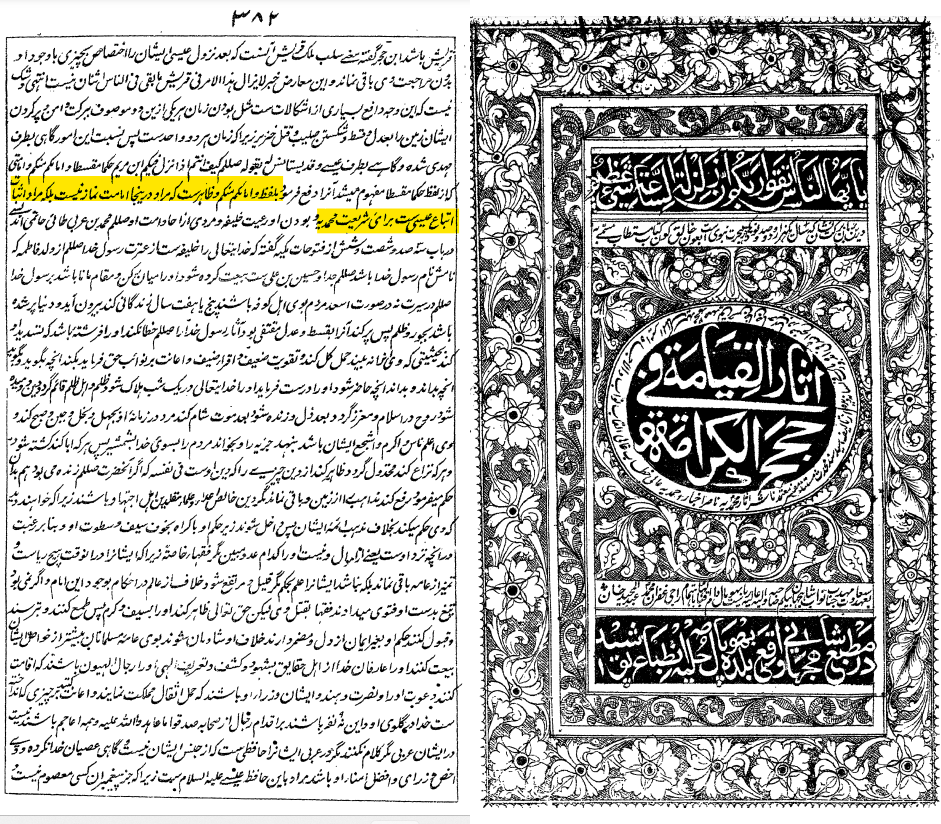
You can see the clear influence of Ibn Abi Dhi’b on Nawab Sideeq Hasan Khan Bhopali.
Mullah Ali Qari, top tier Muhaddith and scholar of the Hanafis, quotes al-Taybi proving that وَإِمَامُكُمْ مِنْكُمْ refers to Masih (AS)
وقال الطيبي فالضمير فى امكم لعيسى و منكم حال
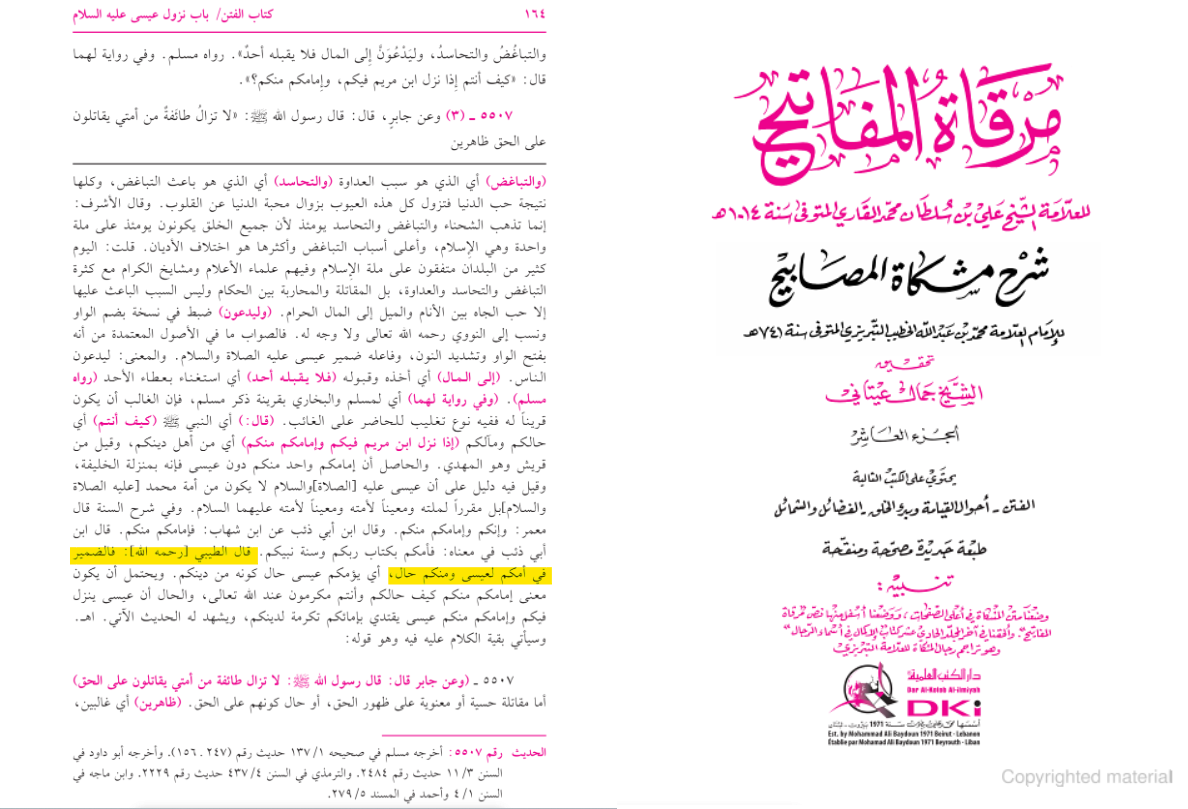
Point # 3 وَإِمَامُكُمْ مِنْكُمْ doesn’t mention Mahdi at all
One of the first points that Maulana Jalaludeen Shams(RA) made was that this hadith of وَإِمَامُكُمْ مِنْكُمْ doesn’t even mention Mahdi in the first place. However, two additional valid points are needed to be made so that the reader gets a full grasp of things.
Point # 1 In Islam Every Prophet is an Imam Mahdi
Referring to Ibrahim(AS)’s progeny of Prophets:
وَجَعَلۡنٰہُمۡ اَئِمَّۃً یَّہۡدُوۡنَ بِاَمۡرِنَا وَاَوۡحَیۡنَاۤ اِلَیۡہِمۡ فِعۡلَ الۡخَیۡرٰتِ وَاِقَامَ الصَّلٰوۃِ وَاِیۡتَآءَ الزَّکٰوۃِ ۚ وَکَانُوۡا لَنَا عٰبِدِیۡنَ ﴿ۚۙ۷۴﴾
And We made them leaders(Aii’mah) who guided(Yahduna) people by Our command, and We sent revelation to them enjoining the doing of good works, and the observing of Prayer, and the giving of alms. And they were worshippers of Us alone.
جَعَلۡنَا مِنۡہُمۡ اَئِمَّۃً یَّہۡدُوۡنَ بِاَمۡرِنَا لَمَّا صَبَرُوۡا ۟ؕ وَکَانُوۡا بِاٰیٰتِنَا یُوۡقِنُوۡنَ ﴿۲۵﴾
And We made from among them leaders(Aii’mah), who guided(Yahduna) the people by Our command, whilst they themselves were steadfast and had firm faith in Our Signs.
The word Imam Mahdi is comprised of two parts, Imam(leader) and Mahdi(Guided one). Mahdi is the guided one by definition a guided one would guide. The word Hadi (Guide), Hidayah(Guidance), Yahduna(to guided), Mahdi(Guided one) have the same root. Therefore it is safe to say that all the prophets were Imam Mahdis as they were Aiimah who guided the people!
Point # 2 There are many Mahdis in Islam
Now that we have covered that every prophet is an Imam Mahdi due to virtue of them being Aii’mah (imams) who guide (yahudna bi amrina) by Allah’s Command, it is interesting to see the clear word of Mahdi (guided one) being used for people who were not the al-Mahdi.
بِمَا عَرَفْتُمْ مِنْ سُنَّتِي وَسُنَّةِ الْخُلَفَاءِ الرَّاشِدِينَ الْمَهْدِيِّينَ
Whoever among you lives will see great conflict. I urge you to adhere to what you know of my Sunnah and the path of the Rightly-Guided Caliphs(Khulafa Rashideen Mahyideen), and cling stubbornly to it
اللهم اغفر لأبي سلمه، وارفع درجته في المهديين،واخلفه في عقبه في الغابرين، واغفر لنا وله يا رب العالمين، وافسح له في قبره، ونور له فيه
“O Allah! Forgive Abu Salamah, raise his rank among those who are rightly-guided and grant him a successor from his descendants who remain behind.
إِلَى لِقَائِكَ فِي غَيْرِ ضَرَّاءَ مُضِرَّةٍ وَلَا فِتْنَةٍ مُضِلَّةٍ اللَّهُمَّ زِيِّنَا بِزِينَةِ الْإِيمَانِ وَاجْعَلْنَا هُدَاةً مَهْدِيِّينَ
O God, beautify us with the adornment of faith, and make us guides who are rightly guided.”
اللَّهُمَّ ثَبِّتْهُ وَاجْعَلْهُ هَادِيًا مَهْدِيًّا ”.
Allah’s Messenger (ﷺ) did not screen himself from me since my embracing Islam, and whenever he saw me he would receive me with a smile. Once I told him that I could not sit firm on horses. He stroke me on the chest with his hand and said, “O Allah! Make him firm and make him a guiding and a rightly guided man.”
اللهُـمِّ اغْفِـرْ لِـفلان (باسـمه) وَارْفَعْ دَرَجَتَـهُ في المَهْـدِييـن
، وَاخْـلُفْـهُ في عَقِـبِهِ في الغابِـرين،
وَاغْفِـرْ لَنـا وَلَـهُ يا رَبَّ العـالَمـين
، وَافْسَـحْ لَهُ في قَبْـرِهِ وَنَـوِّرْ لَهُ فيه
Allāhumma’ghfir li (name of the person) warfa` darajatahu fi ‘l-mahdiyyīn, wakhlufhu fī `aqibihi fi ‘l-ghābirīn, wagh’fir-lanā wa lahu yā Rabba ‘l-`ālamīn, wafsaḥ lahu fī qabrihi wa nawwir lahu fīh.
O Allah, forgive [name of the person] and elevate his station among those who are guided. Send him along the path of those who came before, and forgive us and him, O Lord of the worlds. Enlarge for him his grave, and shed light upon him in it.
“ اللَّهُمَّ اجْعَلْهُ هَادِيًا مَهْدِيًّا وَاهْدِ بِ
Narrated ‘Abdur-Rahman bin Abu ‘Umairah – and he was one of the Companions of the Messenger of Allah (ﷺ):
from the Prophet (ﷺ), that he said to Mu’awiyah: “O Allah, make him a guiding one, and guide (others) by him.”
حَدَّثَنَا أَسْوَدُ بْنُ عَامِرٍ، حَدَّثَنِي عَبْدُ الْحَمِيدِ بْنُ أَبِي جَعْفَرٍ يَعْنِي الْفَرَّاءَ، عَنْ إِسْرَائِيلَ، عَنْ أَبِي إِسْحَاقَ، عَنْ زَيْدِ بْنِ يُثَيْعٍ، عَنْ عَلِيٍّ، رَضِيَ اللَّهُ عَنْهُ قَالَ قِيلَ يَا رَسُولَ اللَّهِ مَنْ يُؤَمَّرُ بَعْدَكَ قَالَ إِنْ تُؤَمِّرُوا أَبَا بَكْرٍ رَضِيَ اللَّهُ عَنْهُ تَجِدُوهُ أَمِينًا زَاهِدًا فِي الدُّنْيَا رَاغِبًا فِي الْآخِرَةِ وَإِنْ تُؤَمِّرُوا عُمَرَ رَضِيَ اللَّهُ عَنْهُ تَجِدُوهُ قَوِيًّا أَمِينًا لَا يَخَافُ فِي اللَّهِ لَوْمَةَ لَائِمٍ وَإِنْ تُؤَمِّرُوا عَلِيًّا رَضِيَ اللَّهُ عَنْهُ وَلَا أُرَاكُمْ فَاعِلِينَ تَجِدُوهُ هَادِيًا مَهْدِيًّا يَأْخُذُ بِكُمْ الطَّرِيقَ الْمُسْتَقِيمَ.
It was said: O Messenger of Allah (ﷺ), who should be appointed in charge after you are gone? He said: “If you appoint Abu Bakr, you will find him trustworthy and uninterested in worldly gains, seeking the Hereafter. If you appoint ‘Umar, you will find him strong and trustworthy and not fearing the blame of anyone for the sake of Allah. If you appoint Ali Which I do not think you will do you will find him a guide and guided, he will take you on the straight path.”
Point # 3 The words Imaman Mahdiyan have been used for Isa(AS)
حدثنا محمد بن جعفر قال حدثنا هشام بن حسان عن محمد عن أبي هريرة عن النبي صلى الله عليه وسلم قال يوشك من عاش منكم أن يلقى عيسى ابن مريم إماما مهديا وحكما عدلا فيكسر الصليب ويقتل الخنزير ويضع الجزية وتضع الحرب أوزارها
“It is near that one who lives from amongst you shall meet ‘Eisa bin Maryam. He will be the rightly guided leader , a leader and a just ruler..”
Musnad Ahmad 9068 – Sahih
_____________________________________________________________________________________________
Links and Related Essay’s
Mirza Ghulam Ahmad totally disrespected Abu Hurairah – ahmadiyyafactcheckblog
Mirza Ghulam Ahmad’s disparaging comments on Abu Hurairah – ahmadiyyafactcheckblog
Ahmadiyya and 24:55 of the Quran and their Spiritual Khilafat – ahmadiyyafactcheckblog
Who is Maulvi Farhan Iqbal? – ahmadiyyafactcheckblog
“Truth Triumphs” by Mumtaz Ahmad Faruqi, published on September 1st, 1965 – ahmadiyyafactcheckblog
Sahih Muslim 156 – The Book of Faith – كتاب الإيمان – Sunnah.com – Sayings and Teachings of Prophet Muhammad (صلى الله عليه و سلم)
____________________________________________________________________________________________
Tags
#ahmadiyya #ahmadiyyafactcheckblog #messiahhascome #ahmadiyyat #trueislam #ahmadianswers #ahmadiyyamuslimcommunity #ahmadiyya_creatives #ahmadiyyatthetrueislam #ahmadiyyatzindabad #ahmadiyyatrueislam #ahmadiyyamuslim #mirzaghulamahmad #qadiani #qadianism #minkum
5 Pingback