Intro
The Ahmadi-mullahs have trained every single Ahmadi that “Qadiani” is a derogatory term and anyone that uses it is some type of extremist and should be shunned altogether. However, this is not true, the fact is, in 1914, there was a split in the Ahmadiyya movement and two opposing ideologies were created. Obviously, there is no malice when a person calls an “Ahmadi” a “Qadiani” or a “Lahori”. In fact, the Qadiani branch called the “Lahori-Ahmadis” as “Paghamis” for over 30 years and the Lahoris returned the favor by calling them “Qadiani” since 1914. It seems that Ahmadis dont have a problem calling each other names, however, they complain to the world about a nonsense issue and create additional nonsense issues that will somehow show them as a persecuted community. As we all know, Ahmadis were debating the claims of MGA, Takfeer, his successorship, and the future of Ahmadiyya from 1909–1914. This was the era of the Khilafat of Noorudin, who’s sons were later ex-communicated and publically shunned.
In 1911 (Jul), the Aligarh Institute Gazette, a publication closely associated with the university efforts, referred to the Ahmadis as “Qadianis” in its 12 July 1911 issue while discussing concerns raised by Muhammad Asghar Dehlavi in an article in The Paisa Akhbar’s issue from 10 July 1911 about how the religious teachings of the 72 sects of Islam could possibly be accommodated in the university’s curriculum. The Ahmadi newspaper Badr swiftly responded to this affront in its 27 July 1911 issue, invoking the Quranic injunction: “nor call one another by nick-names” (Surah al-Hujurat, Ch.49: V.12). Mufti Muhammad Sadiq, the then editor of Badr, affirmed the true identity as “Ahmadis,” a title derived from the revered figure of the Holy Prophet Muhammadsa, emphasizing the unwavering allegiance to the teachings of Islam as revived by MGA. In this profound exposition amidst the escalating discourse surrounding the Muslim University, Mufti Muhammad Sadiq elucidated the significance of this nomenclature: “We are not Qadianis, we are Ahmadis. […] It is a matter of great regret that when this mistake is made by a respected elder or a party claiming to be civilised in the context of the university movement. […] We have repeatedly announced our beliefs, and it has been declared time and again that we are devoted to Islam and its adherents.”
In 1911 (Sep), The Aligarh Institute Gazette’s response, published in its 13 September 1911 issue, sought to clarify its stance and acknowledge the inadvertent offense caused by the use of the term “Qadiani.” However, this conciliatory gesture did little to assuage the deeper concerns that had been raised.
In 1913, in fact, Noorudin even blurted out that Mahmud Ahmad hadnt understood the topic of Takfeer (1913) and had ordered Muhammad Ali to write a conclusive essay on the matter and thus put the matter to rest (1913). However, Noorudin died before any formal policy was introduced, and thus Ahmadis created different and competing ideologies in terms of MGA.
Even in 1920, the Qadiani-Ahmadi’s were proudly calling themselves as Qadiani’s and Mahmudi’s (See the ref in the below).
Ironically, after 1923, the Qadiani branch adopted the Lahori-Ahmadi position on Takfeer and thus complicated their beliefs, similar to how Mormons dropped Polygamy for statehood with America.
_____________________________________________________________________________________________
Here is an importance reference from a neutral source of information, Maulana Abu Kalamazad eventually became India’s first Minister of Education from 1947 to 1958, here is how he explained the split in Ahmadiyya:
(See Al-Hilal, dated 25 March 1914, edited by Maulana Abul Kalam Azad) (Also See “A Mighty Striving” by Mumtaz Ahmad Faruqi, page 111, online edition).
“For some time, there had been two parties in this Movement over the question of takfir. One party believed that non-Ahmadis are Muslims even though they may not believe in Mirza sahib’s claims. The other party, however, declared openly and clearly that those people who do not believe in Mirza sahib are kafir absolutely — inna li-llahi wa inna ilai-hi raji‘un. The head of the latter party is Mirza Bashir-ud-Din Mahmud Ahmad, and this faction has now made him khalifa but the first group does not accept this. The writing published in this connection by Maulana Muhammad Ali, and the wonderful and admirable courage he has shown in expressing these views while staying in Qadian, where the heads of the other party live, is truly an event which shall always be regarded as a memorable event of this year.”
______________________________________________________________________________________________
1911
Unity amid distinction: Ahmadis and the Muslim University Movement | Al Hakam
https://www.alhakam.org/unity-amid-distinction-ahmadis-and-the-muslim-university-movement
In 1911 (Jul), the Aligarh Institute Gazette, a publication closely associated with the university efforts, referred to the Ahmadis as “Qadianis” in its 12 July 1911 issue while discussing concerns raised by Muhammad Asghar Dehlavi in an article in The Paisa Akhbar’s issue from 10 July 1911 about how the religious teachings of the 72 sects of Islam could possibly be accommodated in the university’s curriculum.
_______________________________________________________________________________________________
1915
https://ahmadiyyafactcheckblog.com/2017/11/30/qadiani-jamaat-against-lahori-ahmadi-in-shimla-debate-of-1915/
_______________________________________________________________________________________________
The quote
Al Fazl, 18 & 21 October 1920
https://www.alhakam.org/100-years-ago-new-converts-in-the-uk-and-the-ahmadiyya-mosque-in-london/
“””Ahmadiyya mosque
The designs for the construction of the Ahmadiyya mosque are being finalised and correspondence with architects is ongoing. On the 29th of this month, [mosque related] work will start in Ahmadiyya Dar-ul-Tabligh [mission house] on regular basis, insha-Allah. The construction of the mosque will also begin in the initial months of the New Year. The mosque will have a tall minaret that will be built in the style of the Minarat-ul-Masih [in Qadian]. It will announce the arrival of the Promised Messiahas in the Western countries and those who mocked us and asked for the sign of the Ahmadiyya mosque, will witness how the Unseen [God] shows His signs and how Ahmadis, yes, Qadiani, Mahmudi Ahmadis, progress in the valleys of the West with a resonant sound.”””
______________________________________________________________________________________________
1937
Friday Sermon, 23 July 1937
https://twitter.com/iftiswelt/status/1546591646741037062/photo/2
Scans


______________________________________________________________________________________________
1943
Aug-20
Al-Fazl

_____________________________________________________________________________________________
1948
“Qadiani Islam in America,” Moslem World 38 (1948): 303

_____________________________________________________________________________________________
1970
It seems that the 3rd Khalifa, Mirza Nasir Ahmad was dealing with the Lahori-Ahmadi’s in the early 1970’s. The Pagham-e-Sulh newspaper published several articles which alleged sexual misconduct within the Mirza family and their Khilafat business. The Lahori-Ahmadi’s seem to have also objected to the expensive horses that were being kept by the 3rd Khalifa at Rabwah. This practice seems to have been kept up by the 4th and 5th Khalifa at Tilford, UK. They also accused Mirza Tahir Ahmad of misappropriating Waqf-e-Jadid and Tehrik-e-Jadid funds on his lifestyle, for example, he flew to Karachi instead of other means of travel.
_____________________________________________________________________________________________The Lahori’-Ahmadi’s published “Khilafat-e-Rabwah ki Batalat” [Falsity of the Rabwah Khilafat] and “Khilafat-e-Rabwah Mein Intishar” [Tremors in the Rabwah Khilafat] in the Paigham-e-Sulh newspaper.

______________________________________________________________________________________________
1990’s
https://twitter.com/smlik1/status/1492185370875813895
Mirza Tahir on prayer for and behind Lahoris.
______________________________________________________________________________________________
2018
Qadiani Ahmadis vs. Lahori-Ahmadis, sectarianism within Ahmadiyya–2018 version
_____________________________________________________________________________________________
What was the Al-Hilal Magazine?
The Al-Hilal (Urdu: هلال ‘The Crescent’) was a weekly Urdu language newspaper established by the Indian leader Maulana Abul Kalam Azad and used as a medium for criticism of the British Raj in India. The first issue came out on 13 July 1912. The newspaper also espoused the cause of the Indian independence movement and exhorted Indian Muslims to join the movement. The newspaper was shut down under the Press Act of 1914. “Al-Hilal (The Crescent), published in Calcutta, ushered in a new chapter in Urdu journalism and immediately appealed to Muslims in the city”.
The Al- Hilal covered a range of issues related with theology, politics, wars and scientific advancement besides its critical coverage of the Raj in India and it went on to become a very popular newspaper, reaching a peak circulation of over 25,000, a new record for Urdu journalism in those days. The paper played a catalytic role in shaping Muslim opinion against the Raj, a fact acknowledged by many stalwarts of India’s freedom struggle. Mahatma Gandhi, in 1920, wrote in his publication, Young India, about how Azad used Al-Hilal as a medium for critiquing the British Raj.[2] One online source, ‘Oxford Scholarship Online’ says,”Maulana Abul Kalam Azad was a scholar, intellectual, and nationalist who fought against British imperialists by drawing inspiration from the Koran”.[3]
In his Discovery of India, Jawaharlal Nehru describes Azad and his contribution through the Al-Hilal this way: “Abul Kalam Azad spoke in a new language to them in his weekly Al- Hilal. It was not only a new language in thought and approach, even its texture was different, for Azad’s style was tense and virile, though a little difficult because of its Persian background. He used new phrases for new ideas and was a definite influence in giving shape to the Urdu language, as it is today. The older conservative leaders among the Muslims did not react favourably to all this and criticized Azad’s opinions and approach. Yet not even the most learned of them could easily meet Azad in debate and argument, even on the basis of scripture and old tradition, for Azad’s knowledge of the happened to be greater than theirs”.[4]:381
The British colonial government disapproved of the Al Hilal and demanded securities from it under the Press Act before finally confiscating its press in 1914. The Al Hilal thus ceased to exist after being in operation for only two years. Azad, in turn, started another Urdu weekly, the Al-Balagh in 1914, which too came to an end in 1916 following Azad’s internment at Ranchi.[4]:382
The press that printed the Al Hilal was later bought by Mufti Shaukat Ali Fehmi, to start his Urdu monthly ‘Din Dunia‘. The press continued to be in use for almost five decades, publishing Urdu books and magazines till the 1990s when lithographic printing became obsolete. The Fehmi family then contacted universities, Urdu academies, museums and even the then President Shankar Dayal Sharma to ensure the preservation of Azad’s legacy. Finding no success, the press ultimately ended up being sold for scrap.[2
______________________________________________________________________________________________

_____________________________________________________________________________________________
Unity amid distinction: Ahmadis and the Muslim University Movement | Al Hakam
https://www.alhakam.org/unity-amid-distinction-ahmadis-and-the-muslim-university-movement
Unity amid distinction: Ahmadis and the Muslim University Movement
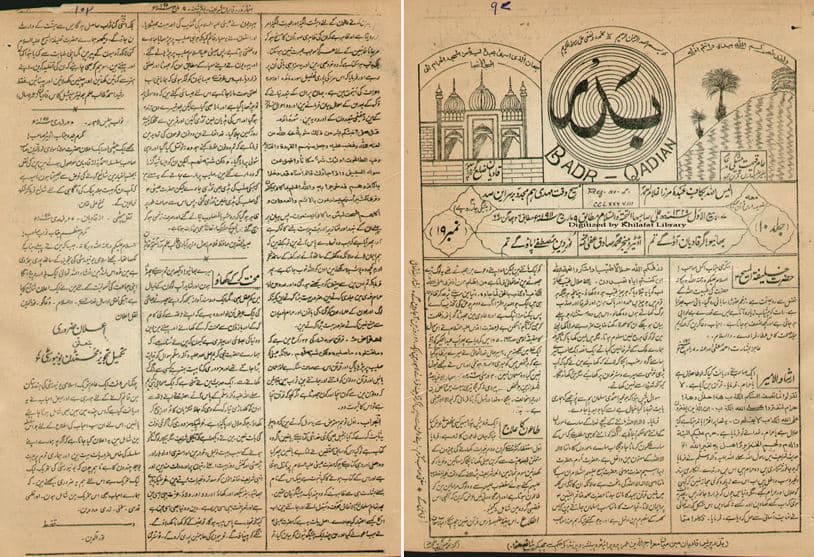
Badr, 9 March 1911
Iftekhar Ahmed, Ahmadiyya Archive & Research Centre
As the twilight years of the 19th century cast their long shadows, a fervent call for an Islamic renaissance echoed across the Indian subcontinent. Sir Sayyid Ahmad Khan, a visionary in the Muslim intellectual movement, dared to envision an audacious dream – an Islamic university unshackled from governmental oversight, a hallowed space akin to the grandeur of Cambridge and Oxford. Upon his demise, the mantle was taken up by Nawab Mohsin-ul-Mulk, who enshrined Sir Sayyid’s vision as a memorial within the aims of the Educational Conference movement.
Fundraising campaigns blanketed the vast expanses of India, rallying institutions, associations, aristocrats, and the common citizenry to this noble cause. In the city of Lahore, it was the esteemed Nawab Fateh Ali Khan who took up the charge, petitioning none other than Hazrat Hakeem Maulvi Noor-ud-Din, Khalifatul Masih Ira, the then supreme head of the Ahmadiyya Muslim Jamaat, to seek his involvement and contribution as well as his Jamaat.
A resounding affirmation from Hazrat Khalifatul Masih Ira
In a letter dated 27 February 1911, Hazrat Khalifatul Masih Ira responded to Nawab Fateh Ali Khan with a resounding affirmation:
“Esteemed Sir,
“assalamu alaikum wa-rahmatullahi wa-barakatuhu
“As I mentioned before, I am in full sympathy with the proposal for an Islamic university. I shall, insha-Allah, donate 1,000 rupees to this fund myself. Regarding the involvement of my Jamaat, I have published an announcement, a copy of which is enclosed herein.”
The announcement, a clarion call to the Ahmadiyya Muslim Jamaat, echoed the importance of this noble endeavour:
“Since a general movement is currently underway to establish an Islamic university in India, and some friends have enquired whether we too should participate in this donation fund, this announcement is made for all those associates involved in this endeavour:
“Although the specific needs of our own movement are many, and our people bear a heavy burden of such donations, since the university movement is a noble cause, we deem it essential that our friends too participate – by pen, stride, speech and monetary aid.” (Badr, March 9, 1911, p. 6)
Accompanying this rallying cry, a donation of one thousand rupees was sent forth on behalf of the Ahmadiyya Muslim Jamaat, solidifying its commitment. (Annual Report Sadr Anjuman Ahmadiyya, 1911-12, p. 81)

Forging unity – Preserving distinction
As the Ahmadiyya Muslim Jamaat embraced this rallying cause, a delicate balance emerged – the imperative to foster unity with the broader Muslim community through the university endeavour, while safeguarding their distinct identity. In a profound discourse recorded in the pages of Al Hakam, 7 March 1911, and Badr, 8 March 1911, Hazrat Khalifatul Masih Ira elucidated the nuances of this intricate dynamic:
“We have decided upon participation (the manifestation of this decision will happen soon). It is certainly necessary to work together on common matters, but it is also necessary to maintain distinction.”
He expounded upon the rationale behind the need for distinction, emphasising it as the wellspring of progress, the bulwark of honour, the catalyst for moral rectitude, and the forge for striving and prayer. Hazrat Khalifatul Masih Ira underscored the impossibility of complete reconciliation, for such a notion would undermine the very essence of the Ahmadi identity.
These profound words, recorded in the annals of Al Hakam and Badr, echoed a sentiment that would reverberate through the ages – the Ahmadi quest was not merely one of unity, but of preserving the sacred distinction that defined their path to Islamic revival.
Contention over nomenclature amid the university discourse

As the Ahmadi involvement in the Muslim University movement gained momentum, a contentious issue arose that struck at the heart of their identity – the very nomenclature by which they were addressed. The Aligarh Institute Gazette, a publication closely associated with the university efforts, referred to the Ahmadis as “Qadianis” in its 12 July 1911 issue while discussing concerns raised by Muhammad Asghar Dehlavi in an article in The Paisa Akhbar’s issue from 10 July 1911 about how the religious teachings of the 72 sects of Islam could possibly be accommodated in the university’s curriculum.
The Ahmadi Muslim newspaper Badr swiftly responded to this affront in its 27 July 1911 issue, invoking the Quranic injunction: “nor call one another by nick-names” (Surah al-Hujurat, Ch.49: V.12). Hazrat Mufti Muhammad Sadiqra, the then editor of Badr, affirmed the true identity as “Ahmadis,” a title derived from the revered figure of the Holy Prophet Muhammadsa, emphasising the unwavering allegiance to the teachings of Islam as revived by the Promised Messiah, Hazrat Mirza Ghulam Ahmadas.
In this profound exposition amidst the escalating discourse surrounding the Muslim University, Hazrat Mufti Muhammad Sadiqra elucidated the significance of this nomenclature: “We are not Qadianis, we are Ahmadis. […] It is a matter of great regret that when this mistake is made by a respected elder or a party claiming to be civilised in the context of the university movement. […] We have repeatedly announced our beliefs, and it has been declared time and again that we are devoted to Islam and its adherents.”

This contention over nomenclature was not merely a matter of semantics, but a battle for the preservation of the Ahmadi identity – an identity rooted in the revivalist teachings of the Promised Messiahas. It struck at the very heart of their involvement in the Muslim University endeavour, a movement they had wholeheartedly embraced as a means of fostering unity while safeguarding their distinct identity.
A dilution of Ahmadi identity

Amidst this discourse, a figure emerged whose approach represented a dilution of Ahmadi identity – Khwaja Kamal-ud-Din Sahib, later a prominent figure within the Lahori Jamaat. In a lecture delivered at Aligarh on 29 June 1911, titled Muslim yunivarsiti aur us ka Islami pehlu (“The Muslim University and its Islamic Aspect”), Khwaja Kamal-ud-Din Sahib echoed sentiments of unity, but his rhetoric compromised the distinct teachings of the Promised Messiahas.
“If God, the Prophet, the Book, the Kaaba, the kalima [Islamic creed], the Hereafter, and many other matters could not unite us on one matter, then God Almighty has created another opportunity for unity among us. What is it? It is this Muslim University,” he proclaimed, underscoring the university’s potential as a unifying force.
However, Khwaja Kamal-ud-Din Sahib’s approach diluted the essence of the Ahmadiyya Muslim Jamaat’s identity, favouring popularity among non-Ahmadi Muslims over the explicit acknowledgement of the Promised Messiah’sas mission. Hazrat Sheikh Yaqub Ali Irfanira, a prominent voice within the Jamaat, exposed this dilution in the pages of the combined issue of Al Hakam of 7 and 14 August 1911:
“The lecturer [referring to Khwaja Kamal-ud-Din Sahib without explicitly naming him] seems to be so engrossed in his own rhetoric that he fails to seize the opportunity to remind the audience that true unity can only be achieved under the guidance of one Imam,” he deplored. “If only he had said that the scattered segments of Muslims can only be united under the leadership of one Imam, and that the university’s true significance would lie in its submission to that one Imam.”

Hazrat Sheikh Yaqub Ali Irfani’sra critique laid bare the stark reality – that Khwaja Kamal-ud-Din Sahib’s quest for acceptance and acclaim among the broader Muslim community came at the cost of diluting the Ahmadi identity and the pivotal role of the Promised Messiahas in reviving the true spirit of Islam.
Irreconcilable divergences
As the discourse surrounding the Muslim University raged on, Hazrat Sheikh Yaqub Ali Irfanira, who had previously chronicled Hazrat Khalifatul Masih I’sra profound discourse on unity and distinction, levelled a scathing critique against the Aligarh Institute Gazette’s stance in that same combined issue of Al Hakam of 7 and 14 August 1911. The Gazette had stated that while Sunni and Shia instruction would be organised by the Muslim University, “groups of small numbers” like Ahmadis would manage their own religious education. He exposed what he perceived as the crux of the matter – the Muslims’ inability and unwillingness to embrace the Ahmadis as equal partners in the pursuit of Islamic revival.
“The [Aligarh Institute] Gazette’s article has given the Ahmadiyya Muslim Jamaat little cause for optimism regarding the university’s ability to foster true unity,” the esteemed editor lamented. “By explicitly stating that religious education will only cater to Sunni and Shia sects, while relegating ‘groups of small numbers’ like the Ahmadis to manage their own religious instruction, the university has effectively sown the seeds of further division.”
His critique, echoing the very words he had recorded from Hazrat Khalifatul Masih Ira, struck at the heart of the Ahmadiyya quest – a pursuit of unity that did not compromise their distinct identity as revivalists of Islam under the guidance of the Promised Messiahra. “If the university truly seeks to unite the scattered segments of the Muslim Ummah, should it not embrace the very group that has arisen to revive the true spirit of Islam?” he questioned rhetorically.
The Aligarh Institute Gazette’s response, published in its 13 September 1911 issue, sought to clarify its stance and acknowledge the inadvertent offense caused by the use of the term “Qadiani.” However, this conciliatory gesture did little to assuage the deeper concerns that had been raised.

A timeless legacy of perseverance
As the sun set on this historic discourse, the echoes of the Ahmadiyya Muslim Jamaat’s pursuit reverberate through the annals of Islamic renaissance. The unwavering dedication to upholding the true spirit of Islam, as embodied in the teachings of the Promised Messiahas, while preserving the distinct identity as Ahmadis, resonates through the ages, serving as a testament to the enduring power of faith, reason, and perseverance.
In the face of resistance and rejection from the broader Muslim community, the Jamaat’s steadfastness stands as a shining example of how even the most daunting challenges can be navigated with wisdom, compassion, and an unwavering commitment to the principles of Islam as revived by the Promised Messiahas.
As the world continues to grapple with the complexities of religious pluralism and coexistence, the Ahmadiyya Muslim Jamaat’s legacy stands as a timeless reminder of the delicate balance between preserving one’s distinct identity and fostering unity within the wider community of faith. The pursuit, forged in the crucible of the late 19th and early 20th centuries, remains as relevant today as it was then – a journey towards harmony that honours the revivalist teachings of the Promised Messiahas, a quest for unity that does not compromise the sacred distinction that defines the path.
______________________________________________________________________________________________Links and Related Essay’s
here: https://ahmadiyyafactcheckblog.com/2017/09/27/ahmadis-are-divided-into-so-many-groups-that-the-main-group-has-to-be-called-qadiani/
Rabia Inqilabi: A conspiracy against the Jamaat in the time of Hazrat Khalifatul Masih III
Qadiani Ahmadis vs. Lahori-Ahmadis, sectarianism within Ahmadiyya–2018 version
https://onlinelibrary.wiley.com/doi/full/10.1111/j.1478-1913.1959.tb02378.x
_____________________________________________________________________________________________Tags
#ahmadiyya #ahmadiyyafactcheckblog
14 Pingback