Intro
In 1984, the famous Al-Azhar University issued a Fatwa of Kufr against the Qadiani-Ahmadi’s and the Lahori-Ahmadi’s, this was signed by the Grand Imam, Gad al-Haq Ali Gad al-Haq. They declared the Qadiani-Ahmadi’s as Kafir because of their belief in the continuation of prophethood. In terms of the Lahori-Ahmadi’s, they were also declared Kafir, however, this was based on their denial of the miraculous birth of Esa (as). This was published in the Muslim Digest of Oct/Nov/Dec of 1984. This seems to be a newspaper in South Africa. We are unsure how many Ahmadi’s were in South Africa in 1984. There was a huge case in terms of the Lahori-Ahmadi’s in this era, it seems like this is in relation to that incident. Again, we are unclear how and when any form of Ahmadiyya made it to South Africa. Check out our brother @browniesaadi on tik tok explaining the same herein. In 2005, an Ahmadi delegation went to Al-Azhar university to do tabligh and get funds for a mosque
_____________________________________________________________________________________________
The data
fatwa_al_azhar
Also found here—http://www.khatmenubuwwat.org/media/File/fatawas/fatwa_al_azhar.pdf
_____________________________________________________________________________________________
2005
[IslamCity] FATWA BY AL-AZHAR CAIRO DECLARINGDECLARING QADIANIS AND AHMEDIS KAFIRS (mail-archive.com)
IslamCity] FATWA BY AL-AZHAR CAIRO DECLARINGDECLARING QADIANIS AND AHMEDIS KAFIRS
Abdul Wahid Osman Belal Mon, 01 Aug 2005 15:12:32 -0700
Qadianis seek help from and shelter under Al-Azhar’s Fatwa to prove that they should not be called Kaafirs but deliberately dishonestly suppress and withhold the truth proves them damn liars and do not refer to Al-Azhar’s Fatwa declaring them Kaafirs which is reproduced below and Al-Azhar’s authority is more than mine and theirs to judge.
Fatwa is based on the Holy Quran, the Sunnah (utterances and actions of the Holy Prophet (Allahs peace on him of Islam) and Ijma (consensus of opinion among Muslims). These factors form the basis of Shariah, the Law of Islam.
Fatwa (Verdict by Islamic scholars) regarding the doctrine of Mirza Ghulam Ahmed of Qadian.
FATWA BY AL-AZHAR CAIRO
Fatwa issued by the Fatwa Department of the Al-Azhar University, Cairo in reply to the questions by the Egyptian Foreign Ministry . It was asked to give its opinion on:
- The Ahmedi sect according to the true teachings of Islam
- Mosques built by certain doubtful sects, for example, the Ahmedi sect ofPakistanwho established mosques for Muslims to pray.
- A request by the Ahmedi sect for financial help to set up a mosque inAmsterdam,Holland.
The Fatwa Department answered as follows:
The Fatwa Department of Al-Azhar is quite aware of the beliefs of the Ahmadiyya sect whose views are that Mirza Ghulam Ahmed imagined himself to be a Messenger of Allah (see Khutba II-Haamiya). He says: Do you not see that I am (a Messenger from Allah) then you reject me. What is the matter with you, O, ye rejecters? Further he says: You see how people are being converted to Christianity and how they become apostates from the religion of Allah then still you say that there had not now come a Messenger from Allah. What is wrong with you? How do ye judge? In another place he states (regarding himself): Then Allah showered bounty on this UMMAT (the Ummat of Islam) by sending the like of Jesus. Will anyone except the blind then reject him? In another place he says: Jesus was a sign to the children of Israel, and I am a sign to you, O, ye extravagant ones.!
Similarly, other statements are also to be found in other writings of this sect, e.g. in a circular issued by one of their leaders, which had been translated into Arabic by Syed Abdul Majeed and printed in Egypt. In it we find: It is impossible that the coming of Divine revelation should be closed in the face of men.
In that same circular we also find: The Mahdi and the Promised Messiah had both appeared in India in a place called Qadian. And thousands and thousands of his followers and apostles are to be found hearing Divine revelation. We know also that Mirza Ghulam Ahmed himself imagined that he was recipient of Divine revelation and that it was revealed to him that: I make you an Imaam over men. Such men shall assist you unto whom shall come Divine revelation.
Qadianis and Ahmedi Kaafirs not to be supported
There are many tracts to be mentioned, all of which are undoubtable signs of clear Kufr (disbelief), exit from the religion of Allah and having gone stray (from the right path).
From the foregoing and other tracts the Fatwa Department has become aware of the fact that the Ahmadiyya sect (a sect which is a branch of the math-hab of Mirza Ghulam Ahmad and Mirzas sect, the Qadianis are both Baatil sects, contrary in their beliefs and iebaadaaat to the beliefs and iebaadaaat of the true Muslims. This is chiefly because they claim that their leaders are the recipients of Divine revelation and that there are prophets and messengers among them, to whom Allah speaks in the way that He speaks to the prophets. This contradicts the Holy Quran and the Sunnah of our Holy Prophet Allahs peace on him. Therefore with these views they reject the verse: Muhammad is not the father of any of your men, but he is the Apostle of God, and the Seal of the Prophets; and God has full knowledge of all things.
They also reject the tradition of the Holy Prophet (Allahs peace on him) which is reported by Abu Huraira in Sahih Bukhari: And verily there shall be no prophet after me.
Their belief is also against what the Prophet (Allahs peace on him) said according to Abu Huraira as reported in Sahih Bukhari: The parable of the other prophets and myself is that of a man who built a mansion excellently and beautiful . Only one place was left for one more brick. People walking round the mansion to admire it inquired: Why was not this one brick put in? Now I am the Seal (last) of the prophets.
In Sahih Muslim it is reported from Jaabir: I am in the place of that brick. I have come and the ring of prophets was completed. Apart from this there are many other authoritative reports to the effect that the Nubuwwat (prophethood) had come to a close with the coming and advent of our Holy Prophet Muhammad (Allahs blessings on him.)
This is the general consensus of opinion (Ijma) among Muslims and belief in it has become one of the necessities of faith in Islam. Whosoever rejects it becomes a Kaafiroutside the pale of Islam.
Compulsory to reject
Thus, as for this sect, it is not permissible to assist them in any way neither for the erection of a mosque nor for any other project. This is because their mosques are not founded except for the purpose of leading astray and swaying from the right path. They only erect their mosques in order to prey upon the ignorance of the youth who are unaware of their subtle methods, and lure them to their faith. Through these mosques they draw true Muslims and their innocent children into the dangers of their condemned beliefs while injecting into them the poison which cause them to swerve from the Siraatal Mustaqeem, the path of Allah, the All Powerful, the Praised.
On the contrary, it is compulsory for each and every Muslim all over the world, to boycott them economically, financially and socially and tread upon the necks of all misleading sects like these until they are forced into submission or perish and die out. With them should be done as was done with Haarith bin Saeed (who made similar claims as Mirza) during the reign of Abdul Malik bin Merwan. Certain people were deceived by his claims and followed him until he was hunted down and fell into the hands of Abdul Malik who killed him. Today there is no sign of this sect left on the earth.
In the same way there arose during the early period of the Abbasids one called Ishaq bin Ag-ras with his extravagant claims. A certain group of people followed him, too. He, too was killed and in that way the fitnah started by him was stopped.
The mosques of these Ahmadis are like the mosque which was built by the hypocrites (for evil purposes) during the time of the Holy Prophet (Allahs blessings on him). Their aim in actual fact was to divide the Muslims and mislead them. Allah thus prohibited the Holy Prophet (Allahs blessings on him) from saying the prayers in them, clarified their intentions to him:
And there are those who put up a mosque by way of mischief and
infidelityto disunite the believers and in preparation for one
who warred against Allah and His Apostle aforetime. They will
indeed swear that their intentions are nothing but good; but Allah
doth declare that they are certainly liars.
Never stand thou forth therein. There is a mosque whose foundation
was laid from the first day on piety; it is more worthy of thy standing
forth (for prayer) therein. Surah Toubah, 9-V. 107108.
Shariat
Inspite of the fact that a Muslim is allowed to say his prayer in any clean spot anywhere on the earth, as a result of the Hadith: the whole earth has been made a mosque and clean for me, it is not permissible to say prayers in the mosques of sects like these. The reason for this is that these people take their mosques as a means towards spreading, expounding and popularizing the beliefs of their sect. Moreover (should we say our prayers there) we are in fact exposing our children and the general public to the dangers of their poison and the dangerous evil of accepting their math-hab. What an evil and corruption that will be. The law of Shariat is that one should rather ward off and avoid evil and corruption than to try afterwards to mend and repair that which had been corrupted and damaged.
SOURCE: Reproduced from QADIANISM: An Anti Islamic Conspiracy Page 21-23 of AWAKE TO THE CALL OF ISLAM Rabi-ulAwwal 1405 Vol 4 No 1- December 1984 – A Half Yearly Publication of Young Mens Muslim Association P.O. Box 5036, Benoni South 1502 (Republic of South Africa)
ABDUL WAHID OSMAN BELAL
***************************************************************************
{Invite (mankind, O Muhammad ) to the Way of your Lord (i.e. Islam) with wisdom (i.e. with the Divine Inspiration and the Qur’an) and fair preaching, and argue with them in a way that is better. Truly, your Lord knows best who has gone astray from His Path, and He is the Best Aware of those who are guided.}
(Holy Quran-16:125)
{And who is better in speech than he who [says: “My Lord is Allah (believes in His Oneness),” and then stands straight (acts upon His Order), and] invites (men) to Allah’s (Islamic Monotheism), and does righteous deeds, and says: “I am one of the Muslims.”} (Holy Quran-41:33)
The prophet (peace and blessings of Allah be upon him) said: “By Allah, if Allah guides one person by you, it is better for you than the best types of camels.” [al-Bukhaaree, Muslim]
The prophet (peace and blessings of Allah be upon him) also said, “Whoever calls to guidance will have a reward similar to the reward of the one who follows him, without the reward of either of them being lessened at all.”
[Muslim, Ahmad, Aboo Daawood, an-Nasaa’ee, at-Tirmidhee, Ibn Maajah]
_____________________________________________________________________________________________
‘Placing poison in honey’: Al-Azhar journal publishes Egyptian scholar’s inadvertent testimony to Ahmadiyya scholarship | Al Hakam
https://www.alhakam.org/al-azhar-journal-scholars-testimony-ahmadiyya
‘Placing poison in honey’: Al-Azhar journal publishes Egyptian scholar’s inadvertent testimony to Ahmadiyya scholarship
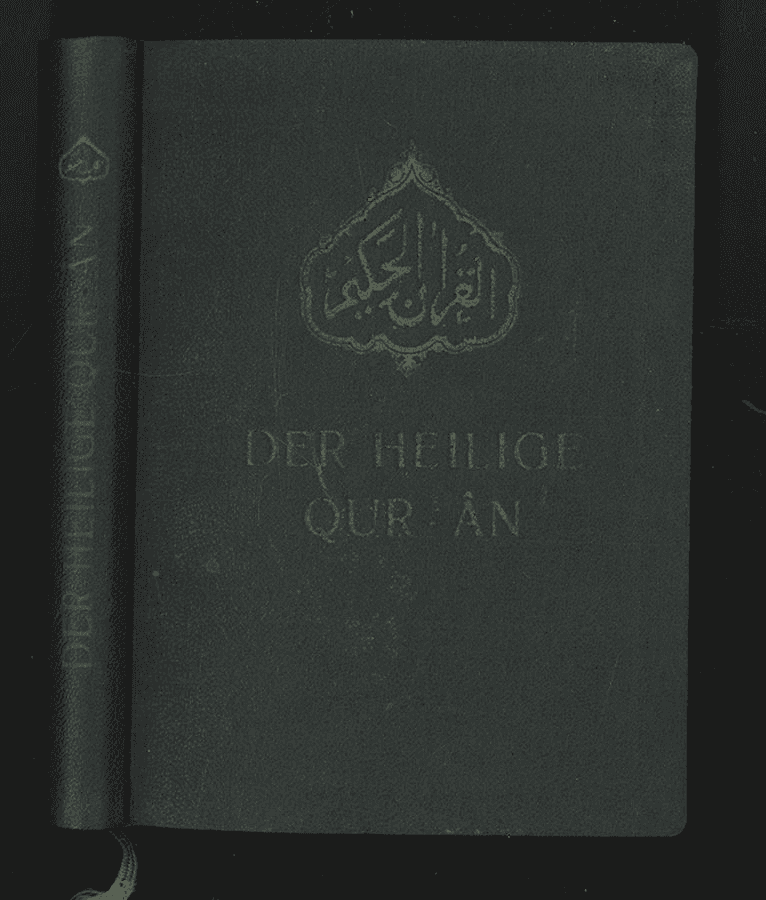
The Ahmadiyya Muslim Jamaat’s first German translation of the Holy Quran | 1954
Iftekhar Ahmed, Ahmadiyya Archive & Research Centre
It strikes me that truth has a curious way of forcing itself upon even those who wish to deny it. This becomes especially clear when religious opposition meets undeniable scholarly excellence, creating what we might call a crisis of knowledge: the need to praise and condemn at the same time, to recognise brilliance whilst rejecting its source, to affirm quality whilst denying its legitimacy.
Such a crisis unfolds with remarkable clarity in Dr Muhammad Abdullah Madi’s 1959 review of the Ahmadiyya Muslim Jamaat’s first German translation of the Holy Quran, published in Majallat al-Azhar,1 the official journal of al-Azhar University. The reviewer’s credentials make this document particularly significant: Dr Madi was no peripheral figure but stood at the apex of Islamic scholarly authority. Born in 1903 in Egypt’s Beheira province, he had memorised the Quran in his village before studying under luminaries like Mahmud Shaltut – later President of Al-Azhar – at the Alexandria Institute. His educational trajectory took him from teaching at that same institute in 1930 to the universities of Berlin and Hamburg, where he earned his doctorate with distinction in 1936, specialising in Islamic history and Eastern studies. By the time of this review, he held the position of Director General of Religious Institutes, having served as Professor of History at Al-Azhar’s Faculty of Theology since 1951, and would later become Deputy of Al-Azhar itself by presidential decree in 1962.
Here, then, we have not merely any reviewer but one who represented the institutional authority of Al-Azhar – that millennium-old bastion of Sunni orthodoxy. His fluency in German, acquired during his years in Berlin and Hamburg, equipped him to assess the translation with scholarly precision. His position at the summit of the Islamic educational establishment meant his words carried institutional weight. Yet this very authority makes his review’s internal contradictions all the more revealing – a text attempting to sustain mutually exclusive positions whilst appearing coherent.

The architecture of reluctant praise
Dr Madi’s review opens with what appears to be a straightforward scholarly assessment. He examines the 1954 translation – Der Heilige Qur’an – published under the supervision of Hazrat Mirza Bashir-ud-Din Mahmud Ahmadra, whom he cannot name without the parenthetical qualifier
(كذا)
“sic”
when referring to him as the Second Khalifa of the Promised Messiahas. Yet this very punctuation mark, this typographical grimace, reveals the central tension running throughout the review: the need to acknowledge authority whilst denying its legitimacy.
What follows is extraordinary in its surgical precision of praise. Dr Madi declares after testing various passages across different Surahs:
فوجدتها من خير الترجمات التى ظهرت للقرآن الكريم
“I found it among the best translations of the Holy Quran that have appeared.”
Coming from someone of his linguistic competence and institutional standing, this assessment carries considerable weight. Not simply acceptable, not simply adequate, but “among the best.” The superlative cannot be retracted. It stands as testimony.
He continues, noting the translation’s
أسلوب دقيق محتاط
“precise and careful style”
and its
محاولة بارعة لأداء المعنى
“skilful attempt to convey the meaning.”
These are not grudging concessions but professional assessments from one whose entire career had been devoted to Islamic scholarship. The accumulated adjectives – precise, careful, skilful – build a fortress of quality that cannot later be demolished by theological disagreement.

The test of jihad: Where prejudice meets precision
Most revealing is Dr Madi’s specific examination of verses relating to jihad and fighting in the way of Allah. Here, one suspects, he hoped to find his smoking gun – evidence of Ahmadi “distortion” that would justify wholesale dismissal. He approaches these verses with explicit suspicion,
بحثاً عما عساه يكون قد ضمن الترجمة مما يتصل بما يراه الأحمدية في الجهاد
“searching for what might have been included in the translation relating to Ahmadi views on jihad.”
The Ahmadi position on jihad – emphasising its spiritual and defensive dimensions whilst rejecting aggressive warfare – has long been a point of theological contention. Dr Madi clearly expected to find this interpretation smuggled into the translation, providing grounds for scholarly and religious objection. Instead, he encounters something that confounds his expectations:
فوجدتها سليمة لا تتضمن أدنى الإشارات إلى هذا الذي كنت أخشى أن تتضمنه
“I found them sound, not containing the slightest indication of what I feared they would contain.”
This admission from a scholar of his calibre is striking not for what it says but for what it demonstrates about the review’s underlying structure. Dr Madi approached the text actively, searching for flaws, bringing to bear all his scholarly expertise to hunt for ideological contamination in the most controversial areas. His failure to find such flaws – indeed, his public admission of this failure in Al-Azhar’s own journal – establishes the translation’s integrity more convincingly than any positive endorsement could achieve.

The Introduction: “Wonderful Islamic research”
The review’s treatment of Hazrat Mirza Bashir-ud-Din Mahmud Ahmad’sra extensive Introduction to the Study of The Holy Quran represents perhaps its most striking contradiction. Dr Madi, whose own doctoral dissertation had involved rigorous textual analysis and historical research, methodically catalogues the Introduction’s contents, listing its comprehensive treatment of Islamic theology, Quranic sciences and spiritual philosophy. His assessment:
بحوث إسلامية رائعة
“wonderful Islamic research.”
From someone like him, the adjective
رائعة
“wonderful”, “splendid”, “magnificent”
exceeds mere adequacy. It expresses genuine scholarly admiration.
He notes how the Introduction addresses humanity’s need for divine guidance, the corruption of previous scriptures, the preservation of the Quran, prophecies fulfilled, the nature of prayer, fasting, pilgrimage, charity, women’s rights, economic systems, the soul, divine attributes – a comprehensive presentation of Islamic thought. Each topic, he acknowledges, receives sophisticated treatment. The phrase
في ثوب وإطار إسلامى
“in an Islamic garment and framework”
confirms that this representative of Al-Azhar recognises this as authentically Islamic scholarship, not some syncretic innovation.
Yet embedded within this praise lies the review’s central tragedy. Dr Madi – recipient of the Order of the Republic First Class for his services to Islamic education – cannot simply acknowledge excellence; he must qualify it with hypothetical conditions. If only – the perpetual subjunctive of sectarian prejudice – if only the author were not who he is, what beautiful things he writes! This hypothetical framing imprisons him – he can acknowledge excellence but never accept it.
The volta: “But!”
The review’s pivot arrives with theatrical emphasis:
ولكن!
“But!”
Dr Madi even repeats it:
نعم ولكن مع الأسف الشديد
“Yes, but with great regret.”
This linguistic performance – the affirmation followed by negation, the “yes, but” structure – reveals the review’s impossible position. Great regret indeed, but regret for what? For the excellence that must be rejected? For the truth that must be denied? Or for the reviewer’s own inability to transcend the sectarian boundaries that his position at Al-Azhar required him to maintain?
The final section of the Introduction, discussing the Promised Messiahas, triggers Dr Madi’s institutional antibodies. Suddenly, all previous praise becomes irrelevant. The “wonderful Islamic research” transforms into
وضع السم فى العسل
“placing poison in honey.”
The metaphor illuminates much: even the Deputy of Al-Azhar acknowledges the honey’s sweetness whilst declaring it contaminated. Yet honey’s sweetness remains honey’s sweetness, regardless of what one claims has been added to it.
The extraordinary conclusion
The review’s conclusion represents a masterpiece of cognitive dissonance. After praising the translation as among the best available, after finding no fault even where he most expected it, after acknowledging the Introduction’s comprehensive excellence, Dr Madi calls for the book’s confiscation:
ينبغى مصادرته
“it should be confiscated.”
Yet even here, he cannot maintain consistency. He immediately qualifies:
وحبذا لو كان من المستطاع فصل هذا الجزء الأخير
“How wonderful if it were possible to separate this last section.”
He wishes to preserve the excellence whilst removing what challenges Al-Azhar’s theological assumptions. The tragedy is that he recognises the value –
لكان فيه خير كثير
“there would be much good in it”
– but his institutional position prevents him from accepting the source.
The inadvertent testimony
What Dr Madi achieves, despite himself, is to provide one of the most compelling testimonies to Ahmadi scholarship from within the Sunni establishment itself. His review, published in Al-Azhar’s official journal and carrying all the weight of his institutional authority, intended as a warning, becomes a witness. His very inability to find fault where he desperately sought it, his compulsion to acknowledge excellence even whilst calling for suppression, his recognition of authentic Islamic scholarship even whilst denying the authors’ Islamic credentials – all serve to highlight the intellectual poverty of sectarian prejudice when confronted with genuine achievement.
The significance of this testimony cannot be overstated. Here was not some marginal figure but one who had ascended through every level of Islamic scholarly authority. His training in both traditional Islamic sciences and modern Western academia prevents him from simply dismissing what his eyes read and his mind comprehends. He must acknowledge quality because quality exists independently of his theological preferences or institutional obligations.
This creates a document of extraordinary historical importance: evidence that even at the height of anti-Ahmadi sentiment in the Arab world, even from the very pinnacle of Sunni religious authority, even from one whose entire career was built within orthodox institutions, excellence could not be denied. The translation’s precision, the Introduction’s comprehensiveness, the scholarship’s authenticity – all had to be acknowledged by Al-Azhar’s own Deputy, even if immediately followed by calls for suppression.
The universal structure illuminated
Dr Madi’s review illuminates a universal pattern in religious discrimination: the simultaneous recognition and rejection of the other’s humanity, scholarship and spiritual insight. It is not ignorance that drives such prejudice but precisely the opposite – the recognition of excellence that threatens established hierarchies. The call to confiscate emerges not from finding flaws but from finding none. The demand for excision comes not from discovering poison but from tasting honey.
The great irony – and Dr Madi seems partially aware of this – is that his review serves the opposite of its intended purpose. By so thoroughly documenting the translation’s excellence whilst simultaneously calling for its suppression, this representative of orthodox Islam provides future generations with evidence of both Ahmadi achievement and establishment prejudice. His review, published in Al-Azhar’s own pages, becomes a monument to the very scholarship it attempts to deny.
Perhaps most poignantly, Dr Madi’s wish to separate the final section and preserve the rest demonstrates a deep truth: even from his position at the summit of Sunni orthodoxy, he recognises that the Islamic scholarship is genuine, the Quranic translation authentic, the theological insights valuable. His objection is not to the content but to its source – a position that indicts not the Ahmadiyya Muslim Jamaat but the institutional framework that required such intellectual contortions from even its most educated representatives.
The review thus stands as inadvertent testimony from the highest echelons of Islamic authority – evidence against its own position, witness to what it attempts to deny, proof of the very excellence it must reject. In attempting to warn against Ahmadi scholarship, Dr Madi has instead preserved for posterity one of its most compelling vindications: that even Islam’s most authoritative institutions, when confronted with Ahmadi reality rather than its caricature, cannot help but recognise its truth.
Endnotes
1. Muhammad Abdullah Madi, “Al-Qur’an al-Muqaddas: Der Heilige Qur-ân,” Majallat al-Azhar, Vol. 30, no. 8 (Sha‘ban 1378/February 1959), pp 653-659.
_____________________________________________________________________________________________
Links and Related Essay’s
https://en.wikipedia.org/wiki/Al-Azhar_University
https://en.wikipedia.org/wiki/Gad_al-Haq
https://vm.tiktok.com/TTPdg2YqgY/
https://www.muslim.org/sa-case/intro.htm
Mirza Basheer-uddin Mahmud Ahmad had 20+ children with 7 wives
Al-Fazl, September 1917, proves Ahmadiyya Takfir towards all Sunni’s/Shia’s
A fake Ahmadiyya response to our essays which expose Ahmadiyya Takfir from Ahmadi.answers.com
https://ahmadiyyafactcheckblog.com/?s=Takfir
https://ahmadiyyafactcheckblog.com/?s=1911
Mirza Mahmud Ahmad’s Speech In January 1913 Saying Only Those Are Kafir Who Brand Ahmadis As Kafir
Ali Rizvi mentions the lies of Qasim Rashid in his book, in terms of Takfir from Ahmadis to Muslims
“Haqiqat Un Nubuwwat” (1915) by Mirza Basheer-uddin Mahmud Ahmad, some quotes and data
Mirza Ghulam Ahmad says that any Muslim who believes in abrogation, is a Kafir
Mirza Ghulam Ahmad and 2:62, the “Salvation” or “status” of Non-Muslim’s in an islamic state?
The 1976, English edition of Tadhkirah, now available for free download
Mirza Bashir Ahmad did Takfir on all Muslims and Lahori-Ahmadis (1915)
[IslamCity] FATWA BY AL-AZHAR CAIRO DECLARINGDECLARING QADIANIS AND AHMEDIS KAFIRS (mail-archive.com)
_____________________________________________________________________________________________
Tags
#ahmadiyyainsouthafrica #southafrica #ahmadiyya #ahmadiyyafactcheckblog #ahmadiyya #ahmadiyyatrueislam #ahmadiapartheid #Ahmadiyyat #rabwah #qadian #meetthekhalifa #muslimsforpeace #ahmadiyyafactcheckblog #nolifewithoutkhalifa #AhmadiMosqueattack #AhmadiyyaPersecution #Mosqueattack #trueislam #Ahmadiyyatakfir #takfir
6 Pingback