Intro
It seems that MGA and his team stole from Al-Ghazali when they presented “The Philosophy of the Teachings of Islam” in 1896? Nevertheless, we present an evaluation of this lecture/book. Be advised, we only have Ahmadiyya sources on this specific topic, hence, most of this background data is dubious, however, Ahmadiyya sources do quote 5-6 British newspapers which only indicate that this event did take place and MGA’s speech was read out and applauded heavily (see Hidden Treasures).
On Page 2 of the book, MGA says that he won’t be referring to any hadith (translated as tradition). Thus, this book is from a Quranist perspective. However, on page 135, Muhammad (Saw) is quoted as describing Jannah (Heaven) as “bounties are such as no eye has seen, not has any ear heard, nor have they been conceived by the mind of man”. This seems to be a reference to hadith (found by Uncle Jamal ud Din from speakers corner).
On Page 4 of this book, MGA and his team of writers quoted 12:53 of the Quran (12:54 in the Kadiani Koran) and argued that Nafs al-Ammarah is an Islamic concept referring to the “commanding self” or “ego-driven self.
On Page 5 of this book, MGA and his team of writers quoted 75:2 of the Quran (75:3 in the Kadiani Koran), in terms of Nafs al-Lawwamah (Arabic: النَّفْس اللَّوَّامَةِ) is the “self-reproaching” or “self-accusing” soul, which feels guilt and remorse for one’s wrongdoings.
On pages 6-7, MGA claimed that per 89:27-28, heaven could be achieved on Earth. MGA and his team of writers totally stole the Sir Syed position on heaven and called all of its descriptions as symbolic (see page 154), 47:15 of the Quran is quoted (47:16 in the Qadiani Quran). Malik Ghulam Farid wrote the same in 1988 via his official 5-volume commentary of the Quran. Also on page-6,
On page 13), MGA and his team of writers alleged that soul (ruh) is created in human sperm (naozobillah).
On page 51, MGA and his team quoted 4:10 of the Quran (4:11 in the Kadiani Koran) and alleged that in Islam the description of the punishment for those who steal property is a blazing fire. MGA argues that this punishment teaches its adherents to be morally upright and listed this scenario as 1 out of 5 ways to maintain chastity in humans.
On page 89, MGA and his team argued that via 36:40 of the Quran (36:41 in the Kadiani Koran), the sun and moon travel in an orbit.
On page 120, MGA alleged that the “blazing fire” (wa sagheera) only means that for those who reject the truth and have no inclination towards accepting it, not an actual fire. Ahmadi’s also allege that via 101:09 (101:10 in the Kadiani Koran), means that Hell is like a mother (fa-ummohoo) with her infant, and have mistranslated the verse accordingly. However, per Ibn Kathir, the verse can be translated as Hell is your mother (His mother will be Hawiyah.)
On page 154, MGA and his team of writers quoted 47:15 of the Quran (47:16 in the Qadiani Quran)(totally stole the Sir Syed position) and argued that all the descriptions of heaven are metaphoric.
On pages 169 and 191, MGA claimed that per 10:64 of the Quran (10:65 in the Kadiani Koran) the friends of God receive glad tidings in this life through revelation and converse with God and will also have the same experience in the Hereafter.
In reality, this book was penned by MGA’s team at Qadian and delivered in a speech at Lahore by Maulvi Abdul Kareem. Khawaja Kamaluddin [who later left Qadiani Jama’at] brought a message to MGA that they should write something. MGA was sick as usual, he seems to have ordered his team to write something for this occasion, Dard claims that MGA had a severe attack of diarrhea as he tried to write this lecture (page 477). Khawaja Kamaluddin was not happy with the exposition and expressed a sense of hopelessness and felt it would be mocked and derided (See Dard pages 477-478)(See the ROR of Nov-1942 also). However, Ahmadi sources claims that their God had already informed MGA that his exposition would excel so he had some posters published about the exposition and assured Khawaja Kamaluddin about it and asked him to put up the posters in Lahore. Khawaja Kamaluddin had made his mind up about the exposition so he withheld putting up the posters and only did so at the very end when others insisted. He put up a few posters high up on walls the night before so that no one could see them because he thought the exposition was not worthy to be read at the convention.
The Conference of Great Religions (called the Dharma Mahotsu in the ROR of Nov-1942) was eventually held on December 26, 27, 28, 1896, and it was extended to December 29 and in Lahore (MGA mentions it 10+ times in “Siraj-e-Munir” (published in March-1897). However, when the exposition was read out at the convention, as we know, MGA’s paper won, however, the judges were overly sympathetic to Ahmadiyya, in fact, the person who gave up his time so that Maulvi Abdul Kareem could keep reading was Maulvi Mubarak Ali of Sialkot, who had many sympathies to the Ahmadiyya Movement. The appointed time for the exposition passed but the audience remained ever eager. The time was extended, so much so that in order to accommodate the exposition the convention had to be extended by a day. Khawaja Kamaluddin was an educated man, he was a lawyer, and he knew that this paper was not good at all. This story is also covered by Muhammad Ali and Mirza Basheer-ud-Din Mahmud in the era of 1915-1924, as they criticized each other extensively. Did MGA‘s team steal from Al-Ghazali when they presented “The Philosophy of the Teachings of Islam” in 1896? In this book, Mirza Ghulam Ahmad alleged that Muhammad (Saw) said that if someone see’s him, it’s as-if they saw Allah (naozobillah).
In 1910, MGA’s famous book, “Philosophy of the Teachings of Islam” is translated into english by Maulvi Muhammad Ali and published as, “The Teachings of Islam”, Mr. Muhammad Alexander Webb is given credit as someone who helped in the translation. This was the second english translation of “Philosophy of the Teachings of Islam. Although Webb acknowledged Ghulam Ahmad as “a man of God” and the one who had guided him to Islam, however, it should be noted that this was before MGA’s claims and a total lie, since Alexander Russell Webb couldn’t read Urdu. Nevertheless, Singleton claims that Webb stayed in touch with Ahmadi’s until his death in 1916. The english ROR of Oct-1915 began quoting a statement by Alexander Webb From New Jersey. This went on for many years and ended in Dec-1923.
The ROR of Sep-1911 tells the world that this book can be bought from London also, at this address: Messrs. Luzac and Co., 46 Great Russell Street, London, W.C.
The ROR of July-1912 has many book reviews of “The Teachings of Islam”, even one from Mary Hunt.
The ROR of March-April-1916 reports that “The Teachings of Islam” is set to get translated into Tamil.
The ROR of Sep-1916 reports that Brother Dr. Abdullah from Rouen has been spreading the French translation of “The Teachings of Islam”.
The ROR of May-1918 reports that Qazi Abdullah has given a Belgian officer a French translation of the “Philosophy of the Teachings of Islam”. It’s unclear as to who translated this. “Our Foreign Missions” 1961 edition reports that a second edition of a chinese language version of “Philosophy of the Teachings of Islam” was published in the early 1960’s.
In 1921, Maulvi Muhammad Ali published a 2nd edition (from Lahore, not Qadian) of his English translation of the “The Teachings of Islam” (aka the “Philosophy of the Teachings of Islam”. There doesn’t seem to be many changes, in fact, the old preface is also used. The same note on Alexander Webb is given from the 1910 edition.
In 1957, Ahmadiyya sources claim to have also created a Burmese translation. This book is also mentioned in the ROR of Jan-1940 and Nov-1940.
The ROR of Nov-1940 alleges that Maulvi Sanaullah and Syed Muhammad Hussain Batalvi were in attendance when the speech was given by Maulvi Abdul Karim, which ended up becoming the book, “Philosophy of the Teachings of Islam”. The ROR of Nov-1940 alleges that it has been translated into English, Arabic, French, Gujrati, Hindi, Bengali, Malay, Sumatri, Chinese, Sindhi, German, Burmese, Kantari, Gurmukhi, Marhatti, Malyalam, Tamil, Telugu, Urdu, Balandi and Sunda.
The ROR of Feb-1944 mentions the conference wherein this book was read out. The ROR of Feb-1947 mentions it. The Muslim Sunrise of the 4th Quarter-1956 mentions how the Spanish Government banned the distribution of the Philosophy of the Teachings of Islam.

______________________________________________________________________________________________
1897
Siraj-e-Munir, online English edition, see page 64
The Shining Lamp
Eighth [Prophecy]
This prophecy was regarding the outcome of the Conference of World Religions that my paper would prevail [over all others]. And these printed announcements were distributed amongst thousands of Hindus and Muslims in Lahore and other places ahead of time. Now ask the Civil & Military [Gazette], question The Observer, and just read with some care—Mashir-e-Hind, Wazir-e-Hind, Paisa Akhbar, Sadiqul-Akhbar, Sirajul-Akhbar, and Makhbar Deccan—so that you may come to learn how powerfully the revelation of Allah manifested its truth.”””
______________________________________________________________________________________________
1902
The October-1902 edition of the ROR contains the final portion of the english translation. It was first translated into english in the March 1902 edition of the English-ROR (see pages 81 to 100) and the April edition of the same year (see pages 121-140), the June edition, pages 209-237, the July edition pages, 253-265, the August edition, pages, 292-297, the October edition, pages 383-389.
______________________________________________________________________________________________
1905
islameeusoolkeephilosophy
https://ahmadiyyafactcheckblog.com/wp-content/uploads/2019/02/islameeusoolkeephilosophy.pdf
Scan
_____________________________________________________________________________________________
1910
It was re-published from London
The book was published in London as “The Teachings of Islam” in 1910″, translated by Muhammad Ali (he even credited Alexander Russel Webb with help on the translation). Muhammad Ali signs off the Preface as May 1910. He also erroneously writes that the translation was continued in the ROR of 1903, however, it wasn’t.
In this same year, it seems to have been used at the famous conference of 1910, Mufti Sadiq and many other high ranking Ahmadi’s attended. The ROR of June-1918 alleges that a white women, Miss Alice Johnson of a random London School is recommending this book to the world. The ROR of Oct-Nov-1917 reports that this book is being used in the UK to get converts.
Basically, all throughout the 1910’s and 20’s, the ROR had advertisements about this book, “The Teachings of Islam”.
_____________________________________________________________________________________________
1910
https://aaiil.org/text/books/mga/teachingsislam/teachingsofislam1910.pdf
The Teachings Of Islam Mirza : Mirza Ghulam Ahmad : Free Download, Borrow, and Streaming : Internet Archive
https://archive.org/details/in.ernet.dli.2015.215977/page/n173/mode/2up
The Teachings of Islam 1910 edition
https://ahmadiyyafactcheckblog.com/wp-content/uploads/2022/04/The-Teachings-of-Islam-1910-edition.pdf
In 1910, MGA’s famous book, “Philosophy of the Teachings of Islam” is translated into english by Maulvi Muhammad Ali and published as, “The Teachings of Islam”, Mr. Muhammad Alexander Webb is given credit as someone who helped in the translation. This was the second english translation of “Philosophy of the Teachings of Islam. Although Webb acknowledged Ghulam Ahmad as “a man of God” and the one who had guided him to Islam, however, it should be noted that this was before MGA’s claims and a total lie, since Alexander Russell Webb couldn’t read Urdu. Nevertheless, Singleton claims that Webb stayed in touch with Ahmadi’s until his death in 1916. The english ROR of Oct-1915 began quoting a statement by Alexander Webb From New Jersey. This went on for many years and ended in Dec-1923.


_____________________________________________________________________________________________
1921
https://babel.hathitrust.org/cgi/pt?id=wu.89092547553&seq=28
In 1921, Maulvi Muhammad Ali published a 2nd edition (from Lahore, not Qadian) of his English translation of the “The Teachings of Islam” (aka the “Philosophy of the Teachings of Islam”. There doesn’t seem to be many changes, in fact, the old preface is also used. The same note on Alexander Webb is given from the 1910 edition.
 _____________________________________________________________________________________________
1981
The Jan-Mar-1981 edition of the Muslim Sunrise was edited by Dr. Khalil Ahmad Nasir only. It’s unclear as to who was the missionary-in-charge in the USA. Dr. Khalil Ahmad Nasir’s private address is given out for those who have questions about the subject matter, all questions about the business affairs of the Muslim Sunrise are addressed at 2141 Leroy Place, N.W., Washington D.C., at the American Fazl Mosque (which was the headquarters of the USA jamaat). 8 pages of “Haqiqatul Wahi” are given, this corresponds to Chapter-1, pages 11-17. A speech by Maulvi Muhammad Din, which was written by Hafiz Maulana Raushan Ali is reproduced. The speech is on Sufism and was delivered in 1924 at the Conference of World Religions in London, the 2nd Qadiani-Ahmadi Khalifa was there too. An essay about the Shroud of Turin is also given. Advertisements about the selling of “The Philosophy of the Teachings of Islam” and Zafrullah Khan’s “Renaissance of Islam” are given.
_____________________________________________________________________________________________
An announcement of certain victory
The June-1916 edition of the ROR reports that MGA allegedly wrote an announcement on Dec-21-1896. This announcement wasn’t published in any newspaper in 1896. Thus, this is a case of back-tracking by the Qadiani-Ahmadi-troll team. Nevertheless, in this announcement, MGA was claiming divine support and asserting that he would win. Interestingly, a revelation of MGA is botched and needed to be fixed in the July-1916 edition of the ROR. They changed haythu to aynamaa, we have no idea why.
_____________________________________________________________________________________________
Nur ud Din concluded the conference
MGA’s ghost writer and speech preparer, Maulvi Nur ud Din was a moderator at the conference and the the person who was to officially close the conference. This data alone proves that MGA has official support during this conference. Further, there didn’t seem to be any other Muslim there to present the case for Islam. Thus, the entire conference was a sham, further, there is no way to tell if Maulvi Abdul Kareem read out the entire lecture or not, this book wasn’t published in Urdu til 1905, additional content could have been added.
_____________________________________________________________________________________________
MGA and his team of writers denied the concepts of heaven and hell
_____________________________________________________________________________________________
MGA writes that if someone’s wife even speaks to another man, the man should divorce her
See Philosophy of the Teachings of Islam, online edition, page 42
Urdu Transliteration
“””maslan jo shakhs kisi ki biwi se na jaaiz harkat ka murtakib ho ya maslan zina to nahi magar is ke muqadmaat mard aur aurat dono se zahuur mein ayen to kuch shak nahi ke is ghairat mand mazloom ki aisi biwi ko jo zina karanay par raazi hogayi thi””.
“”For instance, if a person is guilty of an approach towards the wife of another which, though it does not proceed as far as adultery, yet amounts to its preliminaries, it would become incumbent upon the self-respecting husband of the woman to divorce her on account of her willingness to tolerate such an approach. Her children would also be sadly afflicted. The husband would have to endure all this injury on account of the misconduct of a villain.”””
Scan

1902 translation of Philosophy of the Teachings of Islam, April-1902-ROR
Scan

_____________________________________________________________________________________________Eating Pork/swine = immoral acts and leads to homosexuality
This famous Ahmadi argument was invented in this book.
_____________________________________________________________________________________________Nuzhat Haneef’s data on this lecture
p355 of Begum Nuzhat Haneef’s seminal work “Recognizing the Messiah” says this:
“””I would also like to mention that I have heard (through personal communication) from two different Ahmadee sources that the material in Islaamee Usool kee Filaasafee seems to have been taken from `Abdul Qaadir Jeelaanee, a renowned Muslim saint/scholar of the 6th century AH. But I have not verified this myself.””””
_______________________________________________________________________________________________HEAVENLY WATER PULLS ON EARTHLY WATER DURING RAIN
Philosophy of the Teachings of Islam
That is why in the rainy season the level of the water in the wells also rises. Why does it rise? The reason for which is that heavenly water exercises a pull upon earthly water.
______________________________________________________________________________________________MEN SHOULD NOT LOOK AT WOMEN WHETHER WITH PURE INTENTIONS OR NOT
Philosophy of the Teachings of Islam
we have been positively commanded not to look at their beauty, whether with pure intent or otherwise, nor to listen to their musical voices or to descriptions of their good looks, whether with pure intent or otherwise.
_____________________________________________________________________________________________ STARS DO NOT COLLIDE NOR CHANGE SPEED
Philosophy of the Teachings of Islam
There are so many grand heavenly bodies that are gliding through space that the slightest disorder in their gliding through space that the slightest disorder in their movements would bring about the ruin of the whole world.
What a manifestation of Divine power is it that these bodies neither collide nor change speed, nor alter their courses in the slightest degree, nor have they been worn out by their circulation during such long period, nor has their machinery suffered any disorder.
______________________________________________________________________________________________ INSECTS ARE BORN WITHOUT PARENTS LIKE ADAM
Philosophy of the Teachings of Islam
We observe daily that thousands of insects infect impure and stale foods and are generated in unwashed wounds. Dirty linen secretes hundreds of lice and all sorts of worms are generated inside a person’s stomach. It cannot be said that all these come from outside or can be observed descending from heaven.
_____________________________________________________________________________________________ IT IS OK TO MARRY ORPHAN GIRLS UNDER YOUR CARE
Philosophy of the Teachings of Islam
There is no harm in your marrying orphan girls who are under your care, but if you apprehend that you may not be fair in dealing with them because they are orphans, then marry women who have parents and relations to be watchful of them, who would respect you and concerning whom you would be careful.
______________________________________________________________________________________________Jinn
MGA barely touched the topic of Jinn, in fact, the word Jinn only appears 1 time in the whole book, in the context of MGA quoting 51:56 (51:57 in the Qadiani Quran) of the Quran and explaining that the purpose of humans is to worship and recognize Allah (see page 158.
_____________________________________________________________________________________________
https://history.ahmadiyya.uk/conference-of-great-religions-at-lahore/
A person by the name of Swami Sadhu Shugan Chandar had spent three or four years of his life attempting to reform the Kaisth Hindu caste. In 1892 he concluded that unless people were gathered together under one roof, his efforts would be in vain. He therefore proposed to convene a religious conference, with the first one taking place in 1892 in Ajmer. In 1896, considering Lahore to be a suitable venue, he began preparations for the second such religious conference. Swami Sahib appointed a committee to oversee the arrangements.[1]
Swami Shugan Chandar himself came to Qadian to meet Ahmad and urged that the Promised Messiahas himself write something on the subject. As a matter of fact, it was the Promised Messiahas himself, who had suggested the idea of the conference to the initiator on an earlier visit to Qadian. The sole object of the Promised Messiahas was to acquaint the world with the truth of his mission. The first notice of the conference was actually printed and published at Qadian, the following five subjects were selected, upon which the exponents of the different systems were invited to write their theses:
1. The physical, moral and spiritual condition of man.
2. The state of man after death.
3. The object of man’s life on earth and the means for attaining the same.
4. The effect of actions in this life and the next.
5. What are the means for the attainment of spiritual knowledge?[2]
The Promised Messiahas directed one of his disciples to render the gentleman every possible assistance, and himself promised to contribute an essay. Despite his ill health the Promised Messiahas completed writing his essay and appointed Hazrat Abdul Kareem Sialkotira to read it. While he was writing it, the revelation came to him: ‘The essay has come out best,‘ meaning that his paper would excel all others at the conference. Accordingly, he issued a handbill announcing beforehand that his essay would excel all others.
The dates of the conference were fixed for December 26th, 27th and 28th, 1896. Many of the most eminent exponents of the different religions sent their contributions to the conference, which necessarily excited great public interest. People attended the sessions with great eagerness. In fact, the conference had assumed the aspect of a tournament of religions, and the adherents of the different creeds each wished to see victory declared for their representative.
When the time came for the paper of the Promised Messiahas to be read by Hazrat Maulana Abdul Kareem Sialkotira, two hours were allotted to him. But when he began to read the paper, within a short time, such a spell fell upon the assembly that they sat motionless and till the appointed time was finished nobody was aware how long the lecturer had been speaking. Unfortunately, the time was over, and the audience were greatly agitated because by that time not even the answer to the first question had been finished. The next speaker Maulawi Mubarak Ali of Sialkot willingly allotted his time to Promised Messiahas’s paper. Hazrat Maulana Abdul Kareem Sialkotira continued the reading of the paper till 4:30 p.m., which was the time for the end of the conference. But even then, the first of the questions had not been fully addressed, and the audience desired that that part might be concluded before the sitting broke up. The directors accordingly ordered that the reading be continued, and it accordingly went on till 5:30 p.m. As soon as the reading was over, the audience made the plea that the conference be extended by another day in order to allow the paper to be finished.
Arrangements were made to continue the conference till the 29th. And since representatives of some other religions had also made a request for additional time, it was announced that on the following day the proceedings would begin at 9:30 a.m. instead of 10:30. a.m., and that the first paper to be read would be that of the Promised Messiahas. One effect of the impression created by the first day’s reading of Promised Messiahas’s paper could be perceived in the fact that while on the previous days the audience did not fully assemble even at 10:30. On the third day it had not yet struck nine when men of all creeds and sects began to pour into the hall in large numbers and the proceedings commenced punctually at the appointed time. On this day also the period of two hours and a half assigned for the finishing of the paper proved inadequate, and since the audience with one voice desired that the reading should continue, the directors had no alternative but to extend the time. Thus, the reading of the entire paper took seven and half hours to complete.
There was a stir in the city of Lahore, and everyone agreed that the essay had excelled all other papers at the conference, and the followers of all creeds and sects were unanimous in its praise. Those who wrote the report of the conference estimated that during the time the paper was being read, the audience gradually swelled to between 7,000 and 8,000 persons.
In short, this was a great triumph for the Promised Messiahas, and the occasion further impressed the minds of his opponents with the superiority of his genius. Even adverse newspapers were compelled to admit that the paper excelled all others which were read at the conference. An English translation of the paper under the title of The Teachings of Islam[3] has met with an especially warm reception in Europe and America and to this day is looked upon as the most accurate presentation of Islamic Philosophy.
The Civil and Military Gazette of Lahore, dated December 29th, 1896, p.47, wrote:
‘In the religious conference of Lahore held at the Muhammadan College building on the 26th, 27th and 28th, the following five subjects were elected as the main points to be discussed by the representatives of the various religions: (1) On the mental being, its moral and spiritual welfare. (2) What does human existence mean, and how its aim can be gained. (3) The day of resurrection. (4) What our deeds effect in this world and in the world to come. (5) How to learn and come to attain knowledge of the Supreme Being. Particular interest centred in the lecture of Mirza Ghulam Ahmad of Qadian, a master in the apologetics of Islam. An immense gathering of all sects from far and near assembled to hear the lecture, which, as the Mirza himself was unable to attend in person, was read by one of his able scholars, Munshi Abdul Karim Fasih (‘the Eloquent’) of Sialkot. The lecture on the 27th lasted for about three and a half hours, was listened to with rapt attention, though so far it dealt only with the first question. The speaker promised to treat the remaining questions if time was allowed, so the presidents and the executive committee resolved to extend their sitting to the 29th.’
The publishers of the report also paid tribute to the excellence of the paper on pages 79, 152, 140 of their report. The Indian Spectator 28 October 1911 wrote:
“We have read with pleasure and profit a small volume entitled The Teachings of Islam, which has been sent us from the office of The Review of Religions, Punjab, India. To us it seems the best and most attractive presentation of the Faith of Muhammad which we have yet come across. It is the work of the late Mirza Ghulam Ahmad and has been most admirably translated from Urdu by Muhammad Ali of Qadian. Few are the passages to which the broad – minded Christian or Jew need take exception, and many are the stimulating thoughts and expositions which would find an echo in the hearts of lovers of God in any religion. . . . . Admirably calculated to appeal to the student of comparative religion, who will find exactly what he wants to know as to Muhammadan doctrines on souls and bodies, the three worlds, divine existence, moral law and much else. Most books on Islam which come to hand have a large proportion of their space devoted to the refutation of misstatements of critics and to the endeavour to prove that the tenets of Islam are not inferior to those of other religions which on certain points claim a higher standpoint. The little book under notice on the other hand, is simply an exposition of the teachings of the Koran;….. there is nothing disputatious and nothing which is not drawn direct from the Koran. The author, who wrote the book originally in Urdu, was the founder of the Ahmadiyya movement, which is entirely a propagandist movement for the dissemination of the uncorrupted doctrines of Islam; and he presents his tenets in a very attractive form. It is a very useful book both for the Faithful and for those who wish to get a fair idea of the intelligently orthodox among the followers of the Prophet. “
The Indian Review also published a two-page review in its Nov and December issue:
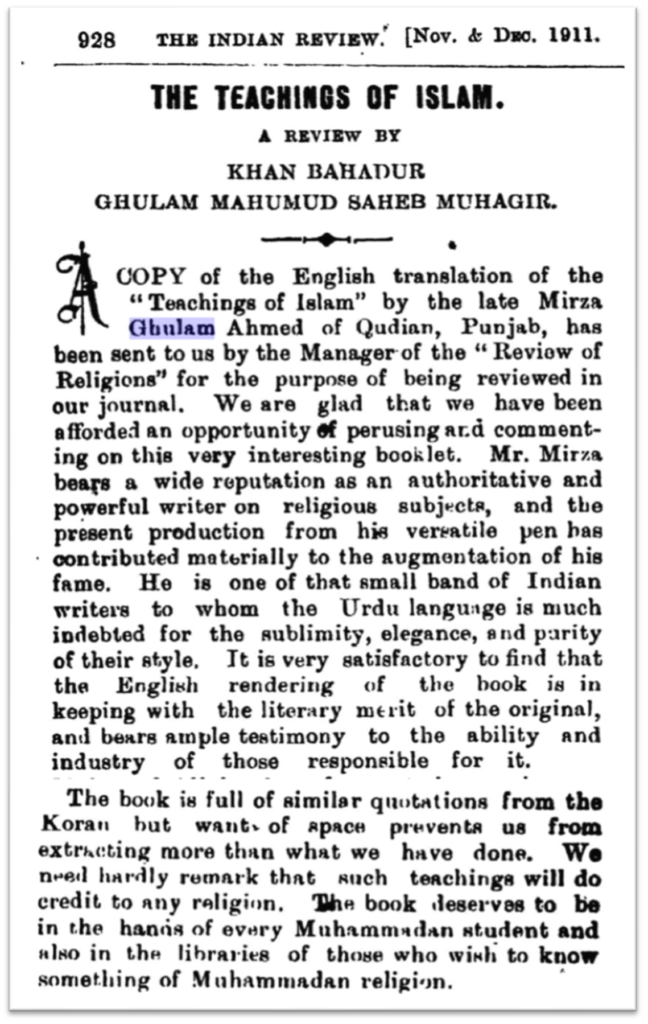
“We are glad that we have been afforded opportunity of perusing and commenting on this very interesting booklet. Mr. Mirza bears a wide reputation as an authoritative and powerful writer on religious subjects and the present production from his versatile pen has contributed materially to the augmentation of his fame. He is one of that small band of Indian writers to whom the Urdu language is much indebted for the sublimity, elegance, and purity of their style. It is very satisfactory to find that the English rendering of the book is in keeping with the literary merit of the original and bears ample testimony to the ability and industry of those responsible for it. Mr: Muhammad Ali has been fortunate in securing the assistance of so chaste a writer as Mr. Muhammad Alexander Russel Webb in revising his translation which as it now stands is a very entertaining and pleasant reading. «The author has divided his subject into the physical, mental and spiritual conditions of man, and has also separate chapters on the existence and attributes of God, on the state of man in the after-life, and other allied subjects. He deals with these difficult and intricate problems in a lucid, comprehensive and philosophical manner which evokes admiration. His discourse on the spiritual conditions of man is worthy of the writer and deserves repeated perusal.
We wish we had space at our disposal to quote freely from his writings but have to content ourselves with a few quotations from the Quran so as to give our readers some idea of the sublime teachings of Islam. The Mirza asserts that the Quran does not inculcate doctrines which are against the reason of man and which therefore one has to follow against better judgment. The whole drift of the Holy Book and the pith of its teachings is the threefold reformation of man and all other directions are simply means to the end. As we see that in the treatment of bodily diseases the physician recognises the necessity of dissecting or performing surgical operations on proper occasions or applying ointments to wounds, etc. , so have the teachings of the Holy Quran also employed these means on fit occasions to serve the purpose when necessary and advisable. All its moral teachings have an all – pervading purpose beneath them which consists in transforming men from the physical state which is imbued with a tinge of savageness into the moral state and from the moral into the boundless deep of the spiritual state. ‘One is inclined to agree with this assertion after reading the various quotations to from the Quran contained in the book – some of which we cite below ….. We need hardly remark that such teachings will do credit to any religion. The book deserves to be in the hands of every Muhammadan student and also in the libraries of those who wish to know something of Muhammadan religion. “
The Muslim Review, Allahabad (November and December 1911):
“The learned writer very wisely depends solely on the Quran for every assertion and argument, stating only that which is contained in it in plain words, or what may be reasonably inferred from its words. The book admittedly does not pretend to be a comprehensive treatment of the Islamic doctrines, but within the narrow compass of the five subjects dealt with the reader will meet with many true, profound, original and inspiring ideas which should interest the Muslim and the non-Muslims alike. A careful perusal of this little volume is well calculated to dissipate many of the misconceptions prevailing against Islam among a class of Christian Missionaries and writers to whom it strongly commended.”
Apart from the national newspapers and journals, when the English translation of the lecture was published and propagated to various parts of the world through the pages of the Review of Religions (to be discussed below in detail) the international newspapers and journals also wrote reviews on it.
The Review of Religions in July 1912 published the opinions of the international press on the teachings of Islam:
The Theosophical Book Notes in March 1912 wrote:
“We have read with pleasure and profit a small volume entitled The Teachings of Islam, which has been sent us from the office of The Review of Religions, Punjab, India. To us it seems the best and most attractive presentation of the Faith of Muhammad which we have yet come across. It is the work of the late Mirza Ghulam Ahmad and has been most admirably translated from Urdu by Muhammad Ali of Qadian. Few are the passages to which the broad – minded Christian or Jew need take exception, and many are the stimulating thoughts and expositions which would find an echo in the hearts of lovers of God in any religion. . . . Admirably calculated to appeal to the student of comparative religion, who will find exactly what he wants to know as to Muhammadan doctrines on souls and bodies, the three worlds, divine existence, moral law and much else. “
Mr. Colville was a lecturer at the Theosophical Society, having read the lecture The Teachings of Islam, he wrote in the journal Mystic Light[4] wrote:
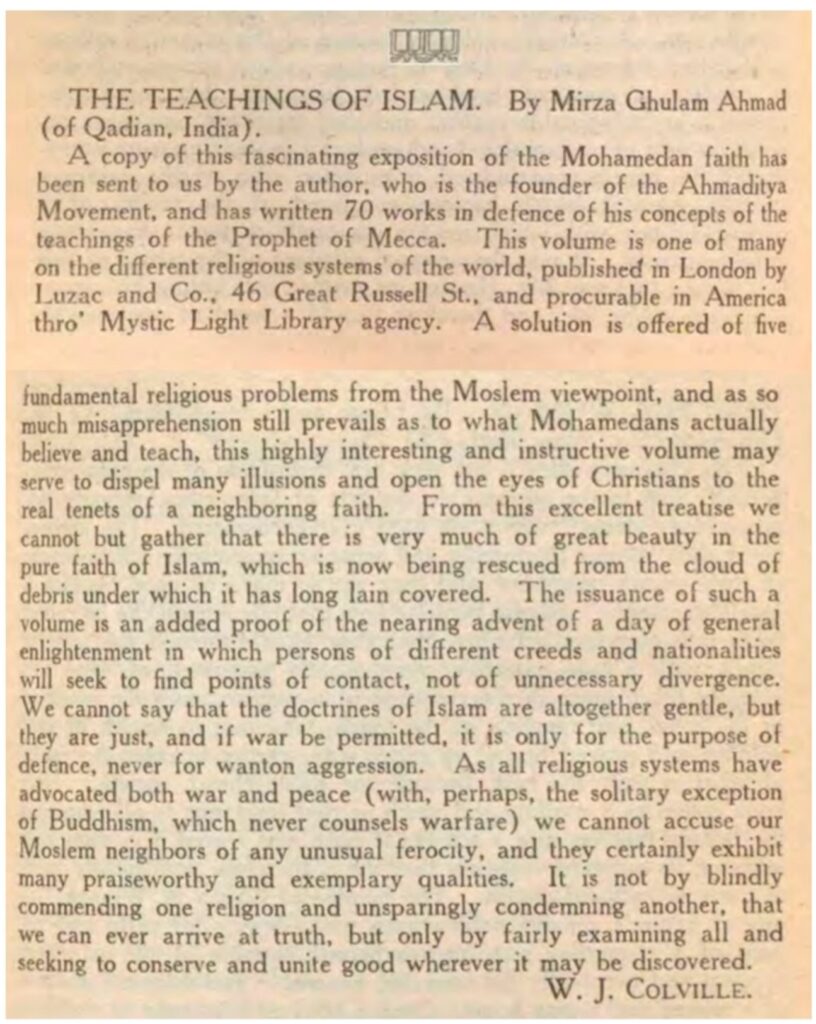
A copy of this fascinating exposition of the Mohamedan faith has been sent to us by the author, who is the founder of the Ahmaditya Movement, and has written 70 works in defence of his concepts of the teachings of the Prophet of Mecca. This volume is one of many on the different religious systems of the world, published in London by Luzac and Co., 46 Great Russell St., and procurable in America thro’ Mystic Light Library agency. A solution is offered of five fundamental religious problems from the Moslem viewpoint, and as so much misapprehension still prevails as to what Mohamedans actually believe and teach, this highly interesting and instructive volume may serve to dispel many illusions and open the eyes of Christians to the real tenets of a neighboring faith. From this excellent treatise we cannot but gather that there is very much of great beauty in the pure faith of Islam, which is now being rescued from the cloud of debris under which it has long lain covered. The issuance of such a volume is an added proof of the nearing advent of a day of general enlightenment in which persons of different creeds and nationalities will seek to find points of contact, not of unnecessary divergence. We cannot say that the doctrines of Islam are altogether gentle, but they are just, and if war be permitted, it is only for the purpose of defence, never for wanton aggression. As all religious systems have advocated both war and peace (with, perhaps, the solitary exception of Buddhism, which never counsels warfare) we cannot accuse our Moslem neighbors of any unusual ferocity, and they certainly exhibit many praiseworthy and exemplary qualities. It is not by blindly commending one religion and unsparingly condemning another, that we can ever arrive at truth, but only by fairly examining all and seeking to conserve and unite good wherever it may be discovered. W. J. COLVILLE
The English Mail on 27th Oct 1911 wrote:
“A nicely got up little book,” The Teachings of Islam, ‘by Mirza Ghulam Ahmad of Qadian, comes to hand for review. The author says, “I deem it a matter of the first importance that every – body who believes in any sacred scriptures as the revealed Word of God, should so set limits to the advocacy of the religion he supports as not to go out of the holy book or depend upon arguments other than those which the book furnishes. ‘This is rather telling the Unbeliever not to read the book. It makes the book itself more interesting, however, since it gives a summary of really Islamic ideas, and does not, as the books of this sort are very prone to do, twist the sense of the Quran to make it agree with Christian teaching.”
The Spiritual Journal, Boston, (April 1912) wrote:
“Through the courtesy of that ripe scholar and able editor, M. Sadiq of Qadian, India, this little volume has been sent to us for review. It embodies the paper originally written by the late Mirza Ghulam Ahmad and read by one of his devoted voters, at the great Religious Conference held at Lahore in December 1896. The paper discourses from a Moslem’s point of view, the five subjects selected for discussion by the Conference … These “vital topics constitute a wide field for study and are calculated to fulfil their intention of diffusing the teachings of Islam in this Western World.”
The Milwaukee Journal, U. S. A. (March 18th, 1912):
“It is hoped to help in the diffusion of the teachings of Islam in the West. The contents have been drawn entirely from the Holy Quran.”
The Daily News, Chicago, (March 16th, 1912):
“A slender volume published in the interests of the propaganda for diffusing the teachings of Muhammad among western nations has come from India. It bears the title “The Teachings of Islam and the author, Mirza Ghulam Ahmad, was a Promised Messiah and Mahdi, now deceased. The work aims to present a solution of the five fundamental religious problems of life from the Moslem point of view. The discussion is based on the Quran. After alluding to some of the questions discussed in the book and after giving quotations from it the paper adds: “The devout and earnest character of the author is apparent.”
The Bristol Times and Mirror:
“The author states in a discussion of the highest divine favour that ‘the mantle of divinity is cast upon the person who is thus favoured by God, and he becomes a looking glass for the image of the Divine Being. ….. … I shall be guilty of a great injustice if I give the fact that I have been raised to this spiritual eminence. Almighty God has favoured me with His certain word, and has chosen me that I may give sight to the blind, lead the seekers to the object of their search, and give to the acceptors of truth the glad tidings of the pure fountain which is talked of among many, but is found by very few. ”But it is necessary to follow the Holy Quran to find the true God .Clearly it is no ordinary person who thus addresses himself to the West, and it may at once be admitted that the sonorous language of the Quran has been the means of conveying truth to a large number of the human race. “
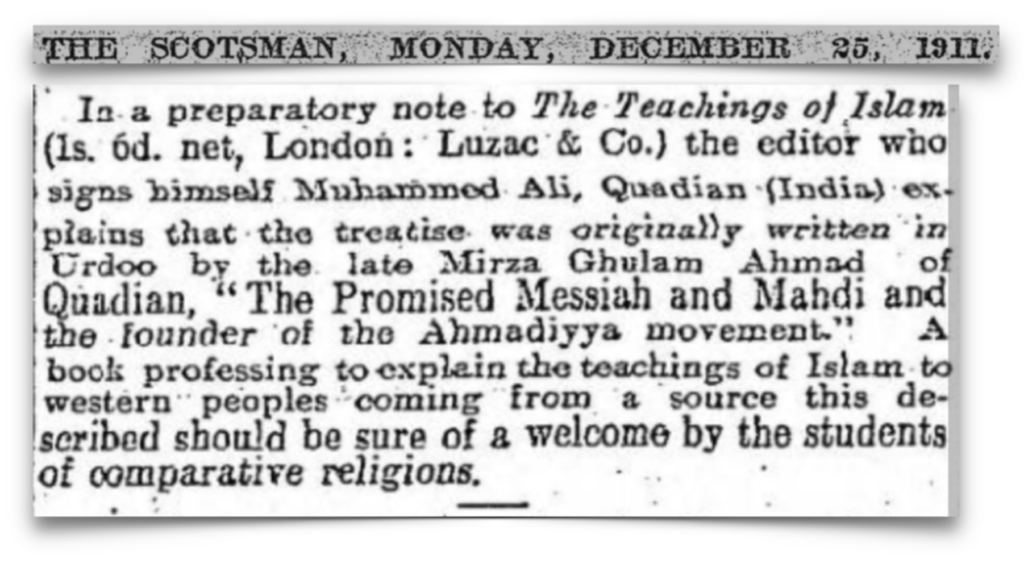
The Scotsman (December 25th, 1911)
“A book professing to explain the teachings of Islam to Western peoples coming from & source thus described should be sure of a welcome by the students of comparative religions.”
Mr. George Bain, Wick Parish Carnegie Free Public Library (4th April 1912)
“The ideas expressed in the little work are very thoughtful, and without a doubt it will be perused by the better class of our readers.”[5]
Mrs. Virginia Stein, Lafayette Public Library, Lafayette, Indiana, (April 9th, 1912):
“We very much appreciate this addition to our library. The book is sure to be of interest to our patrons.”[6]
[1] The Philosophy of the teachings of Islam Introduction.
[2] Life of Ahmadas P.476/Tareekh-e-Ahmadiyyat Vol 1 P.559
[3] At the time it was published under this title later it was published as The Philosophy of the teachings of Islam.
[4] Mystic Light Library Bulletin February 1912 P.38-39
[5] The Review of Religions July 1912 P.296
[6] Ibid
_____________________________________________________________________________________________

_____________________________________________________________________________________________
Links and Related Essays
“The Philosophy of the Teachings of Islam” aka “Islami Usool Ki Falasifi”(1896)–the inside story
https://ahmadiyyafactcheckblog.com/2021/02/10/who-is-khwaja-kamal-ud-din/
https://ahmadiyyafactcheckblog.com/?s=Khwaja
http://www.reviewofreligions.org/wp-content/pdf-downloads/RR190203.pdf#page=2
http://www.reviewofreligions.org/wp-content/pdf-downloads/RR190204.pdf#page=2
http://www.reviewofreligions.org/wp-content/pdf-downloads/RR190206.pdf#page=2
http://www.reviewofreligions.org/wp-content/pdf-downloads/RR190207.pdf#page=2
http://www.reviewofreligions.org/wp-content/pdf-downloads/RR190208.pdf#page=2
http://www.reviewofreligions.org/wp-content/pdf-downloads/RR190210.pdf#page=1
Click to access teachingsofislam1910.pdf
The life and death of Maulvi Abdul Karim Sialkoti (1858–1905)
https://history.ahmadiyya.uk/conference-of-great-religions-at-lahore/
Uncle Jamal ud Din vs. that weirdo Qadiani at Speakers Corner – ahmadiyyafactcheckblog
https://ahmadiyyafactcheckblog.com/2023/08/19/uncle-jamal-ud-din-vs-that-weirdo-qadiani-at-speakers-corner/
______________________________________________________________________________________________
Tags
#ahmadiyya #ahmadiyyatrueislam #ahmadiapartheid #Ahmadiyyat #rabwah #qadian #meetthekhalifa #muslimsforpeace #ahmadiyyafactcheckblog #nolifewithoutkhalifa #AhmadiMosqueattack #AhmadiyyaPersecution #Mosqueattack #trueislam #atifmian
The Conference of Great Religions, The Conference of Great Religions, The Conference of Great Religions, The Conference of Great Religions, The Conference of Great Religions, The Conference of Great Religions, The Conference of Great Religions, The Conference of Great Religions, The Conference of Great Religions, The Conference of Great Religions, The Conference of Great Religions, The Conference of Great Religions, The Conference of Great Religions, The Conference of Great Religions, The Conference of Great Religions, The Conference of Great Religions, The Conference of Great Religions, The Conference of Great Religions,
40 Pingback