Intro
Shaikh Yacub Ali Irfani, also spelled as Sheikh Yakoob Ali Irfanee (And also known as Shaikh Yaqub Ali Torab) was an Ahmadi who worked as a major confidant and was on MGA’s team of writers/editors/imams.
In 1886, Yacub Ali Irfani seems to have been a student/assistant of Noorudin while he was in Jammu as early as 1886. Irfani wrote a note in a letter of Noorudin about a potential marriage between MGA and Noorudin’s pre-teen daughter.
In 1887, Ahmadiyya sources allege that the young Yaqub Ali Irfani had seen Barahin-e-Ahmadiyya in 1887 through Maulvi Ghulam Mohiyuddin Sahib – his teacher and headmaster at the Vernacular Middle School (See Maktubat-e-Ahmad, 2008, Vol. 2, p. 499).
In 1889, Yakoob Ali Irfanee is present at the very first Bait ceremony in Ludhiana but doesn’t take bait with MGA.
In 1892 (Feb), Yakoob Ali Irfanee did bait with MGA.
In 1893, “Yakub Ali, Sheikh, Torab, son of Sheikh Muhammad Ali passed his Entrance Examination as a private student. His father was a subordinate teacher in the Adampur Vernacular Middle School.
In 1894, he began work as Editor in Amritsar of the Riaz-i-Hind, Feroz, Ahluwalia Gazette, Jahan Numa and Punjab.
In 1896, Yacub Ali Irfani is NOT mentioned in the famous list of 313 Ahmadi’s. In 1896 he was selected as a special Police Officer to supervise Muharram arrangements.
In 1897, he was he was named as the main editor of Al-Hakam and then wrote many early biographies on Ahmadiyya. He seems to have lived near the house of MGA, his location is unknown (See Dard, page 563).
In 1900, MGA mentioned Sheikh Yaqub ‘Ali in his book (see Arba’in, online English edition, page 69).
In 1901, Ahmadiyya sources allege that Shaikh Ya‘qub Ali, Qadian gave money for the building of the minaret in Qadian (See Dard, page 856). He was also a worker in and around Qadian (see Dard, page 818).
In 1901 (Jul), Ahmadiyya sources allege that MGA was summoned as a defence witness; so
he left Qadian in a ‘feenis’ (a covered seat fixed on two long poles carried on shoulders by four men) at about 7 a.m. on July 15th, 1901. Maulawi Nur-ud Din, Sh. Ya‘qub Ali and other friends got into ekkas to go to Gurdaspur via Batala; while MGA went direct and reached there at about 3 p.m. As requested by Maulawi Muhammad Ali the party stayed at the house of his father-in-law, Munshi Nabi Bakhsh. Khwaja Kamal-ud-Din came from Peshawar in the evening. It was very hot and MGA was not feeling very well, so he could not sleep the whole night (See Dard, page 702).
In 1905, in the Al-Hakam of July-17-1905 (vol. 9, no. 25, p. 10, 11, Malfuzat-7, English, pages 525-529), the editor (Sheikh Yaqub Ali Irfani) posted a page from an old notebook wherein MGA had written some comments about Buruz. At 45:22, Bro Imtiaz explains how MGA said that the reality of Buruz was opened (like a secret) to MGA. At 49:33, Bro Imtiaz explains how MGA said the concept of Buruz was a secret that was written in the Injil (Gospel).
In 1905-1906, Irfani personally took Mirza Ghulam Ahmad’s eldest grandson to Masjid Mubarak and Mirza Aziz Ahmad did MGA’s bait.
In 1908, when MGA died, he was in Qadian.
In 1909 (Dec), he held meetings in Qadian in support of Khilafat (see page 246), he attended the famous meeting on Dec-31-1909 and was forced to renew his bait to Maulvi Nur ud Din.
In 1911 (Aug, via the Al Hakam of 7 and 14 August 1911, Sheikh Yaqub Ali Irfani wrote vs. Khawaja Kamaluddin after the Khawaja had given a lecture at Aligarh on 29 June 1911, titled Muslim yunivarsiti aur us ka Islami pehlu (“The Muslim University and its Islamic Aspect”), Khwaja Kamal-ud-Din Sahib echoed sentiments of unity, but his rhetoric compromised the distinct teachings of the Promised Messiah.
In 1912, Mirza Bashiruddin Mahmud Ahmad with his companions during their visit of different religious institutions of India, Lucknow, April 1912. Sheikh Yaqub Ali Irfani is seen seated on Huzoor’s right. He also launched the newspaper Ahmadi Khatun in 1912, which lasted for a few years but later was closed.
In 1912, he was for some time [a] translator in the Paisa Akhbar Office. Age 36 years” (See National Archives of India, Home Department, Political, 1912).
In 1914 (Mar), when Nur ud Din died, he stayed in Qadian and supported the 2nd Qadiani-Ahmadi Khalifa.
In 1914 (Dec), he was at the 1914 Jalsa at Qadian and even gave a speech.
In 1915, Yacub Ali Irfani wrote 4 historic books in 1915, Sirat-ul-Nabi, Sirat Ahmad, Hyat-e-Ahmad and Sirat Masih Maoud (See Mujadid e Azam by Dr. Basharat Ahmad, the preface). We have found a scan from Hyat-e-Ahmad which indicates that mga was born in 1839 (See in the below). The Khalifa began to officially change this date in 1916 or so.
In 1917, he was working as an assistant secretary of the Sadr Anjuman at Qadian (See ROR of Jan-1918). He also wrote a biography on the wife of MGA, Nusrat Jehan Begum. The year of his death is unknown.
In 1918, he wrote another biographical entry by a toilet attendant of MGA, Mir Hamid Shah.
In 1920, the Aug-Sep-1920 edition of the ROR tells us that the Ahmadiyya Movement has purchased a plot of land wherein housing for missionaries and a small temple could be built. Ahmadiyya sources alleged, that in early 1920, announcements were made to collect funds for a mosque in London. The Ahmadi community in Qadian raised 12,000 rupees. Unlike others, we didn’t plead with the government for funds but came together ourselves. By August 1920, a piece of land and a building were bought for £2,223 (30,000 rupees) in Southfields, London. Today, we’re sharing a rare image of 63 Melrose Road, the mission house before and during the early years of the Fazl Mosque. The building no longer exists, but this photo captures (from right to left): Chaudhry Ali Muhammad, Abdur Raheem Dard, and Yaqub Ali Irfani in front of it.
In 1924, he accompanied the Khalifa on his tour of Europe.
In 1927, he writes a biography on the father in law of MGA, Mir Nasir Nawab, this is wherein MGA blurts out to the effect that he has cholera. After this was published, it was a shocker, Ahmadiya leadership ordered a 2nd edition be published and they erased the relevant sentences. In 1927, Yaqub Ali Irfani, a prominent & devout companion of the Promised Messiah performed the pilgrimage of Hajj. During his stay in Makkah, he also had the opportunity to meet with Sultan Ibn Saud, who was the king of Hijaz. Ahmadiyya sources admit that the King knew that Irfani was a Qadiani-Ahmadi and still allowed him to perform the Hajj.
In 1929, he gave a speech at the 1929 Jalsa at Qadian.
In 1939, Mahmud Ali Irfani, son of Yaqub Ali Irfani, crafted a stunning world map to commemorate two monumental milestones: the Golden Jubilee—50 years of the Ahmadiyya Community—and the Silver Jubilee—25 years of Musleh-e-Maud’s Khilafat. A Global Legacy: This map, recently rediscovered by the Ahmadiyya Archive & Research Centre, beautifully captures the global presence of the Ahmadiyya Community, marking its remarkable journey of faith and unity across the world. Explore More: Want to see more treasures like this? Visit the Ahmadiyya Museum at ahmadiyyamuseum.artsteps.com for a journey through history!
In 1940, he is mentioned in the ROR of Jan-1940 (via “Truth About the Split”).
In 1942, he is mentioned in the ROR of Oct-1942 by Mirza Aziz Ahmad. Mirza Aziz Ahmad alleges that he went to the school in Qadian which had Sheikh Yakoob Ali Irfanee and Hakeem Muftee Fazlur Rahman as instructors (is this the Talim ul Islam High School?).
In 1943, his son (Mahmud Ahmad Irfani) wrote a book entitled, “Headquarters of the Ahmadiyya Movement” and it was reviewed by the ROR of May-1943. Mahmud Ahmad Irfani is listed as the current editor of the Al-Hakam.
In 1970, the Muslim Sunrise of Oct-Nov-1970 was edited by Maulvi A.R. Khan Bengali. The magazine reports on the World Conference of Religion and Peace that was held in Kyoto, Japan on Oct 16-21, 1970. Major Abdul Hamid and Zafrullah Khan were there and represented Ahmadiyya. The newspaper also reports on the tour of West Africa by the 3rd Khalifa (on April 27th, 1970)(Mirza Nasir Ahmad) and how visited Abidjan, Ivory Coast. A lecture by the 2nd Khalifa on May-29-1922 is reproduced. The same lecture by Mirza Mubarak Ahmad is continued, in this write up, Seth Ghulam Nabi is mentioned, Maulvi Abdul Karim and his book, “Sirat Masih-e-Maud”. Munshi Zafar Ahmad of Kapurthala is also quoted, a book named “Ashab-e-Ahmad” is quoted. Sheikh Yaqub Ali Irfani is also quoted via his book “Shamail Hazrat Masih e Maoud”, he quoted Lalah Sharampat of Qadian and Lala Malawamal, Mirza Bashir Ahmad alleges that Lala Malawama lived to be over 100. The story of Dr. Henry Martyn Clark is also given , as well as the role of Captain Douglas in the case. Muhammad Hussain Batalvi is also quoted. 4 Ahmadiyya locations are given out, the Dayton Mosque-temple at 637 Randolph St, Dayton, Ohio, the Fazl Mosque, 2141 Leroy Place, Washington D.C., the Ahmadiyya Mosque in Chicago, IL, on Wabash Ave and an Ahmadiyya mission in NY, on 147-20 Archer Ave, Jamaica-Queens.

_____________________________________________________________________________________________
His wife and children
Ahmadiyya Archive & Research on X: “🌟 Unveiling a Historical Gem! 🌍 A Dual Celebration: In 1939, Hazrat Mahmud Ali Irfani (ra), son of Hazrat Yaqub Ali Irfani (ra), crafted a stunning world map to commemorate two monumental milestones: the Golden Jubilee—50 years of the Ahmadiyya Muslim Community—and the Silver https://t.co/psi18j4Mz8” / X
His wife is unknown, however, one of his sons was a volunteer missionary in Eygpt, Sheikh Mahmud Ahmad, his name was Mahmud Ahmad Irfani. Mahmud Ahmad Irfani has a book of his reviewed in the ROR of May-1943. The book is entitled, “Headquarters of the Ahmadiyya Movement”, he is also working as the editor of the Al-Hakam in 1943.
In 1939, Mahmud Ali Irfani, son of Yaqub Ali Irfani, crafted a stunning world map to commemorate two monumental milestones: the Golden Jubilee—50 years of the Ahmadiyya Community—and the Silver Jubilee—25 years of Musleh-e-Maud’s Khilafat. A Global Legacy: This map, recently rediscovered by the Ahmadiyya Archive & Research Centre, beautifully captures the global presence of the Ahmadiyya Community, marking its remarkable journey of faith and unity across the world. Explore More: Want to see more treasures like this? Visit the Ahmadiyya Museum at ahmadiyyamuseum.artsteps.com for a journey through history!

#AhmadiyyaHistory #GoldenJubilee #SilverJubilee #LegacyUnveiled
_____________________________________________________________________________________________
Books written by Irfani
(See Mujadid e Azam by Dr. Basharat Ahmad, the preface)
—Sirat-ul-Nabi
—Sirat Ahmad
—Hyat-e-Ahmad
—Sirat Masih Maoud
—Seerat-e-Hazrat Nusrat Jehan Begum
______________________________________________________________________________________________
1886
Irfani wrote a note in a letter of Noorudin about a potential marriage between MGA and Noorudin’s pre-teen daughter.
_____________________________________________________________________________________________1889
He is present at the very first Bait ceremony in Ludhiana but doesn’t take bait with MGA.
_____________________________________________________________________________________________1897
MGA makes Irfani the editor of his first newspaper, the Al-Hakam (see Dard, pages 563-564). Via the ROR of Oct-1942, Mirza Aziz Ahmad (the eldest grandson of MGA) alleges that he went to a school in Qadian wherein Irfani was a teacher.
_____________________________________________________________________________________________1900
Arba’in, online English edition, page 69
Forty Announcements to Convey the Message Conclusively to the Opponents
“”Be it known that in a meeting in Lahore, Hafiz Muhammad Yusuf, Canal Revenue Collector, under the influence of his ignorant and misguided clerics, has stated with full confidence that if anyone falsely claims to be a Prophet, or a Messenger, or an Appointed One from Allah, and thus seeks to misguide people, that such a fraudulent person can survive for twenty-three years or more. What he means to say is that a person surviving for twenty-three years after fabricating a lie against Allah cannot serve as an argument in support of his truthfulness. Those who were present in that meeting were: Mirza Khuda Bakhsh—companion of Nawwab Muhammad ‘Ali Khan; Miyan Mairaj-ud-Din Lahori; Mufti Muhammad Sadiq; Sufi Muhammad ‘Ali, Clerk; Miyan Chittu Lahori; Khalifah Rajab Din the Merchant, Lahori; Sheikh Yaqub ‘Ali, Editor of the newspaper al-Hakam; Hakim Muhammad Husain Qureshi; Hakim Muhammad Husain, the Merchant of the Ointment of ‘Isa; Miyan Charagh Din Clerk and Maulawi Yar Muhammad.””””
______________________________________________________________________________________________
1905
Al-Hakam, vol. 9, no. 25, p. 10, 11, dated 17 July 1905
See Malfuzat-Urdu-V-7, page 351
Online English Edition, M-7, pages 525-529
This specific saying of MGA is published as undated by the Editor of al-Hakam under the heading ‘A Page from the Old Notebook’.
https://www.youtube.com/live/sBStV4JnL9E?si=TCpJ1s1_gy_q0yOD
In the Al-Hakam of July-17-1905 (vol. 9, no. 25, p. 10, 11, Malfuzat-7, English, pages 525-529), the editor (Sheikh Yaqub Ali Irfani) posted a page from an old notebook wherein MGA had written some comments about Buruz. At 45:22, Bro Imtiaz explains how MGA said that the reality of Buruz was opened (like a secret) to MGA. At 49:33, Bro Imtiaz explains how MGA said the concept of Buruz was a secret that was written in the Injil (Gospel).
Scan

_____________________________________________________________________________________________
1905-1906
Irfani personally took Mirza Ghulam Ahmad’s eldest grandson to Masjid Mubarak and Mirza Aziz Ahmad did MGA’s bait.
_____________________________________________________________________________________________
1908
Where was he when MGA in Lahore on May 26, 1908? He seems to have been in Qadian.
_____________________________________________________________________________________________1909—January
The famous Ahmadi clash in 1909 over their silly #Khilafat – ahmadiyyafactcheckblog
Irfani vehemently supports the Khilafat of Noorudin (See Truth about the Split and Noorudin by Zaf Khan).
At the first Ahmadiyya Jalsa (Dec-1908) after MGA died, there seems to have been wranglings about the powers of the Khalifa vs. the Sadr Anjuman the famous autobiography of the life of Maulvi Muhammad Ali (Mujahid-e-Kabir, 1962)(See also (Al-Badr, 24–31 December 1908, p.13). Soon thereafter, Mir Muhammad Ishaq (MGA’s brother-in-law) was tasked to prepare 7 questions about the relationship between the Sadr Anjuman (of which he was President) and the Khalifa (himself).
Soon thereafter (early Jan-1909), Mir Muhammad Ishaq (MGA’s brother-in-law, 18 years old) prepared 7 questions about the relationship between the Sadr Anjuman (of which he was President) and submitted them to the Khalifa (Maulvi Nur ud Din). He lived in the same house as Nur ud Din at the time (1909). Nevertheless, the 2nd Qadiani-Ahmadi Khalifa didn’t mention the questions in 1921 at all, however, in 1962, the Lahori-Ahmadi’s revealed 3 of the questions (the other 4 are alleged to be similar)(see page 88). The 3 questions were: : (1) Is the Anjuman subservient to the Khalifa (Maulana Nur-ud-Din) or vice versa? (2) Can the Anjuman dismiss the Khalifa or vice versa? (3) How far can the Khalifa interfere in the affairs of the Anjuman? Mir Muhammad Ishaq also told the Khalifa that Maulvi Muhammad Ali and his friends were secretly opposing the Khalifa and it’s office. Lahori-Ahmadi sources allege that Maulvi Nur ud Din sent these questions to be answered by Muhammad Ali and they were. They were sent out. The same questionnaire was also sent to prominent Ahmadi’s in Lahore. Maulvi Nur ud Din called an emergency meeting of the top members.
The meeting was setup for Jan-31-1909, on the roof of the Masjid Mubarak (right next to MGA’s house). The 2nd Qadiani Khalifa alleges that 200-225 men were there (See page 242). All members of the Sadr Anjuman were there : Maulana Nur-ud-Din —President, Maulana Muhammad Ali —Secretary, Khwaja Kamal-ud-Din —Legal Advisor, Maulana Syed Muhammad Ahsan of Amroha, Mirza Bashir-ud-Din Mahmud Ahmad, Nawab Muhammad Ali Khan of Malir Kotla, Seth Abdur Rahman of Madras, Maulana Ghulam Hasan Khan of Peshawar, Mir Hamid Shah of Sailkot, Shaikh Rahmatullah of Lahore, Dr. Mirza Yaqub Baig of Lahore, Dr. Syed Muhammad Husain Shah of Lahore, Dr. Khalifa Rasheed-ud-Din, Dr. Mir Muhammad Ismail.
After reading all the responses from Ahmadi’s from Lahore to Qadian, Maulvi Noorudin gave a fiery speech wherein he asserted his control as the Khalifa to whom bait was given and above any Anjuman. Maulvi Noorudin then forced Maulvi Muhammad Ali and Khwaja Kamaluddin to take a new bait at his hand (the nature of this bait was discussed later), they complied accordingly! Maulvi Noorudin then forced Shaikh Yacub Ali Irfani to also take a new bait at his hand and he complied (See page 245). In late 1914, Khwaja Kamaluddin vehemently argued that he and Maulvi Muhammad Ali took a different type of bait that day (Via page 249, Vide Andruni Ikhtilafat e-Silsilah Ahmadiyya kei Asbab, p. 58). Lahori-Ahmadi sources allege that Mir Muhammad Ishaq also had to get a new bait with the Khalifa (see page 89), the 2nd Qadiani-Ahmadi Khalifa didn’t confirm or deny it.
Ahmadiyya issues continued throughout 1909 (see in the below), it was really a tumultuous year, and Noorudin was still living in MGA’s house, which must have been super awkward for all parties involved.
_____________________________________________________________________________________________
1909
muj-kabir-uk-online.pdf (ahmadiyya.org)
During the course of his Eid khutba, on 16 October 1909, Maulana Nur-ud-Din reiterated the position and the powers given to the Anjuman by the Promised Messiah. Referring to the booklet Al-Wasiyyat (The Will) he said: “In the writing of Hazrat sahib [i.e. Al-Wasiyyat by the Promised Messiah] there is a point of deep knowledge which I will explain to you fully. He left it up to God as to who was going to be the khalifa. On the other hand, he said to fourteen men: You are collectively the Khalifat-ul Masih, your decisions are final and binding, and the government authorities too consider them as absolute. Then all those fourteen men became united in taking the bai‘at at the hand of one man, accepting him as their khalifa, and thus you were united. And then not only fourteen, but the whole community agreed upon my khilafat. …
I have read Al-Wasiyyat very thoroughly. It is indeed true that he has made fourteen men the Khalifat-ul-Masih, and written that their decision arrived at by majority opinion is final and binding. Now observe that these God-fearing men, whom Hazrat sahib chose for his khilafat, have by their righteous opinion, by their unanimous opinion, appointed one man as their Khalifa and Amir. And then not only themselves, but they made thousands upon thousands of people to embark in the same boat in which they had themselves embarked.” (Badr, 21 October 1909, p. 11, col. 1)
In the same issue of Badr, immediately after the above khutba, a statement by the members from Lahore is published as follows: “When on the auspicious occasion of Eid-ul-Fitr we went
to Qadian as usual, we learnt that some people had written letters to Hazrat Khalifat-ul-Masih stating that some members of the Majlis-i-Mu‘timiddin (executive committee) of the Sadr Anjuman Ahmadiyya are against him. We were very grieved by these letters and think that Hazrat Khalifat-ul-Masih must have been hurt as well. We do not harbour ill thoughts against our brethren, and we pray that they too think well of us, as is very strongly commanded in the Quran and Hadith. We cannot rip open our hearts and show anyone what thoughts are within
them, but with this announcement we assure all friends that the pledge we took of Hazrat Khalifat-ul-Masih was not due to any pressure or compulsion but willingly from the bottom of our hearts, and we still stand firm on that pledge and obey Hazrat Khalifat-ul-Masih. It is clear that the unity of this Movement is not a unity on pain of punishment but a voluntary unity. It is on the principle of that voluntary unity that all of us took the pledge of Hazrat Khalifat-ul-Masih, and as regards the future we pray to Allah to keep us steadfast on this covenant as Noah prayed: ‘I seek refuge in Thee from asking Thee about that of which I have no knowledge’, for the granting of all capability and strength is only in Allah’s hands.
— Humbly: Mirza Yaqub Baig, signed by his own hand; Rahmatullah, signed by his own hand; members of the executive committee, Sadr Anjuman Ahmadiyya Qadian, 17 October 1909.
_____________________________________________________________________________________________
1911
https://www.alhakam.org/unity-amid-distinction-ahmadis-and-the-muslim-university-movement
In 1911 (Aug), via the Al Hakam of 7 and 14 August 1911, Sheikh Yaqub Ali Irfani wrote vs. Khawaja Kamaluddin after the Khawaja had given a lecture at Aligarh on 29 June 1911, titled Muslim yunivarsiti aur us ka Islami pehlu (“The Muslim University and its Islamic Aspect”), Khwaja Kamal-ud-Din Sahib echoed sentiments of unity, but his rhetoric compromised the distinct teachings of the Promised Messiah.
_____________________________________________________________________________________________
1912
https://www.alhakam.org/100-years-ago-an-appeal-for-al-hakam-an-arm-of-the-promised-messiah/
Mirza Bashiruddin Mahmud Ahmad with his companions during their visit of different religious institutions of India, Lucknow, April 1912. Sheikh Yaqub Ali Irfani is seen seated on Huzoor’s right. He also launched the newspaper Ahmadi Khatun in 1912, which lasted for a few years but later was closed.

_____________________________________________________________________________________________
1914
He was at the 1914 Jalsa at Qadian and even gave a speech.
______________________________________________________________________________________________
1915
He writes a biographical book which is officially published by the Ahmadiyya community called ‘Hyat-e-Ahmad’. He wrote 4 historic books in 1915, Sirat-ul-Nabi, Sirat Ahmad, Hyat-e-Ahmad and Sirat Masih Maoud. We have found a scan from Hyat-e-Ahmad which indicates that mga was born in 1839. The Khalifa began to officially change this date in 1916 or so.
_____________________________________________________________________________________________
1917
By 1917, he was working as an assistant secretary of the Sadr Anjuman at Qadian (See ROR of Jan-1918). The Jan-1918 edition of the ROR reports that he gave speeches at the 1917 Jalsa at Qadian.
____________________________________________________________________________________________ 1918
He wrote another biographical entry by a toilet attendant of MGA, Mir Hamid Shah.
_____________________________________________________________________________________________
1920
https://x.com/ahmadiyya_arc/status/1847356990072508858?s=46&t=HTqZKquoOvKbgoBAF2aQcg
Ahmadiyya sources alleged, that in early 1920, announcements were made to collect funds for a mosque in London. The Ahmadi community in Qadian raised 12,000 rupees. Unlike others, we didn’t plead with the government for funds but came together ourselves. By August 1920, a piece of land and a building were bought for £2,223 (30,000 rupees) in Southfields, London. Today, we’re sharing a rare image of 63 Melrose Road, the mission house before and during the early years of the Fazl Mosque. The building no longer exists, but this photo captures (from right to left): Chaudhry Ali Muhammad, Abdur Raheem Dard, and Yaqub Ali Irfani in front of it.
Photo
 _____________________________________________________________________________________________
1924
https://www.alhakam.org/this-week-in-history-23-29-july/
He accompanies the Khalifa on his tour through Egypt, Israel and the UK. See here also.

_____________________________________________________________________________________________1927
He writes a biography on the father in law of MGA, Mir Nasir Nawab, this is wherein MGA blurts out to the effect that he has cholera. After this was published, it was a shocker, Ahmadiya leadership ordered a 2nd edition be published and they erased the relevant sentences.
In 1927, Yaqub Ali Irfani, a prominent & devout companion of the Promised Messiah performed the pilgrimage of Hajj. During his stay in Makkah, he also had the opportunity to meet with Sultan Ibn Saud, who was the king of Hijaz.
Ahmadiyya sources admit that the King knew that Irfani was a Qadiani-Ahmadi and still allowed him to perform the Hajj.
He writes that MGA married Nusrat Jehan in 1885, this was corrected later.
_____________________________________________________________________________________________
1929
He gave a speech at the 1929 Jalsa at Qadian.
______________________________________________________________________________________________
1930—1940
He is mentioned in the ROR of Jan-1940 (via “Truth About the Split”).
______________________________________________________________________________________________
1942
He is mentioned in the ROR of Oct-1942 by Mirza Aziz Ahmad. Mirza Aziz Ahmad alleges that he went to the school in Qadian which had Sheikh Yakoob Ali Irfanee and Hakeem Muftee Fazlur Rahman as instructors (is this the Talim ul Islam High School?).
______________________________________________________________________________________________
1943
His son (Mahmud Ahmad Irfani) wrote a book entitled, “Headquarters of the Ahmadiyya Movement” and it was reviewed by the ROR of May-1943. Mahmud Ahmad Irfani is listed as the current editor of the Al-Hakam.
______________________________________________________________________________________________
1947
It is unknown when he died.
_____________________________________________________________________________________________
1970
The Muslim Sunrise of Oct-Nov-1970 was edited by Maulvi A.R. Khan Bengali. The magazine reports on the World Conference of Religion and Peace that was held in Kyoto, Japan on Oct 16-21, 1970. Major Abdul Hamid and Zafrullah Khan were there and represented Ahmadiyya. The newspaper also reports on the tour of West Africa by the 3rd Khalifa (on April 27th, 1970)(Mirza Nasir Ahmad) and how visited Abidjan, Ivory Coast. A lecture by the 2nd Khalifa on May-29-1922 is reproduced. The same lecture by Mirza Mubarak Ahmad is continued, in this write up, Seth Ghulam Nabi is mentioned, Maulvi Abdul Karim and his book, “Sirat Masih-e-Maud”. Munshi Zafar Ahmad of Kapurthala is also quoted, a book named “Ashab-e-Ahmad” is quoted. Sheikh Yaqub Ali Irfani is also quoted via his book “Shamail Hazrat Masih e Maoud”, he quoted Lalah Sharampat of Qadian and Lala Malawamal, Mirza Bashir Ahmad alleges that Lala Malawama lived to be over 100. The story of Dr. Henry Martyn Clark is also given , as well as the role of Captain Douglas in the case. Muhammad Hussain Batalvi is also quoted. 4 Ahmadiyya locations are given out, the Dayton Mosque-temple at 637 Randolph St, Dayton, Ohio, the Fazl Mosque, 2141 Leroy Place, Washington D.C., the Ahmadiyya Mosque in Chicago, IL, on Wabash Ave and an Ahmadiyya mission in NY, on 147-20 Archer Ave, Jamaica-Queens.
_____________________________________________________________________________________________
Seerat-e-Hazrat Nusrat Jehan Begum, page 198
https://www.youtube.com/live/9Fugx_enexc?si=IcPYdY1niEiAbliz
12-7-24 stream
Allah wanted to make Nusrat Jehan begum as this era’s Khadija (ra) and Aiesha (ra)(naozobillah). Thus, she was also named Aiesha (ra) in her youth (naozobillah). She became the wife of the Baruz. Thus, she was also called Ummul Momineen.
Scan
 _____________________________________________________________________________________________
https://www.alhakam.org/yaqub-ali-nur-i-afshans-editor-1889
The young Yaqub Ali’s encounter with the Nur-i-Afshan’s editor in 1889, before joining Ahmadiyyat
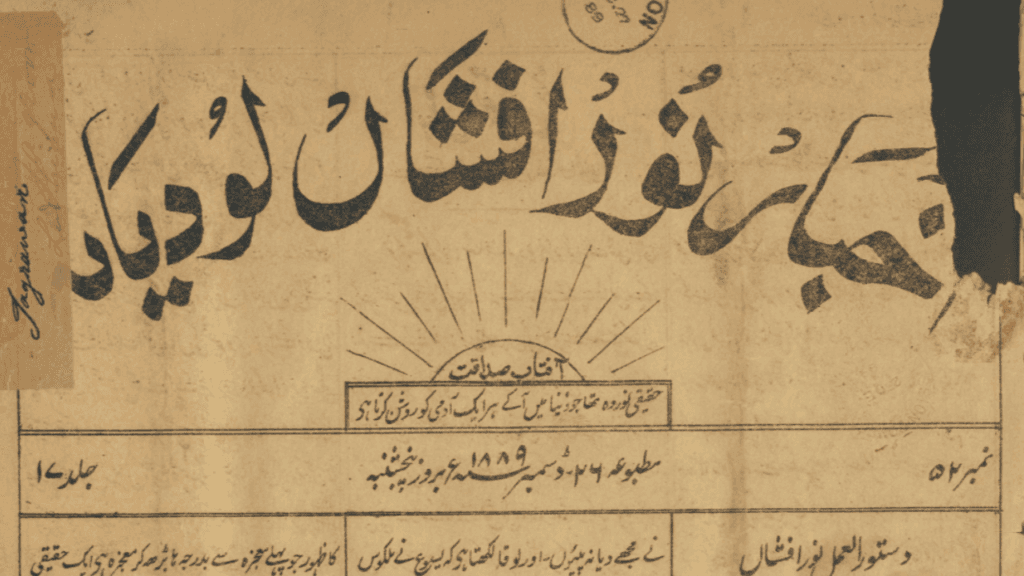
Recently, the Ahmadiyya Archive & Research Centre came across an old postcard – dated 29 January 1894 – from Rev Hassan Ali Safir, Editor of Nur-i-Afshan. This Ludhiana-based Christian newspaper had left no stone unturned in opposing Hazrat Mirza Ghulam Ahmad (as).
Upon searching Rev Safir’s name in the Jamaat’s literature, we found that he is mentioned by Hazrat Sheikh Yaqub Ali Irfani (ra) in an account recorded in Tarikh-e-Ahmadiyyat and also in Hayat-e-Ahmad.
It was interesting to learn that the young Yaqub Ali (ra), during his school days, had an encounter with Rev Hassan Ali Safir – then Assistant Editor of Nur-i-Afshan.
It must be noted that the young Yaqub Ali (ra) had seen1 Barahin-e-Ahmadiyya in 1887 through Maulvi Ghulam Mohiyuddin Sahib – his teacher and headmaster at the Vernacular Middle School – and even met Hazrat Mirza Ghulam Ahmad (as) in 1889. However, he had not done the bai‘at until February 1892.2

It was in 1889 when Hazrat Mirza Ghulam Ahmad (as) established Jamaat-e-Ahmadiyya and took bai‘at (pledge of allegiance) in Ludhiana, the town where Nur-i-Afshan was based and the young Yaqub Ali (ra) was studying.
In March 1889, Nur-i-Afshan mentioned Hazrat Ahmad’s (as) visit to Ludhiana and his announcement to take bai‘at from those who wished to join his Jamaat. In one of its articles, the newspaper questioned the Muslims as to what was the need to pledge allegiance to Hazrat Ahmad (as).3 The Nur-i-Afshan published more comments in the coming issues and used foul language against Hazrat Ahmad (as).4
Without going into details of that episode, this article only intends to narrate the young Yaqub Ali’s (ra) encounter with Rev Hassan Ali Safir, the subsequent interaction with Nur-i-Afshan and the response from the Christian missionaries.
Who was Rev Hassan Ali Safir?
Rev Munshi Hassan Ali Safir was originally a Muslim from the Alwar State in the Rajputana area of British India. He was well-versed in various languages, such as Urdu, Arabic, Persian and English. He later converted to Christianity and actively preached the Christian faith in the Rajputana areas alongside Rev Dr Colin S Valentine.5 He was well-versed in poetry, as evident from various issues of Nur-i-Afshan. A compilation of his ghazals was published entitled Guldasta-e-Safir.6

Rev Imad-ud-Din Lahiz, in the appendix of his paper for the 1893 Parliament of the World’s Religions, has included Safir’s name among the prominent clergy in Punjab Missions as follows:
“Sayad Hassan Ali, Safir. Baptized, American Presbyterian Mission, Lahore. A Christian poet, a descendant of Mohammed, Editor of The Nur Afshan; American Presbyterian Mission, Ludhiana.”7
Mentioning the missionary activities in the Rajputana areas, John Robson DD has written about the conversion of Hassan Ali Safir in the 1860s. He wrote that the first convert at the Nasirabad Mission, named Lachman, was “not a man of brilliant parts”, however, “the next convert was quite a contrast. His name was Hassain [sic.] Ali; he was a Mohammedan, of considerable genius and force of character. His conversion and baptism produced a great sensation in the native community.”8
John Robson DD continued by stating that Hassan Ali Safir “did good service with his pen even more than with his word. Some of the most poetic and literary of the hymns sung by the native Christians throughout the north-west are ‘ghazals’ (a species of Urdu poem) composed by him.”9
Hassan Ali Safir’s early connection with the Nasirabad Mission is evident from Nur-i-Afshan’s 2 March 1876 issue, wherein he has been associated with the said Mission while publishing his ghazal.
John Robson DD further mentioned that in Jaipur, Rev Dr Colin S Valentine was joined by Hassan Ali Safir10 and thereafter, in Alwar State, Rev Henry D St Dalmas “gathered a few native converts, and organised school and other missionary work” where “his chief coadjutor” was Hassan Ali Safir.11
Rev Hassan Ali Safir had been stationed at the Ajmer Mission House,12 before joining the Nur-i-Afshan as the Assistant Editor in October 1889.13 He passed away on 12 August 1895.14 Upon his demise, it was expressed by a Christian writer that “it seems difficult for the newspaper to retain its status after Hazrat Safir.”15
Young Yaqub Ali (ra) and Rev Hassan Ali Safir

Narrating about how he developed an interest in reading the newspapers and writing articles, Hazrat Sheikh Yaqub Ali Irfani (ra) states in his account – recorded in Tarikh-e-Ahmadiyyat – as follows:
“It was due to the editor of Nur-i-Afshan, Mr Hassan Ali Safir, that I grasped a great opportunity to read newspapers.”16
He has explained this point with more detail in Hayat-e-Ahmad, where he states:
“There was an editor of Nur-i-Afshan, namely Hassan Ali Safir. He was around 60 years of age and a very well-versed poet and writer. Once an article was published about him in Manshur-i-Muhammadi. I took that issue to him and asked, ‘Are you the same Safir Sahib who has been mentioned here or someone else?’ He felt a bit embarrassed [mahjub] and said, ‘Sahibzada! You seem to be fond of reading newspapers. I receive many newspapers here, so you may take them [to read].’ In this way, I built some frankness with him and hence, I submitted to him a question to be published [in Nur-i-Afshan].”17
A series of correspondence in Nur-i-Afshan

Mentioning the question, Hazrat Sheikh Yaqub Ali Irfani (ra) did not state the date of Nur-i-Afshan’s issue which published it, however, further research revealed that it was the 26 December 1889 issue. The wording of the question, as published in the newspaper, was as follows:
سوال
توحید کے ماننے والوں کی نجات ہوگی یا نہیں؟ بر تقدیر اول تثلیث ماننے کی ضرورت نہیں اگر نہیں تو انبیائے سابقین مسیح اور اُن کی نجات کا کیا حال ہوگا؟
راقم ایک مستفسر
“Question:
“Will those who believe in Tawhid [Oneness of God] attain salvation or not? If the answer is ‘yes’, there is no need to believe in the Trinity; if the answer is ‘no’, then what will be the status of the previous Prophets prior to Masih [Jesus (as)] and their salvation?
“Author, an inquirer.”
We can make an estimate of the time frame as to when that encounter between the young Yaqub Ali (ra) and Rev Hassan Ali Safir may have taken place.
Rev Hassan Ali Safir took charge as the Assistant Editor of Nur-i-Afshan in October 1889 and the question was published on 26 December 1889, so the meeting might have taken place between early October and 25 December 1889.
Interestingly, there was an announcement on the same page about an incident at the Municipal Board High School Ludhiana, sent by a student named “Muhammad Yaqub Ali”. It is evident from the autobiography of Hazrat Sheikh Yaqub Ali Irfani (ra) that after passing the Vernacular Middle School in 1888, he joined the “Board School of Ludhiana” in 1889.18
Coming back to his question, we learn from Hazrat Sheikh Yaqub Ali Irfani (ra) the following:
“This question got published which initiated a debate in the newspaper. Rahmat Masih Waiz [1857-1935] of Narowal had started a magazine Mubashar [originally started by him entitled ‘Mubashar Injeel’ as a supplement to Nur-i-Afshan and later published separately from Batala as “Mubashar”19], wherein he began publishing articles of Ishaq Kindi which contained a debate on Tawhid.
“Therefore, he posed a question in response to my question as to ‘what kind of Tawhid you believe in?’ My response to it got published […]. At last, Reverend [EP] Newton [Superintendent of Nur-i-Afshan] compelled Munshi Hassan Ali Safir to halt the series [of correspondence].”20

Now, there is no mention of the date on which the response from Rahmat Masih Waiz was published. However, upon looking at the subsequent issues, we find that a response from the said Christian was published in the 9 January 1890 issue, which stated:
“In the previous year’s 26 December issue of Nur-i-Afshan, an inquirer asked whether or not the believers of Tawhid will attain salvation? The inquirer is kindly requested to elaborate as to what he means by believing in Tawhid? In your view, what is meant by believing in Tawhid? […] As long as these points are not explained in detail, this question would be deemed inappropriate. If you explain it, I will be ready to answer.”21
This was followed by an article by Boota Singh Peter from RP Mission Roorkee, who mentioned the question by the young Yaqub Ali (ra) and while answering it, he asserted that “in my view, anyone who believes in Tawhid and rejects Trinity has not truly recognised God.” He concluded by saying that since the beginning of this world, “all those who have attained salvation were believers of the Trinity.”22
In the 13 February 1890 issue, Rahmat Masih Waiz published an article, entitled “Ba-Jawab Khat Muhammad Yaqub Ali, Mut‘allam Board High School Ludhiana” (lit., In response to a letter from Muhammad Yaqub Ali, a student at the Board High School Ludhiana).
Rahmat Masih first mentioned his earlier response to the young Yaqub Ali’s (ra) question about salvation and then stated that he had received a letter from Yaqub Ali (ra). According to Rahmat Masih’s statement, the letter stated that a response was sent to the editor of Nur-i-Afshan, however, the editor returned it without publishing due to prejudice and opposition against Islam.
Rahmat Masih quoted a part from that alleged letter and then wrote that the letter did not define Tawhid, rather, it just says that the Muslims believe in the same Tawhid which was believed by Abraham (as). Rahmat Masih wrote that it is not what he had asked, but rather, he needs to know that in view of Yaqub Ali (ra), what is the definition of Wahid (One) and in what way God is Wahid.
Rahmat Masih concluded his article by saying that once the answer is received, he will request the editor to publish it; however, he has no time to continue this debate back and forth in the personal correspondence.23
The Christian missionaries and their leading newspaper Nur-i-Afshan hesitated in answering the question raised by a 14-year-old Muslim student and – according to the statement of Hazrat Sheikh Yaqub Ali Irfani (ra) – Rev EP Newton instructed Rev Hassan Ali Safir to discontinue the correspondence.
The young Yaqub Ali (ra) later pledged allegiance to the Promised Messiah (as) in 1892 and after a few years, served as the founding editor of the Jamaat’s first-ever newspaper, Al Hakam.
The official records (year 1912) of the Home Department of the British Indian Government, provide a detailed introduction of Hazrat Sheikh Yaqub Ali Irfani (ra) in the following words:
“Yakub Ali, Sheikh, Torab, son of Sheikh Muhammad Ali. He passed his Entrance Examination as a private student in 1893. His father was a subordinate teacher in the Adampur Vernacular Middle School. Resident of Ludhiana, now of Qadian. Worked as a candidate for a Zilladarship in the Irrigation Department. Got employment as a Patwari in that Department, but resigned. In 1894 commenced work as Editor in Amritsar of the Riaz-i-Hind, Feroz, Ahluwalia Gazette, Jahan Numa and Punjab. In 1896 was selected as a special Police Officer to supervise Muharram arrangements. In 1897 started the Hakam [sic.] newspaper in Amritsar, and in 1898 transferred it to Qadian. Was for some time [a] translator in the Paisa Akhbar Office. Age 36 years.”24
Endnotes
1. Maktubat-e-Ahmad, 2008, Vol. 2, p. 499
2. Tarikh-e-Ahmadiyyat, Vol. 18, pp. 637-639
3. Nur-i-Afshan, 14 March 1889, p. 6
4. Ibid., 21 March 1889, 4 April 1889 and 18 April 1889
5. Ibid., 20 March 1896, p. 6
6. Ibid., 9 October 1890, p. 3
7. The Church Mission Intelligencer, Vol. XLIV, London, 1893, p. 585
8. Missions of the United Presbyterian Church, Edinburgh, 1896, Offices of United Presbyterian Church, p. 86
9. Ibid.
10. Ibid., p. 100
11. Ibid., pp. 113-114
12. Nur-i-Afshan, 22 August 1889
13. Ibid., 9 January 1890, p. 3
14. Ibid., 23 August 1895, p. 11
15. Ibid., 13 September 1895, p. 5
16. Al Fazl, 6 May 1958, p. 4
17. Hayat-e-Ahmad, Vol. 3, pp. 213-214, footnote
18. Al Fazl, 6 May 1958, p. 4
19. Nur-i-Afshan, 15 January 1891, p. 5
20. Hayat-e-Ahmad, Vol. 3, pp. 213-214, footnote
21. Nur-i-Afshan, 9 January 1890, p. 12
22. Ibid., 23 January 1890, pp. 5-6
23. Ibid., 13 February 1890, pp. 5-6
24. National Archives of India, Home Department, Political, 1912
_____________________________________________________________________________________________
Links and Related Essays
https://www.alhakam.org/yaqub-ali-nur-i-afshans-editor-1889
Ahmadiyya leadership admitted (in the 1930’s) that MGA used lots of editors and ghost writers
Mirza Ghulam Ahmad lied about his relationship with his newspaper, Al-Hakam
Mirza Ghulam Ahmad’s desire for a 3rd marriage led him to ask Noorudin about his pre-teen daughter
When did MGA’s marriage with his second wife Nusrat Jehan take place? What year?
Mirza Tahir Ahmad authenticated the book, “Hyat-e-Nasir” (1927)
Mir Nasir Nawab (1846-1924), the father-in-law of Mirza Ghulam Ahmad
Ahmadiyya leadership lied about the First Bait ceremony in 1889
_____________________________________________________________________________________________Tags
#ahmadiyya #ahmadiyyatrueislam #ahmadiapartheid #Ahmadiyyat #rabwah #qadian #meetthekhalifa #muslimsforpeace #ahmadiyyafactcheckblog #nolifewithoutkhalifa #AhmadiyyaPersecution #trueislam
50 Pingback