Intro
As we all know, Maulvi Noorudin, Maulvi Abdul Karim and MGA were all influenced by the writings of Sir Syed. Sir Syed denied all miracles in Islam by 1880, he denied the Islamic creation theory, the return of Esa (as), the arrival of the Mahdi, the physicality of the Mir’aj, all the hadith work, etc. etc. etc. Obviously, Noorudin and Abdul Karim knew each other in 1880 and in the below I present data which proves this fact. They would all eventually join MGA’s team of Mullahs and ghost writers, Maulvi Abdul Karim, Maulvi Mufti Muhammad Sadiq, Maulvi Sher Ali, Hakim Fazl Din of Bhera, Noorudin and many others. Some other people who came independently, yet still joined MGA’s team was Maulvi Muhammad Ahsan Amrohi, who was also a member of the Ahl-e-Hadith sect, in fact, uptil his job with MGA, he worked for the founder of the Ahl-e-Hadith sect, Syed Nazeer Husain from Delhi and Siddiq Hasan Khan of Bhopal. Maulvi Muhammad Ali was another, however, he came via Khwaja Kamaluddin and the prominent Ahmadi’s of Lahore.
Sir Syed began publishing his commentary of the Quran in 1880, however, the section which concerns Esa (as) was published (see Nuzhat Haneef) in 1882, MGA almost immediately began calling himself as “like-esa” or “Maseel-e-Maseeh”. It’s important to note that it was Noorudin who urged MGA to do so. Later on, MGA also copied Sir Syed’s swoon theory and passed it off as his own (see Jesus in India, 1908 and Nuzhat Haneef). MGA also attracted lots of people who were already following Sir Syed’s new ideas on Islam, like Maulvi Abdul Karim and others. Sir Syed also denied the entire concept of the Mahdi in this era. The truth is that MGA knew about the new beliefs of Sir Syed as early as 1872 and began to slowly adopt them. However, he lied about his true beliefs from 1876–1890. Check out the books on Islam by Sir Syed herein from 1857-1870. Afzal Upal has revealed in his book on Ahmadiyya that MGA was actually writing letters to Sir Syed back in the early 1860’s, when he was employed in Sialkot (see page 112). Sir Syed Ahmad Khan (spelled Sir Sayyad Ahmad of Aligarh) is mentioned in detail in the ROR of June-1933.
Like I have written before, MGA and his team copied from Sir Syed on almost every single topic, except Jesus in India, that was tooo ridiculous for any human to conjure up. In this specific case, I have a scan from the writings of Sir Syed, pre–1891, wherein he says that all hadith on the Mahdi are weak and unreliable.
In 1891, MGA claimed to be “jesus”, he then downgraded all hadith on the Mahdi and called them as unreliable. However, once he heard about the eclipses, he quickly found a super unreliable hadith and called it as reliable and thus made the claim of being the only Mahdi who was to come. Afzal Upal has revealed in his book on Ahmadiyya that MGA was actually writing letters to Sir Syed back in the early 1860’s, when he was employed in Sialkot (see page 112).
In 1899-1902, Mirza Qadiani alleged that he had published an advertisement on February 20, 1886, stating that Sir Syed Ahmad Khan would die. Then on March 12, 1897, he also stated in the advertisement that he had been informed of Sir Syed’s death (See RK, V-15, p. 466-469, Tiryaqul-Qulub).
In 1905, MGA and his team of writers criticized the beliefs of sects (firqay) like the “Naturalist”, led by Syed Ahmad Khan, who deny Heaven, Hell, angels, revelation and etc. (See Malfuzat-8, online English edition, page 40, via al-Badr, vol. 1, no. 32, p. 2–4, dated 3 November 1905). MGA then says, to distinguish itself from all these sects, this sect was named ‘Ahmadiyya’.

______________________________________________________________________________________________Who is Sir Syed Ahmad Khan?
Born on 17 October 1817 – 27 March 1898), commonly known as Sir Syed Ahmad Khan (also Sayyid Ahmad Khan). He seems to have been a member of the growing Ahl-e-hadith movement in Northern India. However, by the 1860’s, he was a hybrid version of a Quranist. You can also listen to Mufti Mubasher Shah explaining this Tafsir herein. Syed Ahmad Khan started publishing his rationalist ideas in 1880 through the first volume of his Qurʾānic exegesis (S.S. A. Khan, 1880). In it, argued against the notion of supernatural angels that act as mediums between God and humans (Khan 1880: 29–30, 33–34, 53–57). Instead, he said that God communicates with all human beings (and animals) at the time of their conception when he decides their nature (he probably would have used the word DNA instead of nature, had DNA been discovered by 1880).
The Tafseer (commentary) was originally published, probably in parts, in the 1880’s. It does not cover the entire Quraan; it only goes up to Chapter 17, Soorah Banee Israa-eel. Sir Sayyad died
before he was able to complete the work. Chiragh Ali was a student or colleague of Sir Syed and was publishing similar material from Aligarh. Read a thorough review on this Tafsir herein, they claim that an english version is available at the Khuda Baksh Library.
The order of publishing is as follows:
Vol. I Aligarh, 1880.
Vol. II Aligarh, 1882, Agra, 1903.
Vol. III Aligarh, 1885.
Vol. IV Aligarh, 1888.
Vol. V Aligarh, 1892.
Vol. VI Aligarh, 1895.
Vol. VII Agra, 1904.
In this Tafseer, Sir Syed Ahmad Khan denied the physicality of the Miraaj, the concept of the Mahdi, the death of Eisa (as), the denial of Jinn, the denial that Adam (As) was the first human and etc etc.
_____________________________________________________________________________________________
1857–1870
As for the war of Independence 1857 that took place because of the Muslim spirit of freedom struggle and their growing resentment towards the British, “Sir” Syed labeled it as a ‘riot’ and ‘sedition.’ In his pamphlet, ‘Asbab-e-Baghawat-e-Hind’ (Causes of the Hind Sedition), he made it clear that Muslim were guilty of sedition. In this pamphlet, he told the British that the Muslims were in favour of their rule, but rebelled because they had not been given any seat or position in government circles. So, he played along with the British plan to engage Muslims within the British rule, rather than act to uproot it and he himself took a government position.
“Sir” Syed also wrote a book called ‘Loyal Muhammadans of India’. It had three volumes and was published in the years 1860-61. Throughout the book, he proved his loyalty towards the British. In this book, he wrote, “I am extremely angry with the Muslims who rebelled and were defiant against the British and consider them bad because this outbreak by the Muslims was against the People of the Book, the who are our religious brothers, believed in the Messengers, accepted Allah’s rules and keep Allah’s revealed books with them which are part of our fundamental beliefs. Therefore, whenever Christian blood was shed, Muslim blood should have been shed too. And whoever stands against this and are ungrateful to the government, which is not tyrannical, have gone against their religion. They are extremely worthy of being angry with.”
“Sir” Syed seized every opportunity in giving a favourable opinion about the British. After the War of Independence 1857, Queen Victoria appealed to the Muslims for forgiveness and asked them to excuse the British for the mass murder that took place. “Sir” Syed told the Muslims in Muraadabad that it was absolutely necessary to thank her. So a ‘Dargah Hazrat Shah Balaqi’ was suggested and on 28 July 1859, 15,000 people were gathered. To attract more people, food arrangements were made and after ‘Asr Prayer, “Sir” Syed made a collective Dua. Some of the content of this Dua is as follows: “Oh Lord! You have shown mercy to Your people and the people of Hindustan by placing upon them just and equitable rulers and for this we thank You. In the preceding years, we had to face a curse of the absence of such rulers owing to our wicked deeds but now You have compensated it and provided us with such just and kind rulers. We thank You for this blessing of Yours from the core of our hearts. Oh Lord! Accept our gratitude! Ameen! The Indians who were caught into this unfortunate catastrophe, You molded the hearts of our rulers to be merciful to these Indians for the Queen issued an appeal seeking forgiveness just because of Your inspiration. We not only thank You but also pray for the Queen Victoria, wherever, she might be. Oh Lord! Accept our Dua! Ameen!” The cunningness, treachery and deceit against Muslims and Islam is obvious in these words. This Dua is a proof of the loyalty of “Sir” Syed to the British but the tragedy is that such a personality is presented to us as a role model to our Children in School text books while pious personality like Aurangzeb (rahimahullah) are antagonized.
In reality, the decline of the Muslims began with a decline in the comprehension of Islam and its wrong implementation. “Sir” Syed suggested a wrong way to come out of this decline. In his flawed understanding, the Muslims can make progress only by following the British blindly in science, inventions and their thoughts related to life, without adopting the systems springing from the complete Deen of Islam. In fact, we fell behind West, because we did not adopt Islam as a complete way of life. Therefore, if we want to be a progressive Ummah, we must first revive by holding fast onto our Islamic Aqeedah, instead of following the West. Moreover, if science and technology is the only way to success and if Islam mandates that the path to enlightenment is progress and evolution as envisaged by ‘Sir” Syed, then why didn’t Prophet Muhammad صلى الله عليه وسلم spread Islam and conquer through science and technology?? How did the Khulafa-e-Rashideen establish the golden era of Islam without the inventions and discoveries of the Industrial Revolution?? If science was so central to human existence, then wouldn’t the prophets and messengers have been scientists, or at least invented something for mankind??
In the early 1860’s, Mirza Ghulam Ahmad wrote Sir Syed Ahmad Khan a few letters.
_____________________________________________________________________________________________
1870
http://www.sirsyedtoday.org/books/?cid=64
MGA basically stole Sir Syed’s ideas. In fact, the name “Ahmadiyya” came from a book that Sir Syed wrote “””Al Khutbat al Ahmadiya”” (1870), in reply to Muir”s “Life of Mahomet”. Sir William Muir’s “Life of Mahomet” (available online) made some wild allegations against the Prophet Mohammad (saw). Syed Ahmad was greatly disturbed and pained and prepared to write a detailed response in the form of the book “Khutubat-i-Ahmadiya”. He planned to collect research material in England during his trip to England. Syed Ahmad had to endure many financial difficulties for the translation and publication of the book in England. He later expanded upon these ideas in the form of “Tasanif-i-Ahmadiya”. Maulana Moudoodi declared this book as the first major scholarly work on the life of Prophet.
______________________________________________________________________________________________
1877
The scan from tahdheeb al ikhlaaq, vol -7, August 1877
 _____________________________________________________________________________________________ 1880
Upal quoted “Tafseer-ul-Quraan ma` Usool-e-Tafseer” by Sir Syed Ahmad Khan (1880) in 2021, in his book, “The Handbook of Islamic Sects and Movements”
“This proves that that the prophetic capability that God produced in prophets (anbia) is named Gabriel” (Khan 1880: Tafsīr-ul-Qurʾān wa howa alhuda wal furqan. Vol. 1. Lahore: Rifahe-
Aam Steam Press).
“”The angels that Qurʾān mentions cannot physically exist but the manifestations of God’s infinite powers and those capabilities that God created his creation with are called angel (malak) and angels (malaika). One of them is Satan or Iblis. The rise of the mountains, water’s flow, power of the trees to grow, electricity’s powers of attraction and repulsion etc., all capabilities that are present in the creation are the very angels mentioned in the Qurʾān.”” (Khan 1880: Tafsīr-ul-Qurʾān wa howa alhuda wal furqan. Vol. 1. Lahore: Rifahe-
Aam Steam Press).
“””Jesus was taken down from the cross after three or four hours and it is completely possible to believe that he was still alive. At night, he was taken out of the shroud and he secretly stayed under the protection of his disciples. The disciples saw him and met him. And he died later at some unknown location. Undoubtedly, because of the Jewish enmity, he was secretly buried at an unknown location that is unknown to this day. And they popularized the idea that he has been lifted to the heavens”””. Khan 1880: Tafsīr-ul-Qurʾān wa howa alhuda wal furqan. Vol. 1. Lahore: Rifahe-Aam Steam Press).
“””All creation whether it be humans or animals or plants, God has put a nature into everything. Things happen according to that nature without any teacher’s teachings. This blessing of nature has been labeled by some ʿulamāʾ of Islam as ilhamat (revelations). But the High Lord has called it wahi … This wahi was not delivered to the honeybee by Gabriel or another angel of God but God himself put it into it …According to the ranks of their nature there will be people who will be born from among them whom Shāh Waliullah Sahib has labeled as perfects, hakims, khalifas, aided by the Holy Spirit (ruh-ul-qudus) guides, imams, munazir (warners), nabī (prophets). Today’s faithless people call them reformers … A guide who has a perfect nature of guidance is a prophet (nabī) (Khan 1885: 16–17, Vol. III Aligarh, 1885).
_____________________________________________________________________________________________
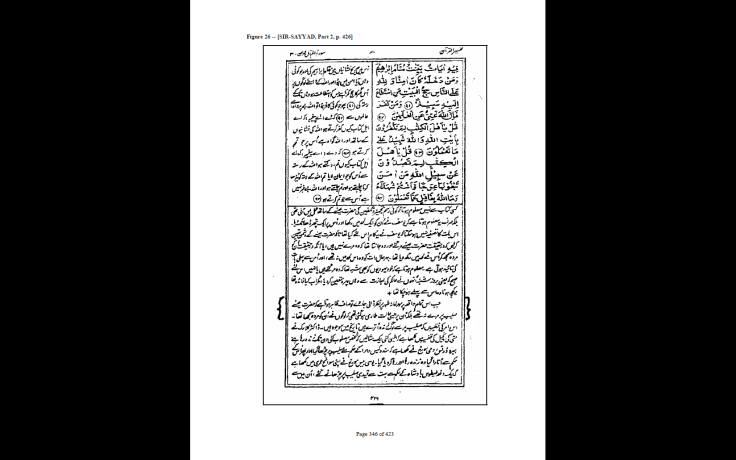
Scans from Sir Syed’s Tafsir



_____________________________________________________________________________________________
Nuzhat Haneef
Ahmadis hate Nuzhat Haneef and all of their critics – ahmadiyyafactcheckblog
Now I provide my English translation of Sir Sayyad’s Urdu translation of Quraan 3:56 and some excerpts from his commentary on this verse, shown in the original Urdu text in the page images above.
[Quraan 3:56, numbered by Sir Sayyad as verse 48] When God said: O `Eesaa [Jesus], indeed I am going to kill you [‘mayn tujh koe maarnay waalaa hoon’] and am going to raise you to Myself and am going to purify you, from those people who became disbelievers, and am going to make those who followed you superior to those who became disbelievers, till the Day of Resurrection. Then you have to come to Me again. Then I will made a decision/judgment in the matter in which you differed. [SIR-SAYYAD, Part 2, p. 403] …
[Commentary on 3:56:] …
A person does not die due to being put on a cross because only the palms of his hands, and sometimes the palms and feet, got wounded. The reason for death used to be that [the person] was kept hanging on the cross for four or five days and [due to] the holes in his hands and feet and by suffering the impact of hunger and thirst and the heat and glare of the sun, [he] used to die in several days. … [SIR-SAYYAD, Part 2, p. 424] …
Upon the end of the day of the Fasah festival [the Pesach or Passover festival96], the Jewish Sabbath was about to begin and, according to the Jewish religion, it was necessary that the corpse of the killed or crucified person be buried prior to the end of the day, that is, prior to the start of the Sabbath. But a person cannot die so soon on the cross. Therefore, the Jews requested that Hadrat Maseeh’s legs be broken so that he would die immediately but Hadrat `Eesaa’s legs were not broken and people thought that he died within that much time [i.e., within the short time]. …
When people erroneously thought that Hadrat `Eesaa has actually died, then Yoosuf [Joseph of
Arimathea] requested the governor [Pilate] to have him buried; he [Pilate] was very astonished that he [Jesus] had died so quickly. The report of [Jesus] having died so quickly not only caused astonishment to the governor but the Christians too used to consider it impossible and, therefore, in the 3rd Christian century [i.e., 3rd century AD] the Christian scholars [of that period] eventually declared Hadrat `Eesaa’s swift death on the cross to be a miracle. [SIR-SAYYAD, Part 2, p. 425] ……
Upon taking a historical view of this whole incident [of Jesus’ crucifixion] it clearly becomes
obvious that Hadrat `Eesaa had not died on the cross; rather, he went into a condition such that people thought him to be dead. … Hadrat `Eesaa was taken down from the cross after three or four hours and one can be sure in every respect that he was alive. At night he was taken out of the grave and he stayed hidden in the protection of his disciples. The disciples saw him and met him and then, at some [later] time, [he] died a natural death. Without a doubt, due to fear of the enmity of the Jews, he must have been buried, in extreme secrecy, at some unknown location, which is unknown up till now and it became publicized [i.e., the word spread] that he had gone to the heavens [or the sky]. [SIR-SAYYAD, Part 2, pp. 426-427]
As you can see, Sir Sayyad presents the theory, later adopted by Mirza Ghulam Ahmad, that Jesus did not die on the cross but rather was taken down alive and died a natural death later on. He also provides the same explanation that Mirza Ghulam Ahmad later provided for why Jesus was able to survive, viz., that he was taken down from the cross within a few hours.
Now that you have read a part of Sir Sayyad’s explanation of the crucifixion incident which was published in the early 1880’s97, I present below a few excerpts from Mirza Ghulam Ahmad’s book Maseeh Hindustaan Mayn (whose preface is dated 1899 but which was published in 1908) which he wrote after declaring in 1891 that God had told him that Jesus was dead. Instead of translating myself from Urdu, I have used the Ahmadiyya Movement’s translation available in the book Jesus in India but I have provided the corresponding Urdu reference as well. In this quotation, see if you can notice the similarities between Mirza Ghulam Ahmad’s writing and Sir Sayyad’s explanation of how Jesus could have come down alive from the cross (see Jesus in India).
_____________________________________________________________________________________________
Sir Syed Ahmad Khan scans and data from 5:117


_____________________________________________________________________________________________The Quotes
i. “Now we must turn to the Holy Quran to see what it says. The Quran makes mention of Jesus’ death in four places … Firstly in Sura Aal Imran, secondly in Sura Ma’ida, … thirdly in Sura Maryam … fourthly in Sura Nisa’. Jesus was not killed by the Jews, either by stoning or by crucifixion, but he died his natural death, and God raised him in rank and status … From the first three verses it is clear that Jesus died a natural death. However, as the Ulama of Islam had followed the Christians, in accepting that Jesus had gone up to heaven alive, before looking at the Quran, so they have tried to interpret some of the words in these verses to accord with their unsound belief.”
(Tafsir Ahmadi by Sir Syed Ahmad Khan, vol. ii, p.48)
ii. Referring to the expression ‘in this’ (Arabic: bi-hi) in the verse: ‘And there is none of the People of the Book but will believe in this before his death’ (4:159), which is generally taken to mean in him (i.e. in Jesus) Sir Syed writes:
“This points to the words ‘And their saying: we have killed the Messiah’ [4:157], and to their saying, and not to the Messiah. So this means: ‘All the People of the Book, before their death, will believe that Jesus was killed’. After this it is said: ‘And on the day of Judgment he, i.e. Jesus, will be a witness against them’. The word ‘ala [‘against’] is used to indicate loss or harm. So the meaning is that on the day of Judgment Jesus will be a witness against their belief.”
(Maktub Sir Syed, No. 2, p. 48)
iii. “Jesus spent his early life migrating from one place to another. His later life was not very long, for he was 33 years of age when he died, and at that time there were only 70 people who believed in him.”
(The Ali Garh Magazine, Intikhab No. 1971, p. 48)
See the lahori website. I copy and pasted from there.
_____________________________________________________________________________________________The scan work
 ______________________________________________________________________________________________
1882
Sir Syed’s view on Esa (as)-1882 – ahmadiyyafactcheckblog
Obviously, MGA took all of his theories on religion from other people. Sir Syed began publishing his commentary of the Quran in 1880, however, the section which concerns Esa (as) was published (see Nuzhat Haneef) in 1882, MGA almost immediately began calling himself as “like-esa” or “Maseel-e-Maseeh”. It’s important to note that it was Noorudin who urged MGA to do so. Later on, MGA also copied Sir Syed’s swoon theory and passed it off as his own (see Jesus in India, 1908 and Nuzhat Haneef). MGA also attracted lots of people who were already following Sir Syed’s new ideas on Islam, like Maulvi Abdul Karim and others. Sir Syed also denied the entire concept of the Mahdi in this era. The truth is that MGA knew about the new beliefs of Sir Syed as early as 1872 and began to slowly adopt them. However, he lied about his true beliefs from 1876–1890. Check out the books on Islam by Sir Syed herein from 1857-1870.
______________________________________________________________________________________________
1889
MGA’s failure to speak at the Aligarh College in April of 1889 – ahmadiyyafactcheckblog
After accepting Bait’s from his followers in March of 1889, MGA immediately traveled to Aligarh and was scheduled to give a speech to many Professor’s, Sir Syed would also be in attendance. However, after MGA arrived in Aligarh, he never came out of his apartment for daily prayers, then, just a few hours before his speech, he declined and abruptly left for Qadian. This was before Noorudin and Maulvi Abdul Karim had began giving speeches on MGA’s behalf. They had just taken his Bait however. Mir Abbas Ali Ludhianvi, Abdullah Sanori and Sheikh Hamid Ali accompanied him on this journey (see Mujadid-e-Azim, page 278). MGA stayed in Aligarh for just a week, after which he returned to Ludhiana. In Aligarh, he was the guest of Tafazul Hussain, Tehsildar, who was at the time serving as the Superintendent of the Deputy Commissioner’s office. There were a couple of report-worthy incidents in Aligarh (IBID). The name of the speech was supposed to be “The Truth of Islam”. This trip is mentioned in the ROR of June-July-1940. MGA and his team returned to Qadian on April-18-1889.
______________________________________________________________________________________________
1892
Oudh Punch (Lucknow)
March-31
A conversation is had about the similarities between MGA’s beliefs and Sir Syed Ahmad Khan’s beliefs.
Scan

_____________________________________________________________________________________________
1892-1893
In 1892-1893, MGA and his team of writers wrote vs. Sir Syed that Allah had opened secrets of prophethood, messenger ship and wahi to MGA and thus, MGA’s deniers are Kafir and destined for Hell (See A’ina-e-Kamalat-e-Islam, online English edition, page 293).
_____________________________________________________________________________________________
1894
Blessings of Prayer (alislam.org)
Barakatud Du‘a, or The Blessings of Prayer, written by MGA and his team in 1893, is a refutation of Sir Sayyid Ahmad Khan’s view that there is no such thing as the acceptance of prayer, and that prayer is no more than a form of worship.
______________________________________________________________________________________________
1898
He died on 27 March 1898.
______________________________________________________________________________________________
1901
The India Census report of 1901 and the #Ahmadiyya Community – ahmadiyyafactcheckblog
MGA adopts the name Ahmadiyya for his new religion, MGA’s followers are ordered to self-identify themselves as Ahmadi’s in the 1901 census.
_____________________________________________________________________________________________
1899-1902
RK, V-15, p. 466-469, Tiryaqul-Qulub
https://youtube.com/shorts/5_kdDZj254w?si=sTF__uP41Ftzl8KS
In 1899-1902, Mirza Qadiani published an advertisement on February 20, 1886, stating that Sir Syed Ahmad Khan would die. Then on March 12, 1897, he also stated in the advertisement that he had been informed of Sir Syed’s death. Mirza Qadiani wrote this but did not write the date and year of this proposal (See RK, V-15, p. 466-469, Tiryaqul-Qulub).


_____________________________________________________________________________________________
1905
Malfuzat-8, online English edition, page 40
Badr, vol. 1, no. 32, p. 2–4, dated 3 November 1905
https://files.alislam.cloud/pdf/Malfuzat-8.pdf
https://ahmadiyyafactcheckblog.com/2016/12/05/ahmadis-are-lied-to-about-the-73-sects-arguments-that-the-keep-making/
In 1905, MGA and his team of writers criticized the beliefs of sects (firqay) like the “Naturalist”, led by Syed Ahmad Khan, who deny Heaven, Hell, angels, revelation and etc. (See Malfuzat-8, online English edition, page 40, via al-Badr, vol. 1, no. 32, p. 2–4, dated 3 November 1905). MGA then says, to distinguish itself from all these sects, this sect was named ‘Ahmadiyya’.
______________________________________________________________________________________________
1907
Badr, vol. 6, no. 29, p. 5, dated 18 July 1907
Via Malfuzat-9, pages 313-314
“””Sir Sayyid was Not a Leader
A person mentioned that in the current age, there have been two national leaders among the Muslims and one among the Hindus. Dayanand was the one among the Hindus. As a result of his teaching the opinions of the Hindus that have formed about the Government are apparent. There have been two leaders among the Muslims, Sir Sayyid [Ahmad Khan] and Hadrat Mirza [Ghulam Ahmad] Sahib. The followers of both of them are such that they are true well-wishers of the Government. The Promised Messiah as said:
It is true that the students who study at the college of Sir Sayyid, or those who share his bent of mind, uphold a noble attitude regarding the Government, but in reality, Sir Sayyid has neither established any religious group nor was he an Imam or national leader. Rather, he had a gathering of learned people around him who agreed with him in some matters and opposed him in others. In contrast to this, this [Ahmadiyya] Movement has been established by God Almighty and He has appointed me the Imam of this Jama‘at. This is a religious Jama‘at that is ready to obey me in every matter at all times, and I have made them understand this matter by way of religious beliefs that it is our religious duty to obey and be grateful to this Government. No one has stressed the obedience to the Government in this manner previously.””
______________________________________________________________________________________________
1933
Sir Syed Ahmad Khan (spelled Sir Sayyad Ahmad of Aligarh) is mentioned in detail in the ROR of June-1933.
______________________________________________________________________________________________
1936
The ROR of March-1936 mentions Sir Syed.
________________________________________________________________________________________________
1937
The ROR of March-1937 mentions Sir Sayyad.
________________________________________________________________________________________________
1943
The ROR of July-1943 gives a testimony by Sh. Karam ilahee (from Patiala) wherein he tells about a story with Maulvi Abdul Kareem leading prayers at Qadian. After the prayer, Sh. Karam ilahee (from Patiala) was introduced to MGA via Maulvi Abdul Kareem as a naturi, a person who was following Sir Syed and etc. Mirza Ghulam Ahmad then asked Sh. Karam ilahee (from Patiala) if he had read the books of Sir Syed Ahmad and Sh. Karam ilahee (from Patiala) confirmed it. Sh. Karam ilahee (from Patiala) said that he came from an educated family and thus had read the books of Sir Syed Ahmad Khan. MGA then asked him if he had the books of MGA? Sh. Karam ilahee (from Patiala) confirmed that he had read all of MGA’s urdu books. MGA then asked as to what books of Sir Syed Ahmad Khan appealed to Sh. Karam ilahee (from Patiala) and he replied with “Khutbat-i-Ahmadiyya” (Which was written by Sir Syed Ahmad Khan while he was in London in 1870). Sh. Karam ilahee (from Patiala) also mentioned “Tabyeenul Kalam” as a favorite book of Sir Syed Ahmad Khan. MGA then asked Sh. Karam ilahee (from Patiala) what difference was between MGA’s books and Sir Syed Ahmad Khan’s books? Sh. Karam ilahee (from Patiala) responded with a metaphor. MGA then said that the difference can be seen in terms of the Miraj, Sir Syed Ahmad Khan called it a dream, whereas MGA called it a spiritual vision (Kashf).
______________________________________________________________________________________________
1946
In the ROR of Oct-1946, MGA’s mubahila with Lekh Ram and the Arya Samaj is mentioned, as well as MGA’s correspondance with Sir Syed Ahmad Khan in this regard.
______________________________________________________________________________________________
1947
Per the ROR of Feb-1947, a photo of Maulvi Jalal ud Din Shams is posted. The ROR also has an essay by him entitled, “Preaching of Islam in Europe” by J.D. Shams (for imam of the London mosque). In this essay, he talks down on Sir Syed Ahmad Khan, Maulvi Chiragh Din and Syed Amir Ali and claims that they fabricated all of their beliefs to please the colonists. For example, Shams states that Sir Syed Ahmad Khan denied the existence of angels. He also mentions how a white man named Dixon (also mentioned in Nuzul ul Masih, 1909)(income tax case) came to Qadian once and MGA walked him out to the canal bridge, which is 2.5 miles outside of Qadian. He also mentioned MGA’s famous fake dream of 1890-1891 which was written in Izala Auham (See Izala-e-Auham, pp. 515–516, Ruhani Khaza’in, vol. 3, p. 377) wherein MGA said that white birds would join Ahmadiyya (See the ROR of June-1917). Shams also mentioned Mufti Muhammad Sadiq and the Piggot. Shams also wrote how Sir Fazl-i-Hussain praised the efforts of Ahmadiyya in London (in 1927). Sir Fazl-i-Hussain mentioned how Khwaja Kamaluddin had travelled to London in 1913 and started this mission of MGA. Shams made disparaging remarks about Khwaja Kamaluddin.
________________________________________________________________________________________________
1958
(Shahid, 1958: 97). See Shahid, Dost Muhammad (1958). Tareekh-e-Ahmadiyyat. Rabwah: Idarat-ul-Musanifeen.
“””Since Mirza Sahib liked to debate Christian clerics, Murad Beg who used the nom de guerre
of Mirza Shikasta (and later on Muwahid) and was a resident of Jallandhar, told him, “Syed
Ahmad Khan has written an exegesis of Torah and Injil. If you write to him it may be helpful.”
Thus Mirza Sahib wrote a letter to Sir Syed in Arabic”””.
_______________________________________________________________________________________________
Mohammed on X: “The deviancy and kufriya beliefs of Syed Ahmad Khan A thread 🧵 https://t.co/GjOrqMpCng” / X
1) Syed Ahmad denied Allah’s Attributes and denied the events of hereafter including hell and heaven Translation: “Everything that has been described in the Qur’an or hadiths about God’s attributes and divine actions, they have all been described as metaphors, and similarly everything that has been described about Ma’ad (hereafter), such as discussion and dissemination, accounting, judging, And the book, the balance, the siraat, the heaven, the hell, etc., all of them are based on authority, not on reality.” Hayat e jawed lahore, page 504.
Scan

2) he denied the existence of angels and used to believe that the word for the angels mentioned in Quran (i.e. Malik, malaikah) don’t actually mean angels. Translation: “but the existence of angels is just strange thoughts of common people”.
Scan

3) he denied the story of Adam عليه السلام and Iblees Translation: we do not consider this story (the story of Adam(A.S.) and Iblees) to be an actual story, but we only describe it in the sense of a language of human’s nature (he means that he only takes this story an example but not real), so man’s stay in the paradise is just a description of his nature (fitrah).
Scan

4) Syed Ahmad denied the journey of Isra wal miraj of Prophet ﷺ to be physical Hayat e jawed lahore, page 502 Translation: Ascension (mi’raj) took place in a dream and not in waking life, whether from Masjid al-Haram to Masjid al-Aqsa or from Masjid al-Aqsa to the heavens.
Scan

5) he denied the existence of “Iblis” Translation: The word “Satan” or “Iblis” in the Holy Quran does not refer to any existence outside of human beings, but rather to the existence of the soul or the power of insurance in the human being. Hayat e jawed lahore page 501.
Scan

6) He denied the upliftment of Isa عليه السلام towards heaven Translation: There is not a single word in the Qur’an that proves that Jesus was lifted up alive to the heavens. (Hayat e jawed lahore, page 503).
Scan

7) Syed Ahmad denied the prophetic miracles mentioned in Qur’an Translation: miracles are not a proof of prophethood, nowhere in the Qur’an any miracle of Prophet is mentioned while Quran clearly mentions the splitting of the moon, a miracle of Prophet in Surah al Qamar ayah 1.
Scan

______________________________________________________________________________________________
https://x.com/iftiswelt/status/1813919773773996077
Insightful presentation by Kamran Khan (@KamranK71025279) titled “Sayyid Ahmad Khan’s Urdu Tafsir and Its Influence on Early English Qur’an Translations” at the 2024 Annual Meeting of the International Qur’anic Studies Association (#IQSA) in London. #IQSA2024 @iqsaweb
_______________________________________________________________________________________________
Daniel Haqiqatjou on X: “The First Voluntary Pajeet Beginning in the 19th century, Muslim reformers began imitating their Jewish and Christian counterparts by introducing bizarre interpretations of scripture to prove that everything in scripture is entirely consistent with a scientific materialist… https://t.co/3bZwBIOBQN” / X (twitter.com)
(1) When Islamic texts assert that Jesus had no father, it simply means that his father was unknown to the public (he also insists that this father had a legitimate marriage to Mary). (2) When Islamic texts claim that Jesus raised people from the dead, it simply means that he awakened people who were in a coma or state of deep sleep. (3) When Islamic texts claim that Jesus healed lepers, it simply means he abolished Jewish ritual rules which classified lepers as uncleans. A discussion of these claims (and others) made by Khan can be found in: Muda Ismail Abd Rahman, The Interpretation of the Birth of Jesus and his Miracles in the Writings of Sir Sayyid Ahmad Khan, Islam and Christian-Muslim Relations 14(1):23-31
_____________________________________________________________________________________________
The Deviant Beliefs of ‘Sir’ Sayyid Ahmad Khan | Islam Reigns (wordpress.com)
THE DEVIANT BELIEFS OF ‘SIR’ SAYYID AHMAD KHAN

[By Maulana Mufti Muhammad Na‛im Sahib and translated by Maulana Mahomedy]
Naturalism: the belief that all religious truth is based not on revelation but rather on the study of natural causes and processes.
(Collins English Dictionary)
Background
After the end of Muslim rule in India and the arrival of the British there, the naturalist sect was the first deviated sect to come into existence. [Aqa’id Islam, vol.1, p. 179].
Sir Sayyid Ahmad Khan was a Ghayr Muqallid in the beginning. He then became a mujtahid. When he went to England, he became a mulhid. Subsequently, he openly commenced propagating his naturalist sect. [Imdad al-Fatawa, vol. 6, p.167]
The British formed this sect with the sole purpose of dividing the Muslims so that they [British] could rule over India without interference or hindrance. They put Sir Sayyid to proper use for this purpose. The following is noted by an insightful Englishman:
Every person belonging to our government in India – whether he is involved in foreign affairs, the courts or the administration of the army – must always bear in mind the principle of divide and rule.
In order to realize their objective, the British first utilized Sir Sayyid. The above statement of the Englishman is more or less conveyed by Sir Sayyid in the following way:
The disruption and disorder which we experienced is solely as a consequence of the ingratitude of the Indians. You did not show gratitude to God and have always been ungrateful. God imposed this situation on you Indians because of your ingratitude, and allowed you to experience again a sample of the government of former times, after he suspended English rule for a short time.
Sir Sayyid was the one who referred to the 1857 war for independence as a rebellion and a mutiny [Sarkashi Dila‛ Bijnaur, p. 47]. On the other hand, Muslims considered it to be a battle for independence.
Sir Sayyid himself writes that there is none from among the Muslim Nawabs and Hindu noblemen in Bijnaur district who has the ability to rule so that the masses could live in an atmosphere of justice and peace.
[Ibid. pp.75-76].
This is why Sir Sayyid constantly received titles from the British government. Queen Victoria referred to him as CSI.
Furthermore, in order to please the British government, Sir Sayyid audaciously changed Islamic teachings in a manner which is not possible for a Muslim. [Angrez Ke Baghi Musalman, p. 408]
It was Sir Sayyid’s view that Muslims should adopt British culture and ways so that they can acquire honour in the eyes of the British. This is why he opened ‛Ali Garh College. He and his ilk made the intellect the basis for everything and rejected anything which could not be fathomed through the intellect.
This sect came into existence around the year 1855. A group of people accepted his beliefs. The more well-known among them were the following: Nawab Muhsin al-Mulk, Deputy Nadhir Ahmad Khan Dehlawi, Shams al-‛Ulama’ Maulwi Dhaka’ullah Dehlawi, Altaf Husayn Hali, Maulwi Mushtaq Husayn, Nawab Intisar Jang, Maulwi Chiragh ‛Ali Khan, Mahdi ‛Ali Khan, Nawab A‛zam Mahir Jang, Shibli Nu‛mani A‛zamgarhi and others.
A Short Biography of Sir Sayyid Ahmad Khan
He was born on 17 October 1817 in Delhi. His early studies were undertaken at home. His father passed away when he was quite young. This is why he had to find employment. He commenced by working as a permanent government employee.
He was then employed by the East India Company and then made into an associate in the court. He continued progressing in this way. During the war for independence, he was a sub-judge in Bijnaur. He progressed further and became the District Magistrate. He was then transferred to Muradabad. While in Muradabad, he wrote Asbab Baghawat-e-Hind and other books.
He was transferred to Ghazipur in 1862 where he established the Scientific Society whose aim was to translate English scientific literature into Urdu. He also opened a school here.
When he was transferred to ‛Ali Garh in 1864, he moved the offices of the Scientific Society from Ghazipur to ‛Ali Garh. From here he published a periodical under the auspices of ‛Ali Garh Institute. Its publication continued until his death.
His beliefs: Sir Sayyid was initially a Ghayr Muqallid. He then started making his own ijtihad. He proceeded to England in 1869 with his sons. The path to atheism opened from there and he began propagating his beliefs.
He wrote several books, some of which are:
(1) A’in Akbari.
(2) Tarikh Firoz Shahi (with corrections and footnotes).
(3) Athar as-Sanadid.
(4) Tahdhib al-Akhlaq.
(5) Asbab Baghawat-e-Hind. He passed away on 27 March 1898 in ‛Ali Garh and was buried near the College.
Beliefs And Doctrines
1. There is no such a thing as angels. [Tahdhib al-Akhlaq, vol. 3, p. 31; Tafsir al-Qur’an, vol. 1, p. 46].
2. There is no such a thing as Shaytan. [Tahdhib al-Akhlaq, vol. 3, p. 31]
3. Hadrat Adam ‛alayhis salam did not eat of the forbidden tree. [Tahdhib al-Akhlaq, vol. 3, p. 31]
4. There is no punishment in the grave. [Tahdhib al-Akhlaq, vol. 3, p. 65]
5. He rejects Paradise and Hell. [Tahdhib al-Akhlaq, vol. 3, p. 110; Tafsir al-Qur’an, vol. 1, p. 39]
6. There will be no bodily resurrection. [Tahdhib al-Akhlaq, vol. 3, p. 110; Tafsir al-Qur’an, vol. 1, p. 39]
7. There is no such a thing as doe-eyed damsels of Paradise. [Tahdhib al-Akhlaq, vol. 3, p. 110; Tafsir al-Qur’an, vol. 1, p. 39]
8. He rejects pre-destination. [Tahdhib al-Akhlaq, vol. 3, p. 9]
9. He rejects miracles. [Tahdhib al-Akhlaq, vol. 3, p. 31]
10. The heavens do not exist. [Nur al-Afaq, vol. 2, p. 52]
11. Ijma‛ is not a valid proof. [Nur al-Afaq, vol. 2, p. 52]
12. No abrogation took place in the Qur’an. [Nur al-Afaq, vol. 4, p. 16]
13. Pictures of animate things are permissible. [Nur al-Afaq, vol. 14, p. 115]
14. Most Ahadith are not authentic. [Nur al-Afaq, vol. 14, p. 187]
15. There is no such a thing as jinn. [Nur al-Afaq, vol. 5, p. 7]
16. He rejects the miracles of Hadrat Musa ‛alayhis salam. [Nur al-Afaq, vol. 5, p. 54]
17. Hadrat ‛Isa ‛alayhis salam passed away and he was not raised to the heavens. [Nur al-Afaq, vol. 22, p. 6]
18. Hadrat ‛Isa ‛alayhis salam had a father. [Nur al-Afaq, vol. 1, p. 3]
19. He rejects the miracle of the splitting of the moon. [Nur al-Afaq, vol. 9, p. 1]
20. He rejects the opening of the chest of Rasulullah sallallahu ‛alayhi wasallam. Anyone who rejects this is not a kafir according to him. [Nur al-Afaq, vol. 1, p. 1]
21. He rejects the Mi‛raj. [Ibid]
22. He rejects Imam Mahdi. He will not come before the day of Resurrection. [Nur al-Afaq, vol. 3, p. 96]
23. An ordinary person can be equal to a Prophet. [Nur al-Afaq, vol. 3, p. 57]
24. No Prophet perfected the teaching of tauhid. (Allah forbid) all their teachings on tauhid were defective. [Nur al-Afaq, vol. 3, p. 63]
25. There is no such a thing as conveying rewards to the deceased (Isal-e-thawab). [Nur al-Afaq, (Jumada al-Ula/Ramadan 96)]
Answers From The Qur’an And Hadith to Naturalist Beliefs And Doctrines
1st Belief: Angels Do Not Exist.
Answer
This belief is against the Qur’an and Hadith. There are countless verses in the Qur’an which make reference to angels. For example:
Thereupon the angels prostrated all of them together. Except for Iblis. [Surah al-Hijr, 15: 30-31]
Angels are mentioned in several places in the Qur’an. Some of them are:
Surah al-Baqarah – 10 verses Surah Al ‛Imran – 8 verses
Surah an-Nisa’ – 4 verses
Surah al-A‛raf – 5 verses
Surah al-Anfal – 3 verses
Surah Hud – 2 verses
Surah Yusuf – 1 verse
Surah ar-Ra‛d – 2 verses
Surah al-Hijr – 4 verses
Surah an-Nahl – 5 verses
Surah al-Isra’ – 4 verses
Surah al-Kahf – 1 verse
Surah Ta Ha – 1 verse
Surah al-Ambiya’ – 1 verse
Surah al-Hajj – 1 verse
Surah al-Mu’minun – 1 verse
Surah al-Furqan – 4 verses
Surah as-Sajdah – 1 verse
Surah al-Ahzab – 2 verses
Surah as-Saba’ – 1 verse
Surah Fatir – 1 verse
Surah as-Saffat – 1 verse
Surah Sad – 2 verses
Surah az-Zumar – 1 verse
Surah al-Muddath-thir – 1 verse Surah an-Naba’ – 1 verse
When your Sustainer said to the angels: I am going to make a vicegerent in the earth. [Surah al-Baqarah, 2: 30]
When We ordered the angels: “Prostrate to Adam”, they all fell into prostration except Iblis. [Surah al-Baqarah, 2: 34]
The Ahadith mention the angels in many places. For example:
Rasulullah sallallahu ‛alayhi wasallam said: When it is Laylatul Qadr, Jibril descends with a troop of angels. [Mishkat, vol.1, p.183]
The person who reads Surah ad-Dukhan at night shall wake up the next morning with 70,000 angels seeking forgiveness for him. [Mishkat, vol. 1, p.187]
Allah ta‛ala read Surahs Ta Ha and Ya Sin 1,000 years before He created the heavens and the earth. When the angels heard the Qur’an being recited, they said: Glad tidings to the nation on which this will be revealed. Glad tidings to the hearts which will memorize this. Glad tidings to the tongues which will read this. [Mishkat, vol.1, p.187]
The books of aqa’id state that belief in the angels is from among the essentials of Din and that rejecting the angels is undoubtedly kufr. [Aqaa’id Islam]
2nd Belief: Rejection of Shaytan
Answer
Rejecting the existence of Shaytan entails rejecting the Qur’an and Hadith because he is mentioned in countless places. For example:
Except Iblis. He did not obey and displayed arrogance. And he was from the unbelievers. [Surah al-Baqarah, 2: 34]
Then Satan caused them to slip from that place and removed them from that honour and comfort in which they were. [Surah al-Baqarah, 2:36]
Those who devour usury (interest) will not rise on the day of Resurrection except as the rising of a person whose senses Satan has squandered by clinging (to him). [Surah al-Baqarah, 2: 275]
Shaytan is mentioned profusely in the Ahadith as well. For example:
Hadrat Abu Hurayrah radiyallahu ‛anhu said: Shaytan comes to one of you and asks: Who created this, who created that? [Mishkat, vol.1, p.18]
Shaytan flows in man just as blood flows in him. [Bukhari and Muslim]
Every infant that is born is most certainly touched by Shaytan at the time of his birth. [Bukhari and Muslim]
3rd Belief: Hadrat Adam Did Not Eat The Forbidden Fruit
Answer
This is also against the Qur’an and Hadith. For example:
Do not approach this tree or else you will become of the transgressors. [Surah al-Baqarah, 2:35]
Your Sustainer did not forbid you from this tree except for the reason that you might become angels or that you live forever. [Surah al-A‛raf, 7:20]
Did I not prohibit you from that tree and did I not tell you that Satan is your open enemy? [Surah al-A‛raf, 7: 22]
4th Belief: Rejection of Punishment of The Grave
Answer
This belief is also against the Qur’an and Hadith. For example:
It is the fire which is displayed before them in the morning and evening. [Surah al-Mu’min, 40:46]
Behind them is a veil till a day when they shall be raised. [Surah al-Mu’minun, 23:100]
Now today you will be recompensed with a humiliating punishment. [Surah al-Ahqaf, 46: 20]
The ‛ulama’ state that there are countless Ahadith which affirm the punishment of the grave. The Muhaddithun classify them as mutawatir Ahadith which cannot be rejected. For example:
Hadrat ‛A’ishah radiyallahu ‛anha narrates that a Jewish woman came to her and was talking about punishment of the grave. The woman said to her: “May Allah protect you from the punishment of the grave.” ‛A’ishah radiyallahu ‛anha then asked Rasulullah sallallahu ‛alayhi wasallam about punishment of the grave and he said: “Yes, the punishment of the grave is certain.” ‛A’ishah radiyallahu ‛anha relates: Subsequently whenever Rasulullah sallallahu ‛alayhi wa sallam performed a salah, he sought refuge in Allah ta‛ala from the punishment of the grave.” [Bukhari and Muslim]
Hadrat Abu Sa‛id Khudri radiyallahu ‛anhu narrates that Rasulullah sallallahu ‛alayhi wa sallam said: Ninety nine serpents are let loose on an unbeliever in his grave. They continue biting and stinging him until the day of Resurrection. If just one of those serpents were to spit on earth, it will not produce any greenery. [Darimi and Tirmidhi]
Hadrat Asma’ bint Abi Bakr radiyallahu ‛anha narrates: Rasulullah sallallahu ‛alayhi wa sallam stood up to deliver a sermon and he spoke about the tribulation of the grave which would put a person to test. When he related this, the Muslims began screaming and crying. [Bukhari]
5th Belief: Rejection of Paradise And Hell
Answer
The Qur’an and Hadith mention Paradise and Hell profusely. For example:
Those who continued fearing their Sustainer will be driven towards Paradise in groups. Till when they reach it and its gates are opened, its keepers will say to them: “Peace be upon you. You are pure people. So enter it, abiding therein forever. [Surah az-Zumar, 39:73]
Enter it with peace. This is the day of eternity. [Surah Qaf, 50: 34]
As for those who are fortunate, they shall be in Paradise. Abiding therein as long as the heavens and the earth endure. [Surah Hud, 11:108]
Those who were unbelievers shall be driven towards Hell in groups. [Surah az-Zumar, 39: 71]
Similarly, Paradise and Hell are mentioned profusely in the Ahadith. For example:
I will be the first to knock on the door of Paradise. [Muslim]
I will go to the door of Paradise on the day of Resurrection and ask for it to be opened. The guard will ask: “Who are you?” I will reply: “Muhammad.” He will say: “I was ordered not to open it for anyone before you.” [Muslim]
Hell is mentioned abundantly in the Qur’an and Hadith. For example:
For them is a bed of Hell [from below]. [Surah al-A‛raf, 7:41]
However, those who are sinners, they shall remain in the punishment of Hell forever. [Surah az-Zukhruf, 43: 74]
The following is stated in the books of aqa’id:
Paradise and Hell have already been created. [Sharh Aqa’id Nasafi]
They will remain forever; they will never perish. There is unanimity of the ummat in this regard.
‛Allamah Shihab ad-Din Khifaji rahimahullah writes:
We classify as a kafir the one who rejects Paradise and Hell themselves or the places in them. [Naseem ul Riyadh]
6th Belief: Rejection of Physical Resurrection
Answer
This belief is against the Qur’an, Hadith and consensus of the ummat. We learn from several Qur’anic verses that after dying, people will be raised with their physical bodies on the day of Resurrection. For example:
The trumpet will be blown. They will then rush forth from their graves towards their Sustainer. [Surah Ya Sin, 36:51]
He puts forth for Us a simile and forgets his [own] creation. He says: “Who will give life to the bones when they have crumbled to dust?” Say: “He will give life to them who had created them the first time. And He knows every creation.” [Surah Ya Sin, 36:78-79]
Similarly, it is learnt from countless Ahadith that people will be assembled on the field of Resurrection. For example:
People will be assembled on a single plain on the day of Resurrection. [Mishkat, 487]
People will be assembled on the day of Resurrection on a white field which will be level like a flat loaf of bread with no sign on it. [Mishkat, 482]
‛A’ishah radiyallahu ‛anha narrates: I asked Rasulullah sallallahu ‛alayhi wasallam about the verse: “The day when the earth and heavens will be replaced by another earth”, where will people be on that day? He replied: They will be on the Sirat (the bridge over Hell). [Mishkat, vol. 1, p. 482]
The books of aqa’id state that the concept of life after death is as clear as the day. This is unanimously accepted by the ummat and there is no room whatsoever for any rationalization. [Aqa’id al-Islam, vol. 1, p. 83]
People who reject this are out of the fold of Islam. The ‛ulama’ of every era classified such people as kafirs. [Ibid. vol. 2, p. 92]
7th Belief: Rejection of Doe-Eyed Damsels of Paradise
Answer
This belief is against the Qur’an and Hadith. The Qur’an makes several references to the doe-eyed damsels of Paradise. For example:
There are maidens confined to tents. [Surah ar-Rahman, 55:72]
Therein are women of modest gaze, whom neither man nor jinn will have touched before. [Surah ar-Rahman, 55:56]
We created those maidens in a wonderful way. We then made them virgins. Loving companions of the same age. [Surah al-Waqi‛ah, 56: 35-37]
The Ahadith also mention the doe-eyed damsels profusely. For example:ََََّْْ
When a person stands up for salah, Paradise is opened for him, the veils between himself and His Allah are removed, and he faces the doe-eyed damsel as long as he does not spit nor blows his nose. [Tabarani]
The number of doe-eyed damsels is much more than you. They pray for their partners thus: O Allah! Assist him on Your Din, turn his heart to Your obedience, O the most Merciful of those who show mercy! Convey him to us with Your special proximity. [Al-Targheeb Wa’l Tarheeb]
If a person suppresses his anger while having the ability to give vent to it, Allah ta‛ala shall call him before the entire creation on the day of Resurrection and give him the choice to choose whichever doe-eyed damsel he likes.
8th Belief: Rejection of Predestination
Answer
The Ahl as-Sunnah’s belief is that Allah ta‛ala has knowledge of everything before the occurrence of incidents and events. Allah ta‛ala recorded all this in the Preserved Tablet. The issue of predestination is proven from countless Qur’anic verses and Ahadīth. For example:
That if Allah wills, He could have brought all the people to the path. [Surah ar-Ra‛d, 13: 31]
But you cannot will it unless Allah, the master of all the worlds, wills. [Surah at-Takwir, 71: 29]
Allah leads astray whom He wills and guides whom He wills. [Surah al-Muddath-thir, 74:31]
Belief in predestination is also explained profusely in the Ahadith. For example:
Hadrat ‛Abdullah ibn ‛Amr radiyallahu ‛anhu narrates that Rasulullah sallallahu ‛alayhi wasallam said: Allah ta‛ala recorded the destinies of the creations 50,000 years before He created the heavens and earth. His Throne was on water at that time. [Muslim]
Hadrat ‛Abdullah ibn ‛Umar radiyallahu ‛anhu narrates that Rasulullah sallallahu ‛alayhi wasallam said: Everything is predetermined – even incapability and intelligence. [Muslim]
Hadrat Sahl ibn Sa‛d radiyallāhu ‛anhu narrates that Rasulullah sallallahu ‛alayhi wasallam said: A person continues doing the actions of the people of the Hell-fire but he becomes of the people of Paradise. A person continues doing the actions of the people of Paradise but he becomes of the people of the Hell-fire. [Bukhari]
9th Belief: Rejection of Miracles
Answer
A definition of a miracle:
The majority of theologians define a miracle as a matter which is different from the norm accompanied with tahaddi, i.e. a claim to messenger-ship, while it cannot be opposed.
Miracles are given to Prophets by Allah ta‛ala so that they can serve as proofs of their messenger-ship and prophet-hood. This is clarified in many places in the Qur’an. For example:
So these are two evidences from your Sustainer. [Surah al-Qasas, 28:32]
This is because there used to come to them their Messengers with clear signs. But they rejected [them]. So Allah seized them. Surely He is powerful, severe in punishment. [Surah al-Mu’min, 40:22]
We gave to Musa nine clear signs [Surah Bani Isra’il,17:101]
We have come to you with a sign from your Sustainer. [Surah Ta Ha, 20:47]
The Ahadith also describe the miracles of the Prophets ‛alayhimus salam. For example:
Hadrat Jabir radiyallahu ‛anhu narrates: The people got thirsty at Hudaybiyah. Rasulullah sallallahu ‛alayhi wasallam had a pitcher of water from which he performed wudu’. The people went towards him. He asked them: “What is it?” They replied: “We do not have any water for wudu’ or to drink except the water which you have in front of you.” Rasulullah sallallahu ‛alayhi wasallam placed his hand in the pitcher and water began gushing forth like fountains. We drank and performed wudu’. The narrator asked Jabir: “How many people were you?” He replied: “If we were 100,000 it would have sufficed us. We were 1,500.” [Bukhari & Muslim]
Hadrat Barra’ ibn ‛Azib radiyallahu ‛anhu narrates: We were about 1,400 with Rasulullah sallallahu ‛alayhi wasallam at Hudaybiyah. There was a well whose water we used up, not leaving a single drop. When Rasulullah sallallahu ‛alayhi wasallam came to know of this, he came to the well, sat on its edge, and asked for a utensil of water. He performed wudu’, then gargled his mouth and threw that water into the well. He said: “Leave the well for a little while.” Thereafter, all who were present satiated their thirst from it, and gave to their animals also. They continued utilizing water from the well until they departed. [Bukhari]
Hadrat ‛Ali ibn Abi Talib radiyallahu ‛anhu narrates: I was with Rasulullah sallallahu ‛alayhi wasallam in Makkah when we went to one of its outlying areas. As we were walking, every rock and tree which came before him [on the path] greeted him by saying: “Peace be to you, O Rasulullah!” [Tirmidhi, Daarimi]
10th Belief: Rejection of Ijma‛
Answer
Ijma‛ refers to the unanimity of the jurists and mujtahids on an injunction of the Shari‛ah in any era after the era of Rasulullah sallallahu ‛alayhi wasallam.
It becomes necessary to practise on it as it is to practise on the Qur’an and Hadith. Ijma‛ is proven from the Qur’an and Hadith.
Hold fast to the rope of Allah altogether and do not sow dissension [Surah Al ‛Imran, 3:103]
O believers! Continually fear Allah and remain with the truthful. [Surah at-Taubah, 9: 119]
Whoever opposes the Messenger after the straight path has become manifest to him and treads the path against all the Muslims, We shall hand him over to that which he himself has chosen and We shall cast him into Hell. He has reached a very evil place. [Surah an-Nisa’, 4:115 ]
There are many Ahadith on the subject of ijma‛ which are classified as mutawatir. A mutawatir Hadith refers to a Hadith which has been related by such a large number of people in every era that it is impossible for so many of them to concur on fabricating a lie or committing a mistake.
My ummah or the ummah of Muhammad (sallallahu ‛alayhi wa sallam) will never concur on deviation. Allah’s hand is on the group. The one who separates himself [from the main body] shall be separated in the Hell-fire. [Tirmidhi]
The condition of this ummah will remain straight and upright until the Final Hour. [Bukhari]
Anas ibn Malik radiyallahu ‛anhu narrates: I heard Rasulullah sallallahu ‛alayhi wasallam saying: My ummah will never concur on deviation. If you see any disunity, hold on firmly to the main body of Muslims. [Ibn Majah]
Whose Ijma‛ will be a proof
There are several opinions in this regard:
1. Imam Malik rahimahullah is of the view that the ijma‛ of the people of Madinah will be considered. (Al-Taqrir Sharh al-Tahrir)
2. Some are of the view that only the ijma‛ of the Sahabah radiyallahu ‛anhum will be considered. (Tahseel al-Wusool)
3. The most balanced view is that it is sufficient for the jurists and mujtahids of any era to concur on a ruling of the Shari‛ah. Thereafter, the opposition of the Ahl-e-Bid‛at, flagrant sinners and masses will not be considered.
The third view is the most preferred by the majority of scholars. (Al-Taqrir Sharh al-Tahrir)
11th Belief: No Abrogation Took Place in The Qur’an
Answer
Abrogation means cancelling a certain ruling. In other words, to replace one ruling by another. The exegists are of the view that abrogation is of three types:
Words are abrogated but the ruling remains. For example, the verse related to stoning to death. Its words have been abrogated but the ruling is still valid.
2. The words are present but the ruling is abrogated. For example, bequests for relatives: “A bequest for parents and relatives with equity.” [Surah al-Baqarah, 2:180]
3. The words and ruling are both abrogated. For example, a Hadith states that Surah al-Ahzab was equal to Surah al-Baqarah, but its recitation and ruling are both abrogated.
Based on the importance of abrogation, the exegists hold it in very high regard. Abrogation is from among the essential sciences required by exegists.
The ummat is unanimous about abrogation in the Qur’an. No one from the past – except a few Mu‛tazilah – rejected it. The exegists severely refute the Mu‛tazilah on this subject. [Tafsir Ibn Kathir]
Imam Qurtubi rahimahullah writes:
Knowledge of this science [abrogation] is essential and its benefit is immense. The scholars cannot do without knowledge of this science and none but the foolish ignoramuses can deny it. [Tafsir Qurtubi]
The following is stated in Ruh al-Ma‛ani:
Only Abu Muslim Asfahani rejected abrogation. He says that abrogation of divine injunctions is possible but it did not occur. [Ruh al-Ma‛ani]
To sum up, none of the past and latter day scholars rejected abrogation outright. Yes, there are differences as to the number of abrogated verses, but not outright rejection of the occurrence of abrogation. [Ma‛arif al-Qur’an, vol. 1, p. 286]
It should be clear that abrogation did not take place in the Qur’an because Allah ta‛ala did not have pre-knowledge, later He realized, and therefore He abrogated the previous ruling. Rather, Allāh ta‛ala had knowledge before issuing a ruling, He also knew that conditions will change, and that a different ruling will have to be issued. This is similar to a specialist physician who knows that a certain medication has to be given to a patient bearing in mind his current condition. He also knows that the patient’s condition will change after a few days and that he will have to give him another type of medication. This is why he prescribes one medicine in the beginning and changes it after a few days.
The specialist physician could have also prescribed all the medicines on the first day and instructed his patient by saying: Take this medicine for two days, and then you must take this other medicine. However, this would have been weighty on the patient and also the danger of his taking the wrong medicine and causing damage to his health. [Ma‛arif al-Qur’an, vol. 1, p. 283]
It is also incorrect to hold the belief that pictures of animate objects are permissible. It is the belief of the Ahl as-Sunnah that every picture of an animate object – whether of humans or animals – is haraam. This is proven from many Ahadith. For example:
A man came to Hadrat ‛Abdullah ibn ‛Abbas radiyallahu ‛anhu and said: “I make these images, I would like you to give me a verdict in this regard.” He said: “Come near me.” The man came close. He said: “Come closer.” The man came closer. ‛Abdullah ibn ‛Abbas radiyallahu ‛anhu then placed his hand on the man’s head and said: I will tell you something which I heard from Rasulullah sallallahu ‛alayhi wa sallam. He said: “Every image-maker shall be in the Hell-fire. A physical body will be created for every image which he produced which will then punish him in the Hell-fire.” If you really have to produce any images, make of those which have no soul, like a tree.
A man came to Hadrat ‛Abdullah ibn ‛Abbas radiyallahu ‛anhu and said: “I make these images, I would like you to give me a verdict in this regard.” He said: “Come near me.” The man came close. He said: “Come closer.” The man came closer. ‛Abdullah ibn ‛Abbas radiyallahu ‛anhu then placed his hand on the man’s head and said: I will tell you something which I heard from Rasulullah sallallahu ‛alayhi wa sallam. He said: “Every image-maker shall be in the Hell-fire. A physical body will be created for every image which he produced which will then punish him in the Hell-fire.” If you really have to produce any images, make of those which have no soul, like a tree. [Muslim]
Hadrat Qatadah radiyallahu ‛anhu relates: I was sitting with Hadrat ‛Abdullah ibn ‛Abbas radiyallahu ‛anhu…he replied to a question which he was asked: I heard Muhammad sallallahu ‛alayhi wa sallam saying: Whoever produces an image In this world will be compelled to blow life into it on the day of Resurrection and he will not be able to do it. [Bukhari]
Hadrat ‛Abdullah ibn ‛Umar radiyallahu ‛anhu narrates that Rasulullah sallallahu ‛alayhi wa sallam said: Those who produce these images will be punished on the day of Resurrection. They will be ordered: “Give life to your creations.” [Bukhari]
It is the ijma‛ of the entire ummat and the fatwa of all four Imams that it is forbidden to make images of animate objects.
Allamah Nawawi rahimahullah writes:
Our elders and other ‛ulama’ said that producing images of animate objects is severely prohibited. It is from among the major sins because very severe warnings against it have been issued in the Ahadith. This is irrespective of whether the image is of something which is disrespected or not. Producing such an image is forbidden under all conditions because it entails imitating Allah’s attribute of creating…
12th Belief: Most Ahadith Are Not Authentic
Answer
This belief is also against the Qur’an and Hadith. For example:
Whatever the Messenger gives you, accept it. Whatever he forbids you, abstain from it. [Surah al-Hashr, 59: 7]
It is not for a believing man nor a believing woman, that when Allâh and His Messenger have decided a matter, to have a choice in their matter. [Surah al-Ahzab, 33:36]
It is He who raised among the unlettered people a Messenger from among themselves, reciting to them His verses, purifying them, and teaching them the Book and wisdom. And before this they were lying in manifest error. [Surah al-Jumu‛ah, 62:2]
The scholars and exegists concur that the word “wisdom” in the above verse refers to the blessed Ahadith of Rasulullah sallallahu ‛alayhi wasallam. It is clearly known that many verses of the Qur’an cannot be understood without resorting to the blessed Ahadith. For example:
Establish salah and pay zakah. [Surah al-Baqarah, 2:43]
The questions which arise are: When must the salah be performed? How many salahs? At what time must they be performed? What must be read in the salah? How must it be performed? What is the sequence as regards the bowing, prostrating, sitting, standing postures? Many other points about salah have to be learnt but they are not to be found in the Qur’an. All these are found in the Ahadith. The Qur’an itself states that in addition to the Qur’an, Rasulullah sallallahu ‛alayhi wasallam receives revelation (which is known as Ahadith). There are several verses of the Qur’an which make reference to this. For example:
Whatever date-palms you chopped off or left standing on their roots, it is by the order of Allah. [Surah al-Hashr, 59:5]
A brief background to this verse is that during the expedition to Khaybar, the Jews locked themselves in their forts. Rasulullah sallallahu ‛alayhi wasallam instructed the Sahabah radiyallahu ‛anhum to chop down their orchards so that they come out of their forts. Some of the trees were to be left untouched so that when the Muslims gain victory, they could be of benefit to them. The Jews spread the story that Muslims cause destruction. A reply to the allegations of the Jews was given in the above verse. That is, whatever happens does so by the order of Allah ta‛ala. However, this order is not found in the Qur’an. It was Jibra’il ‛alayhis salam who came and conveyed it to Rasulullah sallallahu ‛alayhi wasallam. This is known as Hadith. The exegists refer to it as wahy ghayr matluw (un-recited revelation).
This is why Imam Abu Hanifah rahimahullah said:
Had it not been for the Sunnah, none of us would have understood the Qur’an. The following are few Ahadith on this subject.
Hadrat Miqdad ibn Ma‛dikariba radiyallahu ‛anhu narrates that Rasulullah sallallahu ‛alayhi wasallam said: Listen! I have been given the Qur’an and the like of it with it. Listen! A person with a full stomach resting on his couch may well say: “This Qur’an is enough for you. Consider to be lawful whatever it makes lawful, and consider to be unlawful what it makes unlawful.” Whereas the things which Rasulullah sallallahu ‛alayhi wasallam says to be unlawful are as if Allah ta‛ala made them unlawful. [Abu Dawud]
Rasulullah sallallahu ‛alayhi wasallam said: I have left you two things, you will never be misguided as long as you hold on to them. They are the Book of Allah and the Sunnah of His Messenger.
13th Belief: Rejection of Jinn
Answer
Jinn is a creation which Allah ta‛ala created from fire. They have the ability to take whatever form they like. The Qur’an and Ahadith are filled with discussions on jinn. There is no room for their rejection. A quick overview of jinn in the Qur’an:
Surah al-An‛am – 4 verses
Surah al-A‛raf – 2 verses
Surah Hud – 1 verse
Surah al-Isra’ – 1 verse
Surah al-Kahf – 1 verse
Surah an-Naml – 2 verses
Surah as-Sajdah – 1 verse
Surah as-Saba’ – 3 verses
Surah as-Saffat – 1 verse
Surah adh-Dhariyat – 2 verses Surah ar-Rahman – 5 verses
Surah al-Jinn – 6 verses
Surah an-Nas – 6 verses
Surah Fussilat – 1 verse
Surah ash-Shura – 1 verse
Syrah az-Zukhruf – 3 verses
Surah Muhammad – 3 verses Surah an-Najm – 2 verses
Surah at-Tahrim – 1 verse
Surah at-Tariq – 1 verse
Surah al-Ma‛arij – 1 verse
Surah al-Fajr – 1 verse
Surah al-Qadr – 1 verse
A few Qur’anic verses
[Remember] the time when We sent a group of jinn to you, listening to the Qur’ān. Then when they attended [its recitation], they said: “Remain silent.” [Surah al-Ahqaf, 46:29]
Say: It has been revealed to me that a group of jinn listened [to the Qur’an] and they then said: “We have heard a wonderful recitation. [Surah al-Jinn, 72:1]
Of jinn, there were many who laboured before him by the command of his Sustainer. [Surah Saba’, 34:12]
Ahadith
Rasulullah sallallahu ‛alayhi wasallam was asked about fortune tellers. He said: They cannot be relied upon.” The Sahabah said: “O Rasūlullāh! Sometimes they relates things which are true.” He said: “The jinn sometimes hear things from the angels and convey them into the ears of their friends [fortune tellers] who then mix it with more than a hundred lies. Allah ta‛ala then prevented the devils from overhearing the conversations of the angels by striking them [with shooting stars]… [Bukhari, 857]
It is not right to reject jinn solely because we cannot see them. There are countless things which humans cannot see but they believe in them and accept them. For example, the soul, man’s intellect, angels and so on. This is why the scholars say that rejection of jinn entails rejection of the Qur’an and Hadith, and is therefore kufr. [Aqa’id Islam, vol. 2, p.62]
14th Belief: Rejection of The Miracles of Hadrat Musa
Answer
This is also kufr because it entails rejection of the Qur’an and Hadith. The affirmation of miracles in favour of the Prophets ‛alayhimus salam is proven through Qur’anic verses and mutawatir Ahadith. Miracles are essentially given to the Prophets ‛alayhimus salam in support of their claim to prophet-hood so that these miracles could become proofs of the authenticity of their claim to prophet-hood. The miracles of Hadrat Musa ‛alayhis salam are mentioned in the Qur’an. For example:
We gave to Musa nine clear signs. [Surah Bani Isra’il,17:101]
When Musa asked for water for his people, We said: “Strike your staff on the rock.” Then there gushed forth from it twelve springs. [Surah al-Baqarah, 2:60]
Press your hand to your side, it will come forth white without any blemish – another sign. [Surah Ta Ha, 20:22]
We have come to you with a sign from your Sustainer. [Surah Ta Ha, 20:47]
Hadrat Maulana Idris Kandhlawi rahimahullah writes with reference to miracles:
Miracles are signs of the truthfulness of the Prophets ‛alayhimus salam. It is similar to when the kings of this world select certain people as their close associates. The latter are given certain signs to demonstrate their honour and distinction. These are beyond the wishes of ordinary people. In the same way, when Allah ta‛ala confers prophet-hood to a person, He gives him special signs which distinguish him from the rest of the world. [Aqa’id Islam, vol. 2, p. 68]
15th Belief: Hadrat ‛Isa is Dead
Answer
This belief is also in conflict with the texts of the Qur’an and Hadith.
And for their saying: “We killed the Messiah, ‛Isa, the son of Maryam, who was a Messenger of Allah.” They neither killed him nor did they crucify him, but it was made to appear like that before them. Those who hold conflicting views about it are in doubt thereof. They have no knowledge whatsoever thereof. They are merely following conjecture. They certainly did not kill him. Rather, Allah raised him towards Himself. And Allah is powerful, wise. [Surah an-Nisa’, 4:157-158]
Ruh al-Ma‛ani states: “He is alive in the heavens.” All the exegists concur on this.
All the groups of the people of the Book will have conviction in ‛Isa prior to their death. And on the day of Resurrection he shall be a witness against them. [Surah an-Nisa’, 4:159.]
He is a sign of the Resurrection. Therefore do not be in doubt thereof, and obey Me. This is a straight path. [Surah az-Zukhruf, 43:61]
It is learnt from many Ahadith which could be classified as mutawatir that Hadrat ‛Isa ‛alayhis salam was taken up to the heavens and will descend before the day of Resurrection. There was no difference of opinion in this regard in the era of the Sahabah radiyallahu ‛anhum and the succeeding generations.
Hadrat ‛Abdullah ibn ‛Abbas radiyallahu ‛anhu narrates that Rasulullah sallallahu ‛alayhi wa sallam said: My brother, ‛Isa ibn Maryam, will descend from the heavens. [Bukhari]
Hadrat Abu Hurayrah radiyallāhu ‛anhu narrates that Rasūlullāh sallallāhu ‛alayhi wa sallam said: One of the astonishing things to take place is when [‛Isa] ibn Maryam will descend from the heavens to you and he will rule by the Qur’an [and not by the Injil]. [Wafa’ al Wafa’]
Hadrat ‛Abdullah ibn ‛Umar radiyallahu ‛anhu narrates that Rasulullah sallallahu ‛alayhi wa sallam said: ‛Isa ibn Maryam will come down to earth, he will marry, children will be born to him, he will remain on earth for 45 years and die. He will be buried with me in my grave. ‛Isa ibn Maryam and I will then get up from one grave, and Abu Bakr and ‛Umar will be between us.
Muslims unanimously concur that Hadrat ‛Isa ‛alayhis salam was raised to the heavens and will return close to the day of Resurrection. This is also stated by the four Imams.
Shaykh ‛Abd al-Wahhab Sha‛rani rahimahullah writes:
The descent of Hadrat ‛Isa ‛alayhis salam is established from the Qur’an and Sunnah. The Christians claim that Nasutah was crucified and Lahutah was raised. The fact of the matter is that Hadrat ‛Isa ‛alayhis salam was raised physically to the heavens. Belief in this is mandatory. Allah ta‛ala says: Rather Allah raised him towards Himself.
16th Belief: Rejecting The Splitting of The Moon
Answer
The incident concerning the splitting of the moon is established from the Qur’an and authentic Ahadith. The gist of this incident is that Rasulullah sallallahu ‛alayhi wasallam was in Mina when the idolaters of Makkah asked him for a sign of his prophet-hood. Allah ta‛ala displayed the miracle of splitting the moon in two. After the people saw this happening, Allah ta‛ala rejoined the moon.
People who arrived from other regions also acknowledged witnessing this incident. ‛Allamah Tahawi rahimahullah and others are of the view that the narration which makes reference to the splitting of the moon is mutawatir. Under no situation is it permissible to reject it. The following are some of the narrations in this regard:
Hadrat ‛Abdullah ibn Mas‛ud radiyallahu ‛anhu narrates that the moon split into two in the time of Rasulullah sallallahu ‛alayhi wasallam. When the people saw it clearly, he said: “Testify.” [Bukhari wa Muslim]
Hadrat Anas ibn Malik radiyallahu ‛anhu narrates that the people of Makkah asked Rasulullah sallallahu ‛alayhi wasallam to show them a sign. So Allah ta‛ala showed them the moon in two pieces to the extent that they could see Mt. Hira’ between them.
[Bukhari Wa Muslim]
Hadrat ‛Abdullah ibn Mas‛ud radiyallahu ‛anhu narrates that the moon split in two while they were in Makkah. The Quraysh unbelievers – the people of Makkah – said: “This is magic with which Ibn Abi Kabshah [Rasulullah sallallahu ‛alayhi wa sallam] bewitched you. Wait for travellers to come from outside. If they also saw the moon in two pieces, he [Rasulullah sallallahu ‛alayhi wasallam] is speaking the truth. But if the outside travellers did not see it, he has certainly performed magic with which he bewitched you.” When the travellers from all regions arrived and they inquired from them, they all attested to seeing the moon in two pieces. [Abu Dawud]
It is stated in Aqa’id Islam that it is obligatory to believe in the miracle of the splitting of the moon, and that its rejection is kufr. Trying to rationalize it is misguidance and there is a fear of kufr because this miracle is established from explicit texts in which there is no room for rationalization. [Aqa’id Islam, vol. 2, p.72]
17th Belief: Rejection of The Opening of The Chest of Rasulullah
Answer
Erudite ‛ulama’ are of the opinion that the opening of his chest was experienced by Rasulullah sallallahu ‛alayhi wasallam on four occasions:
1. When he was four years old.
2. When he was ten years old.
3. When he was 40 years old just before receiving prophet-hood.
4. Just before going on Mi‛raj.
The opening of the chest of Rasulullah sallallahu ‛alayhi wa sallam used to take place as follows: Jibril ‛alayhis salam and Mika’il ‛alayhis salam would come to him, open his chest, remove his heart, wash it with Zam Zam, and return it to its place as it had been. These four instances are established from authentic narrations and reliable Ahādīth. The ‛ulama’ explain many underlying reasons and wisdoms behind the opening of Rasulullah’s chest (but this is not the place to mention them). It is incorrect to reject this merely by claiming that it is difficult and impossible. ‛Allamah Qastalani rahimahullah and ‛Allamah Zurqani rahimahullah state:
Whatever is narrated with regard to opening of the chest, removal of the heart and other extraordinary incidents have to be accepted as they have been reported without trying to change it from its reality. [Sharh Muwahib]
Imam Qurtubi, Tibi, Taurbishti, Hafiz Ibn Hajar ‛Asqalani, Suyuti and other erudite scholars state that the opening of the chest is accepted in its reality. It is also supported by authentic Hadith that the Sahabah radiyallahu ‛anhum used to see traces of stitches on Rasulullah’s blessed chest. ‛Allamah Suyuti rahimahullah says some ignoramuses of our times reject the opening of the chest and consider it to be a metaphysical event. This is clear ignorance and a vile error which stems from Allah’s forsaking such people, and because of their occupation with philosophical sciences, and their distance from the sciences of the Sunnah. May Allah ta‛ala safeguard us against sin.
18th Belief: Rejection of Mi‛raj
Answer
Mi‛raj refers to Rasulullah sallallahu ‛alayhi wasallam being taken at night from earth to the heavens where he was shown Paradise and Hell. It is a well-known incident during which the five salahs were made compulsory on the ummat of Rasulullah sallallahu ‛alayhi wasallam. The ‛ulama’ refer to the journey from al-Musjid al-Haram to al-Musjid al-Aqsa as Isra’, and the journey from al-Musjid al-Aqsa to the seven heavens as Mi‛raj. Sometimes, the entire incident is referred to as the Mi‛raj. This incident is established from the Qur’an and Hadīth. It is therefore not possible for a believer to reject it. The Qur’an states:
Exalted is He who took His servant by night from the Sacred Musjid to the Aqsa Musjid – the precincts of which We have blessed – so that We may show him some signs of Our power. He alone is the hearer, the seer. [Surah Bani Isra’il, 17:1]
There are many Ahadith which make reference to this even. For example:
Hadrat Ibn ‛Abbas radiyallahu ‛anhu narrates that whatever Rasulullah sallallahu ‛alayhi wasallam saw on the night of mi‛raj were seen with his eyes. [Bukhari]
Hadrat Abu Bakr radiyallahu ‛anhu said to Rasulullah sallallahu ‛alayhi wa sallam on the night he experienced the mi‛raj: “O Rasulullah! I searched for you in your house last night but did not find you.” Rasulullah sallallahu ‛alayhi wasallam said that Jibril had taken him to al-Musjid al-Aqsa. [Al-Shifa]
Mulla ‛Ali Qari rahimahullah writes in Sharh Fiqh Akbar with reference to those who reject the Mi‛raj:
Whoever rejects the Mi‛raj we will have to check: If he rejects the night journey from Makkah to Bayt al-Maqdis, he is a kafir. If he rejects the journey from Bayt al-Maqdis (to the heavens) he will not be classified a kafir. This is because the night journey from Makkah to Bayt al-Maqdis is established from a Qur’anic verse which is an explicit proof. As for the Mi‛raj from Bayt al-Maqdis to the heavens it is proven from the Sunnah which is a tacit proof. [Sharh Fiqhul Akbar]
It is stated in Aqa’id Islam that it is compulsory to believe in the miracle of the Mi‛raj, rejecting it is kufr and rationalizing it is misguidance. [Aqa’id Islam, vol. 2, p. 72]
Note: A full investigation of the Mi‛raj can be seen in Kitab Dau’ as-Siraj fi Tahqiq al-Mi‛raj of Maulana Muhammad Sarfaraz Khan Safdar.
19th Belief: Rejection of Hadrat Mahdi
Answer
According to the Ahl as-Sunnah, the coming of Hadrat Mahdi close to the day of Resurrection is established from mutawatir Ahadith. For example:
Hadrat Umm Salamah radiyallahu ‛anha narrates: I heard Rasulullah sallallahu ‛alayhi wasallam saying: Mahdi will be from my progeny, from the progeny of Fatimah. [Abu Dawud]
Hadrat ‛Ali radiyallahu ‛anhu narrates that Rasulullah sallallahu ‛alayhi wasallam said: There will come a person from the progeny of [my son Hasan] a person who will have the name of your Prophet, his character will be similar to him, and he will the earth with justice. [Abu Dawud]
Hadrat ‛Abdullah ibn Mas‛ud radiyallahu ‛anhu narrates that Rasulullah sallallahu ‛alayhi wa sallam said: A person from my family will rule over the Arabs. His name will be the same as mine, and his father’s name will be the same as my father’s name. [Tirmidhi]
The ‛ulama’ state that under no condition is it permissible to reject Hadrat Mahdi. There is unanimity of the ummat as regards his arrival.
20th Belief: An Ordinary Person Can be Equal to a Prophet
According to this belief, an ordinary person can be equal to a Prophet and he can acquire this rank by striving for it.
Answer
This belief is against the Qur’an and Hadith. The ummat of Muhammad sallallahu ‛alayhi wa sallam unanimously states that prophet-hood is an Allah-conferred rank which Allah ta‛ala confers to whomever He wills. It has nothing to do with spiritual exercises and striving or any meditation. Allah ta‛ala says:
He alone is of high ranks, master of the throne. He sends down the secret [spirit] by His command upon whomever He wills of His servants so that He may warn of the day of meeting. [Surah al-Mu’min, 40:14]
He sends the angels after giving them the secret by His command to whomever He wills of His servants: “Warn that there is no worship for anyone but Me, so fear Me.” [Surah an-Nahl, 16:2]
Those who are unbelievers from among the people of the Book and the polytheists do not wish that any good be sent down to you from your Sustainer. But Allah singles out through His mercy whom He wills. Allah is possessor of great bounty. [Surah al-Baqarah, 2:105]
Imam Ghazzali rahimahullah says that just as the humaneness of the human race and becoming an angel cannot be earned through striving and exercises, in the same way the prophet-hood and messenger-ship of the Prophets and Messengers cannot be earned. [Ma‛arij al-Quddus]
The entire ummat is unanimous in this regard. Furthermore, it is against the Qur’an, Hadith and Ijma‛ to claim that (Allah forbid) none of the Prophet’s teaching of tauhid was perfect and that all were defective. A person who holds such a belief is unanimously classified as a kafir.
21st Belief: A Deceased Person Does Not Receive Rewards
Answer
This belief is against that of the Ahl as-Sunnah. It is established from the Qur’an and Hadith that a person can convey the rewards of his good deeds to the deceased. The Ahl as-Sunnah is unanimous in this regard. Several narrations contain the incident of a Sahabi who dug a well for the sake of conveying rewards to his mother after consulting Rasulullah sallallahu ‛alayhi wasallam in this regard. [Mishkat]
Similarly, Rasulullah sallallahu ‛alayhi wasallam permitted a woman to perform hajj for her father. [Mishkat]
The Qur’an states:
O Sustainer! Show mercy to them as they reared me when I was little. [Surah Bani Isra’il,17:24]
Those who are carrying the throne and those who are around it – they glorify the praises of their Sustainer, they believe in Him, and they seek forgiveness for the believers. [Surah al-Mu’min, 40:7]
‛Allamah Ibn Humam rahimahullah writes in this regard:
These narrations and those which were quoted before them, and other similar narrations in the Sunnah which have been related by many persons which we left out for the sake of brevity – the common point which is concluded from them all is that through the conveying of rewards for the deceased, Allah ta‛ala confers benefits on the deceased. This point has reached the level of tawatur. In the same way, the Qur’an which instructs us to pray for parents: “O Sustainer! Show mercy to them as they reared me when I was little”, and where the Qur’an makes reference to angels praying for the forgiveness of believers: “Those who are carrying the throne and those who are around it – they glorify the praises of their Sustainer, they believe in Him, and they seek forgiveness for the believers” provide absolute proof that the deeds of one benefit others. [Fathul Qadeer]
Fatawa With Reference to The Naturalist Sect
When the naturalist sect was on the ascendancy, Maulana ‘Ali Bakhsh Khan went to Makkah Mukarramah and obtained fatawa from the muftis of the four juridical schools against the religious beliefs of Sir Sayyid. The muftis of all four schools concurred that:
This person is deviated and is leading others astray. In fact, he is the deputy of the accursed Shaytan. He aims to deceive Muslims. His tribulation is worse than that of the Christians and Jews. It is obligatory on those of authority to take him to task, and to discipline him by beating him and imprisoning him.
Maulana ‛Ali Bakhsh Khan then obtained a fatwa from the chief mufti of Madinah Munawwarah who wrote:
The essence of whatever is learnt from the marginal notes of ad-Durr al-Mukhtar is that this person is either a mulhid, has inclined towards kufr from the very beginning, or is a zindiq without any religion. It is gauged from the explanations of Hanafi scholars that the repentance of such people after they are apprehended is not accepted. If this person repents before he is apprehended, retracts from his blasphemous beliefs, and the signs of repentance are apparent on him, he will not be killed. If not, it is obligatory to kill him. [Layl wa Nahar, 19 April 1970]
It is stated in Tajanub Ahl as-Sunnah that anyone who comes to know of any one of the absolute and certain kufr beliefs of Sir Sayyid and still doubts the latter being a kafir and murtad, or abstains from labelling him a kafir and murtad, then he too is – according to the pure Shari‛ah – most certainly a kafir and murtad. If such a person passes away without repenting, he will be eligible for eternal punishment. [Tajanub Ahl as-Sunnah, p. 86]
The famous scholar of the Barelwi sect, Hashmat ‛Ali, also issued a fatwa of kufr against Sir Sayyid. [Layl wa Nahar, 19 April 1970]
Hadrat Maulana ‛Ashraf ‛Ali Thanwi rahimahullah also issued fatawa of kufr with reference to some of his beliefs and classified some of his other beliefs as deviated. [Imdad al-Fatawa contains a detailed discussion about this sect. Volume 6, pp. 166-185].
Shared from the Book Deviated Sects.
_____________________________________________________________________________________________
Links and Related Essay’s
Mirza Ghulam Ahmad totally copied Sir Syed Ahmad Khan of Aligarh
The life and death of Maulvi Abdul Karim Sialkoti (1858–1905)
Nooruddin urged Mirza Ghulam Ahmad to make the claim of being “like the messiah” (1882-1884 era)
MGA explains how he misunderstood his prophethood in 1880 and was confused for 20+ years
Sir Syed was the first Muslim in India to ever say that all hadith on the Mahdi were weak…MGA copied
Sir Syed was the first Muslim in India to ever say that all hadith on the Mahdi were weak…MGA copied
https://www.alislam.org/library/book/heavenly-sign/
Nooruddin urged Mirza Ghulam Ahmad to make the claim of being “like the messiah” (1882-1884 era)
Friedman explains how MGA wrote 3 books in 1889 and was planning his claims
_____________________________________________________________________________________________
Tags
#ahmadiyya #ahmadiyyafactcheckblog #messiahhascome #ahmadiyyat #trueislam #ahmadianswers #ahmadiyyamuslimcommunity #ahmadiyya_creatives #ahmadiyyatthetrueislam #ahmadiyyatzindabad #ahmadiyyatrueislam #ahmadiyyamuslim #mirzaghulamahmad #qadiani #qadianism
50 Pingback