Intro
Ahmadiyya factions, both Lahori and Qadiani were given access to many countries around the world as they spread their nonsensical ideas about Islam. I have came across an important research book, it can be found here: https://www.amazon.com/Islam-Interwar-Europe-Nathalie-Clayer/dp/1850658781. This study was also quoted by Fanusie in her famous dissertation.
Intro
Nowadays, Ahmadi’s on social media pretend like themselves and their community oppose blasphemy laws, however, MGA was much different. MGA even smacked his beloved child in the face when it seemed to MGA that his young son (Mubarak Ahmad) may have said something which was against the respect of Muhammad (saw). MGA had a fanatical love of Muhammad (Saw), and he took it tooooo far. In Islamic theory, Muhammad (SAW) is just a messenger, a slave of Allah, that’s it, he wasn’t an example of domestic life, since he married more then 4 based on political custom and etc. Nevertheless, Ahmadiyya aligned themselves with the “Ahl-e-Hadith” aka “Wahabbis” on this subject, and many other topics like women, Hijaab and child marriage. MGA was in fact, a Wahabi and thus kept those mannerisms and made sure this sons and grandsons were bound to that lifestyle. MGA never opposed a punishment for blasphemy, his final word is recorded from 1895. Finally, what about MGA’s nasty writings about Jesus Christ? Moreover, Ahmadiyya INC opposed Salman Rushdie and his famous book “The Satanic Verses”.
In the 1920’s, Ahmadi leadership, including Mirza Mahmood Ahmad (the 2nd Qadiani-Ahmadi Khalifa) and Sir Zafrullah Khan, proposed the “new blasphemy law” to India’s Viceroy, Lord Irwin. They also rallied to free Ilm-ud-Din, the first blasphemy killer (1929), and criticized his conviction through their publication, Al-Fazl. This fact is accepted By Hazrat Mirza Tahir Ahmad in his book Murder in the Name of Allah in the 1990’s.

Continue reading “Mirza Ghulam Ahmad supported blasphemy laws in British-India–1895”
Intro
In the Review of Religions of June 1914, Mirza Bashir Ahmad (the younger brother) has described being Mujaddid of the 14th century as the mission of Hazrat Mirza sahib. The Lahori-Ahmadi’s present this an argument against the prophethood of MGA. They argue that the sons of MGA didn’t know about the prophethood of MGA and thus made these errors.
We have posted the June edition of the 1914 ROR herein. 1914 June. This seems to be from Mirza Bashir Ahmad’s first ever essay in any Ahmadi magazine, he was barely 21 years old at the time and a college student. The name of his essay is “The True Religion”, of which only 3 pages were published in this edition. However, his brother, Mirza Basheerudin Mahmud Ahmad also has an older essay in this very edition of the ROR. It seems to be from just 2 weeks before the death of the Khalifa, Maulvi Noorudin and dated as March 1st, 1914. The essay is entitled “Islamic Mode of Worship” and runs over 13 pages with a footnote by the only official missionary of the Ahmadiyya movement in London, Fateh Muhammad Sial. Interestingly, in the same era, the Khalifa seems to have been unsure of the exact nature of MGA’s prophetood, as evidenced herein and exposed by the Lahori-Ahmadi’s (see the Pagham e Sulh of July-1914). Muhammad Ali’s first article against the Qadiani’s was in the summer of 1914 he wrote a booklet Al-Muslih al-Mau‘ud (‘The Promised Reformer’) after a Qadiani wrote an article in May 1914 in the magazine Tashhiz-ul-Azhan, published from Qadian, trying to prove that Mirza Mahmud Ahmad was the Reformer whose coming had been prophesied by the Promised Messiah. In this booklet Maulana Muhammad Ali proved that none of the then living sons of Hazrat Mirza sahib fulfilled the prophecy of being Muslih Mau‘ud. One more thing, even 2-3 months after the split, the Qadiani Jamaat was still marketing Khwaja Kamaluddin‘s magazine, the Islamic review from London. So when the Lahori-Ahmadi’s were formed it was decided to send Maulana Sadr-ud-Din to Woking, and he left in August of 1914.
After his arrival Khwaja Kamal-ud-Din came back to India temporarily in November 1914 and stayed here till August 1916. The Qadiani-Jamaat, might have been unsure as to what side Khwaja Kamaluddin was on. However, as soon as he returned from England he gave speech which was turned into the an urdu-only book, “Ikhtalayfaat-e-Silsilaa-e-Ahmadiyya kay Usbaab”. Khwaja Kamaluddin’s quotes “Tuhfatul-Muluk” (A Present to Kings) by the Khalifa, Mirza Basheer ud Din Mahmud Ahmad which seems to have been written in the summer of 1914. This book was published on Dec 24th, 1914, during the Qadiani Jalsa. It was the first ever book about the split in the Ahmadiyya Movement. Mirza Basheer ud Din Mahmud Ahmad responded with his famous book “Qaul al Fasl” (Jan of 1915). “Haqiqat un Nubuwwat” by the Khalifa came out later in March of 1915. Muhammad Ali responded with “Prophethood in Islam”, a huge book, which was published in December of 1915.
Continue reading “In 1914, Mirza Bashir Ahmad simply called MGA a Mujadid, not a Prophet—Review of Religions of June 1914”
Intro
The prophethood of MGA and the nature of the split in Ahmadiyya are some interesting reads, it was this exact topic which caused me to drift away from Ahmadiyya in 2005-2006. I wanted to post a letter that was written by the 2nd Qadiani Khalifa from 1914, which seems to assert that MGA’s prophethood is being discussed and determined.
The quote
In a letter addresses to Muhammad Osman of Lucknow
HMBMA wrote:
“I want to tell you this about prophethood that all ahmadis regard the Pm as an honorary prophet(or the shadow of a prophet). But, as people have degraded the Promised Messiah from his real position nowadays, hence it has become expedient to inform the community about his high rank. Otherwise I myself do not like to use the word prophet so casually or commonly. Not, because he was not a sort of prophet, but by the common use of this word people may not in course of time come to consider Mirza Ghulam Ahmad as a permanent full-fledged prophet. So my use of the word is for a limited period and is remedial in nature.
A photostat of this was published in the Pagham-sulh 16 August 1914
Also see—Faruqi also showed this event in his book:
http://www.aaiil.org/text/books/others/mumtazahmadfaruqui/truthtriumphs/truthtriumphs.pdf
61/70
______________________________________________________________________________________________
Links and Related Essays
The Causes of Internal Dissensions in the Ahmadiyya Movement, By Khwaja Kamaluddin, 1914
Maulvi Abdul Karim claims Prophethood per MGA, Maulvi Amrohi disagrees
https://ahmadiyyafactcheckblog.com/2019/01/13/what-is-arbain-a-book-by-mga-and-his-team-of-writers/
In 1891, when MGA made his big claims, he denied prophethood–Mufti Sadiq was heavily involved
Mirza Ghulam Ahmad was accused of claiming prophethood in the 1879–1884 era
Mirza Ghulam Ahmad was considered a Kafir in 1884, before his wildest claims
Some rare books from the 1901-1902 era, which refute MGA’s claim to prophethood
Maulvi Sanuallah acknowledges that MGA claimed prophethood in Nov 1901
Mirza Sultan Ahmad, Son Of Hazrat Mirza Ghulam Ahmad, On Finality Of Prophethood
“Eik Ghalti Ka Izala” aka “Correction of an Error” was re-published on March-1-1914
A few months after becoming Khalifa, Mirza Mahmud Ahmad waffled on his father’s prophethood
MGA explains how he misunderstood his prophethood in 1880 and was confused for 20+ years
Noorudin didn’t care if Mirza Ghulam Ahmad claimed even law-bearing prophethood
_____________________________________________________________________________________________Tags
#ahmadiyya #ahmadiyyatrueislam #ahmadiapartheid #Ahmadiyyat #rabwah #qadian #meetthekhalifa #muslimsforpeace #ahmadiyyafactcheckblog #nolifewithoutkhalifa #AhmadiMosqueattack #AhmadiyyaPersecution #Mosqueattack #trueislam #atifmian
Intro
This was the first book that Mirza Basheeruddin Mahmud Ahmad ever wrote. He wrote it just a few months after becoming Khalifa in March of 1914. Its english version can be found online here. It is an English translation of a lengthy letter addressed by him to the Nizam of Hyderabad Deccan (Muslim ruler of that state). It’s an 85-page book, which discusses at length the claims of Mirza Ghulam Ahmad. It was written shortly after the author became Khalifa, probably in 1914 (it says on page 45 that 30 years have passed since the year 1300, and no one has claimed to be mujaddid of the century except Hazrat Mirza sahib; this would make it 1914 when this book was written). In the Urdu collection of his writings Anwaar-ul-Uloom, in which these are arranged chronologically, this book is vol. 2, no. 5. The book immediately after this (no. 6) is dated 9th November 1914. The book after this (no. 7) consists of his speeches at the December 1914 Jalsa. The books immediately before it are not dated but seem to be from about April 1914. Khwaja Kamal ud Din quotes this book in his famous “Ikhtalayfaat-e-Silsilaa-e-Ahmadiyya kay Usbaab”, its english translation is posted here. Also, in the Review of Religions of June 1914, Mirza Bashir Ahmad (the younger brother) has described being Mujaddid of the 14th century as the mission of Hazrat Mirza sahib. See this link.
In this book of 85 pages, the mission of the Ahmadiyya Movement and the position of Mirza Ghulam Ahmad is presented just as the Lahore Ahmadiyya Movement would do it. There is no mention of any claim to prophethood by Hazrat Mirza sahib or mention of continuity of prophethood after the Holy Prophet Muhammad. Only the continuity of revelation is mentioned and it is stated that “actual events also testify that Islam has never been bare of such holy spirits who have attained the highest stages of spiritual development” (p. 39) . As to how many such persons there have been, it is said just before these words that: “If they are enumerated their number will pass from thousands to lacs.” (“Lac” is one hundred thousand.)
Part-1 of this book appeared in the ROR of Sep-1915 (translated by Abul Hasham Khan Chaudhry). Part-2 of this book appeared in the ROR of Oct-1915. Part-3 of this book appeared in the ROR of Dec-1915. Part-4 of this book appeared in the ROR of February-1916. Part-5 of this book appeared in the ROR of July-1916. Part-6 of this book appeared in the ROR of Sep-1916. Part-7 of this book appeared in the Jan-1917 edition of the ROR. This book is also mentioned in the ROR Of May-1915.
_____________________________________________________________________________________________Some quotes
On page 2, in his “self-introduction”, he says that upon the death of Maulana Nur-ud-Din, God appointed him to be the second khalifa of the community. He then adds:
“I am not aware to which family God may choose to transfer this office after me.”
_____________________________________________________________________________________________
He explains at the beginning that his motivation in writing this “epistle” (letter) is that he saw a dream in which “I was explaining to Your Highness all about this movement” (p. 3 of English version).
On page 2, he writes:
“At the present time, God has, out of His sheer grace, appointed me to be the leader of this community and to be their second khalifa. … and I am not aware to which family God may choose to transfer this office after me.”
Is this a Qadiani Jamaat belief, that the office of khilafat may go to a person of any family?
On page 36 he quotes the hadith about the coming of Mujaddids, in Arabic with English translation, and explains its meaning as being that there will come:
“reformers who will re-establish the faith, and through their means there will always be raised bodies of men who will safeguard the true meaning of the Holy Quran…”
In other words, Hazrat Mirza sahib was a Mujaddid who created a Movement.
On page 37-38 he writes about Islam that:
“not only does it believe in the possibility of revelation, but positively requires that the beginning of every century should see the appearance of an inspired reformer. Such was the promise of God vouchsafed to the Blessed Prophet (on whom be peace) and such shall always be the case of Islam.”
On page 38 he goes on to say about the continuity of revelation:
“Up to now thousands of men in Islam have been graced with this privilege, and no age has passed wherein there has not been present among the Muslims some claimant of Divine revelation.”
On page 41 there is a heading saying: “The Promised Reformer of the Present Age”. Under it he writes:
“… it is established that Islam is a living faith and that it is incumbent that a reformer should appear in it at the commencement of every century, there being a promise made by God to that effect in the Holy Quran … Where is the reformer who has been raised by God at the commencement of the current century. In answer to this question let me convey to Your Highness the gladsome news that we too in this age through the mercy of God have not been deprived of this blessing and that God has out of His grace raised at the commencement of this century a mighty man who in his grandeur is superior to, and nobler than, all the reformers who have gone before. His name is Mirza Ghulam Ahmad of Qadian.”
17/86 bottom of the page—“…Islam does not need a prophet for its accomplishments”
34/86—he talks about some muslim saint that had khalifas.
37/86—he talks about how GOD sends mujadids into the world.
39/86—he talks about how divine revelation is open forever, and that mujadids fullfil this!!!!!!!
41/86 —he writes that if ISLAM was deprived from Mujaddids than Muhammad was a liar…. OR GUILTY OF A MISSTATEMENT
82/86 It may be possible and is natural that some small section of the community should be weak…….
84/86 Since the claim of being the PM is a question of grave moment….
85/86 Another time will come when powerful kings will enter the following of this Messenger of God.
________________________________________________________________________________________________The Khalifas comments on Mujadids
As we know, Ahmadis don’t believe in Muajdids anymore, as long as they have Khilafat, they don’t need any prophets or any mujadids, and this runs contrary to the famous hadith on Mujadids. Further, the Messiah wasn’t even supposed to have any Khalifa’s, he is supposed to physically return to Earth and convert the entire world to Islam, hence ending Jihad and Jizya. So Ahmadis are waaaaaay out in left field with this logic.
_____________________________________________________________________________________________Links and Related Essay’s
“Haqiqat Un Nubuwwat” (1915) by Mirza Basheer-uddin Mahmud Ahmad, some quotes and data
Mirza Ghulam Ahmad lost his court case vs. Karam din 1904, but won on appeal
“My beliefs about non-Ahmadi Muslims”, dated 18 August 1911 by Khwaja Kamal-uddin
Tashhiz al-Azhan was a Magazine founded by Mahmud Ahmad in 1906, quotes and background info
The Causes of Internal Dissensions in the Ahmadiyya Movement, By Khwaja Kamaluddin, 1914
_____________________________________________________________________________________________Tags
#ahmadiyya #ahmadiyyatrueislam #ahmadiapartheid #Ahmadiyyat #rabwah #qadian #meetthekhalifa #ahmadiyyat #muslimsforpeace #ahmadiyyafactcheckblog #nolifewithoutkhalifa #drsalam #AhmadiMosqueattack #AhmadiyyaPersecution #Sialkot #Mosqueattack
Intro
This is an interesting essay that I came across. I have the scans in my garage. The issue here is that MGA didn’t claim prophethood until Nov. of 1901. Why is this Qadiani-Ahmadi referring to MGA’s writing’s before he ever claimed prophethood? It seems like even Qadiani-Ahmadi’s were unsure of the nature of MGA’s prophethood by 1914. Read this essay also: https://ahmadiyyafactcheckblog.com/2017/10/05/ahmad-as-a-prophet-review-of-religions-of-april-1913/
Continue reading ““”The Ahmadiyya Movement and Ahmad’s place among the prophets””, Number 2, By M. Ataur Rahman—Review of Religions, November 1914″


Intro
Ahmadiyya leadership wants all of their critics silenced and labelled as terrorists, Ahmadi troll teams are thus working around the clock on this project. The Khatme-Nubuwwat organization is a registered non-profit organization in the USA, with no ties to terrorism, they have been investigated by the FBI and the IRS. However, Ahmadiyya “extremists” like Kashif Chaudhry are hell bent on getting all of Ahmadiyya’s critics labelled as terrorists. In this case, they seem to have been tipped off by Ahmadi trolls about this fundraiser, which was held at a Holiday-Inn Hotel in Virginia and then attended as “under-cover”, just like Kashif did a few years ago in the UAE. They were there to dig up dirt on the “Khatme-Nubuwwat” organization, however, they failed.
No Ahmadis were hurt at this event
Ahmadis have always been invited to all Khatme Nubuwwat events since these 2 organizations began their beef in the 1930’s. Back then, they were called the Majlis e Ahrar. Kashif Choudhry who is all over the internet as a “fanatical-Ahmadi” even told lots of Muslims at the event that he is an Ahmadi. However, nothing happened. This proves that Ahmadis lie on social media about their plight in Pakistan, they are allowed to attend any event by any group of Muslims in Pakistan, and will not be hurt. However, Ahmadis keep spreading their fake “persecution” propaganda.
Kashif Chaudhry is bold
This guy is a fanatic and the reason is, his family is in jail for defying Pakistan’s Ord-XX. He wants to die on behalf of Ahmadiyya. Someone please stop him. Lots of Ahmadis are suicidal in this way, they were raised in the 1980’s when Mirza Tahir Ahmad was radicalizing all young Ahmadis.
Intro
Mir Nasir Nawab was the second father-in-law of Mirza Ghulam Ahmad. While MGA’s family was busy helping the British kill “Indian-mutineers”, the fate of Mir Nasir Nawab’s family was quite the opposite. We have recently uncovered writings from Mir Nasir Nawab’s famous controversial biography, “Hyat-e-Nasir“, which was written by Yacub Ali Irfani (editor of the Al-Hakam magazine, which was the first Ahmadi newspaper), and published just a few years after Mir Nasir Nawab died.
Continue reading “Most of Mir Nasir Nawab’s family were killed by British-Soldiers during the 1857 mutiny”
Intro
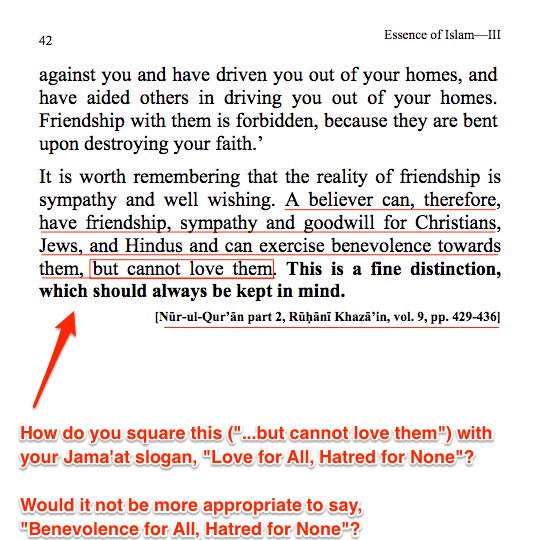
This essay was taken directly from here: http://reasononfaith.com/the-ahmadi-muslim-slogan-and-the-prohibition-on-love-for-non-believers/
This tweet from the Ahmadiyya Muslim run Voice of Islam (VOI) Radio caught my attention. This short post elaborates on some friendly twitter conversation on the subject.

My first tweet opening up this question was as follows:
An Ahmadi Muslim, Nabil Ahmad Mirza, was kind enough to give me a detailed and thoughtful response:
No one doubts that most religions have plentiful references to having sympathy for others, that we should feed the poor, etc. That’s not even at issue here. The issue is above the not loving them excerpt from Mirza Ghulam Ahmad’s own translated writing.
To start, I’d like to thank you for your detailed response, Nabil.
With respect to reading the context, I too, would encourage everyone to read the pages that lead up to this quotation. Even the previous paragraph is taking about people who drive you out of your homes. Obviously, no one is talking about friendship with these people. Several pages back we read of the two types of words that can be translated as love, and how it’s the all consuming, lose yourself in the attributes of another kind of love that is being withheld.
The next paragraph which begins with, “It is worth remembering that the reality of friendship is sympathy and well wishing,” is where the context shifts to talking about friendships more generally.
So we are talking about what kind of relationship can be had with friends who are Christians, Jews and Hindus who don’t wish upon us any harm. These people are worthy of at least our benevolence since they are not persecuting us, nor do they wish to.
I think any fair minded reader would see this context shift.
So the issue really comes down to the word translated as ‘love’ here.
You’ve made an excellent point about muhabbat vs. marhamah. This discussion is of course, also seen in the preceding pages of Mirza Ghulam Ahmad’s own writing from which the excerpt in question arises.
Urdu and Hindi readers will be familiar with muhabbat, as it’s often used in Indian movies and songs for romantic love. This however, still poses a problem with a Muslim man who is allowed to marry a Christian woman. Should he not be able to have that deeply romantic love for his own wife? According to Mirza Ghulam Ahmad, the answer appears to be no. That makes such marriages which are sanctioned by Islam, necessarily viewed as something which Islam deems to be merely contractual and devoid of true romantic depth, if the Muslim man is one who truly also loves Allah.
The bigger point remains however: marhamah has already been explained as what can be used for non-antagonistic non-Muslims in these pages and it is always described as compassion and benevolence.
So a more theologically consistent slogan would have been:
“Compassion and Benevolence for All, Hatred for None”.
Did not Mirza Nasir Ahmad read these same pages of his master, Mirza Ghulam Ahmad, when formulating the Ahmadi Muslim slogan?
Finally, the other big implication here is that no Muslim could ever look upon a kind hearted, righteous Christian of excellent character, as someone they could love–more than that lesser ‘love’ of compassion and sympathy.
It reflects the arrogance of a superiority complex prevalent with Muslims—that no Jew, Christian or Hindu is worthy of emulating or looking up to as a moral example—merely because they have a different theological label and practice.
It’s one thing to say that love of a deity is incomparable to how we can love other human beings—but setting up distinctions between human beings based on their religious labels also appears unnecessarily divisive. Are we really thinking about nuanced religious attributes when we talk of loving our sisters? If they convert from Islam to Christianity, are we going to change what we feel in our hearts from muhabbat to marhamah? If it was marhamah all along, because we’re speaking of our own sister, then the entire distinction made by Mirza Ghulam Ahmad on page 42 of Essence of Islam, Volume 3, was unnecessary:
A believer can, therefore, have friendship, sympathy and goodwill for Christians, Jews, and Hindus and can exercise benevolence towards them, but cannot love them.
In my estimation, the only reason for Mirza Ghulam Ahmad to bring up the topic of love is to double down on the love that the Qur’an itself withholds, and to find some way to explain it. It makes sense not to love those who persecute you (Qur’an 3:118). However, the Qur’an is conspicuously silent on even acknowledging that a fair minded Christian could even exist who is worthy of love. One who is moral, pious, and yet disagrees with and rejects Islamic truth claims from reasoned and sincere conviction.
Is it hard to imagine a wonderful, selfless Christian human being? Consider a Christian who demonstrates charity, kind speech, selflessness, honesty, concern for their parents, for orphans and for the elderly. None of this could ever possibly amount to anything worth a muhabbat kind of love? By this token, Muslim family members who don’t think deeply about the minutia of Islam aren’t worthy of a muhabbat kind of love either.
What’s the common fine distinction then to go from mere compassionate love to a deeply immersive kind of love? The minutia of Islamic theology.