Intro
The London Mosque fund was started in 1910 by a group of deviant pseudo Muslims like the Aga Khan. This same group of people began working at the Woking Mosque in 1913 with Khwaja Kamaluddin. By 1920 a well known British agent and fake Muslim named Khalid Sheldrake secretly funded this Qadiani-Ahmadi temple (aka The Fazl Mosque, London) (Art and culture website and a few others). However, the Qadiani-Ahmadi lied about this and alleged that Ahmadi women gave their jewelry.
Before the building of the Fazl Mosque, London, the Qadiani-Ahmadi’s were using various prayer hall areas on Melrose Ave. The March-1920 edition of the ROR reports the Ahmadiyya headquarters at: 4 Star St , Edgware Road, London, W.2. That all changed when the Khalifa visited in 1924. It’s a mystery as to how the Khalifa had so much money to purchase such an expensive property. The Fazl Mosque became the second mosque in all of the UK, the Lahori-Ahmadi’s were operating the Woking Mosque until the 1960’s. At the same time, the Khalifa was claiming to have enough money to build a temple in Berlin, Germany, which failed and caused all Ahmadi mullahs to leave the country, the Lahori-Ahmadi’s got theirs built however and it still stands. The Khalifa lied and claimed that the women of the Qadiani-Ahmadi community gave the money, which is impossible. By the end of 1924, the Khalifa and Maulvi Mubarak Ali and others returned to British-India.
It is also known as The London Mosque, is the first purpose-built mosque in London, England. It was opened on 23 October 1926 in Southfields, Wandsworth (See the ROR of Feb-1947). At a cost of £6,223, the construction of the mosque and the purchase of the land on which it stands. The ROR of December-1926 shows a photo of the architect, the contractor and a few ahmadi mullah’s, Mr. H. Roffey (the contractor) is pictured on the left, next to an ahmadi mullah, Maulvi G.P. Malik. On the right is Mr. J. Oliphant (the architect) and A.R. Dard, an ahmadi mullah. Thomas Mawson is said to be the designer. The ROR of October-1926 tells us that King Faisal was requested to conduct the opening ceremony, however, he was indisposed.
In 1935, Sir Hubert Stewart-Rankin, the 36-year-old leader President of the British Muslim Society has resigned. Sir Hubert Stweart-Rankin tried to get a resolution passed wherein Ahmadi’s would be barred from joining this organization. However, this resolution was shot down, since most of the executive committee and secretaries were Ahmadi. After the resolution was shot down, Sir Hubert walked out. Sir Hubert alleged that he would be starting a new organization. This seems to be referring to the Lahori-Ahmadi’s and their leader, Maulvi Muhammad Ali. Khalid Sheldrake is also mentioned, as well as his short lived, “Western Islamic Association”, of which Sheldrake is the President and Sir Hubert the Vice President. The newspaper alleges that there are roughly 10k Muslims in the UK, of which 90%+ are Indian sailors. The Aga Khan is trying to build a mosque at South Shields. The newspaper also acknowledges that there are 2 mosques in London in 1935, the Qadiani’s at Southfields and the Lahori-Ahmadi’s at the Woking.
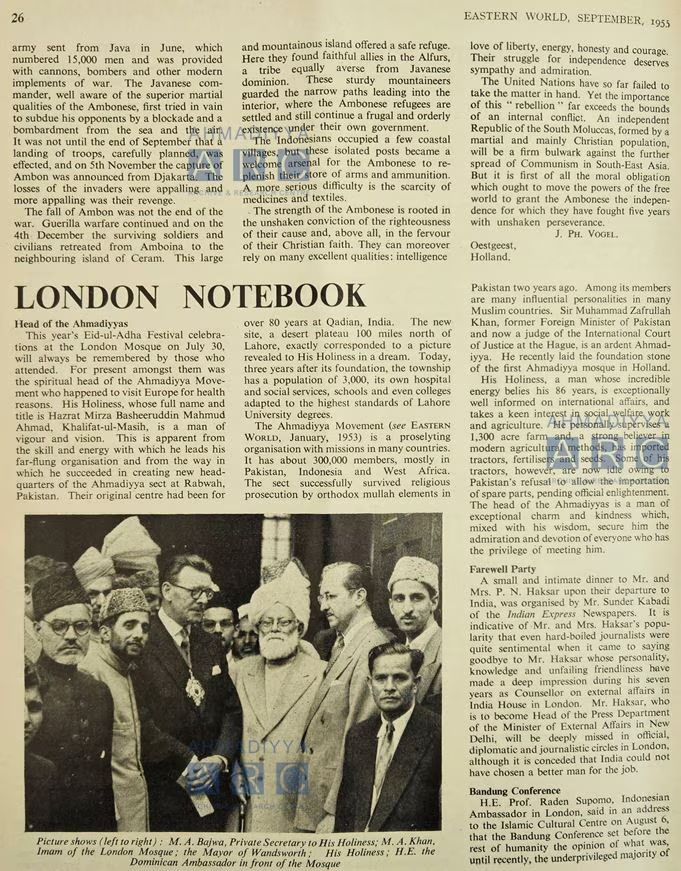
In 1955, the 2nd Qadiani-Ahmadi Khalifa visited London for the second time. He led the Eid-ul-Adha prayer at the Fazl Mosque, on 30 July 1955. This was the first-ever Eid at the Fazl Temple, led by a Khalifatul Masih and also the first-ever Eid-ul-Adha led in Europe by a Khalifatul Masih. The total attendance was around 500, including various non-Muslim dignitaries, such as a Soviet attaché Mr Ivan Skripov, ambassadors of Argentina, Chile, Haiti, and the Dominican Republic; and Shaw Desmond (1877-1960) – an Irish author, spiritualist, and founder of the International Institute of Psychical Research. Moreover, Ald E Whitlock conveyed the greetings of the Wandsworth Rotary Club as well. This speech was reproduced in the Muslim Sunrise of the 4th-Quarter-1955.
In 2026, Maulvi Raheel Ahmad was an episode of “This week with Hujoor”, Mirza Masroor Ahmad openly criticized Maulvi Raheel Ahmad and his management on the 100-year anniversary of the Fazl Mosque-temple in 2024. Mirza Masroor Ahmad said that some of the neighbors didn’t even know about the event, nor did they know about the history of the Fazl Mosque-temple.
______________________________________________________________________________________________
1920
https://x.com/ahmadiyya_arc/status/1847356990072508858?s=46&t=HTqZKquoOvKbgoBAF2aQcg
Ahmadiyya sources alleged, that in early 1920, announcements were made to collect funds for a mosque in London. The Ahmadi community in Qadian raised 12,000 rupees. Unlike others, we didn’t plead with the government for funds but came together ourselves. By August 1920, a piece of land and a building were bought for £2,223 (30,000 rupees) in Southfields, London. Today, we’re sharing a rare image of 63 Melrose Road, the mission house before and during the early years of the Fazl Mosque. The building no longer exists, but this photo captures (from right to left): Chaudhry Ali Muhammad, Abdur Raheem Dard, and Yaqub Ali Irfani in front of it.
Photo
 ______________________________________________________________________________________________
1923
The Moslem Sunrise of Apr. & July 1923 alleges Nayyar is back in London and getting medical treatment. He is working with brother Misbah ud Din and doing tabligh work.
The Moslem Sunrise of Oct-1923 alleges that Eid was held, a photo is given.
 _____________________________________________________________________________________________
1924
In 1924, the Ahmadiyya Khalifa traveled from India to England and stopped in Egypt, Damascus and why? – ahmadiyyafactcheckblog
On 19 October 1924, the 2nd Qadiani-Ahmadi Khalifa laid the cornerstone for London’s First Mosque—a moment that forever shaped the history of Islam in the UK.
Photo

______________________________________________________________________________________________
1925
1925 Eid: Historic Eid receptions at the London Mosque
https://www.alhakam.org/1925-eid-ul-fitr-london-fazl-mosque/
1925: First Eid since the Fazl Mosque’s foundation
The historic Eid-ul-Fitr of 1925 was covered by multiple periodicals of England, Canada and America, along with photographs. The Sunday Pictorial of 26 April 1925 wrote, “For the first time the ‘Happy Feast’ of Islam Eed-Ul-Fitr, was celebrated yesterday, on the chosen site for the first mosque in London, at Melrose-road, Southfields.”
The Evening Standard of 25 April 1925 reported under the heading “Cairo in London: Picturesque Scenes at Moslem Service” and The Daily Express of 27 April 1925 reported under the heading “Prayers in a Garden”.

Multiple American and Canadian newspapers reported on this Eid-ul-Fitr gathering, along with photographs. For instance, The Saskatoon Phoenix published a photograph on 21 May 1925 with the caption, “In Constantinople, commonplace, but in London, novel. Members of the Ahmadiyya Community at prayer on the grounds of the new London Mosque, during the recent celebrations of Eid.” St Louis Globe-Democrat of 24 May 1925, The Toronto Daily Star of 16 May 1925 and The Leader of 21 May 1925 also published photographs. The most detailed report was published by the South Western Star of London on 1 May 1925, under the heading “Islam at Southfields”.
Ten weeks later, the first Eid-ul-Adha was offered at the proposed Fazl Mosque’s premises in July 1925.

_____________________________________________________________________________________________
1926-Oct
The Western Daily Press, Bristol of Oct-4-1926
On Oct-1, King Faisal seems to have landed in the UK and was received by A.R. Dard.

The Western Daily Press, Bristol of Oct-4-1926 reports that the King of Saudia (Faisal bin Abdulaziz Al Saud) was supposed to open the Melrose Road mosque with Dr. A.R. Dard, even making the trip there but at the last minute he pulled out because he heard that it wasn’t a real Muslim mosque.
Scans


______________________________________________________________________________________________
1926–Oct
Via the Daily Chronicle
London’s voice from the minaret, Muezzins call at opening of Mosque
Too small to read.
Scan

_____________________________________________________________________________________________
1926–Nov, Review of Religions
Ahmadiyya sources lie and claim that 4 white people joined Ahmadiyya on 23 October 1926, the opening of the temple, their names are:
1—Mr. King
2—Mr. Nutall
3—Mrs. Amy Jordan
4—Mr. Cowap

_____________________________________________________________________________________________
1926-Dec, Review of Religions
The Sphere reports that the new Qadiani Mullah at London is Imam Dard (aka M. Rahim Bakhsh), and he is working at the Qadiani Fazl Mosque.
Scan


1925 Eid: Historic Eid receptions at the London Mosque
https://www.alhakam.org/1925-eid-ul-fitr-london-fazl-mosque/
1926-1927: Eid-ul-Fitr and Eid-ul-Adha

Reporting on the 1926 Eid-ul-Fitr, The Daily Mirror of 15 April 1926 published a photograph with the caption, “Moslems at their devotions in the grounds of the mosque at Southfields, near London, yesterday, when the Islamic festival of Eid-ul-Fitr was celebrated.” The Daily Herald of 15 April 1926 and Diario de la Marina of 23 May 1926 also published photographs.
______________________________________________________________________________________________1927
1925 Eid: Historic Eid receptions at the London Mosque
The 1925 Eid-ul-Fitr: Press reports of historic Eid receptions at the London Mosque (1925-1955)
Capturing a moment at the 1927 Eid-ul-Adha, The Sphere of London, dated 25 June 1927, published a photograph with the caption, “The Mecca of London: The embracing ceremony which ends the Moslem festival of Eid-ul-Azha, in which many Mohammedan Londoners took part. The Imam of the London Mosque Mr. A. R. Dard, is on the extreme right.” The Jewish Missionary Magazine gave news about this gathering by quoting an excerpt from The Palestine Weekly. The Evening Despatch of 11 June 1927 and South Western Star of 17 June 1927 also published a report.


______________________________________________________________________________________________
1928
The Daily Mirror of Jun-1-1928, it is reported how Imam Dard was with Lord Allenby (aka Field Marshall Viscount Allenby) at a Garden Party at the Fazl Mosque in London.
Scan

_____________________________________________________________________________________________
1928-1934
Khan sahib Maulvi Farzand Ali (Imam) – 1928 to 1934
1925 Eid: Historic Eid receptions at the London Mosque
The 1925 Eid-ul-Fitr: Press reports of historic Eid receptions at the London Mosque (1925-1955)
He left London on March 12th, 1933 for Qadian, he turned over the mission to A.R. Dard (See ROR of May-1933). He arrived back in Qadian on April 11th, 1933.

1925 Eid: Historic Eid receptions at the London Mosque
https://www.alhakam.org/1925-eid-ul-fitr-london-fazl-mosque/
1928: Viscount Allenby at the Eid-ul-Adha reception
On 31 May 1928, the Eid-ul-Adha reception was attended by various dignitaries including Viscount Allenby (1861-1936) – a senior British Army officer and Imperial Governor, and Sir E Denison Ross (1871-1940) – an orientalist and the first Director of the School of Oriental Studies (now SOAS) London. The Daily Mirror of 1 June 1928 published a photograph with the following caption:
“Field-Marshal Viscount Allenby and Viscountess Allenby arriving at the London Mahomedan Mosque at Southfields yesterday for a garden party, and welcomed by the Imam (priest), Mr. A. R. Dard.”

The Scotsman of 1 June 1928 reported under the heading “Moslem Festival in London: Lord Allenby Present” and The Palestine Bulletin of 25 June 1928 also published a detailed report. The Sunday Mercury of 3 June 1928 published an interesting story as it states, “A number of M.P.s and their wives attended a garden party at the London mosque one day this week in celebration of a Mohammedan festival, and the Imam or priest who received them surprised and even offended the ladies by refusing to shake hands with them though he did so with all the men visitors. Later he explained that it was against his religion to shake hands with women.”
______________________________________________________________________________________________
1929
1925 Eid: Historic Eid receptions at the London Mosque
The 1925 Eid-ul-Fitr: Press reports of historic Eid receptions at the London Mosque (1925-1955)
We have posted a photo of Maulvi Farzand Ali from the January 1929 edition of the ROR. His title is the Imam of the London Mosque.

1929


1925 Eid: Historic Eid receptions at the London Mosque
The 1925 Eid-ul-Fitr: Press reports of historic Eid receptions at the London Mosque (1925-1955)
1929: Sarojini Naidu and Maharajah of Burdwan at the Eid-ul-Adha reception

On 20 May 1929, the Eid-ul-Adha reception was attended by the Maharajah of Burdwan – Sir Bijay Chand Mahtab (1881-1941), and Sarojini Naidu (1879-1949) – an Indian political activist who served as the first Governor of United Provinces, after India’s independence.
A French newspaper, L’Homme Libre of 21 May 1929 reported under the heading “A Muslim Festival at the London Mosque” and stated that with the Maharajah of Burdwan presiding over the reception, both Muslims and Hindus will take advantage of this example to put an end to the sectarian conflicts that lie at the root of almost all the unrest occurring in British India.
The South Western Star of 24 May 1929 declared “the presence of these prominent Hindus at a Moslem festival in London” a “unique” event.
According to The Norwood News of 17 May 1929, an invitation was sent to the Balham Rotary Club as well. The Evening News of 20 May 1929 gave details of this reception.
______________________________________________________________________________________________1930
1925 Eid: Historic Eid receptions at the London Mosque
https://www.alhakam.org/1925-eid-ul-fitr-london-fazl-mosque/
1930: Sir Francis Younghusband presides the Eid reception

The 1930 Eid-ul-Adha reception was attended by various dignitaries, including Sir Francis Younghusband (1863-1942) – a well-known orientalist of the 20th century.
The Christchurch Star of 28 June 1930 published a photograph with the caption, “The Moslem Festival of Id-ul-Azha was carried out with customary ritual at the London Mosque at Southfields on May 9. Here are some faithful at prayer. They include a number of white women.”
The Labor Daily of Australia published the same photograph on 21 June 1930. The Civil and Military Gazette of 12 May 1930 reported under the heading “Id-uz-Zuha in London: Sir F. Young Husband at Wandsworth Mosque”. The Palestine Bulletin of 12 May 1930 also published a report.


 ______________________________________________________________________________________________
1932
1925 Eid: Historic Eid receptions at the London Mosque
https://www.alhakam.org/1925-eid-ul-fitr-london-fazl-mosque/
1932: Eid-ul-Fitr
Mentioning the Eid-ul-Fitr in 1932, The Daily Telegraph of 17 March 1932 published a photograph with the following caption:
“Shoes lined up outside the Southfields Mohammedan Mosque, London, told that the faithful had entered to celebrate the feast of Eid-El-Fitr.”
______________________________________________________________________________________________
1933
1925 Eid: Historic Eid receptions at the London Mosque
The 1925 Eid-ul-Fitr: Press reports of historic Eid receptions at the London Mosque (1925-1955)
In 1933 (See ROR of May-1933), Maulana Dard was again appointed to England for a second term as Imam of The London Mosque. He is mentioned in the ROR of May-1933 as doing religious work in London. (he officially took over the London mission on March-12, 1933 from Maulvi Farzand Ali, see ROR of May-1933).
Maulana Abdur Raheem Dard is also mentioned in the ROR of Aug-1933. Maulvi Muhammad Yar Arif (Secretary and assistant imam of the London mosque wrote a report on Ahmadiyya in London on July 20th, 1933, this report was published in the ROR of Sep-1933. He mentioned how Dard gave a speech to many visitors, how Zafrullah Khan was there. Zafrullah Khan had been in England for about 3 months, (June, July, August) and would be travelling to Canada on behalf of the British Government and then to the USA.
Dard‘s report of missionary activity is published in the ROR of Nov-1933. He claims to have given a lecture at the Dorking Rotary Club. He talked about MGA’s prophecies like Dowie, Lekh Ram, the Great European War (doomsday earthquake), the destruction of the Czar dynasty (Russia). He also mentioned how Ahmadi’s are persecuted and killed in Afghanistan, Maulvi Abdul Latif and a few others. Dard also claims that M.M. Ahmad (B.A.) had recently came to London.
The ROR of Dec-1933 has a report of missionary work by Maulvi Muhammad Yar Arif (assistant imam of the London mosque) dated Oct-26-1933. He reports that Maulana Abdur Raheem Dard gave the Friday sermon. He then alleges that a Mr. and Mrs. Kween have accepted Ahmadiyya.
He also alleges that a South African man named Dr. Sullaiman’s (who was allegedly one of the most sincere Ahmadi’s of England) brother-in-law had converted to Ahmadiyya. He reports how Zafrullah Khan was in England and helping the Ahmadiyya mission. Maulvi Muhammad Yar Arif claims to have went to Hyde park and did some preaching.
Jinnah announced his plan to return to politics from an Ahmadi mosque in the UK
As we all know, Ahmadis were heavily involved in politics since at least 1889. Before that, MGA was favored in British-India, they dropped charged on MGA many times and always offered him a chair when he came to their court. here is a famous incident from the late 1890’s wherein MGA’s biggest critic and old friend wasn’t given a chair…whereas MGA was. It’s obvious, that Ahmadis were always favored by the British and used to shape the politics of the sub-continent.
Sir Muhammad Zafrulla Khan (1978). Ahmadiyyat: the renaissance of Islam. Tabshir Publications. pp. 242–. He, therefore, directed Mr A. R. Dard, Imam of the London Mosque, to get in touch with Mr Jinnah and try to persuade … of 9 April 1933: There was a large gathering in the grounds of the mosque in Melrose Road, Wimbledon, where Mr Jinnah, ..
The Sunday Times of London reported:
“There was also a large gathering in the grounds of the little mosque in Melrose Road, Wimbledon, where Mr Jinnah, the famous Indian Moslem, spoke on India’s future. The chair was taken by Sir Nairne Stewart Sandeman, MP, and there were quite a number of other non-Moslems present.
“Mr Jinnah made unfavourable comments on the Indian ‘White Paper’ and the ‘safeguards’ from a national point of view. The chairman, in reply, took up the Churchill attitude on the subject, and this led to heckling by some of the Muslim students present, who were, however, eventually calmed by the Imam of the Mosque.” (Sunday Times, 9 April 1933)

Sunday Times, 9 April 1933
During his speech, Jinnah said:
“The eloquent persuasion of the Imam left me no escape.” (Encyclopaedia Quaid-e-Azam, p. 780, Zahid Hussain Anjum)
Elaborating on this, the Pakistan Times stated:
“It was Mr. Liaquat Ali Khan and Maulana Abdur Rahim Dard[ra], an Imam of London Mosque, who persuaded Mr. M. A. Jinnah to change his mind and return home to play his role in the national politics. Consequently, Mr. Jinnah returned to India in 1934 and was elected to the Central Assembly, un-opposed.” (Pakistan Times, 11 September 1981, Quaid-I-Azam Anniversary Supplement, p. 11, col. 1)

1925 Eid: Historic Eid receptions at the London Mosque
https://www.alhakam.org/1925-eid-ul-fitr-london-fazl-mosque/
1933: Jinnah at the Eid-ul-Adha reception

In April 1933, the Eid-ul-Adha reception was attended by various dignitaries including Muhammad Ali Jinnah (1876-1948), who was later known as the Founder of Pakistan.
The Daily Mirror of 7 April 1933 published a photograph of this gathering with the following caption:
“At London’s Mosque.–Moslem worshippers at prayer at the Woking [sic., Fazl] Mosque yesterday during the festival of Eid-ul-Azha, commemorating Abraham’s great sacrifice.”
During this reception, Jinnah delivered a speech on the future of India which attracted many newspapers of the British and Indian press, including The Statesman, Madras Mail, Hindu, Sunday Times, etc.
It is believed that it was after this reception that he decided to return to Indian politics and continue his strive for Muslim rights and later the formation of Pakistan.
_____________________________________________________________________________________________
1934
1925 Eid: Historic Eid receptions at the London Mosque
https://www.alhakam.org/1925-eid-ul-fitr-london-fazl-mosque/
1934: British MP presides the Eid-ul-Adha reception

Reporting on the 1934 Eid-ul-Fitr, The Western Mail of 22 February 1934 published a photograph with the following caption:
“Towards Mecca: Muslims at prayer inside the London Mosque, Southfields, during the celebration of a festival by the Muslim Society of Great Britain.”
On 27 March 1934, the Eid-ul-Adha reception was presided over by the Earl Winterton, P.C., M.P. The Eastern Post and City Chronicle of 10 March 1934 announced, “The Earl Winterton, P.C., M.P., will preside at the London Mosque on Tuesday, March 27th, on the occasion of the Moslim festival of ‘Id-ul-Azha, when Sir John Wardlaw-Milne, M.P., K.B.E., will speak on ‘British Empire and Islam.’”
The Evening Standard published an article on 28 March 1934, stating, “A friend of mine attended the celebration of the ‘Feast of Sacrifice’ at the London Mosque yesterday.” The Palestine Post also published a report in its 9 April 1934 issue.
______________________________________________________________________________________________
1935
July-12
Ahmadi sources allege that in July of 1935, King Faisal Crown Prince Faisal Bin Abdul Aziz visited the Qadiani Fazl Mosque in London, he is seen seated here with his colleague and Qadiani-Ahmadi missionary Jalal ud Din Shams giving a speech. However, Jalal ud Din Shams was reportedly in Qadian and soon to leave)(ROR of Oct-1935). Thus the timeline seems dubious. In the 2nd photo, King Faisal Crown Prince Faisal Bin Abdul Aziz is in front of the Al-Fazl Mosque with his entourage and Jalal ud Din Shams is also spotted. It could be Maulana Abdur Rahim Dard (who was the Imam in London in 1935).
The 3rd photo (seems to be from the 1950’s) you can see Hafiz Qudratullah, (Qadiani missionary in Holland) and Zafrullah Khan in what looks like the 1950’s, they are giving something (Ahmadiyya literature) to Prince Fahd Al-Faisal.
Scans


_____________________________________________________________________________________________
1935
1925 Eid: Historic Eid receptions at the London Mosque
The 1925 Eid-ul-Fitr: Press reports of historic Eid receptions at the London Mosque (1925-1955)
1935: High Commissioner for India presides over the Eid-ul-Adha reception

On 17 March 1935, Eid-ul-Adha reception was attended by various dignitaries, including Sir Francis Younghusband and presided over by the High Commissioner for India. Reporting on this, the South Western Star of 22 March 1935 wrote under the heading “Muslims at Southfields: A Great Festival”:
“The High Commissioner for India, who was in the chair, introduced Sir Francis Younghusband as a great explorer and one of the sincerest advocates of a better understanding between East and West. There was, he said, nothing more hopeful than the prevalence of religious tolerance. Religion might still be a stumbling block in politics, but no-one now believes it can be promulgated by violence.”
Towards the end, it wrote:
“The London Mosque has been founded and endowed by the Ahmadiyya Movement, the founder of which, Prophet Ahmad of Qadian (India) has been the most energetic and spiritual figure in the history of Islam since Mohammad. The foundation stone of the mosque was laid in 1924 by the Commander of the Faithful, the present head of the community, and the mosque was formally opened in 1926.”
_____________________________________________________________________________________________1935
Evening Post of Thu, Dec 12, 1935 ·Page 10
https://ahmadiyyafactcheckblog.com/2024/07/28/who-is-maulvi-muhammad-ali-in-the-history-of-ahmadiyya/
In 1935, Sir Hubert Stewart-Rankin, the 36-year-old leader President of the British Muslim Society has resigned. Sir Hubert Stweart-Rankin tried to get a resolution passed wherein Ahmadi’s would be barred from joining this organization. However, this resolution was shot down, since most of the executive committee and secretaries were Ahmadi. After the resolution was shot down, Sir Hubert walked out. Sir Hubert alleged that he would be starting a new organization. This seems to be referring to the Lahori-Ahmadi’s and their leader, Maulvi Muhammad Ali. Khalid Sheldrake is also mentioned, as well as his short lived, “Western Islamic Association”, of which Sheldrake is the President and Sir Hubert the Vice President. The newspaper alleges that there are roughly 10k Muslims in the UK, of which 90%+ are Indian sailors. The Aga Khan is trying to build a mosque at South Shields. The newspaper also acknowledges that there are 2 mosques in London in 1935, the Qadiani’s at Southfields and the Lahori-Ahmadi’s at the Woking.
 ______________________________________________________________________________________________
1936
The Daily Herald of Sep-22-1936
The Daily Herald of Sep-22-1936 reports that A.R. Dard is working out of London and alleges that 200-300 white people have converted to Qadianism. A convert is mentioned, Miss Sakeena (previously known as Ella Banks), the newspaper alleges that her mother, father and 2 younger sisters also joined the Qadiani’s. The entire family disappeared from the history of Ahmadiyya soon thereafter.
1925 Eid: Historic Eid receptions at the London Mosque
https://www.alhakam.org/1925-eid-ul-fitr-london-fazl-mosque/
1936: Lord Lloyd and LS Amery meets Hazrat Mirza Nasir Ahmadrh at Eid reception

In 1936, an Eid-ul-Adha reception was held which was attended by LS Amery (1873-1955), the then-member of the British Parliament who later served as the Secretary of State for India and Burma in the 1940s. The dignitaries also included George Ambrose Lloyd (1879-1941), a British Conservative politician and colonial administrator.
The South Western Star of 13 March 1936 published a detailed report along with a photograph with the following caption:
“Lord Lloyd (left) and Lieut.-Col. Amery (right) at tea with Imam Maulvi A. R. Dard at the London Mosque, Southfields, on Sunday.”
The report was titled “A Festival at the Mosque: Big Gathering at Southfields” and stated:
“In the afternoon a reception was held in a large marquee in the grounds of the mosque. […] The company, numbering about 200, were received by the Imam, who was assisted by Mr. Ahmad [Hazrat Mirza Nasir Ahmadrh], [grand]son of his Holiness the founder of the community. This young gentleman is an under-graduate of Balliol College, Oxford. Having qualified in theological and oriental subjects he intends to take modern greats at the premier English university. Both Lord Lloyd and Mr. Amery greeted him with great cordiality.”
The Daily Telegraph of 9 March 1936, The Morning Post of 9 March 1936, The Times of 10 March 1936 and Edinburgh Evening News of 14 March 1936 also reported.
_____________________________________________________________________________________________
1937
1925 Eid: Historic Eid receptions at the London Mosque
https://www.alhakam.org/1925-eid-ul-fitr-london-fazl-mosque/
1937: Secretary of State for India at the Eid-ul-Adha reception

On 22 February 1937, an Eid-ul-Adha reception was presided over by Lord Zetland (1876-1961), the then Secretary of State for India.
The Yorkshire Post of 23 February 1937 reported under the heading “Great Experiment in India: Lord Zetland’s Tribute to Moslems”:
“Because both rested on a democratic basis, Britain had much in common with the Islam world, said Lord Zetland, Secretary of State for India, at the London Mosque, Southfields, last night.
“In the great experiment in constitutional government which was being carried out in India the Moslem community was being given the opportunity of playing a great part in the future government of the country, he said. He paid tribute to the contribution which Islam has made to the culture of the world.”
The South Western Star of 26 February 1937 reported under the heading “The London Mosque: Festival at Southfields”.
______________________________________________________________________________________________
1938
1925 Eid: Historic Eid receptions at the London Mosque
The 1925 Eid-ul-Fitr: Press reports of historic Eid receptions at the London Mosque (1925-1955)
1938: Eid-ul-Fitr

In 1938, reporting on the Eid-ul-Fitr reception, the South Western Star of 2 December 1938 published a photograph with the following caption:
“Muslims grouped outside the Mosque. Among those in the picture are the Imam (Maulvi J. D. Shams), Prof. M. A. Butt, Dr. Sulaiman and Dr. Omar, of South Africa, Mr. Sayce, brother-in-law of a Muslim Nawab in India), Sirdar Iqbal Ali Shah (a well known writer), Chaudari M. Naqi (Son of the Financial minister of the Maharajah of Jodhpur), and Messrs Ahmadullah, W. Booth, Salam, Bilal Nuttall, Gregory, W. Nivashauda, and A. Aziz. All ladies except three are Muslims.”
The article stated:
“The Muslim festival of Eid ul Fitr was celebrated at the London Mosque, Southfields, on Thursday. This festival marks the end of Ramadan, the Muslim month of abstinence. Nearly 100 people were present, including Professor M. Butt, of Aligarh University, Mr. W. Nivashauda, of Siam, and Mr. W. Booth, vice-chairman of Putney Literary Debating Society, and a number of English Muslims. Prayers were led by the Imam (Maulvi J. D. Shams). The former Imam (the Rev. A. R. Dard) left for India a month ago.”
______________________________________________________________________________________________
1939
Even in 1938-1939, the British Government had the #Qadianis representing Muslims – ahmadiyyafactcheckblog
1925 Eid: Historic Eid receptions at the London Mosque
https://www.alhakam.org/1925-eid-ul-fitr-london-fazl-mosque/
On 31 January 1939, Eid-ul-Adha was celebrated at the Fazl Mosque in London. On this occasion, a reception was held at the Fazl Mosque which was attended by various dignitaries. The then Imam of the Fazl Mosque, Maulana Jalal-ud-Din Shams expressed his concerns over the deteriorating situation in Palestine and called the British Government’s attention towards making efforts for peace in Palestine. He also praised the efforts of the British Prime Minister towards the peace of Europe. He mentioned a telegram from Musleh-e-Maud (The 2nd Qadiani Khalifa) as well, which was sent to the British Prime Minister, appreciating his peace efforts amidst the conflict between major powers of Europe.
On 7 February 1939, the Conference on the Palestine issue began in London. The Birmingham Mail reported under the heading “Palestine Talks”. On 11 March 1939, Maulana Jalal-ud-Din Shams invited the Viceroy of Mecca and representatives of Palestine, Iraq and Yemen — who were in London for the Palestine Conference — to a reception at the Fazl Mosque in which 200 guests participated in total, including various dignitaries.
Mirza Bashir-ud-Din Mahmud Ahmad, sent a special message to the Arab delegates through a telegram. The message was read out in both English and Arabic by Hazrat Maulana Jalal-ud-Din Shams.
1925 Eid: Historic Eid receptions at the London Mosque
https://www.alhakam.org/1925-eid-ul-fitr-london-fazl-mosque/
1939: Eid-ul-Fitr and Eid-ul-Adha

On 31 January 1939, Eid-ul-Adha reception was attended by various dignitaries. The South Western Star of 3 February 1939 wrote under the heading “Muslim Festival: A Meeting at Southfields Mosque”:
“Among the large number of people present, including Muslims, Christians, Hindus, and men and women from many nations, were Sir Telford Waugh, Sir Findlater Stewart, Major-General J. H. Beith, Sir Arthur Wauchope (former High Commissioner for Palestine), Countess Carlisle, the Rev. S. Hopkinson, the Rev. Mr. Stevenson, Dr. and Miss Hatherby, and Capt. Ataullah, I.M.S. Members of the delegation from Saudi Arabia had accepted invitations to be present, but could not attend because arrangements were being made for the talks on Palestine.”
On 13 November 1939, Eid-ul-Fitr was offered at the Fazl Mosque and the same newspaper, on 17 November 1939, reported it under the heading “Muslims at Southfields: A Festival Gathering”.
_____________________________________________________________________________________________
1940-1947
1925 Eid: Historic Eid receptions at the London Mosque
https://www.alhakam.org/1925-eid-ul-fitr-london-fazl-mosque/
1940-1947: Various Eid gatherings at the Fazl Mosque

The Eid gatherings during the years 1940-1947 also caught considerable attention from the British press. Most prominent news reports were published by the South Western Star. For instance, the 1940 Eid-ul-Fitr was reported on 8 November 1940, under the heading “Muslim Celebration at Southfields: Festival of Eid ul Fitr”; the 1941 Eid-ul-Fitr was reported on 24 October 1941, under the heading “The London Mosque: Eid-ul-Fitr Celebrations”; the 1944 Eid-ul-Fitr was reported on 22 September 1944, under the heading “Islamic Festival in Southfields Mosque”; the 1944 Eid-ul-Adha was reported on 1 December 1944, under the heading “The Festival of Sacrifices: Celebration at the London Mosque” and the 1945 Eid-ul-Fitr was reported on 14 September 1945, under the heading “Muslim Festival at London Mosque Southfields”.
On the occasion of Eid-ul-Adha in 1945, Hazrat Maulana Jalal-ud-Din Shamsra spoke about the Palestine conflict and advised the British Government that “in making its decision, the Government should not however, overlook the fact that the inhabitants of Palestine had the right to rule themselves.” (Leicester Evening Mail, 17 November 1945, p. 5).

A French newspaper, France-soir of 4 September 1946, reported on the 1946 Eid-ul-Fitr and published a photograph. The South Western Star reported it on 6 September 1946, under the heading “Muslim Festival Gathering”.
The 1947 Eid-ul-Fitr reception was attended by various dignitaries, including a representative of the Mayor of Wandsworth. (South Western Star, 22 August 1947, p. 4).
______________________________________________________________________________________________
1947
The ROR of Feb-1947 mentions the origins of the Fazal Mosque and how the 2nd Khalifa travelled to London and laid the foundation stone in 1924.
_____________________________________________________________________________________________
1948
Ahmadiyya Archive & Research on X: “🌍 A Historic Eid-ul-Adha Reception at the Fazl Mosque! 🕌✨ On 14 October 1948, the Fazl Mosque in London hosted a remarkable Eid-ul-Adha reception, attended by African dignitaries who were in England for an African Conference. 🤝🌍 Covered by European Media: A Belgian https://t.co/yNnCS6lLAy” / X (twitter.com)
On 14 October 1948, the Fazl Mosque in London hosted a remarkable Eid-ul-Adha reception, attended by African dignitaries who were in England for an African Conference. Covered by European Media: A Belgian periodical, Le Soir illustré, published a photograph of the event with the caption: “Presence of the Orient, in London—Maulvi Mohd. Siddique, representing the colony of Sierra Leone (right), and the Emir of Abuja […] at the London Mosque, during the Eid-ul-Adha festival.” This rare coverage highlights the global significance of the Ahmadiyya Muslim Community’s role in fostering unity and dialogue.

1925 Eid: Historic Eid receptions at the London Mosque
The 1925 Eid-ul-Fitr: Press reports of historic Eid receptions at the London Mosque (1925-1955)
1948: Delegates of the African Conference at the Eid reception
On 14 October 1948, Eid-ul-Adha was offered at the Fazl Mosque. In those days, an African Conference was taking place in England, hence, the African dignitaries attended an Eid reception at the Fazl Mosque.
Le Soir illustré of Belgium published a photograph capturing guests who had gathered for the reception, with the following caption:
“Presence of the Orient, in London – Maulvi Mohd. Siddique, representing the colony of Sierra Leone in the English capital (right), and the Emir of Abuja […] at the London Mosque, during the Eid-ul-Adha festival.” (Le Soir illustré, 21 October 1948)

In the above-mentioned photograph, the 6th Amir of Abuja, Suleimanu Barau (1903-1979), is having a discussion with Maulvi Muhammad Siddique Sahib Amritsari.
L’Indépendance of Belgium – in its 1 December 1948 issue – published another photograph of the same event. The same photograph was published by Greymouth Evening Star of New Zealand on 8 November 1948 as well.
_____________________________________________________________________________________________
1949-1954
1925 Eid: Historic Eid receptions at the London Mosque
The 1925 Eid-ul-Fitr: Press reports of historic Eid receptions at the London Mosque (1925-1955)
1949-1954: Various Eid gatherings at the Fazl Mosque

Reporting the 1949 Eid-ul-Fitr reception, the South Western Star published a photograph on 5 August 1949, with the caption, “Curry during the heat-wave did not bother Ald. G. T. Rowe, pictured here facing the camera, during the Muslim festival of Eid-ul-Fitr at which he was a guest, at the LondonMosque, Southfields, last week.”
The Civil and Military Gazette of 15 August 1949 published an article under the heading “Id Celebration at Putney Mosque”.
Reporting on the 1950 Eid-ul-Fitr reception, the South Western Star of 21 July 1950 wrote, “The present Imam, Mr. M. A. Bajwa, who has been in this country for five years, is returning to Pakistan and among those who paid tribute to his work in this country was Mr. Hugh Linstead, local Member of Parliament. The Mayor of Wandsworth, Cllr. R. W. K. Edgley, was also present.”
Reporting on the 1950 Eid-ul-Adha, the South Western Star of 29 September 1950 wrote:
“The Muslim Festival of Eid-ul-Adha (the Festival of Sacrifice), was celebrated at the London Mosque, Southfields,” and “after luncheon a meeting was held in which representatives of five different religions, including Mr. Shaw Desmond, the famous writer, paid tribute to the noble character of the Holy Prophet Muhammad.”
Reporting on the Eid-ul-Adha of 1952, The Manchester Guardian of 1 September 1952 wrote under the heading “At the London Mosque”:
“For Moslems everywhere this has been the day of Eid-ul-Adha – the celebration of the sacrifice by Abraham of his son Ishmael. It is a day for them to pray together and to eat together, and this some two hundred did at the London mosque in Wandsworth. Cream painted, with a dome of streaky turquoise, the mosque is a rare shell thrown up from the East on a beach of English terraced houses. Turks and Africans, Egyptians and Indians, and Pakistanis and English crowded into it this morning – guests on chairs to the rear, Moslem men on the floor across the front, and Moslem women, chairless also, hidden from the rest of the congregation by sheets pinned to a wire by clothes pegs.”

An Australian newspaper published a photograph captured during the Eid-ul-Adha prayer at the Fazl Mosque, with the following caption:
“Members of the Muslim Faith filled the London Mosque at Putney for the celebration of the Muslim Festival of Eid-ul-Adha. All footwear is removed before the congregation enter the mosque for the celebrations.” (The Morning Bulletin, 28 August 1954, p. 1)
______________________________________________________________________________________________
1955
1925 Eid: Historic Eid receptions at the London Mosque
https://www.alhakam.org/1925-eid-ul-fitr-london-fazl-mosque/
1955: First-ever Eid led at the Fazl Mosque by a Khalifatul Masih
During his visit to Europe in 1955, Hazrat Musleh-e-Maudra led the Eid-ul-Adha prayer at the Fazl Mosque, on 30 July 1955. This was the first-ever Eid at the Fazl Mosque, led by a Khalifatul Masih and also the first-ever Eid-ul-Adha led in Europe by a Khalifatul Masih.
The total attendance was around 500, including various non-Muslim dignitaries, such as a Soviet attaché Mr Ivan Skripov, ambassadors of Argentina, Chile, Haiti, and the Dominican Republic; and Shaw Desmond (1877-1960) – an Irish author, spiritualist, and founder of the International Institute of Psychical Research. Moreover, Ald E Whitlock conveyed the greetings of the Wandsworth Rotary Club as well.

On 23 July 1955, The Civil and Military Gazette announced under the heading, “Id-ul-Azha in London”:
“At the London Mosque, Mirza Bashiruddin Mahmud Ahmad, head of the Ahmadiyya community, will lead the prayers.”
The Evening Standard of 30 July 1955 published a report under the heading “A Moslem Occasion”. The South Western Star of 5 August 1955 reported under the heading “Middle East in SW18”:
“Deep in the heart of the Southfields suburban scene rises the dazzling white dome of the London Mosque. […]
“Last Saturday,” scores of “fezzed and turbaned men walked through quiet suburban streets on their way to celebrate the festival of Eid-ul-Adha commemorating the offer of Abraham to sacrifice his son as commanded by God.
“Inside the Mosque, which was completely devoid of all decoration and painted a cool green, Hazrat Khalifatul Masih II[ra] who is visiting England from Pakistan, preached the sermon. A venerable white-bearded figure, he wore a white turban with his beige tunic and trousers. His talk, a simple little homily on the virtues of giving up luxury, was relayed to the garden, where a score of Muslims knelt on prayer mats with their faces turned towards Mecca.
“Then, putting on their shoes, which they had abandoned before entering the Mosque, the worshippers filed into a huge marquee for the traditional feast of lamb stew and rice. […]
“Non-Muslim visitors included a Soviet attaché, Mr Ivan Skripov, the Ambassadors of Argentina and the Dominican Republic, and Irish author Shaw Desmond. Greetings of the Wandsworth Rotary Club were conveyed by Ald E. Whitlock.”

The Eastern World of September 1955 also gave a detailed report along with a photograph of Hazrat Musleh-e-Maudra.
 Eastern World, September 1955
_____________________________________________________________________________________________
1976
The Muslim Sunrise of July-1976 was edited/published by Mian Muhammad Ibrahim (a Qadiani-Ahmadi Maulvi) and from Dayton, Ohio. Imam M.S. Shahid (Missionary-in-Charge, USA) is the consulting editor and Dr. Khalil Ahmad Nasir is the contributing editor. The arrival of Mirza Nasir Ahmad is announced, he seems to have already arrived (he landed on July-20-1976) before the publishing of this edition. It is claimed that there are 10 million Ahmadi’s in the world. It is alleged that the attendance at the 1975 Jalsa Salana at Rabwah was the highest ever. Imam M.S. Shahid (Missionary-in-Charge, USA) has an essay. The Ahmadiyya Movement alleges to have 10 million members worldwide and alleges to be an International Organization. They allege to be operating in Ghana, the Gambia, Ivory Coast, Kenya, Liberia, Mauritius, Nigeria, Sierra Leone, South Africa, Tanzania, Uganda, Zambia, Canada, Guyana, Trinidad, the USA, Fiji, India, Indonesia, Japan, Philippines, Singapore, Sri Lanka, Syria, Denmark, Germany, Great Britain, Holland, Spain, Sweden, Switzerland, Yemen, Argentina, Australia, Burma, Bukhara (Uzbekistan), Egypt, Borneo (Brunei?), France, Gulf states (maybe Qatar or the U.A.E.), Hong Kong (China), Iran, Italy, Thailand, Lebanon, Muscat (Oman), Yugoslavia, Iraq, Turkey and Malaysia. It is alleged that in the USA there are 26 jamaats, 300 mosques in Ghana and over 100 mosques in Indonesia. A new mosque in Sweden is mentioned, the Fazl mosque in London is declared as the oldest mosque in Europe (a lie, the Woking is the oldest), 1 mosque in Holland (Netherlands) and 1 mosque in Switzerland, and 2 in West Germany (Frankfurt and Hamburg). The Ahmadiyya Movement then shows its 5 temple-mosques in the USA, St. Louis, Baltimore, Washington D.C., Ny and Dayton. The Dowie prophecy is mentioned. Dr. Khalil Ahmad Nasir has an essay on world peace. There is also a photo of all of the Jamaat Presidents from Feb-1976. A list of 27 jamaats in the USA are mentioned, my uncle Sharif Ahmad Shah is mentioned at 2001 Newton Way, Concord, Ca 94518, 415-687-0133.
_____________________________________________________________________________________________
1984
In 1984, Mirza Tahir Ahmad said that Nabiyeena in 4:69 only promises the like-of-prophets – ahmadiyyafactcheckblog
On Aug-12-1984, Mirza Tahir Ahmad held a Question/Answer session at the Fazl Mosque in London. The Ahmadi questioner said that Allah revealed that prophets would come. Mirza Tahir Ahmad immediately said NO! At 1:28, Mirza Tahir Ahmad says that MGA claimed to be that prophet who was predicted by Muhammad (Saw) and addressed as Nabi by Muhammad (saw). On the same day, Mirza Tahir Ahmad argued that NO ONE says that NO prophet can come, and a prophet in the fashion of Muhammad (Saw) can also come.
At 1:53, Mirza Tahir Ahmad says that if anyone repeats the claim of MGA, it would be their duty to prove where Muhammad (Saw) has referred to another one and gave this other one as a “prophet”.
Mirza Tahir Ahmad eventually discussed 4:69 (4:70 in the Kadiani Koran) and alleged that the verse says “nabiyeen”, which doesn’t mean plural would come, it’s a way of expression, instead, they would become the “the like of prophets”.
At 2:16, the questioner specifically quotes 4:69 (4:70 in the Kadiani Koran) and asks about its implications in this entire discussion. The questioner specifically asked about the phrase “nabiyeen” and inferred that this means additional prophets in the future. Mirza Tahir Ahmad immediately shook his head and answered “No it doesn’t, it doesn’t at all”. Mirza Tahir Ahmad says that the verse says “nabiyeen” doesn’t mean plural would come, it’s a way of expression, it’s a language, first you need to understand the language of Arabic to understand this word (“nabiyeen”). Mirza Tahir Ahmad says, “Minan Nabiyeena” means from among the prophets, and it refers to the previous prophets, because it is they that are mentioned, you must first understand the text of this verse, only then, the confusion in your mind will be removed.
At 3:45, Mirza Tahir Ahmad says that the possibility is open that if “whoever” obey’s Allah and follows his prophet (Muhammad, saw), would be counted among those, who appeared before them, who would be treated like those, we can also translate it like this, who appeared before them and who were well rewarded by Allah, such as “Minan Nabiyeena”. The plural here refers to the prophets of the past and the promise says that you could also reach the status, which was given to the prophets of the earlier ages. The number who would attain that status is not mentioned.
At 5:08, Mirza Tahir Ahmad argued that in response to Muslims that argue that there should be many new prophets in Ahmadiyya, since “Minan Nabiyeena” means in the plural sense. Mirza Tahir Ahmad says that he counters this by arguing that there is only one Siddiq in the entire ummah, that is Hadhrat Abu Bakr Siddiq. Mirza Tahir Ahmad gives additional arguments.
At 6:07, Mirza Tahir Ahmad says that they would be counted amongst them (nabiyeena, siddiqeena, and etc).
At 6:43, Mirza Tahir Ahmad argues that 4:69 (4:70 in the Kadiani Koran) doesn’t mean that “nabiyeen would come”, and he tells the questioner: “this is where you are wrong”. Mirza Tahir Ahmad alleges that this verse means that “Nabi’s are those who were rewarded before them. Siddiqun are those who were rewarded before them, Saliheen and Shahideen. Mirza Tahir Ahmad then concludes and says that the entire verse is an explanation of “Who were those, who were rewarded before them” (7:04).
At 7:08, the questioner tells Mirza Tahir Ahmad that thank you and since 1953, and he mentioned his father and their struggle vs. Muslims in that era and how his father pointed out this verse to him as a good argument. He says that he has been arguing to Muslims that in 4:69 (4:70 in the Kadiani Koran) since siddiq is plural, nabiyeen is also plural and thanks for clarification. This guy admitted to be making mistakes while doing debate vs. Muslims and not understanding the Ahmadiyya position himself.
Mirza Tahir Ahmad says that this is what the verse 4:69: (4:70 in the Kadiani Koran) means or infers (7:56 time stamp).
At 8:00, Mirza Tahir Ahmad again argues that 4:69 (4:70 in the Kadiani Koran) refers to the people of the past. Mirza Tahir Ahmad argues that anyone who follows, could be one of those. Mirza Tahir Ahmad then argues that this verse is connects to the famous hadith about being “the like of prophets”.
At 8:47, Mirza Tahir Ahmad says that MGA is a “subordinate prophet”, and the number of “subordinate prophets” is much larger than you can conceive. Because, there are 2 types of “subordinate prophets”, one is that wherein Muhammad (Saw) gave him the title of “Nabi”, by saying, he would be Nabi. And in-between me and himself, there would be no one with the title of “Nubuwwat”. Mirza Tahir Ahmad alleged that Muhammad (Saw) said this. Mirza Tahir Ahmad also alleges that since Muhammad (Saw) said that his ulema would be “the like of prophets” of old and 4:69 (4:70 in the Kadiani Koran) is also referring to the prophets of the old days. They would be counted amongst the people of the past.
At 10:20, Mirza Tahir Ahmad says that via 4:69 (4:70 in the Kadiani Koran) people can become no less than prophets, by the standards of the era before Muhammad (Saw). They are definitely not less than prophets. By the standard of the era, that Mirza Tahir Ahmad has observed after the era of Muhammad (Saw), they can’t be called prophets, because that standard has risen now. And since this verse only promises prophethood according to the past standards, it is true, there are so many.
At 11:06, the same questioner stands up and repeats the fact that he has been arguing incorrectly for the past 10+ years and has been telling Muslims that prophethood can never end and he gave may arguments. The questioner then mentions how he believes that MGA pointed out to the world, that here is an opening (for prophethood). Mirza Tahir Ahmad agrees with him!
At 12:44, Mirza Tahir Ahmad argues that being Last is not a matter of pride at all, Mirza Tahir Ahmad suggests that Non-Ahmadi’s believe in this as a matter of pride. Mirza Tahir Ahmad argues that they don’t say that Maseeh e Maud (MGA) is the Last prophet and thus the greatest. Mirza Tahir Ahmad argues that each chain of prophets, always had someone who was last, and that person was never the Best. This is wrong! The best came before him (referring to Muhammad, saw, coming before MGA). Mirza Tahir Ahmad then clarifies that not never “the best”, but, more often than not, they were never “the best”. Mirza Tahir Ahmad argued that maybe accidentally a few of them were the better than previous people (prophets). Mirza Tahir Ahmad says it’s not a rule, it’s pure chance.
At 14:08, Mirza Tahir Ahmad says that hypothetically, if we consider that other people could also be called as “Prophet”. Then wouldn’t people argue that he is the LAST?
At 14:53, the questioner interjects and turns the conversation towards, “the last prophet in time”. They then spoke about Nuh (as) and his era.
At 16:50, Mirza Tahir Ahmad is now talking about the last days and how it will happen to the worst people in existence.
At 17:33, Mirza Tahir Ahmad argues that Ahmadi’s don’t insist that there shouldn’t be a prophet (to come in the future), or it is forbidden by the Holy Quran (that a prophet might come in the future). Ahmadi’s don’t believe this. Mirza Tahir Ahmad argues that the Holy Quran opens a possibility and that possibility is not closed by anyone, it remains open, that possibility also covers those who are given the “status” of prophethood, like the prophets of the past and people as such would continue to come. Mirza Tahir Ahmad then alleges that even in the Ahmadiyya movement in 1984, there are some with this status. Their status in the eyes of Allah, is like that of a prophet of the past, thus, the promise in the verse 4:69 (4:70 in the Kadiani Koran) is covered.
At 18:40, Mirza Tahir Ahmad explains that the argument of 4:69 (4:70 in the Kadiani Koran) is twofold, firstly, it encompasses MGA as the only prophet who was promised to come as well as the promise that people can become “like-prophets”. Mirza Tahir Ahmad then argues that when he searches the Quran and hadith he doesn’t find anyone else who is mentioned as a prophet other than MGA.
At 20:48, Mirza Tahir Ahmad argues that if Allah decides to send a prophet in 1000 years, it’s up to him to make his arguments, why should he care? Why should we fight his battle and not our own? If a prophet comes, he will look out for himself!
______________________________________________________________________________________________
1984
In Aug-1984, Mirza Tahir Ahmad argued that NO ONE says that NO prophet can come, and a prophet in the fashion of Muhammad (Saw) can also come – ahmadiyyafactcheckblog
On Aug-12, 1984, at the Fazl Mosque in London, Mirza Tahir Ahmad seems to have held a lengthy semi-open pre-planned Question and Answer session. It starts off with an Ahmadi questioner who is perplexed over the Ahmadiyya argument on the possibility of prophets after MGA (Hazrat Maseeh-e-Maud). The questioner says that many Ahmadi’s in his circle of friends are also perplexed. The questioner tells Mirza Tahir Ahmad that the Ahmadi argument is that prophethood is a “rahmat” (blessing) and this can’t be stopped. The questioner said that Ahmadi’s are feeling like this in 1984 too, i.e., that after MGA, there will be no prophets. On the same day, Mirza Tahir Ahmad said that Nabiyeena in 4:69 only promises the like-of-prophets.
Mirza Tahir Ahmad then answered by saying that the “like of prophets are NO less than prophets” (1:42 time stamp). Mirza Tahir Ahmad argued that this is an inferiority complex that Muslims are suffering from. Mirza Tahir Ahmad argues that Muslims are the best ummah and thus, their station is much higher than anyone who passed before (this includes prophets, nauozoillah). He argues that only Ahmadi’s know about the high status of Muhammad (Saw). He argued that Ibn Arabi, Shah Wali Ullah and Abdul Qadir Jilani were better than some of the prophets of Israel (naozobillah). He argued that even Bilal was no less than a prophet. Mirza Tahir Ahmad argues that these types of prophets Ibn Arabi, Shah Wali Ullah, Abdul Qadir Jilani and Abu Bakr (ra), Uthman (ra), Ali (ra) Umar (ra) Bilal (ra) will all continue to come (see this clip on TikTok and Twitter). Mirza Tahir Ahmad says that you pick any of the great saints of Islam, and truly and honestly, if you compare them with the prophets of Israel, the older (Israeli-prophets) they look like “pick-me’s” (did he say pygmy? 6:44 time stamp)(this is great disrespect of the previous prophets by Mirza Tahir).
At 7:45, Mirza Tahir Ahmad argues that those type of prophets, who are similar in nature, to the older prophets of Israel, have been coming before and will continue to come. Nobody can stop them! And this is the promised contained in 4:69 (4:70 in the Kadiani Koran). Mirza Tahir Ahmad says that however, they are not called “the-prophets”. Why is their status mentioned to be the same he says? Mirza Tahir Ahmad says that the coming of prophets is NO problem. That type of prophets will continue to come (the likes of prophets).
At 8:44, Mirza Tahir Ahmad argues that only ONE will be called “The Prophet”. Mirza Tahir Ahmad argues that when Muhammad (Saw) came to Earth, the station of prophethood was enlarged. All the previous prophets were now considered simply ulema (naozobillah). Mirza Tahir Ahmad argued that in comparison to Muhammad (Saw), all the previous prophets could not be called prophets anymore (naozobillah). Mirza Tahir Ahmad argued that the definition of prophethood was changed. Mirza Tahir Ahmad argued that only that person would now be called prophet who’s message was global. Mirza Tahir Ahmad argued that MGA is that 1 prophet out of all the Muslims. Mirza Tahir Ahmad argued that this is how and why MGA was given the title of prophet, however a “subordinate-prophet” (ummati-nabi).
At 11:38, Mirza Tahir Ahmad argues that NO ONE says that NO prophet can come, and a prophet in the fashion of Muhammad (Saw) can also come (like the Baruzi, Zilli and second coming of Muhammad [saw}), however, there is no prophecy about it. Mirza Tahir Ahmad argues that Ahmadi’s still don’t negate the possibility (even though there is no prophecy about someone else coming) of prophets.
At 12:06, Mirza Tahir Ahmad argues that as far as he knows, Muhammad (saw) only prophesied about one person, who would be a prophet in stature and would be named a prophet. If Allah chooses another one, it would be the responsibility of the new prophet to prove that he has also been mentioned in the hadith. Mirza Tahir Ahmad argued that the office of prophethood has not finished, only one branch has ended, that is only because we don’t see the mention of any other branch. Mirza Tahir Ahmad argues that the rest of the branches will continue to flourish.
______________________________________________________________________________________________
2003
Mirza Masroor Ahmad’s election to Khalifa in 2003 – ahmadiyyafactcheckblog
The election of the 5th Khalifa was conducted in the Fazl Mosque.
_____________________________________________________________________________________________
2025

______________________________________________________________________________________________
2026
In 2026, Maulvi Raheel Ahmad was an episode of “This week with Hujoor”, Mirza Masroor Ahmad openly criticized Maulvi Raheel Ahmad and his management on the 100-year anniversary of the Fazl Mosque-temple in 2024. Mirza Masroor Ahmad said that some of the neighbors didn’t even know about the event, nor did they know about the history of the Fazl Mosque-temple.
______________________________________________________________________________________________
1925 Eid: Historic Eid receptions at the London Mosque
The 1925 Eid-ul-Fitr: Press reports of historic Eid receptions at the London Mosque (1925-1955)
Ata-ul-Haye Nasir, Ahmadiyya Archive & Research Centre

In the last 100 years, the Fazl Mosque in London has hosted various receptions attended by dignitaries from all walks of life – from religious circles to the worldly spheres. These receptions would be held to mark certain occasions such as the Eid-ul-Fitr and Eid-ul-Adha.
Though the London Mission had been hosting the Eid gatherings even before the foundation of the Fazl Mosque, the 1925 Eid-ul-Fitr possesses a special significance, as it was the first Eid prayer offered at the premises of the Fazl Mosque since its foundation that was laid in October 1924 by Hazrat Musleh-e-Maudra.
In addition to presenting a glimpse of the press coverage received by this historic Eid-ul-Fitr in 1925, the article aims to highlight the press coverage of the later years’ Eid gatherings at the Fazl Mosque – from 1925 to 1955. The 1955 Eid-ul-Adha was the first-ever Eid led at the Fazl Mosque by a Khalifatul Masih.
1925: First Eid since the Fazl Mosque’s foundation
The historic Eid-ul-Fitr of 1925 was covered by multiple periodicals of England, Canada and America, along with photographs. The Sunday Pictorial of 26 April 1925 wrote, “For the first time the ‘Happy Feast’ of Islam Eed-Ul-Fitr, was celebrated yesterday, on the chosen site for the first mosque in London, at Melrose-road, Southfields.”
The Evening Standard of 25 April 1925 reported under the heading “Cairo in London: Picturesque Scenes at Moslem Service” and The Daily Express of 27 April 1925 reported under the heading “Prayers in a Garden”.
Multiple American and Canadian newspapers reported on this Eid-ul-Fitr gathering, along with photographs. For instance, The Saskatoon Phoenix published a photograph on 21 May 1925 with the caption, “In Constantinople, commonplace, but in London, novel. Members of the Ahmadiyya Community at prayer on the grounds of the new London Mosque, during the recent celebrations of Eid.” St Louis Globe-Democrat of 24 May 1925, The Toronto Daily Star of 16 May 1925 and The Leader of 21 May 1925 also published photographs. The most detailed report was published by the South Western Star of London on 1 May 1925, under the heading “Islam at Southfields”.
Ten weeks later, the first Eid-ul-Adha was offered at the proposed Fazl Mosque’s premises in July 1925.
1926-1927: Eid-ul-Fitr and Eid-ul-Adha
Reporting on the 1926 Eid-ul-Fitr, The Daily Mirror of 15 April 1926 published a photograph with the caption, “Moslems at their devotions in the grounds of the mosque at Southfields, near London, yesterday, when the Islamic festival of Eid-ul-Fitr was celebrated.” The Daily Herald of 15 April 1926 and Diario de la Marina of 23 May 1926 also published photographs.
Capturing a moment at the 1927 Eid-ul-Adha, The Sphere of London, dated 25 June 1927, published a photograph with the caption, “The Mecca of London: The embracing ceremony which ends the Moslem festival of Eid-ul-Azha, in which many Mohammedan Londoners took part. The Imam of the London Mosque Mr. A. R. Dard, is on the extreme right.” The Jewish Missionary Magazine gave news about this gathering by quoting an excerpt from The Palestine Weekly. The Evening Despatch of 11 June 1927 and South Western Star of 17 June 1927 also published a report.
1928: Viscount Allenby at the Eid-ul-Adha reception
On 31 May 1928, the Eid-ul-Adha reception was attended by various dignitaries including Viscount Allenby (1861-1936) – a senior British Army officer and Imperial Governor, and Sir E Denison Ross (1871-1940) – an orientalist and the first Director of the School of Oriental Studies (now SOAS) London. The Daily Mirror of 1 June 1928 published a photograph with the following caption:
“Field-Marshal Viscount Allenby and Viscountess Allenby arriving at the London Mahomedan Mosque at Southfields yesterday for a garden party, and welcomed by the Imam (priest), Mr. A. R. Dard.”
The Scotsman of 1 June 1928 reported under the heading “Moslem Festival in London: Lord Allenby Present” and The Palestine Bulletin of 25 June 1928 also published a detailed report. The Sunday Mercury of 3 June 1928 published an interesting story as it states, “A number of M.P.s and their wives attended a garden party at the London mosque one day this week in celebration of a Mohammedan festival, and the Imam or priest who received them surprised and even offended the ladies by refusing to shake hands with them though he did so with all the men visitors. Later he explained that it was against his religion to shake hands with women.”
1929: Sarojini Naidu and Maharajah of Burdwan at the Eid-ul-Adha reception
On 20 May 1929, the Eid-ul-Adha reception was attended by the Maharajah of Burdwan – Sir Bijay Chand Mahtab (1881-1941), and Sarojini Naidu (1879-1949) – an Indian political activist who served as the first Governor of United Provinces, after India’s independence.
A French newspaper, L’Homme Libre of 21 May 1929 reported under the heading “A Muslim Festival at the London Mosque” and stated that with the Maharajah of Burdwan presiding over the reception, both Muslims and Hindus will take advantage of this example to put an end to the sectarian conflicts that lie at the root of almost all the unrest occurring in British India.
The South Western Star of 24 May 1929 declared “the presence of these prominent Hindus at a Moslem festival in London” a “unique” event.
According to The Norwood News of 17 May 1929, an invitation was sent to the Balham Rotary Club as well. The Evening News of 20 May 1929 gave details of this reception.
1930: Sir Francis Younghusband presides the Eid reception
The 1930 Eid-ul-Adha reception was attended by various dignitaries, including Sir Francis Younghusband (1863-1942) – a well-known orientalist of the 20th century.
The Christchurch Star of 28 June 1930 published a photograph with the caption, “The Moslem Festival of Id-ul-Azha was carried out with customary ritual at the London Mosque at Southfields on May 9. Here are some faithful at prayer. They include a number of white women.”
The Labor Daily of Australia published the same photograph on 21 June 1930. The Civil and Military Gazette of 12 May 1930 reported under the heading “Id-uz-Zuha in London: Sir F. Young Husband at Wandsworth Mosque”. The Palestine Bulletin of 12 May 1930 also published a report.
1932: Eid-ul-Fitr
Mentioning the Eid-ul-Fitr in 1932, The Daily Telegraph of 17 March 1932 published a photograph with the following caption:
“Shoes lined up outside the Southfields Mohammedan Mosque, London, told that the faithful had entered to celebrate the feast of Eid-El-Fitr.”
1933: Jinnah at the Eid-ul-Adha reception
In April 1933, the Eid-ul-Adha reception was attended by various dignitaries including Muhammad Ali Jinnah (1876-1948), who was later known as the Founder of Pakistan.
The Daily Mirror of 7 April 1933 published a photograph of this gathering with the following caption:
“At London’s Mosque.–Moslem worshippers at prayer at the Woking [sic., Fazl] Mosque yesterday during the festival of Eid-ul-Azha, commemorating Abraham’s great sacrifice.”
During this reception, Jinnah delivered a speech on the future of India which attracted many newspapers of the British and Indian press, including The Statesman, Madras Mail, Hindu, Sunday Times, etc.
It is believed that it was after this reception that he decided to return to Indian politics and continue his strive for Muslim rights and later the formation of Pakistan.
1934: British MP presides the Eid-ul-Adha reception
Reporting on the 1934 Eid-ul-Fitr, The Western Mail of 22 February 1934 published a photograph with the following caption:
“Towards Mecca: Muslims at prayer inside the London Mosque, Southfields, during the celebration of a festival by the Muslim Society of Great Britain.”
On 27 March 1934, the Eid-ul-Adha reception was presided over by the Earl Winterton, P.C., M.P. The Eastern Post and City Chronicle of 10 March 1934 announced, “The Earl Winterton, P.C., M.P., will preside at the London Mosque on Tuesday, March 27th, on the occasion of the Moslim festival of ‘Id-ul-Azha, when Sir John Wardlaw-Milne, M.P., K.B.E., will speak on ‘British Empire and Islam.’”
The Evening Standard published an article on 28 March 1934, stating, “A friend of mine attended the celebration of the ‘Feast of Sacrifice’ at the London Mosque yesterday.” The Palestine Post also published a report in its 9 April 1934 issue.
1935: High Commissioner for India presides over the Eid-ul-Adha reception
On 17 March 1935, Eid-ul-Adha reception was attended by various dignitaries, including Sir Francis Younghusband and presided over by the High Commissioner for India. Reporting on this, the South Western Star of 22 March 1935 wrote under the heading “Muslims at Southfields: A Great Festival”:
“The High Commissioner for India, who was in the chair, introduced Sir Francis Younghusband as a great explorer and one of the sincerest advocates of a better understanding between East and West. There was, he said, nothing more hopeful than the prevalence of religious tolerance. Religion might still be a stumbling block in politics, but no-one now believes it can be promulgated by violence.”
Towards the end, it wrote:
“The London Mosque has been founded and endowed by the Ahmadiyya Movement, the founder of which, Prophet Ahmad of Qadian (India) has been the most energetic and spiritual figure in the history of Islam since Mohammad. The foundation stone of the mosque was laid in 1924 by the Commander of the Faithful, the present head of the community, and the mosque was formally opened in 1926.”
1936: Lord Lloyd and LS Amery meets Hazrat Mirza Nasir Ahmadrh at Eid reception
In 1936, an Eid-ul-Adha reception was held which was attended by LS Amery (1873-1955), the then-member of the British Parliament who later served as the Secretary of State for India and Burma in the 1940s. The dignitaries also included George Ambrose Lloyd (1879-1941), a British Conservative politician and colonial administrator.
The South Western Star of 13 March 1936 published a detailed report along with a photograph with the following caption:
“Lord Lloyd (left) and Lieut.-Col. Amery (right) at tea with Imam Maulvi A. R. Dard at the London Mosque, Southfields, on Sunday.”
The report was titled “A Festival at the Mosque: Big Gathering at Southfields” and stated:
“In the afternoon a reception was held in a large marquee in the grounds of the mosque. […] The company, numbering about 200, were received by the Imam, who was assisted by Mr. Ahmad [Hazrat Mirza Nasir Ahmadrh], [grand]son of his Holiness the founder of the community. This young gentleman is an under-graduate of Balliol College, Oxford. Having qualified in theological and oriental subjects he intends to take modern greats at the premier English university. Both Lord Lloyd and Mr. Amery greeted him with great cordiality.”
The Daily Telegraph of 9 March 1936, The Morning Post of 9 March 1936, The Times of 10 March 1936 and Edinburgh Evening News of 14 March 1936 also reported.
1937: Secretary of State for India at the Eid-ul-Adha reception
On 22 February 1937, an Eid-ul-Adha reception was presided over by Lord Zetland (1876-1961), the then Secretary of State for India.
The Yorkshire Post of 23 February 1937 reported under the heading “Great Experiment in India: Lord Zetland’s Tribute to Moslems”:
“Because both rested on a democratic basis, Britain had much in common with the Islam world, said Lord Zetland, Secretary of State for India, at the London Mosque, Southfields, last night.
“In the great experiment in constitutional government which was being carried out in India the Moslem community was being given the opportunity of playing a great part in the future government of the country, he said. He paid tribute to the contribution which Islam has made to the culture of the world.”
The South Western Star of 26 February 1937 reported under the heading “The London Mosque: Festival at Southfields”.
1938: Eid-ul-Fitr
In 1938, reporting on the Eid-ul-Fitr reception, the South Western Star of 2 December 1938 published a photograph with the following caption:
“Muslims grouped outside the Mosque. Among those in the picture are the Imam (Maulvi J. D. Shams), Prof. M. A. Butt, Dr. Sulaiman and Dr. Omar, of South Africa, Mr. Sayce, brother-in-law of a Muslim Nawab in India), Sirdar Iqbal Ali Shah (a well known writer), Chaudari M. Naqi (Son of the Financial minister of the Maharajah of Jodhpur), and Messrs Ahmadullah, W. Booth, Salam, Bilal Nuttall, Gregory, W. Nivashauda, and A. Aziz. All ladies except three are Muslims.”
The article stated:
“The Muslim festival of Eid ul Fitr was celebrated at the London Mosque, Southfields, on Thursday. This festival marks the end of Ramadan, the Muslim month of abstinence. Nearly 100 people were present, including Professor M. Butt, of Aligarh University, Mr. W. Nivashauda, of Siam, and Mr. W. Booth, vice-chairman of Putney Literary Debating Society, and a number of English Muslims. Prayers were led by the Imam (Maulvi J. D. Shams). The former Imam (the Rev. A. R. Dard) left for India a month ago.”
1939: Eid-ul-Fitr and Eid-ul-Adha
On 31 January 1939, Eid-ul-Adha reception was attended by various dignitaries. The South Western Star of 3 February 1939 wrote under the heading “Muslim Festival: A Meeting at Southfields Mosque”:
“Among the large number of people present, including Muslims, Christians, Hindus, and men and women from many nations, were Sir Telford Waugh, Sir Findlater Stewart, Major-General J. H. Beith, Sir Arthur Wauchope (former High Commissioner for Palestine), Countess Carlisle, the Rev. S. Hopkinson, the Rev. Mr. Stevenson, Dr. and Miss Hatherby, and Capt. Ataullah, I.M.S. Members of the delegation from Saudi Arabia had accepted invitations to be present, but could not attend because arrangements were being made for the talks on Palestine.”
On 13 November 1939, Eid-ul-Fitr was offered at the Fazl Mosque and the same newspaper, on 17 November 1939, reported it under the heading “Muslims at Southfields: A Festival Gathering”.
1940-1947: Various Eid gatherings at the Fazl Mosque
The Eid gatherings during the years 1940-1947 also caught considerable attention from the British press. Most prominent news reports were published by the South Western Star. For instance, the 1940 Eid-ul-Fitr was reported on 8 November 1940, under the heading “Muslim Celebration at Southfields: Festival of Eid ul Fitr”; the 1941 Eid-ul-Fitr was reported on 24 October 1941, under the heading “The London Mosque: Eid-ul-Fitr Celebrations”; the 1944 Eid-ul-Fitr was reported on 22 September 1944, under the heading “Islamic Festival in Southfields Mosque”; the 1944 Eid-ul-Adha was reported on 1 December 1944, under the heading “The Festival of Sacrifices: Celebration at the London Mosque” and the 1945 Eid-ul-Fitr was reported on 14 September 1945, under the heading “Muslim Festival at London Mosque Southfields”.
On the occasion of Eid-ul-Adha in 1945, Hazrat Maulana Jalal-ud-Din Shamsra spoke about the Palestine conflict and advised the British Government that “in making its decision, the Government should not however, overlook the fact that the inhabitants of Palestine had the right to rule themselves.” (Leicester Evening Mail, 17 November 1945, p. 5)
A French newspaper, France-soir of 4 September 1946, reported on the 1946 Eid-ul-Fitr and published a photograph. The South Western Star reported it on 6 September 1946, under the heading “Muslim Festival Gathering”.
The 1947 Eid-ul-Fitr reception was attended by various dignitaries, including a representative of the Mayor of Wandsworth. (South Western Star, 22 August 1947, p. 4)
1948: Delegates of the African Conference at the Eid reception
On 14 October 1948, Eid-ul-Adha was offered at the Fazl Mosque. In those days, an African Conference was taking place in England, hence, the African dignitaries attended an Eid reception at the Fazl Mosque.
Le Soir illustré of Belgium published a photograph capturing guests who had gathered for the reception, with the following caption:
“Presence of the Orient, in London – Maulvi Mohd. Siddique, representing the colony of Sierra Leone in the English capital (right), and the Emir of Abuja […] at the London Mosque, during the Eid-ul-Adha festival.” (Le Soir illustré, 21 October 1948)
In the above-mentioned photograph, the 6th Amir of Abuja, Suleimanu Barau (1903-1979), is having a discussion with Maulvi Muhammad Siddique Sahib Amritsari.
L’Indépendance of Belgium – in its 1 December 1948 issue – published another photograph of the same event. The same photograph was published by Greymouth Evening Star of New Zealand on 8 November 1948 as well.
1949-1954: Various Eid gatherings at the Fazl Mosque
Reporting the 1949 Eid-ul-Fitr reception, the South Western Star published a photograph on 5 August 1949, with the caption, “Curry during the heat-wave did not bother Ald. G. T. Rowe, pictured here facing the camera, during the Muslim festival of Eid-ul-Fitr at which he was a guest, at the LondonMosque, Southfields, last week.”
The Civil and Military Gazette of 15 August 1949 published an article under the heading “Id Celebration at Putney Mosque”.
Reporting on the 1950 Eid-ul-Fitr reception, the South Western Star of 21 July 1950 wrote, “The present Imam, Mr. M. A. Bajwa, who has been in this country for five years, is returning to Pakistan and among those who paid tribute to his work in this country was Mr. Hugh Linstead, local Member of Parliament. The Mayor of Wandsworth, Cllr. R. W. K. Edgley, was also present.”
Reporting on the 1950 Eid-ul-Adha, the South Western Star of 29 September 1950 wrote:
“The Muslim Festival of Eid-ul-Adha (the Festival of Sacrifice), was celebrated at the London Mosque, Southfields,” and “after luncheon a meeting was held in which representatives of five different religions, including Mr. Shaw Desmond, the famous writer, paid tribute to the noble character of the Holy Prophet Muhammad.”
Reporting on the Eid-ul-Adha of 1952, The Manchester Guardian of 1 September 1952 wrote under the heading “At the London Mosque”:
“For Moslems everywhere this has been the day of Eid-ul-Adha – the celebration of the sacrifice by Abraham of his son Ishmael. It is a day for them to pray together and to eat together, and this some two hundred did at the London mosque in Wandsworth. Cream painted, with a dome of streaky turquoise, the mosque is a rare shell thrown up from the East on a beach of English terraced houses. Turks and Africans, Egyptians and Indians, and Pakistanis and English crowded into it this morning – guests on chairs to the rear, Moslem men on the floor across the front, and Moslem women, chairless also, hidden from the rest of the congregation by sheets pinned to a wire by clothes pegs.”
An Australian newspaper published a photograph captured during the Eid-ul-Adha prayer at the Fazl Mosque, with the following caption:
“Members of the Muslim Faith filled the London Mosque at Putney for the celebration of the Muslim Festival of Eid-ul-Adha. All footwear is removed before the congregation enter the mosque for the celebrations.” (The Morning Bulletin, 28 August 1954, p. 1)
1955: First-ever Eid led at the Fazl Mosque by a Khalifatul Masih
During his visit to Europe in 1955, Hazrat Musleh-e-Maudra led the Eid-ul-Adha prayer at the Fazl Mosque, on 30 July 1955. This was the first-ever Eid at the Fazl Mosque, led by a Khalifatul Masih and also the first-ever Eid-ul-Adha led in Europe by a Khalifatul Masih.
The total attendance was around 500, including various non-Muslim dignitaries, such as a Soviet attaché Mr Ivan Skripov, ambassadors of Argentina, Chile, Haiti, and the Dominican Republic; and Shaw Desmond (1877-1960) – an Irish author, spiritualist, and founder of the International Institute of Psychical Research. Moreover, Ald E Whitlock conveyed the greetings of the Wandsworth Rotary Club as well.
On 23 July 1955, The Civil and Military Gazette announced under the heading, “Id-ul-Azha in London”:
“At the London Mosque, Mirza Bashiruddin Mahmud Ahmad, head of the Ahmadiyya community, will lead the prayers.”
The Evening Standard of 30 July 1955 published a report under the heading “A Moslem Occasion”. The South Western Star of 5 August 1955 reported under the heading “Middle East in SW18”:
“Deep in the heart of the Southfields suburban scene rises the dazzling white dome of the London Mosque. […]
“Last Saturday,” scores of “fezzed and turbaned men walked through quiet suburban streets on their way to celebrate the festival of Eid-ul-Adha commemorating the offer of Abraham to sacrifice his son as commanded by God.
“Inside the Mosque, which was completely devoid of all decoration and painted a cool green, Hazrat Khalifatul Masih II[ra] who is visiting England from Pakistan, preached the sermon. A venerable white-bearded figure, he wore a white turban with his beige tunic and trousers. His talk, a simple little homily on the virtues of giving up luxury, was relayed to the garden, where a score of Muslims knelt on prayer mats with their faces turned towards Mecca.
“Then, putting on their shoes, which they had abandoned before entering the Mosque, the worshippers filed into a huge marquee for the traditional feast of lamb stew and rice. […]
“Non-Muslim visitors included a Soviet attaché, Mr Ivan Skripov, the Ambassadors of Argentina and the Dominican Republic, and Irish author Shaw Desmond. Greetings of the Wandsworth Rotary Club were conveyed by Ald E. Whitlock.”
The Eastern World of September 1955 also gave a detailed report along with a photograph of Hazrat Musleh-e-Maudra.
_____________________________________________________________________________________________
Links and Related Essay’s
https://en.wikipedia.org/wiki/Fazl_Mosque,_London
https://x.com/ahmadiyya_arc/status/1847356990072508858?s=46&t=HTqZKquoOvKbgoBAF2aQcg
1925 Eid: Historic Eid receptions at the London Mosque
The 1925 Eid-ul-Fitr: Press reports of historic Eid receptions at the London Mosque (1925-1955)
Mirza Masroor Ahmad’s election to Khalifa in 2003 – ahmadiyyafactcheckblog
Who is Maulvi Mubarak Ali, the first Ahmadi missionary to Germany
Who is Maulvi Mubarak Ali, the first Ahmadi missionary to Germany
“The Conference of Living Religions Within the Empire” (1924) in London
https://historicengland.org.uk/listing/the-list/list-entry/1454338
https://x.com/ahmadiyya_arc/status/1847356990072508858?s=46&t=HTqZKquoOvKbgoBAF2aQcg
_____________________________________________________________________________________________
Tags
#ahmadiyya #ahmadiyyafactcheckblog #messiahhascome #ahmadiyyat #trueislam #ahmadianswers #ahmadiyyamuslimcommunity #ahmadiyya_creatives #ahmadiyyatthetrueislam #ahmadiyyatzindabad #ahmadiyyatrueislam #ahmadiyyamuslim #mirzaghulamahmad #qadiani #qadianism
33 Pingback