Intro
Watch my video on this herein. In 1920, it seems that Khwaja Kamaluddin was invited by the Dutch Empire to spread Ahmadiyya teachings in Indonesia (On 10-23-1920, Khwaja Kamaluddin was in the Dutch colony of Indonesia and arrived in Surabaya (see “Conversion to Ahmadiyya in Indonesia: Winning Hearts through Ethical and Spiritual Appeals” by Ahmad Najib Burhani, 2014).
Per Burhani, Khwaja Kamaluddin stayed in Dutch-Indonesia for 2 months and gave speeches (see this book, which mentions Kamal-uddin’s trip to Indonesia) in Surabaya and Batavia (Batavia was the capital of the Dutch East Indies. The area corresponds to present-day Jakarta, Indonesia).
Khwaja Kamaluddin was -in-charge of the only mosque in England and had been touring the British Empire and spreading Ahmadiyya beliefs (and not mentioning MGA specifically). This tour of Dutch-Indonesia wasn’t reported in any newspaper. Ahmadiyya beliefs and missionaries (Lahori’s and Qadiani’s) also made it to Dutch-Guyana (modern day Suriname), thus, the Dutch liked Ahmadiyya beliefs and wanted them spread to Muslims in their colonies.
In 1923, the Dutch colony of Indonesia officially sent 4 men to Qadian for missionary training. This is highly suspicious. These were: Maulwi Abu Bakr Ayub sahib, Maulwi Ahmad Nur-ud-din sahib, Maulwi Zani Halaan sahib and Haji Mahmood sahib. There whereabouts were unknown after 1923 (See Mirza Masroor’s Ahmad Friday sermon of 2-11-2011).
In 1924, the Lahori-Ahmadi’s sent 3 missionaries, Maulana Ahmad, Hafiz Muhammad Hasan Cheema and Mirza Wali Ahmad Baig (See Mujahid e Kabir). Due to certain reasons the Hafiz sahib stopped in Singapore. Maulana Ahmad was taken ill after arriving in Java and had to return to India after four months. This left Mirza Wali Ahmad Baig as the only Ahmadi missionary in all of Indonesia and he landed in Java. Mirza Wali Ahmad Baig stayed there till 1937. He seemed to have been the teachers of the famous Sukarno, who eventually became the leader of the Indonesian struggle for independence from the Dutch Empire. He was a prominent leader of Indonesia’s nationalist movement during the Dutch colonial period and spent over a decade under Dutch detention until released by the invading Japanese forces in World War II. Sukarno and his fellow nationalists collaborated to garner support for the Japanese war effort from the population, in exchange for Japanese aid in spreading nationalist ideas. Upon Japanese surrender, Sukarno and Mohammad Hatta declared Indonesian independence on 17 August 1945, and Sukarno was appointed as its president.
By 1979, the Ahmadiyya Movement was claiming to have 74 mosques in Indonesia and Borneo and 13 mission houses.

Indonesia’s first President, Dr AR Sukarno (left) meeting with Ahmadi missionaries in Indonesia, Syed Shah Muhammad Sahib and Hafiz Qudratullah Sahib
_____________________________________________________________________________________________
The Amir Jamaat-e-Ahmadiyya Indonesia and missionary in-charge
The Amir is a local indonesian, Abdul Basit Shahid. He has been the Amir since at least 2013.
The Missionary-in-Charge, Mirajuddin Shahid Sahib.
_____________________________________________________________________________________________
Qadiani-Ahmadiyya places of worship in Indonesia
—Ahmadiyya sources claim the Masjid Mubarak in Padang, West Sumatra, Indonesia is an Ahmadiyya place of worship. It was built in 1979, capacity is 750.
—Baitur Rahman, Bogor Indonesia. Capacity 500.
—Al Falah Mosque, Capacity: 100, Location: Bogor, Indonesia.
—Asy Syifa Mosque, Capacity: 50, Location: Bogor, Indonesia
—At Taufiq Mosque, Location: Bogor, Indonesia.
—Nusrat Jahan Mosque, Location: Semarang, Indonesia
—An Nur Mosque, Capacity: 700, Location: Manislor, Indonesia
—Al Fazl Mosque, Capacity: 200, Location: Bogor, Indonesia
—Masjid Al Husna – Central Java, Indonesia.
—Nasir Mosque in Indonesia[39]
—Baitul Anwar (see “Mosques Around the World).
—Masjid Baitul Mujib. Opened in 2000, capacity seems to be 50. A small community.
—Baitul Hafiz, Built on 28 February 2020, Capacity: 200. Location: Bendungan, Wonosobo, Central Java, Indonesia.
—Masjid Hidaya, shut down by the Indonesian government.
Jl. Balikpapan I No.10, RT.2/RW.6, Petojo Utara, Kecamatan Gambir, Kota Jakarta Pusat, Daerah Khusus Ibukota Jakarta 10130, Indonesia.
—Masjid Mubarak, shut down by the government, Jakarta, Indonesia. Sindangbarang too, maybe in Sindangbarang they have another mosque.
—-An Nasr Masjid, Built: ?, Capacity: 200, Location: Borneo, Indonesia
—Ahmadiyya mission house on Borneo island, Indonesia side. Jl. Dahlia Kebun Sayur No.7, Mawar, Kec. Banjarmasin Tengah, Kota Banjarmasin, Kalimantan Selatan 70112, Indonesia.
—Ahmadiyya Jamaat Semarang, Indonesia. Seems to be a mission house.
_____________________________________________________________________________________________
Lahori-Ahmadiyya places of worship
_____________________________________________________________________________________________
1920
In October 1920, Khwaja Kamal-ud-Din, the leader of the splinter group Lahore Ahmadiyya Movement toured Southeast Asia. The reason for this tour is unknown. Nevertheless, he specifically went to the Dutch colony of Indonesia. This was the only time he ventured outside of the British government. We think that the Dutch had heard about Ahmadiyya and how it was being used to convert Muslims into well wishers of the British government and thus, the Dutch wanted some Ahmadi’s to come over. Khwaja Kamal-ud-Din seems to have had successfully managed to win confidence among some Indonesian Muslims. He delivered a number of speeches in Surabaya and Batavia which attracted headlines in several leading newspapers.
Per Ahmadiyya sources some random teacher read about Ahmadiyya and then sent a few of students to India (this story seems to be a lie). These Indonesians didn’t know the difference between Lahori and Qadiani-Ahmadi’s. On complying with their teachers advice, all three students set out separately and reunited in the north Indian city of Lucknow. Whilst in the city they began their education in Islamic studies at Madrasah Nizhamiyyah Darun Nadwah under the supervision of Abdul Bari-al Ansari. Feeling unsatisfied, and having recalled a lecture by Khwaja Kamal-ud-Din in Java, they soon set out towards his city, Lahore, over 500 miles north west of Lucknow, and encountered with members of the Lahore Ahmadiyya Movement, which at that time had already split with the main Ahmadiyya Muslim Community, still based in Qadian. Impressed by the Ahmadi teachings under the supervision of Maulana Abdus Sattar, and on the other hand, having discovered the split of the Lahori Ahmadis, they decided to travel to Qadian. Multiple theories abound as for the justification for this move. It has been suggested that the students desired to know more about the source of the teachings of Ahmadiyya and Mirza Ghulam Ahmad. However, a more popular opinion suggests that Abdus Sattar was himself convinced of the superiority of the main branch, the Ahmadiyya Muslim Community and was spiritually aligned to them.
Soon after their arrival, the three students decided to take oath of allegiance at the hands of Caliph Mirza Basheer-ud-Din Mahmood Ahmad and opted to continue their studies in Qadian. On invitation, a further 23 students from the Indonesian boarding school Sumatra Tawalib, arrived in Qadian to further pursue Islamic studies and having learnt of the Ahmadi teachings, they too converted to the Ahmadiyya movement.
_____________________________________________________________________________________________
1923
Jamaat-e-Ahmadiyya’s role in Indonesia’s independence from the Dutch
Per Ahmadiyya only sources, it was in 1923 that 4 young Indonesian men came to British-India for religious education and found their way to Qadian. These were: Maulwi Abu Bakr Ayub sahib, Maulwi Ahmad Nur-ud-din sahib, Maulwi Zani Halaan sahib and Haji Mahmood sahib. The British government gave these 4 visa’s, however, they didn’t speak any Urdu and thus communication with Ahmadi’s at Qadian was impossible (See Mirza Masroor’s Ahmad Friday sermon of 2-11-2011).
_____________________________________________________________________________________________
1924
Jamaat-e-Ahmadiyya’s role in Indonesia’s independence from the Dutch
In 1924, the caliph toured the Middle East and Europe. Having learnt this, a number of Indonesian students, whilst still studying in Qadian, desired that their caliph should also visit the East, in particular the Indonesian archipelago. In a formal speech delivered in Arabic to the caliph, by Haji Mahmud, a spokesman for the Indonesian students in Qadian, the students expressed this very desire. The caliph, assured them that he himself will not be able to visit Indonesia but will soon send a representative, a missionary, to the region.
On Huzoor’s return from his tour of Europe in 1924, several receptions were held in his honour. The Indonesian youngsters also arranged a tea party on 29 November 1924, in which they presented an Arabic address, and Huzoorra also delivered an Arabic speech in response. (Al Fazl, 4 December 1924, p. 2)
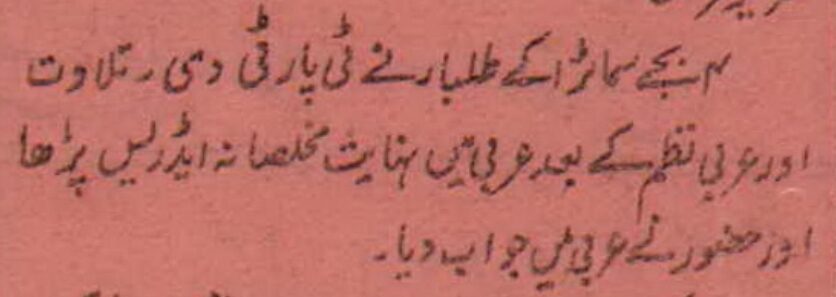 Al Fazl, 4 December 1924, p. 2
_____________________________________________________________________________________________
1925
In the summer of 1925, under the directive of the caliph, Rahmat Ali, a missionary of the Ahmadiyya movement, arrived in Tapaktuan, Aceh, the northern province of the Sumatra Island. With this, the foundation of the Ahmadiyya movement in Indonesia was laid.[7] In the history of the Community, the three aforementioned students are renowned as the early pioneers of the Ahmadiyya movement in Indonesia. Through their pioneering efforts, and various missionaries of the Community, Ahmadiyya was to spread across Indonesia.[8]
On October 2, 1925, with 13 members, under the leadership of Rahmat Ali, the first branch of the movement was established in Tapaktuan, the ROR of October-1925 reports that there are indonesian men already at Qadian getting training. The ROR of December-1925 reports that their missionary is working in Sumatra.
Discussions, lectures, and debates played a crucial role in the early progress of the Ahmadiyya movement in Indonesia. As soon as Rahmat Ali arrived in Tapaktuan, the first lecture he organized was on the death of Jesus, concerning which Ahmadi Muslims hold a distinctive theological perspective from mainstream Muslims and Christians. Many early converts to the Ahmadiyya movement are attributed to theological debates, including, but not limited to the death of Jesus. However, many conversions required more than satisfactory arguments, and it was not solely debates that attracted people. The charisma, attitude and the ‘spiritual power’ of the missionaries appealed to the public. The patience exemplified by the Ahmadi debaters in face of abusive criticisms and humiliation played an important role (See Burhani).
Thus, Huzoorra sent Hazrat Maulvi Rahmat Alira to Indonesia to establish the Ahmadiyya mission there. He departed for Indonesia on 17 August 1925 and in September, reached Tapak Tuan, a small town in Sumatra.
He established the first jamaat (chapter) in Indonesia within a few months, with eight people performing bai‘at, and the first Ahmadiyya mosque built in 1937.
_____________________________________________________________________________________________
1926
A few months later, in 1926, Rahmat Ali moved to Padang, in the west coast of Sumatra and established the second branch of the movement. Following this, several branches of the movement were established all over the Island.
The ROR of September-1926 reported that Maulvi Rahmat Ali had converted many people to Ahmadiyya.

_____________________________________________________________________________________________
1928
Mirza Wali Ahmad Baig established a Jamaat for the Lahori-Ahmadi, we don’t know what this means.
____________________________________________________________________________________________
1929
Since the earliest days of the Ahmadiyya Islamic movement in Indonesia numerous fatwas have been issued by Indonesian religious organizations. One of the earliest to issue a fatwa was the Sunni Indonesian movement Muhammadiyah, which issued its fatwa in 1929, declaring anyone who does not believe in the finality of Muhammad as infidel. Although the fatwa does not explicitly mention Ahmadiyya, nor Ahmadi Muslims, it is believed that it was directed at the Ahmadiyya movement. It is to be noted however that Muhammadiyah initially maintained cordial relations with the small Lahore Ahmadiyya group, so much so that it was rumoured that the two groups were going to merge.[13]
_____________________________________________________________________________________________
1930
In the April edition of the ROR, his picture is there along with many new indonesian Ahmadi’s.

______________________________________________________________________________________________
1931
In 1931, Rahmat Ali moved to Batavia (known today as Jakarta, the capital of Indonesia), in the northwest coast of Java Island.[7]
_____________________________________________________________________________________________
1932
The ROR of Feb-1932 reports that Maulvi Abu Bakr (spelled as Aboe Bacar Ajub, who has the title of “Maulvi Fazal”) arrived on the island of Sumatra accompanied by Mr. Abdul Aziz Sharif. They landed at Padang (Sumatra) via the ship “Hemskerk”. A man named Seth Aboe Bacar (Abu Bakr) received them, he is the “Amir-i-Jamaat” for the ahmadiyya community therein.
Mirza Bashir Ahmad (M.A.) is mentioned in the ROR of March-1932, the ROR quotes a newspaper (Djawah Tengah Review) from Semereng, Java (modern day Indonesia) which appreciates the work of Mirza Bashir Ahmad (editor of the Review of Religions) and the effect it is having in Europe and America.
Allegedly, per the ROR of Jan-1933, Ahmadi’s from Indonesia (Java and Sumatra) were at the Jalsa at Qadian in 1932.
______________________________________________________________________________________________
1933
A few years after the arrival of Rahmat Ali, a committee Komite Mencari Hak (committee for finding the truth) was assembled by Tahar Sultan Marajo, a non-Ahmadi Muslim in the Pasar Gadang locality of Padang, western Sumatra, in order to bring Ahmadi missionaries and orthodox clerics together to debate on religious matters. However, the debate did not ensue as the clerics did not appear. According to Ahmadi reports, some of the committee members converted to Ahmadiyya. Some of the most famous debates, in the early years of the movement, between Ahmadi Muslims of Indonesia and the orthodox clergy was with Persatuan Islam, an Indonesian Islamic organization founded in 1923. The debates were commonly held in Bandung and Batavia, both of which lie in the western portion of Java. The first debate with Persatuan Islam was on the death of Jesus, attended by over a 1,000 people and lasted over three days during April 1933. A second debate discussing wider topics, was held in September of the same year, and was witnessed by over 2,000 people (See Burhani).
The ROR of Feb-1933 has this photo of Maulvi Rahmat Ali.

The ROR of Aug-1933 reports that Maulvi Rahmat Ali and his newspapers, “Islam” and “sinar Islam” have stirred a controversy with the local Muslim Community (The Anjuman Himayat-i-Islam of Java) and their newspaper “Pembala Islam”. A debate was setup for April 13-14th. The controversy lasted for 3 days, Maulvi Abu Bakr also helped. Ahmadi’s claimed victory in the ROR.
The ROR of Dec-1933 mentions the missionary work of Maulvi Rahmat Ali in modern day Indonesia. Maulvi Rahmat Ali has been aggressively debating the Muslim of Batavia (Java and Sumatra). A Maulvi Abdul Wahid is also mentioned, he gives details of the debates, in one instance, he explains how Maulvi Rahmat Ali gave a lecture on the death of Jesus. On the second day of the debate, Maulana Abu Bakr gave a speech on “The Truth of the Claims of the Promised Messiah”. The “Benting Taimur” newspaper (Of Batavia) was quoted.
_____________________________________________________________________________________________
1934
Mirza Wali Ahmad Baig got translated Maulana Muhammad Ali’s Translation of Holy Quran into Dutch in 1934. He then taught in many schools in Indonesia and among his students was 1st president of Indonesia, Mr. Sukarno (See page 22).
The ROR of Jan-Feb-1934 reports that Maulvi Muhammad Sadiq is working out of Sumatra (his letter is from Dec-1933). Maulana Rahmat Ali was also there and was in Java. The ROR of Aug-1934 reports that Maulvi Muhammad Sadiq has arrived in Maidan, Sumatra (modern day Indonesia).
In an official document presented to the Governor General of India, the Ahmadiyya Movement and the 2nd Khalifa claim to have many local converts to Ahmadiyya (See ROR of April-1934).
______________________________________________________________________________________________
1935
Although the Community had established a number of branches throughout the country, it was not until a conference was held in December 1935 that the organisational structure of the Community was established.[1] R. Muhyiddin was elected as the first president of the Ahmadiyya Muslim Community in Indonesia.[7] The Indonesian branch adopted the name Ahmadiyah Qadian Departemen Indonesia, which was later changed to Anjuman Ahmadiyah Departemen Indonesia in June 1937. In late 1949, after the Indonesian Revolution, the name was once again changed to Jemaat Ahmadiyah Indonesia (JAI), thereby emphasizing the organizational nature of the Community and its connection to the worldwide Ahmadiyya Muslim Community.[1]
In a separate development, the Lahore Ahmadiyya Movement, which had split from the main Ahmadiyya Muslim Community in 1914, sent its first missionary Mirza Wali Ahmad Baig in 1926. Although the Lahore Ahmadiyya was established in the country on December 10, 1928, it was not legally registered in the country (as Gerakan Ahmadiyah Indonesia ‘GAI’) until the following September. Due to a lack of effort produced by the Lahori Ahmadis in seeking converts in Indonesia, and into the faith in general, the group failed to attract a sizeable following. In particular, Mira Wali Ahmad Baig was the last missionary of the group, in contrast to the main Ahmadiyya movement, which had sent missionary after missionary to Indonesia.[1] Due to the organizational strength adopted in overseas missionary activity, during the era of the second Caliphate, and for various financial and theological reasons, the main Ahmadiyya branch became increasingly successful in gaining converts to their interpretation of Islam.[5] Shielded by Indonesia’s Constitution, which guaranteed religious freedom, the Ahmadi Community continued to grow, whilst facing little persecution up until the fall of the Suharto government.[8]
In 1935, local members of the Indonesian Ulema Council in East Sumatra issued their first warning of the ‘heretical’ status of the Ahmadiyya. However it was not until 1965 that this position was formalized through a fatwa. Having produced little influence, the national body of the Indonesian Ulema Council took up the issue and in 1980 issued its first fatwa against the Ahmadiyya movement, although it excluded the splinter Lahore Ahmadiyya group from this ordeal. It declared Ahmadi Muslims outside the pale of Islam, “deviant” and that the government is to give ear to the Council in its dealings with Ahmadi Muslims. As a result, the Ministry of Religious Affairs issued a statement declaring the Ahmadiyya movement as a ‘deviant’ sect. However the New Order government of the second President of Indonesia, Suharto, gave little support in the implementation of the final part of the fatwa through actual state policy.[3][14]
The ROR of Jan-1936 alleges that Ahmadiyya has centers in many countries of the world, these were all represented at the 1935 Jalsa at Qadian. They are as follows: England, America, Japan, China, Syria, Palestine, Egypt, Java and Sumatra, Nigeria, Nairobi (Modern day Kenya), Afghanistan and Persia.
_____________________________________________________________________________________________
1936
The ROR of Jan-1936 alleges that Ahmadiyya has centers in many countries of the world, these were all represented at the 1935 Jalsa at Qadian. They are as follows: England, America, Japan, China, Syria, Palestine, Egypt, Java and Sumatra, Nigeria, Nairobi (Modern day Kenya), Afghanistan and Persia.
______________________________________________________________________________________________
1937
Jamaat-e-Ahmadiyya’s role in Indonesia’s independence from the Dutch
Mirza Wali Ahmad Baig returned to India from Indonesia.
He established the first jamaat (chapter) in Indonesia within a few months, with eight people performing bai‘at, and the first Ahmadiyya mosque built in 1937.
_____________________________________________________________________________________________
1939
The ROR of Dec-1939 alleges that there are Ahmadi representatives in Batavia-Centrum aka modern day Indonesia.
_____________________________________________________________________________________________1940
https://en.wikipedia.org/wiki/Ahmadiyya_in_Indonesia#cite_note-Burhani143-1
The ROR of Dec-1940 has a full report of Qadiani-Ahmadiyya in Garut, Java, Indonesia. This was also published in the Al-Fazl of Nov-1940. They allege that there are 328 Ahmadi’s in Garut now. The Ahmadi’s have their own temple and club house therein, which costs 12.5 guilders per year. There is also a printing press that is owned by Ahmadi’s. An Ahmadi has given the Ahmadiyya Movement a garden full of orange trees, the community is now making money off of this donation (1650 rupees per year). It is reported that the Ahmadi mullah working in Garut, Java, Indonesia, he has travelled extensively on the island of Java and even met the other Qadiani-Ahmadi missionary working in Sorabaya. The ROR also reports that the 2nd Khalifa’s book, “Invitation to the Ameer” has been translated into Malay. A man named M. Abdul Wahid is described as the Qadiani-Ahmadi missionary-in-charge, they also mention how he has changed his headquarters to Bandung, Western Java. They also allege that there are 6 Ahmadi’s in Badung.
The Lahore Ahmadiyya movement, also known as Gerakan Ahmadiyyah Indonesia (GAI) in Indonesia, had only 400 members up until the 1940s. Due to a lack of effort produced by the Lahori Ahmadis in seeking converts in Indonesia, and into the faith in general, the group failed to attract a sizeable following. By the 1970s the group’s membership stood between 500 and 1000 people. In the 1980s, it fell to 708 members.
_____________________________________________________________________________________________
1941
The ROR of Aug-1941 reports that Maulvi Rahmat Ali is the missionary-in-charge for all of Indonesia and he recently toured the island of Sumatra, he went to the town of Padang and stayed for 2 months. He returned to the island of Java on March 16th, he toured the entire island in roughly 45 days and gave 30 lectures. The Ahmadiyya Community at Batavia (corresponds to present-day Jakarta, Indonesia) is also discussed. They also allege that 40 people converted to Ahmadiyya through these tours and lectures.
______________________________________________________________________________________________
1943
The ROR of March-1943 has an essay by A.H. Yusuf of Borneo and Java, he is listed as a Tahreek-i-Jadeed.
Sufi Muti-ur-Rahman Bengali has an essay in the ROR of March-1943 entitled, “The Ahmadiyya Movement”. From Chicago! He also alleges that Ahmadiyya has spread around the world in countries/continents like England, North and South America (Trinidad and Suriname), various parts of Africa (mostly, Ghana, Nigeria, Sierra Leone, Uganda, Tanzania and Kenya), Italy, Palestine, Dutch East Indies (aka Indonesia), Straight Settlements (aka Malaysia), China, Japan and Mauritius.
Ameer Hamza Yusuf of Borneo has another essay in the ROR of June-1943.
The July-1943 edition of the ROR has an essay by Amir Hamza of Borneo.
The ROR of Nov-1943 alleges that Ahmadiyya has spread into Java and Sumatra.
_____________________________________________________________________________________________
1944
Jalal-ud-Din Shams writes an essay on “Christianity and Islam”, this speech was delivered in the UK at Southwell. He alleges that there are regular missions of the Ahmadiyya Movement in the USA, Argentina, Gold Coast, Nigeria, Sierra Leone, Java, Sumatra and Palestine, he alleges that before the war, there were missions in Hungary, Poland and Rome.
______________________________________________________________________________________________
1945
https://www.alhakam.org/jamaat-e-ahmadiyyas-role-in-indonesias-independence-from-the-dutch/
Maulana Muhammad Sadiq who was serving as an Ahmadi missionary in Sumatra.
The 2nd Khalifa stated that the best option would be to get as many rights as possible and make a conciliation. In case the government held the majority’s support, then the Ahmadis should support it, but as the Dutch would have the support from the Western powers, it would be unwise for the Indonesians to not reconcile with them. (Tarikh-e-Ahmadiyyat, Vol. 9, pp. 588-589).
The ROR of March-1945 alleges that Ahmadiyya has spread into the Dutch East Indies aka “Indonesia”.
The ROR of Nov-1945 alleges that there is an active Qadiani-Ahmadi mission in Java and Sumatra.
______________________________________________________________________________________________
1946
Jamaat-e-Ahmadiyya’s role in Indonesia’s independence from the Dutch
On 16 August 1946, the 2nd Khalifa called the attention of the Muslim world to support the freedom movement of Indonesia.
The 2nd Khalifa stated that there were around 70 million Muslims in Indonesia, who belonged to one nation, spoke a common language and had a desire for unity as well.
He said:
“The Indonesian Muslims have shown a great example of their unity, while striving for their independence, and such an example is not even found in the Arab countries […] The Indonesian islands have displayed such great excellence from which the other Islamic world has been deprived. They have a united voice […] During the last few months, the Dutch tried their utmost to create differences among them, but did not succeed. Regretfully, other Islamic countries do not sense the beauty of unity […]
“Singapore is the key to the Asian countries, and that too cannot remain separate from the [Indonesian] islands because it is a part of these [islands] with respect to race and language. And if Singapore is in the grip of a nation, then other countries would feel compelled to make peace with it.” (Al Fazl, 27 August 1946, p. 3)
Huzoorra continued:
“If these islands become independent, they could serve as a huge source for spreading the Islamic teachings and Islam’s majesty. But regretfully, other Islamic countries have raised very minimal voices in favour of these islands, and shown very little sympathy for them. This is an area where the Muslims are in the majority […] The Muslims should exert every possible effort for the help of this area, and demand from the Dutch their independence […]
“A dire need of the time is that the Muslims should raise their voice in favour of their [Indonesian] brothers, in their newspapers, magazines and gatherings, and demand for their independence. If they are not helped and supported now, then I fear the Dutch will completely suppress the voice [of the Indonesians].” (Ibid)
Huzoorra stressed that the political future of the Asian Muslims was linked with the future of the Muslims of Java and Sumatra because no other country had Muslims united in such great numbers compared to Indonesia. Moreover, these islands could prove very beneficial for making good relations with other countries through seaways.
Huzoorra continued:
“Our missionaries who are [present] in different countries should raise their voice [for Indonesia’s independence] and write articles in different magazines and newspapers in favour of Indonesia. It is the duty of our own newspapers and magazines to raise this voice time and time again as much as possible, so that all those Muslims start supporting Indonesia’s independence, who learn about this through our newspapers and magazines […]
“Our missionaries are present in five European countries. Our missionaries are present in North and South America. If members of the Jamaat understand their duty, I think that they would definitely succeed in this cause with the grace of God Almighty. Such articles should be published regularly in our newspapers and magazines, that state that the people of Java and Sumatra have the right to get independence.
“[Indonesia] is a developed country with respect to education and industry, and a smaller nation like the Dutch has no right to rule such a big nation with such a huge population. The very first benefit of the presence of a foreign government should be that it should protect the [ruled] country, but the Dutch government is not capable of protecting Indonesia from foreign attacks.” (Ibid, p. 4)
Huzoorra further stated that such articles should be published in newspapers and magazines in which the Dutch should be told:
“If they do not give independence to Indonesia, then there is a danger that communism will spread there, which will be dangerous for all other governments as well […] Your act of giving independence to Java and Sumatra, will not weaken you; rather, it will be a source of strength […] If you give them independence with love and peace, it will instil the emotions of love for you in their hearts. But if you oppress them, it will create a severe grudge against you in their hearts once they get independence from you.” (Ibid, p. 5)
Huzoorra continued:
“We have no interest in political matters, instead we are concerned with religious preaching. But we will exert every possible effort whenever the future of Islam is concerned […] and according to the requirements, we will continue to expand our efforts […] If the reason behind our special sympathy for the Arab [world] is that we have learned Islam from the Arabs, then the reason behind our special sympathy for the Indonesians is that after India, this area is at the forefront in accepting Ahmadiyyat. Thus, it is our duty to exert every possible effort for this country’s independence.” (Ibid)
“The circumstances faced by the Muslims nowadays are very bleak. The identity of the Muslims in places such as India, Palestine, Egypt, Indonesia is in severe danger […] The Dutch government is leaving no stone unturned to enslave the Muslims in Indonesia […] So, all members [of the Jamaat] should especially pray these days. The other [non-Ahmadi] Muslims should also be urged to start praying, as there is no other remedy for the Muslims. Until the Muslims step aside from worldliness and the pursuit of luxury and unite for offering all types of sacrifices […] success is impossible.” (Al Fazl, 10 September 1946, p. 2)
During his Friday Sermon on 18 October 1946, Huzoorra stated:
“Initially, Japan had occupied Sumatra and Java, then the sovereign Indonesian government was established. Then, the English tried to bring the Dutch there [again], and now a republican government is established there. There had been many trials for our Jamaat as well, and during the time of Japanese occupation, Ahmadis had been treated harshly […] When they had strongly revealed their intentions against Jamaat-e-Ahmadiyya, suddenly Allah the Almighty dissolved their government, and a republican government was established in Indonesia […]
“During the time of the republican government and even before that, when the people were only striving for the protection of their individual rights, our Jamaat supported the republican movement, and exerted efforts to capacity for the country’s independence. For this reason, when the republican government was established after the Japanese withdrawal, the overall treatment with our Jamaat was good.” (Al Fazl, 13 November 1946, p. 1)
During his Friday Sermon on 10 September 1948, while describing the problems faced by the Muslim world, Huzoorra stated that the only solution to eradicate those problems was Muslim unity. (Al Fazl, 28 September 1948, p. 4)
The ROR of June-1946 reports that B. Orchard gave a speech to the Qadiani-Ahmadi’s of Bombay about their musleh maud. He called MGA as the second coming of Krishna and Zoroaster. He also alleged that Ahmadiyya was growing in countries like England, America, France, all over Africa, Palestine, Arabia, Java, Burma and Malaya. He said that MGA was a manifestation of God’s attributes, he also alleges that the 2nd Khalifa is regularly receiving dreams, revelations and etc.
Via the Moslem Sunrise of the 2nd Quarter-1946, Sufi Muti-ur-Rahman Bengali gave 220 South State St., Suite 1010 as the only mailing address for the Ahmadiyya Movement in the USA. “Life of Muhammad” by Sufi M.R. Bengalee is promoted heavily too. Khalil Ahmad Nasir was a Qadiani-Ahmadi murrabi arrived in the USA in the 2nd quarter 1946 (See Moslem Sunrise of 2nd Quarter-1946)(he was Missionary-In-Charge-USA from 1948 to 1959. Zafrullah Khan alleges that there are now large and flourishing Ahmadiyyah communities in the Dutch East Indies (Indonesia), the Malay States (Malaysia), Burma, Ceylon (Sri Lanka), Mauritius and the British Colonies of West Africa. In the Gold Coast alone (Ghana) there are 12 Ahmadiyyah schools and 88 mosques. While Sierra Leone alone has 3 schools and 12 mosques. There are large communities all over Nigeria, and to me was accorded the honour and privilege of laying the foundation stone of the Central Ahmadiyyah Mosque in Lagos in March of last year. In spite of the serious handicaps imposed by the war, the construction of the Mosque was completed within less than six months. There are active communities in East Africa (Uganda, Tanzania and Kenya) Egypt, Palestine, Syria, Iraq, Iran and Afghanistan. Two families of Ahmadis have migrated to Qadian from Turkestan.
The ROR of Nov-1946 alleges that a successful mission center has been setup by the Qadiani’s in the Dutch East Indies.
______________________________________________________________________________________________
1948
_____________________________________________________________________________________________
1950–1956Hafiz Qudratullah is recalled to Pakistan and begins working as the secretary of the Ahmadiyya business venture in Indonesia.
_____________________________________________________________________________________________
1969
_____________________________________________________________________________________________
1970
By the 1970s the group’s membership stood between 500 and 1000 people. In the 1980s, it fell to 708 members.[1]
The Muslim Sunrise of April-May-1970 doesn’t give any name of any editor. The gist of a Friday sermon by the 3rd Khalifa from 2-24-1970 is given. The gist of a Friday sermon by the 2nd Khalifa from 5-30-1928 is also given. A lecture by a grandson of MGA is given (Mirza Mubarak Ahmad) while he was in Indonesia in 1969. Mirza Mubarak Ahmad mentioned the brother-in-law of MGA (Mir Muhammad Ismail). The famous case from 1904 with Karam Din is also given. 4 Ahmadiyya locations are given out, the Dayton Mosque-temple at 637 Randolph St, Dayton, Ohio, the Fazl Mosque, 2141 Leroy Place, Washington D.C., the Ahmadiyya Mosque in Chicago, IL, on Wabash Ave and an Ahmadiyya mission in NY, on 147-20 Archer Ave, Jamaica-Queens.
_____________________________________________________________________________________________
1973
Via the Muslim Sunrise of July-1973, the Ahmadiyya Movement has 5 locations in America, 2141 Leroy Place, Washington D.C. 20008, 637 Randolph St, Dayton, OH, 185 North Wabash Ave, Chicago, iL, 60601 (this seems to be down the street from the Ahmadiyya temple-residence at 4448 S. Wabash Ave), 604 Wandless St, Pittsburgh, PA, 15219, 2519 Arch St, Philadelphia, 19139, 4385 N. Greenbay Ave, Milwaukee, Wisconsin, 53209, 147-20 Archer Ave, Jamaica-Queens, 11435. It also gives out its global mailing addresses in Nairobi-Kenya, Tabora-Tanzania, Accra-Ghana, Kumasi-Ghana, Lagos-Nigeria, Freetown-Sierra Leone, Monrovia-Liberia, Bathurst-Gambia, Rangoon-Burma and Toronto,-Canada. A Friday sermon by Mirza Nasir Ahmad from May-4-1973 is given, this is the speech wherein he discusses the fact that Ahmadi’s were declared as Non-Muslim in Azad Kashmir. The next issue of the Muslim Sunrise (September-October issue) will be most probably distributed at the annual convention of the
Ahmadiyya Movement in Islam, to be held during August-31-September 2, 1973, at Forest College, Lake Forest, Illinois. Meanwhile, the subscribers are requested to send their subscriptions ($3.00 per year) to the Missionary-in-Charge, 2141 Leroy Place, N.W., Washington, D.C., 20008. Please send your complete mailing address to the Manager, Sister Rehana Salam, c/o the Dayton Mosque, 637 Randolph Street, Dayton, Ohio, 45408. Thank you. It has an essay by Muhammad Ali Chaudhri, who is the Principal, T. l College, Rabwah, Pakistan. It also has an essay from Dr. Qazi Muhammad Barkatullah. Ahmadiyya global missions are mentioned, in the UK, Denmark, Germany (Hamburg and Frankfurt), Holland (Netherlands), B.A. Orchard in Ireland, Sweden, Spain, Switzerland, Japan, Indonesia (Suva), Fiji, Guyana, Trinidad, Mauritius, Borneo, Sri Lanka, Syria and Singapore.
The EDITORIAL BOARD is as follows:
Editor— Mian Muhammad Ibrahim
Advisory Editor— Imam Sharif Ahmad Bajwa
Contributing Editors— Hasan Hakeem, Dr. Basharat Ahmad Munir, Dr. Qazi Muhammad Barkatulla.
_____________________________________________________________________________________________
1974
Per the Muslim Sunrise of Summer-1974, only 4 locations are given for Ahmadiyya in the USA, and nothing in Chicago. The Ahmadiyya headquarters at 2141 Leroy Place, N.W., Washington D.C., 637 Randolph St, Dayton, Ohio (Ahmadiyya temple). A mission house at 1064 Union Street, Brooklyn, N.Y. 11225 and a mission house at Pomeroy Road , R.D. 5, Athens, Ohio 45701. It also gives global locations of Ahmadiyya missions, in countries like Canada, Guyana, Trinidad, Denmark, England, Germany, Holland (aka Netherlands), Spain, Sweden, Switzerland, Ghana, The Gambia, Ivory Coast, Kenya, Liberia, Mauritius, Nigeria, Sierra Leone, South Africa, Tanzania, Uganda, Ceylon (aka Sri Lanka), Fiji, Indonesia, Phillipines and Singapore. Mirza Muzaffar Ahmad gave the inaugural speech at the 1974 USA Jalsa (27th USA Jalsa), held at Wheelock College on Sep-1-1974. It also has an essay by Dr. Khalil Ahmad Nasir (Professor of Political Science, Long Island University). Muhammad Siddique Shahid Gurdaspuri also gave a speech at the at the 1974 USA Jalsa (27th USA Jalsa), another speech from the same Jalsa by Muhammad Ahmad Sadiq (from Boston) is also given. The Editor of the Muslim Sunrise is Maulvi Mian Muhammad Ibrahim. The Advisory-editor is, Imam M.S. Shahid (aka Muhammad Siddique Shahid Gurdaspuri). Contributing editors are Hasan Hakeem, Dr. Basharat Ahmad Munir, Dr. Qazi Muhammad Barkatullah, Rab Nawaz Malik and Dr. M.M. Abbas. This magazine was published from the Dayton Mosque, 637 Randolph Street, Dayton, Ohio, 45408.
_____________________________________________________________________________________________
1975
The Muslim Sunrise of April-1975 was published from Dayton, Ohio, via the Ahmadiyya Temple at 637 Randolph Street, Dayton, Ohio, 45408. The Editor of the Muslim Sunrise is Maulvi Mian Muhammad Ibrahim. The Consulting-editor is Imam M.S. Shahid (aka Muhammad Siddique Shahid Gurdaspuri). Contributing editors are Hasan Hakeem, M.M. Abbas PhD, Q. M. Barkatullah PhD, Rab Nawaz Malik PhD, Basharat Ahmad Munir PhD and Khalil Ahmad Nasir PhD. The headquarters of Ahmadiyya in North America is given as 2141 Leroy Place, Washington D.C. 20008. There is speech by Imam M.S. Shahid (Missionary-in-Charge, USA)(aka Muhammad Siddique Shahid Gurdaspuri) which was given on March-30-1975 at “University Campus” in Detroit (not sure where this might be), on Seerat un Nabi Day. There is also an essay by Qazi Muhammad Barkatullah (aka Q. M. Barkatullah) and Professor Khalil Ahmad Nasir PhD (Director International Studies, C.W. Post Center, New York). A speech by Yusuf Amin from the USA-Sep-1974 Jalsa is also given. Ahmadi’s in the UK also held a “Prophet’s Day” at the Al-Fazl Mosque in London on Sunday, April-13-1975, it is alleged that there more than 500 guests. Zafrullah Khan was there and gave a short speech. The Imam of the London Mosque (aka the Fazl Mosque) (B.A. Rafiq) was also there and also gave a short speech. Allegedly, the High Commissioner of the Gambia was also there. The Muslim Sunrise then gives locations of the Ahmadiyya Movement all around the world, starting with P.O. Box 39, Salt Pond, Ghana, P.O. Box 6, Banjul, the Gambia, P.O. Box 3416, Adjame, Abidjan, Ivory Coast, P.O. Box 40554, Nairobi, Kenya, P.O. Box 618, Monrovia, Liberia, P.O. Box 6, Rose Hill, Mauritius, P.O. Box 418, Lagos, Nigeria, P.O. Box 11, Bo and P.O. Box 353, Freetown, Sierra Leone, Mr. M.G. Ibrahim, P.O. Box 4195, Capetown, South Africa, P.O. Box 376, Darresalam, Tanzania, P.O. Box 343, Kampala, Uganda, 99 Driebergs Avenue, Colombo 10, Ceylon, P.O. Box 3758, Samabula, Suva, Fiji, Qadian, District Gurdaspur, Punjab, India, Djl, Balikpapan 1/10, Djakarta 1/13, Indonesia, Haji Muhammad Ebbah, Simunal, Bongao, Sulu, Philippines, 111 Onan Rd, Singapore 15, Eriksminde Alle 2, Hvidovre, Copenhagen, Denmark, 16 Gressenhall Road, London, S.W. 18 and 152 Nithsdale Road, Glasgow S1, United Kingdom, Die Moschee, Wiekstrasse, 24 Hamburg, Stellingen and Die Moschee, Babenhouser, Landstrasse 25, Frankfurt, Germany, De Moschee, Oostduinlaan 79, Den Haag, Holland, Mission Ahmadia del Islam, Colonja San Nicolas 19, Madrid 21, Spain, Islams Ahmadiyya Mission, All Manna Vagen 21, 41460, Goteborg, Sverige, Sweden, 323 Forchstrasse, 8008, Zurich, Switzerland. They also give 5 Ahmadiyya locations in the USA, 2141 Leroy PL, N.W. Washington D.C., 637 Randolph Street, Dayton, Ohio, 45408, 1064 Union Street, Brooklyn, N.Y., 112225, Pomeroy Road, P.O. Box 338, Athens, Ohio, 45701, 2522 Webster Avenue, Pittsburgh, PA, 15219 and 4448, S. Wabash Avenue, Chicago, ill, 60615.
_____________________________________________________________________________________________
1976
The Muslim Sunrise of July-1976 was edited/published by Mian Muhammad Ibrahim (a Qadiani-Ahmadi Maulvi) and from Dayton, Ohio. Imam M.S. Shahid (Missionary-in-Charge, USA) is the consulting editor and Dr. Khalil Ahmad Nasir is the contributing editor. The arrival of Mirza Nasir Ahmad is announced, he seems to have already arrived (he landed on July-20-1976) before the publishing of this edition. It is claimed that there are 10 million Ahmadi’s in the world. It is alleged that the attendance at the 1975 Jalsa Salana at Rabwah was the highest ever. Imam M.S. Shahid (Missionary-in-Charge, USA) has an essay. The Ahmadiyya Movement alleges to have 10 million members worldwide and alleges to be an International Organization. They allege to be operating in Ghana, the Gambia, Ivory Coast, Kenya, Liberia, Mauritius, Nigeria, Sierra Leone, South Africa, Tanzania, Uganda, Zambia, Canada, Guyana, Trinidad, the USA, Fiji, India, Indonesia, Japan, Philippines, Singapore, Sri Lanka, Syria, Denmark, Germany, Great Britain, Holland, Spain, Sweden, Switzerland, Yemen, Argentina, Australia, Burma, Bukhara (Uzbekistan), Egypt, Borneo (Brunei?), France, Gulf states (maybe Qatar or the U.A.E.), Hong Kong (China), Iran, Italy, Thailand, Lebanon, Muscat (Oman), Yugoslavia, Iraq, Turkey and Malaysia. It is alleged that in the USA there are 26 jamaats, 300 mosques in Ghana and over 100 mosques in Indonesia. A new mosque in Sweden is mentioned, the Fazl mosque in London is declared as the oldest mosque in Europe (a lie, the Woking is the oldest), 1 mosque in Holland (Netherlands) and 1 mosque in Switzerland, and 2 in West Germany (Frankfurt and Hamburg). The Ahmadiyya Movement then shows its 5 temple-mosques in the USA, St. Louis, Baltimore, Washington D.C., Ny and Dayton. The Dowie prophecy is mentioned. Dr. Khalil Ahmad Nasir has an essay on world peace. There is also a photo of all of the Jamaat Presidents from Feb-1976. A list of 27 jamaats in the USA are mentioned, my uncle Sharif Ahmad Shah is mentioned at 2001 Newton Way, Concord, Ca 94518, 415-687-0133.
Scans


_____________________________________________________________________________________________
1978
The Jan-June-1978 issue of the Muslim Sunrise was edited by Dr. Khalil Ahmad Nasir with Maulana Ata-Ullah Kaleem (who is the missionary-in-charge, USA) as the consulting editor. Dr. Khalil Ahmad Nasir’s home address is given for private letters. Mian Muhammad Ibrahim’s departure back to Rabwah is announced. An essay by Zafrullah Khan is given. An essay by Maulana Ata-Ullah Kaleem is also given. An essay by Maulvi Shaikh Nasir Ahmad (Maulvi in Switzerland) is also given, he discusses the Yuz Asaf theory and the Shroud of Turin. Ahmadiyya locations around the world are given: Ghana, the Gambia, Ivory Coast, Kenya, Liberia, Mauritius, Nigeria, Sierra Leone, South Africa, Tanzania, Uganda, Canada, Guyana, Trinidad, Sri Lanka, Fiji, India, Indonesia, Philippines, Singapore, Denmark, Great Britain (2 locations), Germany, Holland, Spain, Sweden, Switzerland, and they also give 5 Ahmadiyya locations in the USA, 2141 Leroy PL, N.W. Washington D.C., 637 Randolph Street, Dayton, Ohio, 45408, 1064 Union Street, Brooklyn, N.Y., 112225, Pomeroy Road, P.O. Box 338, Athens, Ohio, 45701, 2522 Webster Avenue, Pittsburgh, PA, 15219 and 4448, S. Wabash Avenue, Chicago, ill, 60615.
______________________________________________________________________________________________
1979
By 1979, the Ahmadiyya Movement was claiming to have 74 mosques in Indonesia and Borneo and 13 mission houses.
The March-June-1979 edition of the Muslim Sunrise was edited by Dr. Khalil Ahmad Nasir only. It’s unclear as to who was the missionary-in-charge in the USA. Dr. Khalil Ahmad Nasir’s private addres is given out for those who have questions about the subject matter, all questions about the business affairs of the Muslim Sunrise are addressed at 2141 Leroy Place, N.W., Washington D.C., at the American Fazl Mosque (which was the headquarters of the USA jamaat). It has essay’s by B.A. Munir on the Dead Sea Scrolls, Sheikh Abdul Qadir, Dr. Qazi Muhammad Barkatullah. It also discusses the “Yuz Asaf” theory and even mentions how it was published in “The Japan Times” of July 14, 1978. It also alleged that Prof. Yasin, head of the post-graduate department of history at Kashmir University, who they allege is a Sunni Muslim, admits that this is the tomb of Eisa (as). The book by German philosopher Andreas Faber-Kaiser whose book “Jesus died in Kashmir” is also mentioned. The Chief Kadhi of Kenya, Sheikh Abdalla Saleh Farsy is mentioned and his opinion on 3:144 is twisted. Ahmadiyya locations around the world are given: the Gambia, Ghana, Ivory Coast, Kenya, Liberia, Mauritius, Nigeria, Sierra Leone, South Africa, Tanzania, Uganda, Zambia, Canada, Guyana, Suriname, Trinidad, Burma, Fiji, India, Indonesia, Japan, Pakistan, Philippines, Singapore, Sri Lanka, Denmark, Germany, Holland, Spain, Sweden, Switzerland, and the United Kingdom. They also give 5 Ahmadiyya locations in the USA, 2141 Leroy PL, N.W. Washington D.C., 637 Randolph Street, Dayton, Ohio, 45408, 1064 Union Street, Brooklyn, N.Y., 112225 and 3336 Maybelle Way, Oakland, CA 94619.
______________________________________________________________________________________________
1980
The Jan-Apr-1980 edition of the Muslim Sunrise was edited by Dr. Khalil Ahmad Nasir only. It’s unclear as to who was the missionary-in-charge in the USA. Dr. Khalil Ahmad Nasir’s private address is given out for those who have questions about the subject matter, all questions about the business affairs of the Muslim Sunrise are addressed at 2141 Leroy Place, N.W., Washington D.C., at the American Fazl Mosque (which was the headquarters of the USA jamaat). In this editorial, Dr. Khalil Ahmad Nasir writes about the visit of the Pope to the USA in 1979 as well as Dr. Abdus Salam winning the Nobel Prize in 1979. A speech by Zafrullah Khan which was given in Oct-1979 at the University of Calgary (department of religious studies) is reproduced. Zafrullah Khan quotes 62:3 and alleges that Muhammad (Saw) was destined to come back into this world. There is also an essay by Abdullah A. Odeh (on Jihad)(from the Odeh family of Kababir, Haifa, Israel). An essay about the Shroud of Turin is also given. Ahmadiyya locations around the world are given: the Gambia, Ghana, Ivory Coast, Kenya, Liberia, Mauritius, Nigeria, Sierra Leone, South Africa, Tanzania, Uganda, Zambia, Canada, Guyana, Suriname, Trinidad, Burma, Fiji, India, Indonesia, Japan, Pakistan, Philippines, Singapore, Sri Lanka, Denmark, Germany, Holland, Spain, Sweden, Switzerland, and the United Kingdom. They also give 5 Ahmadiyya locations in the USA, 2141 Leroy PL, N.W. Washington D.C., 637 Randolph Street, Dayton, Ohio, 45408, 1064 Union Street, Brooklyn, N.Y., 112225 and 3336 Maybelle Way, Oakland, CA 94619.
______________________________________________________________________________________________
1982
Jamia Ahmadiyya established in March 1982.[7]
The Jan-1982 edition of the Muslim Sunrise was edited by Dr. Khalil Ahmad Nasir (named as the Editor in Chief), Mubasher Ahmad (M.A., L.L.B.) is named as the managing editor and there are 3 associate editors, Dr. Muhammad Abbas, Dr. M.H. Sajid and Dr. Bashir uddin Usama. Dr. Khalil Ahmad Nasir’s private address is given out for those who have questions about the subject matter, all questions about the business affairs of the Muslim Sunrise are addressed at 2141 Leroy Place, N.W., Washington D.C., at the American Fazl Mosque (which was the headquarters of the USA jamaat). A book by Zafrullah Khan is quoted, as well as an entire essay entitled, “The Concept of the Second Coming in World Religions”. A speech by Dr. Khalil Ahmad Nasir which was given at the Ahmadi USA-Jalsa of 1981 is reproduced (held on Sep-5-6-1981 in Washington D.C.), the essay was on the shroud of Turin. A quote is given from Tohfa Golarhviyyah, however, the page number is not given, this is about Ahmadiyya taking over the world. 7 locations of the Ahmadiyya Movement in the USA are given, 2141 Leroy PL, N.W. Washington D.C., 1064 Union Street, Brooklyn, N.Y., 112225, 637 Randolph Street, Dayton, Ohio, 45408, 4448 South Wabash Ave, Chicago, Ill, 60653, 4401 Oakwood St, St. Louis, MO, 63121, 8218 Wyoming, Detroit, MI, 48204 and 3401 Sitrus Ave, Walnut Creek, Ca 94598. Ahmadiyya locations around the world are given: Benin, the Gambia, Ghana, Ivory Coast, Kenya, Liberia, Mauritius, Nigeria, Sierra Leone, South Africa, Tanzania, Uganda, Zambia, Canada, Guyana, Suriname, Trinidad, Burma, Fiji, India, Indonesia, Japan, Pakistan, Philippines, Singapore, Sri Lanka, Denmark, Germany, Holland, Norway, Spain, Sweden, Switzerland, and the United Kingdom.
The July-1982 edition of the Muslim Sunrise was edited by Dr. Khalil Ahmad Nasir (named as the Editor in Chief), Mubasher Ahmad (M.A., L.L.B.) is named as the managing editor and there are 3 associate editors, Dr. Muhammad Abbas, Dr. M.H. Sajid and Dr. Bashir uddin Usama. Dr. Khalil Ahmad Nasir’s private address is given out for those who have questions about the subject matter, all questions about the business affairs of the Muslim Sunrise are addressed at 2141 Leroy Place, N.W., Washington D.C., at the American Fazl Mosque (which was the headquarters of the USA jamaat). Dr. Khalil Ahmad Nasir wrote about USA President Ronald Reagan and abhorred how he spoke about Jihad. The 2nd Qadiani-Ahmadi Khalifa’s speech at the Annual Jalsa of 1925 at Qadian is reproduced. An essay by Abdullah Nasir, who works as a Director of a Special Training College in Winneba, Ghana is given. Mubarak A. Malik has an essay wherein he alleges that there was a prophecy about Ahmadi’s moving out of Qadian in 1947, he quotes the Al-Fazl of August-16-1947, and July-20-1947. Mubarak A. Malik alleged (via Al-Fazl of July-20-1947), that a group of Sikhs attacked a train full of Qadiani’s. On Aug-21, allegedly, 50 men were killed in Qadian. The family of MGA left Qadian on Aug-25, allegedly, Mirza Nasir Ahmad stayed in Qadian. On Aug-29, the 2nd Qadiani-Ahmadi Khalifa gave his final sermon in Qadian (See Al-Fazl, Sep-1-1947). It was also alleged that 2000 Muslims from the surrounding areas are in Qadian and seeking refuge. 6 locations of the Ahmadiyya Movement in the USA are given, 2141 Leroy PL, N.W. Washington D.C., 637 Randolph Street, Dayton, Ohio, 45408, 4448 South Wabash Ave, Chicago, Ill, 60653, 4401 Oakwood St, St. Louis, MO, 63121 ,8218 Wyoming, Detroit, MI, 48204 and G.P.O. Box 1828 New York, NY, 10116 and 11584 Circle Way, Dublin, Ca 95466. Ahmadiyya locations around the world are given: Benin, the Gambia, Ghana, Ivory Coast, Kenya, Liberia, Mauritius, Nigeria, Sierra Leone, South Africa, Tanzania, Uganda, Zambia, Canada, Guyana, Suriname, Trinidad, Burma, Fiji, India, Indonesia, Japan, Pakistan, Philippines, Singapore, Sri Lanka, Denmark, Germany, Holland, Norway, Spain, Sweden, Switzerland, and the United Kingdom.
_____________________________________________________________________________________________
1983
The Sep-Dec-1983 edition of the Muslim Sunrise was edited by Dr. Khalil Ahmad Nasir (named as the Editor in Chief), Mubasher Ahmad (M.A., L.L.B.) is named as the managing editor and there are 2 circulation managers, Nazir A. Ayaz and Saeeda Lateef. Dr. Khalil Ahmad Nasir’s private address is given out for those who have questions about the subject matter, all questions about the business affairs of the Muslim Sunrise are addressed at 2141 Leroy Place, N.W., Washington D.C., at the American Fazl Mosque (which was the headquarters of the USA jamaat). Dr. Khalil Ahmad Nasir wrote an editorial on “Current Trends in Islamic Thought”. The 1925 Jalsa speech by the 2nd Qadiani-Ahmadi Khalifa is given. An essay by Zafar Ahmad Chaudhry? (Air Marshall of the Pakistani Air Force) on “Ahmadiyya Beliefs: Some Allegations Corrected” is given, in this article he talks about Ahmadiyya Takfir, the Ahmadiyya violation of the Kalima, the Ahmadiyya violation on Jihad, the split in Ahmadiyya and etc. In the next essay, the Munir Inquiry of 1953-54 is mentioned, Zafrullah Khan is mentioned, this is an essay by Dr. Syed Barakat Ahmad. Jihad is also discussed via a newspaper from Ghana named “The Guardian” of Dec-1982. 5 locations of the Ahmadiyya Movement in the USA are given, 2141 Leroy PL, N.W. Washington D.C., 637 Randolph Street, Dayton, Ohio, 45408, 4448 South Wabash Ave, Chicago, Ill, 60653, 4401 Oakwood St, St. Louis, MO, 63121, G. P. O. Box 1828, New York, NY 10116. Ahmadiyya locations around the world are given; Benin, the Gambia, Ghana, Ivory Coast, Kenya, Liberia, Mauritius, Nigeria, Sierra Leone, South Africa, Tanzania, Uganda, Zambia, Canada, Guyana, Suriname, Trinidad & Tobago, Australia, Burma, Fiji, India, Indonesia, Japan, Pakistan, Philippines, Singapore, Sri Lanka, Denmark, Germany, Holland, Norway, Spain, Sweden, Switzerland, and the United Kingdom.
_____________________________________________________________________________________________
1984
The March-1984 edition of the Muslim Sunrise was edited by Dr. Khalil Ahmad Nasir (named as the Editor in Chief), Dr. Khalil Ahmad Nasir’s private address is given out for those who have questions about the subject matter, all questions about the business affairs of the Muslim Sunrise are addressed at 2141 Leroy Place, N.W., Washington D.C., at the American Fazl Mosque (which was the headquarters of the USA jamaat). Dr. Khalil Ahmad Nasir wrote an editorial vs. William Safire. Sheikh Mubarak Ahmad is announced as the Missionary-in-Charge for the USA, he also has a short essay wherein he mentions Zafrullah Khan. An essay by Zafrullah Khan is given thereafter, Sheikh Mubarak Ahmad wrote the forward. In this essay, the review by Batalvi is mentioned, Sufi Ahmad Jan is also mentioned, it is also alleged that there are 10 million Ahmadi’s in the world. Ahmadiyya locations around the world are given; Benin, the Gambia, Ghana, Ivory Coast, Kenya, Liberia, Mauritius, Nigeria, Sierra Leone, South Africa, Tanzania, Uganda, Zambia, Canada, Guyana, Suriname, Trinidad & Tobago, Australia, Burma, Fiji, India, Indonesia, Japan, Pakistan, Philippines, Singapore, Sri Lanka, Denmark, Germany, Holland, Norway, Spain, Sweden, Switzerland, and the United Kingdom.
_____________________________________________________________________________________________
1994
Per Ahmadiyya sources only, “Mosques Around the World”, Syarif Ahmad Lubis was the Amir, he was a local indonesian. Mahmood Ahmad Cheema was the missionary-in-charge (a Pakistani).
_____________________________________________________________________________________________
2000
Mirza Tahir Ahmad visited. He opened a new Ahmadiyya place of worship. Masjid Baitul Mujib.
_____________________________________________________________________________________________
2005
With the fundamentalist Islamist organizations still unsatisfied, the Indonesian Ulema Council were pressured to issue another fatwa 25 years later, in July 2005. This time, the council additionally charged Ahmadi Muslims of apostasy. The fatwa, entitled Aliran Ahmadiyah (Ahmadiyya branch), cited a 1985 fatwa by the Organisation of Islamic Cooperation on Ahmadi Muslims and placed itself above the Indonesian government with respect to its treatment towards Ahmadi Muslims. It demanded that the fatwa be enforced. The fatwa ordered the government to impede the spread of Ahmadi teachings among the Muslim populations, suspend the organizational activity of the movement and seal off all public Ahmadi buildings, such as mosques. This fatwa, accompanied with the fall of the Suharto government a few years back in 1998, played a pivotal role in providing ideological justification and an open platform for the opposition and the persecution of Ahmadi Muslims all over the country. In the Post-Suharto era, the Yudhoyono government has generally overlooked the hostilities by radical Muslim groups against Ahmadi Muslims.[3][15]
_____________________________________________________________________________________________
2008
The Qadiani-Khalifa responds to this controversy in a Friday Sermon on the 8th February.
_____________________________________________________________________________________________
2011
In a brutal attack, 3 Ahmadi’s are killed live on video.
During his Friday Sermon on 11 February 2011, while mentioning the Jamaat’s services for the independence of Indonesia, Hazrat Khalifatul Masih Vaa stated:
“Hazrat Musleh-e-Maudra raised a strong voice from the Indian subcontinent in favour of the Indonesian independence movement, and urged other Muslims to strongly support the Indonesian independence movement. This was stated by Hazrat Khalifatul Masih IIra in his Friday Sermon on 16 August 1946. Following this guidance, Ahmadi missions around the world, in addition to Qadian’s central press, were called on to raise their voices in support of the Indonesian independence movement. Eventually, Indonesia gained independence […]
“The Ahmadi missionaries and other [Indonesian] Ahmadis took part in the freedom movement under the guidance of Hazrat Khalifatul Masih IIra, and the Ahmadi missionaries and members of the [Indonesian] Jamaat worked along with the Republican government.
“Syed Shah Muhammad Sahib went to Yogyakarta and met with Dr Sukarno and requested him that he wished to serve the country by joining the freedom movement. He was also a missionary. In addition to some other works, President Sukarno gave him the task of broadcasting news in Urdu on the radio. In addition, Maulvi Abdul Wahid Sahib and Malik Aziz Ahmad Khan Sahib also worked on the radio for about two or three months.
“Syed Shah Muhammad Sahib enthusiastically joined this movement. His enthusiasm was so great that a former interior minister [of Indonesia] said, ‘We recognise Syed Shah Muhammad Sahib as a member of our own nation.’ […] In recognition of the role played by Syed Shah Muhammad Sahib during the independence movement of Indonesia and the services rendered by him, Indonesia granted him a certificate of acknowledgement on 3 August 1957 […]
“During the independence movement in 1946, some Ahmadi members sacrificed their lives and were martyred. One of them was Radin Muhyiddin Sahib, president of Jamaat Indonesia, who was also the secretary of the Committee for Indonesia. He was busy preparing for the celebration of the first independence day of Indonesia, when he was abducted by the Dutch forces, and martyred later.” (Khutbat-e-Masroor, Vol. 9, pp. 67-68)
_____________________________________________________________________________________________
2015
Indonesian Police shutting down Ahmadiyya Mosque in Tasikmalaya, West Java.
_____________________________________________________________________________________________
2016
Indonesian Police forcefully close Ahmadiyya Furqan Mosque in Sukabumi, West Java.
Read—Understranding the oppressed, A Study of Ahmadiyya and their strategies for overcoming adversity in Contemporary Indonesia by Aleah Connely (2016)
_____________________________________________________________________________________________
2017
Indonesia closes down Ahmadiyya Mosque in Depok.
_____________________________________________________________________________________________
2020
Jamia in Indonesia graduates its first class.
_____________________________________________________________________________________________
2021
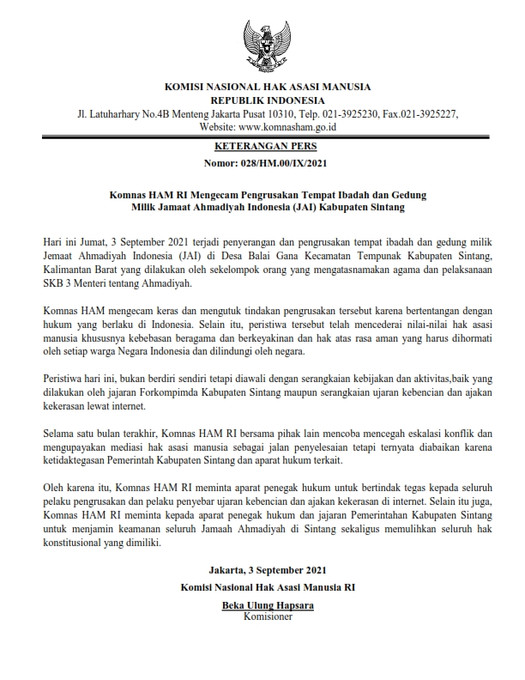
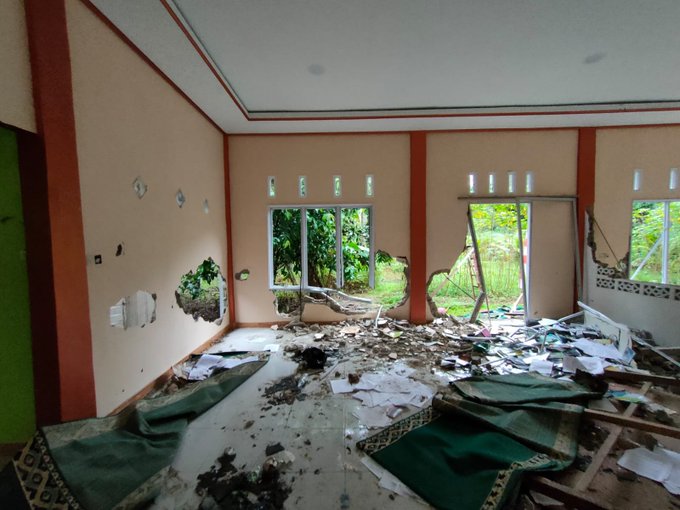
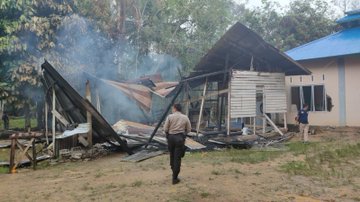
A mob called Aliansi Umat Islam attacked an Ahmadiyah mosque in Sintang, West Kalimantan. It has about 130 members. Army and police officers looked at them. Last month Sintang govt closed down this mosque https://t.co/zUiYLsZipf pic.twitter.com/x2FsrH7zFG
— Andreas Harsono (@andreasharsono) September 3, 2021
Indonesia’s
asked the police to arrest attackers and arsonists, as well as to end anti-Ahmadiyah hate speech on the net. The Sintang local government should uphold the constitution and to protect Ahmadiyah members komnasham.go.id

Indonesian policemen inspected an Ahmadiyah mosque after the Muslim mob had attacked it this afternoon in Sintang, West Kalimantan. The village has around 70 Ahmadiyah families hrw.org/news/2014/05/1



_____________________________________________________________________________________________
2023
Amjad Mahmood Khan on X: “RT @NewsMTA: 📢 7,500 Indonesian Ahmadis ring in 2024 with ‘Clean the City’ Initiative – Powerful act of community service As the world res…” / X (twitter.com)

_____________________________________________________________________________________________
Centenary of the Ahmadiyya Mission in Indonesia: The early years and press coverage
Indonesia: Centenary of the Ahmadiyya Mission, 1925
Centenary of the Ahmadiyya Mission in Indonesia: The early years and press coverage
Ata-ul-Haye Nasir, Ahmadiyya Archive & Research Centre

In the early 1920s, four Sumatran youth – Maulvi Abu Bakr Ayub Sahib, Maulvi Ahmad Nuruddin Sahib, Maulvi Zaini Dahlan Sahib and Haji Mahmud Sahib – came to India for their religious education. In August 1923, Allah’s decree drew them to Qadian after their visit to Calcutta, Lucknow and Lahore.
These students met with Hazrat Musleh-e-Maudra and requested for their religious education and training to be arranged. Huzoorra accepted the request and arranged for their education. After being convinced about the truthfulness of the Promised Messiahas, they accepted Islam Ahmadiyyat.
After swearing allegiance in Qadian, the youth preached to their relatives back home through letters, thus paving the way for the propagation of Ahmadiyyat to those islands.
On Hazrat Musleh-e-Maud’sra return from his tour of Europe in 1924, several receptions were held in his honour. The Sumatran students also arranged a tea party on 29 November 1924 and spoke to Huzoorra in regard to preaching the message of Ahmadiyyat in their homeland.1
Hence, Hazrat Musleh-e-Maudra sent Hazrat Maulvi Rahmat Alira to spread the message of Islam Ahmadiyyat to the people of the Dutch East Indies – present day Indonesia. He departed from Qadian on 17 August 1925, exactly 100 years ago.2
This article will focus on presenting the historical records about the Ahmadi missionary’s arrival in the islands, his preaching activities in the early years and a glimpse of the press coverage.
Departure, rumours and a series of telegrams
Since Hazrat Maulvi Rahmat Ali’sra departure from Qadian, no information had yet reached about his well-being and rumours began circulating that he had been detained by the Dutch authorities – who were governing Indonesia at the time.

Hence, on 15 October 1925, a letter was sent to the Foreign and Political Department of the British Indian Government by Hazrat Maulvi Abdur Rahim Nayyarra, who raised concerns about the rumours, stating that the “Dutch authorities have detained our missionary Maulvi Rahmat Ali at Subang Sumatra.”3
He expressed his hope that the Dutch Government will respect the rights of British subjects which a Dutch European or East Indian expects from British authorities.4
A response was received on 24 October, stating that “inquiries are being made into the matter”5 and the acknowledgement of this reply was sent from Qadian on 28 October wherein the authorities were further informed that a telegram to the missionary remained unanswered.6

Official records also suggest that – due to some misunderstanding or their usual security protocols – the British officials began an enquiry about the missionary, initiating a long correspondence between the Foreign and Political Department, Home Department, Director Intelligence Bureau (DIB) and officials in the Dutch East Indies. However, on 14 November 1925, a telegram from the Foreign and Political Department to the British Consul-General in Batavia declared that “it was believed that deputation was politically harmless.”7
The above-quoted telegram further mentioned the Jamaat’s concerns about the missionary’s safety and thereafter, a reply from the Consul-General stated that “according to the local authorities, person named is not being detained at Sabang.”8 This response was then conveyed to Qadian.
The British Consul-General wrote to the Foreign and Political Department, on 20 November, mentioning further details including a letter from Qadian that was sent on behalf of Hazrat Khalifatul Masih IIra – addressed to the missionary. The British official also shared information about the whereabouts of the missionary.

Mentioning all these details, the British Consul-General stated that the Acting Consul-General at Medan, Mr Bailey, had been in communication with him on the subject of Rahmat Ali Sahibra, regarding whose whereabouts Mr Bailey “had received an enquiry by telegram from Amritsar signed ‘Secretary, Qadian, Betala’”. This telegram, according to the British Consul-General, had been followed up by a letter addressed to Mr Bailey from “The Secretary for Missionary Work to Hazrat Khalifatul Masih, Qadian, Punjab.”
The British Consul-General continued by mentioning that the Acting Adviser to the Government of the Dutch East Indies for Native Affairs “heard of the arrival at Sabang some two months ago of an Ahmadiyya missionary, who expressed his intention of going to Tapatoean, on the West Coast of Atjeh, Sumatra, where there is a numerous colony of Malays from Padang, which latter place is a centre of devout Muslim activity further to the South.”9
Thereafter, on 23 November 1925, the Acting Consul-General at Medan sent a detailed report to the Foreign and Political Department in regards to the enquiry on Hazrat Maulvi Rahmat Alira. He mentioned the telegrams received from Qadian on 17 and 28 October. He went on to mention further correspondence he had with the Jamaat and the government officials, regarding the same matter.

On 4 December, the British Consul-General in Batavia informed the Government that Rahmat Ali Sahibra was in Tapatoean. The British official stated that according to the latest information received by the Dutch authorities, Maulvi Rahmat Ali Sahibra arrived at Tapatoean on 2 October and intended to proceed to Padang within a month’s time.10
This message was conveyed to Qadian on 7 December. In response, a letter of thanks was sent to the Under Secretary to the Government of India, on behalf of Hazrat Musleh-e-Maudra, stating:
“I am directed by the Head of the Community to thank you and through you to the British Government” and the British “Consul at Batavia for communicating information about our missionary’s safety.”11

During this ongoing correspondence between the government officials, it was stated that “Enquiries made by the D.I.B. have elicited that there is nothing politically objectionable against Rahmat Ali.”12
A comprehensive personal introduction to Maulvi Rahmat Ali Sahibra was included in the official correspondence which stated that “he is reported to take no interest in politics.”13
On 4 January 1926, the Acting Consul-General at Medan informed the Government about the activities of Maulvi Rahmat Ali Sahibra, stating:
“It appears that he is making propaganda for the Ahmadiya society, whence he receives a salary. He is said to be quiet and peaceable and to exercise a good influence over the ‘Sumatra Thawalib’ (progressive) and ‘Kaoem Koeno’ (conservative) parties.”14

Sowing the seed in the islands
Upon reaching the islands – now Indonesia – Maulvi Rahmat Ali Sahibra propagated the message of Islam Ahmadiyyat with great zeal, as a result of which Allah the Almighty blessed his efforts with good results.
During a speech at the Jalsa Salana 1925, Hazrat Musleh-e-Maudra informed the Jamaat about the establishment of Ahmadiyyat in Sumatra and stated that around 15 people had accepted Ahmadiyyat within a few days.15
During the 1927 Majlis-e-Shura, held on 15-17 April, a summarised report of the Indonesian Mission was presented. According to this report, the headquarters had been changed from Tapak Tuan to Padang and the missionary had to face severe opposition from the non-Ahmadi Muslims and Christians. The opponents were making all possible efforts to urge the government to expel him from the country. The missionary reported that he delivered various speeches in large gatherings and discussions were also held, attended by high-ranking government officials and dignitaries as well.

In 1926, the number of new converts was 70, while during the year 1927 – thus far – 150 more people had accepted Ahmadiyyat in Padang. By that time, there were 17 students from Java and Sumatra who were attaining religious knowledge in Qadian and writing articles for the newspapers of their country as well.16
The above-quoted Shura report also mentioned a periodical called “Iqbal”. Its full name was Iqbaloel Haq. In a previous speech, at the Jalsa Salana 1926, Hazrat Musleh-e-Maudra had stated that a distinguished local non-Ahmadi Muslim launched a periodical at his own expense and invited Ahmadis to publish articles about Ahmadiyyat in that periodical.17

We learn from the Indonesian press that considering the increasing hostility shown by the opponents of the Jamaat, a committee was established with the cooperation of some good-natured non-Ahmadi Muslims. Its aim was to invite the non-Ahmadi scholars to dialogue and to resolve the differences in a peaceful manner by presenting theological arguments. This committee was called “Mentjari Hak Penoelak Sjoebahat”. The committee launched the periodical Iqbaloel Haq in July 1926.
In addition to the articles by Ahmadis, articles by many non-Ahmadi scholars were published in which they presented their arguments against the Ahmadiyya beliefs. In the 3 August 1926 issue, an announcement from this committee was published, outlining a plan to send a delegation of non-Ahmadi scholars to Qadian so that they could themselves thoroughly get to know the beliefs of Ahmadiyyat and claims of the Promised Messiahas.

A report from Maulvi Rahmat Ali Sahibra stated:
“The Ulema are bitterly opposing our movement here. They are trying to keep the people away from us by all sorts of means. Some of them reported us to the Government, saying that we believed in a bloody Mahdi who proclaims a holy war against the ‘infidels.’ I had to send a telegram to contradict this misrepresentation of our Movement.
“We have started a monthly paper from here in Malaya, the vernacular of the people, and we are thinking of making it a weekly if it proves a success. The Ulema are issuing fatwa after fatwa against us, and people abuse me openly. Some of the nobles are favourably disposed towards us, and they are beginning to defend our movement against the Maulvis.”18
Press coverage

The activities of the Ahmadiyya Mission in Indonesia caught the attention of the local press. A glimpse is presented below:
A Dutch periodical wrote about the above-mentioned committee and the launch of the magazine, stating:
“In Padang, a new religious magazine saw the light of day, the ‘Iqbaloel Haq’ (Acceptance of the Truth), headed by M. T. Soetan Maharadja and by the board members Aboebakar Baginda Maharadja and Daoed Bangso Diradjo of the ‘Comité mentjari haq, penolaq sjoebahat’ (Committee for the search of the truth, the dispelling of doubt).”19
Another issue of the same periodical published an article, titled “The Ahmadiyya-Qadian Movement on Sumatra’s West Coast”, and mentioned the preaching activities of Hazrat Maulvi Rahmat Alira.20

This was followed by another article21 which mentioned another local periodical, Boeka Mata of 26 November 1926. The latter was devoted to the arguments against the Ahmadiyya Muslim Jamaat and a letter to the editor from some Aboezeed bin Hilal was also mentioned in which he asked the editor for some details about the Ahmadi missionary and some local Ahmadis.
Another local journal, Mededeelingen: Tijdschrift voor zendingswetenschap – in its 1926 issue – wrote that a British-Indian Ahmadiyya missionary, Rahmat Ali, is travelling through Sumatra and propagating his beliefs. It also mentioned the magazine Iqbaloel Haq.
An announcement was made about a debate that was scheduled to be held on 9 January 1927 between Maulvi Rahmat Ali Sahibra and some Pakih Hasim.22
A detailed account was published about the missionary activities of Maulvi Rahmat Ali Sahibra which also mentioned the committee called “Mentjari Hak Penoelak Sjoebahat”.23
Another local newspaper published an article about his missionary activities. The article began with the introduction of the Promised Messiahas and his claims. It was stated that during the past two years, the missionary had succeeded in converting many locals to Islam Ahmadiyyat, for instance in Padang, Pandang, Fort de Kock, Fort van der Capellen and some other places. It was mentioned that the message is being spread through a magazine, titled Iqbaloel Haq. This was followed by some details of the debates with the non-Ahmadi Muslims of the local area.24

The same article was published by De Nieuwe Vorstenlanden on 3 December 1927.
The local newspapers announced about an upcoming gathering where a debate was scheduled to be held between the Ahmadiyya missionary and the non-Ahmadi clerics. However, the opponent did not come for the debate, hence, Rahmat Ali Sahibra delivered a speech about the prophecies mentioned in various scriptures in regards to the advent of the Promised Messiah.25
Another article emerged, featuring a group photo of the speakers who delivered speeches in 24 different languages at a historic Jalsa in Qadian on 29 January 1926.26

The speech in Dutch was delivered by an Indonesian, Ahmad Sarido Sahib27, who was studying in Qadian at the time. The article stated that in one of their previous issues they had mistakenly written that Hazrat Mufti Muhammad Sadiqra was the head of the Ahmadiyya Community. So, correcting its statement, the periodical wrote:
“Dr. M. M. Sadik, a leader of Ahmadiyya and a great scholar, said, ‘The head of the Ahmadiyya Community is Hazrat Mirza Bashir-ud-Din Mahmud Ahmad[ra] who is currently in Qadian.’”
The article continued by mentioning Hazrat Musleh-e-Maud’sra visit to England, and stated that he laid the foundation of the Fazl Mosque in London which was later inaugurated in 1926. The article further mentioned Hazrat Maulvi Abdur Rahim Dardra and Hazrat Malik Ghulam Faridra, and the missionary activities in London.
A lengthy article was published in a local newspaper about a local Ahmadi who had studied in Qadian for three years. This article narrated his experience in Qadian during those three years.28
According to a local newspaper, Maulvi Rahmat Ali Sahibra was supposed to go back to Qadian, however, this plan was postponed since no replacement had arrived yet.29
Eventually, in October 1929, Hazrat Maulvi Rahmat Alira returned to Qadian. It was reported by an Indonesian newspaper that he would soon return to Indonesia and that another missionary, Maulvi Muhammad Sadiq Sahib, would also come with him.30
These two missionaries reached Indonesia in December 1930, and hence began the second phase of the Ahmadiyya Mission in Indonesia. Their activities continued to attract the attention of the local press which served as a great means for spreading the message of the Promised Messiahas. For instance, a local newspaper published the photograph of the Promised Messiahas and gave an extensive introduction of his claims.31
The message continues to echo in Indonesia

The above was just a glimpse into the press coverage received by the Ahmadiyya Muslim Jamaat in Indonesia in the early years. The message of Islam Ahmadiyyat continued to echo in that country during the coming years as well, under the blessed guidance of Khilafat-e-Ahmadiyya.
Indonesian Ahmadis also played a huge role in the country’s independence from the Dutch and rendered great services for their homeland despite facing severe persecution. More details have been narrated in our previous article, titled “Jamaat-e-Ahmadiyya’s role in Indonesia’s independence from the Dutch”.32
During this blessed era of Hazrat Khalifatul Masih Vaa, Jamaat-e-Ahmadiyya Indonesia is making even greater progress, and it will continue to flourish, insha-Allah.
Endnotes
1. Al Fazl, 4 December 1924, p. 2
2. Al Fazl, 20 August 1925, p. 1
3. National Archives of India, Foreign and Political Department, External (Secret), 1925, File No. 421-X
4. Ibid.
5. Ibid.
6. Ibid.
7. Ibid.
8. Ibid.
9. Ibid.
10. Ibid.
11. Ibid.
12. Ibid.
13. Ibid.
14. Ibid.
15. Minhaj-ut-Talibeen, Anwar-ul-Ulum, Vol. 9, p. 169
16. Report Majlis-e-Mushawarat 1927, pp. 35-36
17. Anwar-ul-Ulum, Vol. 9, p. 412
18. The Review of Religions, September 1926, p. 1
19. Overzicht van de Inlandsche en Maleisisch-Chineesche pers, 24 July 1926
20. Ibid., 9 October 1926
21. Ibid., 4 December 1926
22. Bintang Timoer, 5 January 1927
23. Tjaja-Soematra, 17 November 1927
24. De Sumatra Post, 1 December 1927
25. Sumatra-Bode, 27 December 1927
26. Pertja-Timoer, 10 March 1928
27. Al Fazl, 2 February 1926
28. Tjaja-Soematra, 8 June 1928
29. Tjaja-Soematra, 23 August 1928
30. Sinar Deli, 16 May 1930
31. Pemandangan, 4 October 1933
32. Al Hakam, 24 December 2021
_____________________________________________________________________________________________
Centenary of the Ahmadiyya Mission in Indonesia: The early years and press coverage
Centenary of the Ahmadiyya Mission in Indonesia: The early years and press coverage
Ata-ul-Haye Nasir, Ahmadiyya Archive & Research Centre
In the early 1920s, four Sumatran youth – Maulvi Abu Bakr Ayub Sahib, Maulvi Ahmad Nuruddin Sahib, Maulvi Zaini Dahlan Sahib and Haji Mahmud Sahib – came to India for their religious education. In August 1923, Allah’s decree drew them to Qadian after their visit to Calcutta, Lucknow and Lahore.
These students met with Hazrat Musleh-e-Maudra and requested for their religious education and training to be arranged. Huzoorra accepted the request and arranged for their education. After being convinced about the truthfulness of the Promised Messiahas, they accepted Islam Ahmadiyyat.
After swearing allegiance in Qadian, the youth preached to their relatives back home through letters, thus paving the way for the propagation of Ahmadiyyat to those islands.
On Hazrat Musleh-e-Maud’sra return from his tour of Europe in 1924, several receptions were held in his honour. The Sumatran students also arranged a tea party on 29 November 1924 and spoke to Huzoorra in regard to preaching the message of Ahmadiyyat in their homeland.1
Hence, Hazrat Musleh-e-Maudra sent Hazrat Maulvi Rahmat Alira to spread the message of Islam Ahmadiyyat to the people of the Dutch East Indies – present day Indonesia. He departed from Qadian on 17 August 1925, exactly 100 years ago.2
This article will focus on presenting the historical records about the Ahmadi missionary’s arrival in the islands, his preaching activities in the early years and a glimpse of the press coverage.
Departure, rumours and a series of telegrams
Since Hazrat Maulvi Rahmat Ali’sra departure from Qadian, no information had yet reached about his well-being and rumours began circulating that he had been detained by the Dutch authorities – who were governing Indonesia at the time.
Hence, on 15 October 1925, a letter was sent to the Foreign and Political Department of the British Indian Government by Hazrat Maulvi Abdur Rahim Nayyarra, who raised concerns about the rumours, stating that the “Dutch authorities have detained our missionary Maulvi Rahmat Ali at Subang Sumatra.”3
He expressed his hope that the Dutch Government will respect the rights of British subjects which a Dutch European or East Indian expects from British authorities.4
A response was received on 24 October, stating that “inquiries are being made into the matter”5 and the acknowledgement of this reply was sent from Qadian on 28 October wherein the authorities were further informed that a telegram to the missionary remained unanswered.6
Official records also suggest that – due to some misunderstanding or their usual security protocols – the British officials began an enquiry about the missionary, initiating a long correspondence between the Foreign and Political Department, Home Department, Director Intelligence Bureau (DIB) and officials in the Dutch East Indies. However, on 14 November 1925, a telegram from the Foreign and Political Department to the British Consul-General in Batavia declared that “it was believed that deputation was politically harmless.”7
The above-quoted telegram further mentioned the Jamaat’s concerns about the missionary’s safety and thereafter, a reply from the Consul-General stated that “according to the local authorities, person named is not being detained at Sabang.”8 This response was then conveyed to Qadian.
The British Consul-General wrote to the Foreign and Political Department, on 20 November, mentioning further details including a letter from Qadian that was sent on behalf of Hazrat Khalifatul Masih IIra – addressed to the missionary. The British official also shared information about the whereabouts of the missionary.
Mentioning all these details, the British Consul-General stated that the Acting Consul-General at Medan, Mr Bailey, had been in communication with him on the subject of Rahmat Ali Sahibra, regarding whose whereabouts Mr Bailey “had received an enquiry by telegram from Amritsar signed ‘Secretary, Qadian, Betala’”. This telegram, according to the British Consul-General, had been followed up by a letter addressed to Mr Bailey from “The Secretary for Missionary Work to Hazrat Khalifatul Masih, Qadian, Punjab.”
The British Consul-General continued by mentioning that the Acting Adviser to the Government of the Dutch East Indies for Native Affairs “heard of the arrival at Sabang some two months ago of an Ahmadiyya missionary, who expressed his intention of going to Tapatoean, on the West Coast of Atjeh, Sumatra, where there is a numerous colony of Malays from Padang, which latter place is a centre of devout Muslim activity further to the South.”9
Thereafter, on 23 November 1925, the Acting Consul-General at Medan sent a detailed report to the Foreign and Political Department in regards to the enquiry on Hazrat Maulvi Rahmat Alira. He mentioned the telegrams received from Qadian on 17 and 28 October. He went on to mention further correspondence he had with the Jamaat and the government officials, regarding the same matter.
On 4 December, the British Consul-General in Batavia informed the Government that Rahmat Ali Sahibra was in Tapatoean. The British official stated that according to the latest information received by the Dutch authorities, Maulvi Rahmat Ali Sahibra arrived at Tapatoean on 2 October and intended to proceed to Padang within a month’s time.10
This message was conveyed to Qadian on 7 December. In response, a letter of thanks was sent to the Under Secretary to the Government of India, on behalf of Hazrat Musleh-e-Maudra, stating:
“I am directed by the Head of the Community to thank you and through you to the British Government” and the British “Consul at Batavia for communicating information about our missionary’s safety.”11
During this ongoing correspondence between the government officials, it was stated that “Enquiries made by the D.I.B. have elicited that there is nothing politically objectionable against Rahmat Ali.”12
A comprehensive personal introduction to Maulvi Rahmat Ali Sahibra was included in the official correspondence which stated that “he is reported to take no interest in politics.”13
On 4 January 1926, the Acting Consul-General at Medan informed the Government about the activities of Maulvi Rahmat Ali Sahibra, stating:
“It appears that he is making propaganda for the Ahmadiya society, whence he receives a salary. He is said to be quiet and peaceable and to exercise a good influence over the ‘Sumatra Thawalib’ (progressive) and ‘Kaoem Koeno’ (conservative) parties.”14
Sowing the seed in the islands
Upon reaching the islands – now Indonesia – Maulvi Rahmat Ali Sahibra propagated the message of Islam Ahmadiyyat with great zeal, as a result of which Allah the Almighty blessed his efforts with good results.
During a speech at the Jalsa Salana 1925, Hazrat Musleh-e-Maudra informed the Jamaat about the establishment of Ahmadiyyat in Sumatra and stated that around 15 people had accepted Ahmadiyyat within a few days.15
During the 1927 Majlis-e-Shura, held on 15-17 April, a summarised report of the Indonesian Mission was presented. According to this report, the headquarters had been changed from Tapak Tuan to Padang and the missionary had to face severe opposition from the non-Ahmadi Muslims and Christians. The opponents were making all possible efforts to urge the government to expel him from the country. The missionary reported that he delivered various speeches in large gatherings and discussions were also held, attended by high-ranking government officials and dignitaries as well.
In 1926, the number of new converts was 70, while during the year 1927 – thus far – 150 more people had accepted Ahmadiyyat in Padang. By that time, there were 17 students from Java and Sumatra who were attaining religious knowledge in Qadian and writing articles for the newspapers of their country as well.16
The above-quoted Shura report also mentioned a periodical called “Iqbal”. Its full name was Iqbaloel Haq. In a previous speech, at the Jalsa Salana 1926, Hazrat Musleh-e-Maudra had stated that a distinguished local non-Ahmadi Muslim launched a periodical at his own expense and invited Ahmadis to publish articles about Ahmadiyyat in that periodical.17
We learn from the Indonesian press that considering the increasing hostility shown by the opponents of the Jamaat, a committee was established with the cooperation of some good-natured non-Ahmadi Muslims. Its aim was to invite the non-Ahmadi scholars to dialogue and to resolve the differences in a peaceful manner by presenting theological arguments. This committee was called “Mentjari Hak Penoelak Sjoebahat”. The committee launched the periodical Iqbaloel Haq in July 1926.
In addition to the articles by Ahmadis, articles by many non-Ahmadi scholars were published in which they presented their arguments against the Ahmadiyya beliefs. In the 3 August 1926 issue, an announcement from this committee was published, outlining a plan to send a delegation of non-Ahmadi scholars to Qadian so that they could themselves thoroughly get to know the beliefs of Ahmadiyyat and claims of the Promised Messiahas.
A report from Maulvi Rahmat Ali Sahibra stated:
“The Ulema are bitterly opposing our movement here. They are trying to keep the people away from us by all sorts of means. Some of them reported us to the Government, saying that we believed in a bloody Mahdi who proclaims a holy war against the ‘infidels.’ I had to send a telegram to contradict this misrepresentation of our Movement.
“We have started a monthly paper from here in Malaya, the vernacular of the people, and we are thinking of making it a weekly if it proves a success. The Ulema are issuing fatwa after fatwa against us, and people abuse me openly. Some of the nobles are favourably disposed towards us, and they are beginning to defend our movement against the Maulvis.”18
Press coverage
The activities of the Ahmadiyya Mission in Indonesia caught the attention of the local press. A glimpse is presented below:
A Dutch periodical wrote about the above-mentioned committee and the launch of the magazine, stating:
“In Padang, a new religious magazine saw the light of day, the ‘Iqbaloel Haq’ (Acceptance of the Truth), headed by M. T. Soetan Maharadja and by the board members Aboebakar Baginda Maharadja and Daoed Bangso Diradjo of the ‘Comité mentjari haq, penolaq sjoebahat’ (Committee for the search of the truth, the dispelling of doubt).”19
Another issue of the same periodical published an article, titled “The Ahmadiyya-Qadian Movement on Sumatra’s West Coast”, and mentioned the preaching activities of Hazrat Maulvi Rahmat Alira.20
This was followed by another article21 which mentioned another local periodical, Boeka Mata of 26 November 1926. The latter was devoted to the arguments against the Ahmadiyya Muslim Jamaat and a letter to the editor from some Aboezeed bin Hilal was also mentioned in which he asked the editor for some details about the Ahmadi missionary and some local Ahmadis.
Another local journal, Mededeelingen: Tijdschrift voor zendingswetenschap – in its 1926 issue – wrote that a British-Indian Ahmadiyya missionary, Rahmat Ali, is travelling through Sumatra and propagating his beliefs. It also mentioned the magazine Iqbaloel Haq.
An announcement was made about a debate that was scheduled to be held on 9 January 1927 between Maulvi Rahmat Ali Sahibra and some Pakih Hasim.22
A detailed account was published about the missionary activities of Maulvi Rahmat Ali Sahibra which also mentioned the committee called “Mentjari Hak Penoelak Sjoebahat”.23
Another local newspaper published an article about his missionary activities. The article began with the introduction of the Promised Messiahas and his claims. It was stated that during the past two years, the missionary had succeeded in converting many locals to Islam Ahmadiyyat, for instance in Padang, Pandang, Fort de Kock, Fort van der Capellen and some other places. It was mentioned that the message is being spread through a magazine, titled Iqbaloel Haq. This was followed by some details of the debates with the non-Ahmadi Muslims of the local area.24
The same article was published by De Nieuwe Vorstenlanden on 3 December 1927.
The local newspapers announced about an upcoming gathering where a debate was scheduled to be held between the Ahmadiyya missionary and the non-Ahmadi clerics. However, the opponent did not come for the debate, hence, Rahmat Ali Sahibra delivered a speech about the prophecies mentioned in various scriptures in regards to the advent of the Promised Messiah.25
Another article emerged, featuring a group photo of the speakers who delivered speeches in 24 different languages at a historic Jalsa in Qadian on 29 January 1926.26
The speech in Dutch was delivered by an Indonesian, Ahmad Sarido Sahib27, who was studying in Qadian at the time. The article stated that in one of their previous issues they had mistakenly written that Hazrat Mufti Muhammad Sadiqra was the head of the Ahmadiyya Community. So, correcting its statement, the periodical wrote:
“Dr. M. M. Sadik, a leader of Ahmadiyya and a great scholar, said, ‘The head of the Ahmadiyya Community is Hazrat Mirza Bashir-ud-Din Mahmud Ahmad[ra] who is currently in Qadian.’”
The article continued by mentioning Hazrat Musleh-e-Maud’sra visit to England, and stated that he laid the foundation of the Fazl Mosque in London which was later inaugurated in 1926. The article further mentioned Hazrat Maulvi Abdur Rahim Dardra and Hazrat Malik Ghulam Faridra, and the missionary activities in London.
A lengthy article was published in a local newspaper about a local Ahmadi who had studied in Qadian for three years. This article narrated his experience in Qadian during those three years.28
According to a local newspaper, Maulvi Rahmat Ali Sahibra was supposed to go back to Qadian, however, this plan was postponed since no replacement had arrived yet.29
Eventually, in October 1929, Hazrat Maulvi Rahmat Alira returned to Qadian. It was reported by an Indonesian newspaper that he would soon return to Indonesia and that another missionary, Maulvi Muhammad Sadiq Sahib, would also come with him.30
These two missionaries reached Indonesia in December 1930, and hence began the second phase of the Ahmadiyya Mission in Indonesia. Their activities continued to attract the attention of the local press which served as a great means for spreading the message of the Promised Messiahas. For instance, a local newspaper published the photograph of the Promised Messiahas and gave an extensive introduction of his claims.31
The message continues to echo in Indonesia
The above was just a glimpse into the press coverage received by the Ahmadiyya Muslim Jamaat in Indonesia in the early years. The message of Islam Ahmadiyyat continued to echo in that country during the coming years as well, under the blessed guidance of Khilafat-e-Ahmadiyya.
Indonesian Ahmadis also played a huge role in the country’s independence from the Dutch and rendered great services for their homeland despite facing severe persecution. More details have been narrated in our previous article, titled “Jamaat-e-Ahmadiyya’s role in Indonesia’s independence from the Dutch”.32
During this blessed era of Hazrat Khalifatul Masih Vaa, Jamaat-e-Ahmadiyya Indonesia is making even greater progress, and it will continue to flourish, insha-Allah.
Endnotes
1. Al Fazl, 4 December 1924, p. 2
2. Al Fazl, 20 August 1925, p. 1
3. National Archives of India, Foreign and Political Department, External (Secret), 1925, File No. 421-X
4. Ibid.
5. Ibid.
6. Ibid.
7. Ibid.
8. Ibid.
9. Ibid.
10. Ibid.
11. Ibid.
12. Ibid.
13. Ibid.
14. Ibid.
15. Minhaj-ut-Talibeen, Anwar-ul-Ulum, Vol. 9, p. 169
16. Report Majlis-e-Mushawarat 1927, pp. 35-36
17. Anwar-ul-Ulum, Vol. 9, p. 412
18. The Review of Religions, September 1926, p. 1
19. Overzicht van de Inlandsche en Maleisisch-Chineesche pers, 24 July 1926
20. Ibid., 9 October 1926
21. Ibid., 4 December 1926
22. Bintang Timoer, 5 January 1927
23. Tjaja-Soematra, 17 November 1927
24. De Sumatra Post, 1 December 1927
25. Sumatra-Bode, 27 December 1927
26. Pertja-Timoer, 10 March 1928
27. Al Fazl, 2 February 1926
28. Tjaja-Soematra, 8 June 1928
29. Tjaja-Soematra, 23 August 1928
30. Sinar Deli, 16 May 1930
31. Pemandangan, 4 October 1933
32. Al Hakam, 24 December 2021
_____________________________________________________________________________________________
2026
In 2026, Ahmadi’s allege that Wage Rudolf Supratman was an Ahmadi.

_____________________________________________________________________________________________
Links and Related Essay’s
https://en.wikipedia.org/wiki/Sukarno#Removal_from_power_and_death
https://en.wikipedia.org/wiki/Ahmadiyya_in_Indonesia#cite_note-75years-7
- 75 Tahun Jemaat Ahmadiyah Indonesia” (in Indonesian). Archived from the original on March 4, 2016. Retrieved March 28, 2015.
- ^ Jump up to:a b Philip Shishkin (February 13, 2011). “The Persecution of Indonesia’s Ahmadi Muslims”. Retrieved March 29, 2015.
_____________________________________________________________________________________________
Tags
#ahmadiyyafactcheckblog #ahmadiyya #ahmadiyyainindonesia
34 Pingback